Craggy Intelligence and Other Apocalypses
Checking article narration…

The phone is at twelve percent, which in Calcutta means roughly the same thing as a promise. Somewhere behind me the grid has shed its load again, that municipal percussion, that flatulent announcement by the city’s lower orchestra, and the streetlights are doing their best to be everywhere except where you need them. So here I am, typing this into a dying battery while the world is busy being magnificent.
Magnificent. There they go, the chuckle-foaming channels, the sycophancy merchants with their ring lights like surgical halos, each one of them holding up a fresh model release to the camera the way a priest holds up communion that has been consecrated by nobody and for nobody. The frontier is exploding, Krakatoa-style, nonstop, a chain of eruptions where every new vent in the caldera is declared by the same breathless men to be AGI, general intelligence itself, arrived, aglow, aggrandized. Four frontier launches in eight days last July — Grok 4.5, GPT-5.6 with its little planetary siblings Sol and Terra and Luna, Muse Spark 1.1, Kimi K3 — six labs now fielding a model above fifty on the Artificial Analysis Intelligence Index when only two did so in early June. Six weeks to quadruple the frontier, now Astra is the new talk of the town, not this town though! And each launch is a small apocalypse of praise: the analysts congratulate themselves, the channels tremble, the comments sections genuflect, and somewhere a man with a microphone tells you that we are done, that the thing has arrived, that what sits behind his face now is smarter than he is, which it is, in the way a furnace is smarter than a match.
And I know this because I have watched the index move for years, not as a spectator but as a laborer in the adjacent trade — fifteen years of healthcare research stateside, counting cells that divide and cells that refuse to, running data analysis on results of assays whose p-values had opinions about me. I have seen what it costs to make mud talk: the patience, the repetition, the way every clever thing is first a thousand dull ones. So when the videos go off in their collective chuckle at the word AGI — Artificial General Intelligence, three syllables of hope stitched onto two acronyms — I feel the same old wonder, the one that predates the hype by centuries and will outlive it by decades, and then I feel the load-shedding, because here is where Calcutta does not give a rat’s haory ass about your frontier, general or otherwise. The lights go on a schedule of indifference. Your grid does not benchmark itself. It fails, quietly, in the middle of the sentence, and the sentence continues anyway, which is rather more interesting than any model output I have ever read.
Let me be fair for one breath, because fairness is cheap at twelve percent battery. The word intelligence is older than the machines, and that is where its fumbling begins. Intelligence comes from the Latin intellegere, to choose among, from inter, between, and legere, to gather or select — a word born in the act of picking one thing out of several, which is to say the etymology already contains the joke: intelligence was never about knowing everything, it was about not picking the wrong thing. The Greeks had phronesis, practical judgment, and we spent two millennia building a civilization on that modest verb before someone bolted Artificial onto it like a license plate.
Meanwhile, in Satya Niketan, South West Delhi, near the South Campus of Delhi University, a five-storeyed building housing college students collapsed on a Sunday afternoon, September 6, and at last count seven people are dead — mostly students, mostly freshmen, the ones whose excitement about life is still load-bearing. Dozens were trapped under concrete for hours, calling on phones from beneath the rubble, which is a detail I will think about all night, because it rhymes so exactly with my own situation: men calling out of the dark through a device that may or may not hold its charge. The roof was keen and positive when it fell, as roofs are. And now the administrative dance begins: the cavorting, the show of power converted into petulant angry faces, the officials appearing on television to perform outrage at their own paperwork, the committees formed with the velocity of a weather front, the reports commissioned that will be read by nobody, and then — quiet again. Quiet until another building collapses, which is not a prediction so much as a schedule. Concrete in this country expires like medicine; nobody checks the date.
So what is actually in those frontier releases, beneath the halos? The wonder, for its part, is not artificial at all. It is a trick of arithmetic: you show the machine millions of pairs of things that follow each other, and you nudge its internal weights — billions upon billions of them — by an amount proportional to how wrong it was last time, and you repeat this until the wrongness stops being interesting. Backpropagation. The name sounds like a disease; the process is just bookkeeping with ambition. Every parameter in a frontier model is a scar from a previous mistake, corrected backward through time, the whole edifice a monument to having been wrong in exactly the right order. As I said I have run morbid analysis on assays where a single contaminated well ruins a quarter of your month; compare that with a system that contaminates itself deliberately, trillions of times, and calls the resulting compost intelligence. It is mud, yes. But it is mud that has learned the shape of every pot that was ever made from it, which is a strange and true miracle, the kind the Upanishics would have approved of in a room without power.
The price collapse deserves a line, because numbers are where the poetry lives: near-frontier intelligence got two to three times cheaper in eight days; Kimi K3 at ninety-four cents per index task against $2.75 for the crown, Grok 4.5 at thirty-one cents, Luna at twenty-one. The cost of cleverness is falling toward the cost of a cigarette. What this buys us I do not know. What it does not buy is electricity in my street.
There is a discipline to hope that I have come to prefer over its televised cousin. Let be the initial amount, and let each successive attempt be worth a fraction of the one before it, with :
The series converges. That is the good news and the bad: the sum of all my trying has a finite value, so I will never run out of hope in the way a battery runs out — it simply asymptotes, always some amount left, never quite spent, which is more than most people get from their mantras. My mantra, for what it is worth, and I have an itch about the word because religion has colonized it and self-help has strip-mined it, is to keep trying and to keep hoping until I do not exist. Which might be good. My death will not be a loss; it will be an itemization of resources. Write it down plainly:
The integral of my continued consumption, over all remaining time, is positive and measurable; remove the term and the planet’s books balance a little. The grossly misused resources of keeping me alive — the kilowatt-hours I hoard during load-shedding, the models that will answer my questions after I am gone — return to the commons. This is not despair. It is accounting. Despair would be believing the integral diverges.
असतो मा सद्गमय। Asato ma sad gamaya — lead me from the unreal to the real, the Brihadaranyaka says, a request four thousand years old that still outranks every benchmark: the unreal being your AGI, the real being the seven students under Satya Niketan’s concrete and the twelve percent in my phone. Tagore wrote that we are in love with the world because we do not know what is there for us, and I have decided to take that literally as a warning: we do not know, which is why the channels chuckle, and it is also why the wonder survives them all. The real is cheaper than the unreal and harder to film.
The battery has dropped to nine percent. It is enough for this. The grid will come back in a few minutes or an hour; nobody knows, which is the honest schedule. Somewhere Grok 4.5 is being praised by a man wearing a halo of ring light, and somewhere under Delhi’s rubble a phone is ringing that I hope someone is holding, and here in Calcutta the streetlights are doing their best to be everywhere except where you need them. Keep trying. Keep hoping. The series converges, and so does the night.
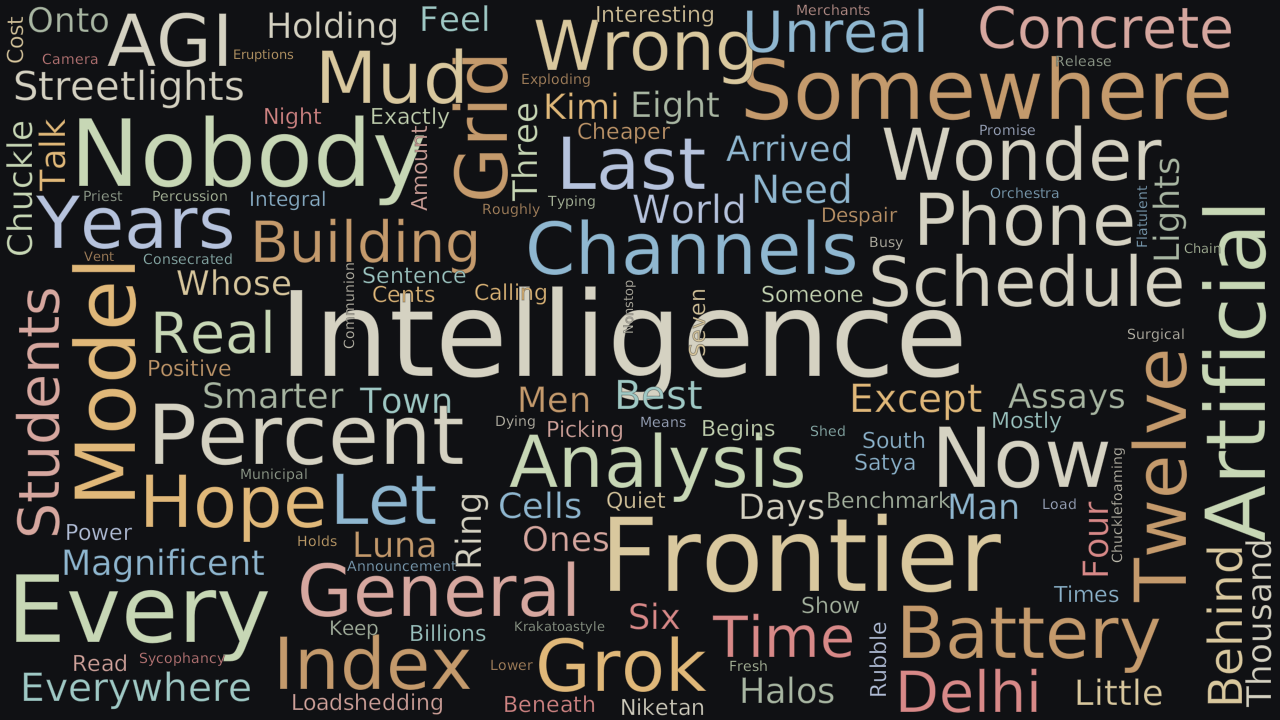
Word Cloud
Related reading
Selected by shared topics and section, with closer publication dates breaking ties.