The Cow Who Crossed The Sea
Checking article narration…

The first thing you should know about a cow is that she has no opinion about your renaissance. She will give you her milk whether you are abolishing the burning of widows or not, and she will deposit on the deck exactly as much manure as the ship’s carpenter can scrape off before dinner. That is, in my experience, the oldest moral philosophy ever exported from Bengal: do what you do, and be done with it, and if anyone asks, say it was for the milk.
Raja Ram Mohan Roy took one to England in 1831. Not as a monument. Not as a mascot. As infrastructure. A milking cow, shipped across fifteen thousand kilometres of open water out of Bombay harbour, while her master — the man this town now calls the father of the Indian Renaissance — stood on deck in his ship’s clothes and made himself useful to no one.
The tellers disagree on the head count, which is itself a small mercy. One account has him arriving at Liverpool in April of 1831 with his adopted son Rajaram, two servants, and several cows for the daily milk. Another says one milking cow and a Brahmin cook. I have no way to settle it; the sea keeps its own ledger, and the ledger is not public. What is certain: there was at least one cow aboard, there was at least one man whose sole job was to keep her food separate from everyone else’s, and there was milk in the galley every morning that smelled, I am told by people who have never been on a ship with livestock, exactly like the milk does today when it has travelled too far from the udder.
Why? Because crossing the sea made you an outcast. The old rule — samudra-atikrama\u1e47a, the transgression of the great water — held that a Brahmin who crossed the ocean lost his caste the way a man loses his shadow at noon: completely, and with no legal remedy. You came back a new man. You re-performed your sramana. You started life over from the beginning, which for a reformer with enemies is to say you came back as nothing. And Roy’s enemies in Calcutta were not men who would let such an opportunity go to waste. He had already signed his own social death warrant by making the burning of widows illegal; the pandits could smell him crossing water, and they wanted, quite reasonably from their standpoint, a finished product.
So he brought the cow. The cow was portable orthodoxy. She was a fact that could not be argued with in the pandit’s own grammar: look, he drinks milk; look, his food is cooked by a Brahmin hand; look, his ghee has come from a legitimate udder and his tongue has not tasted beef. He had not lost caste. The sea did not take him. The rite of purity continued aboard ship as it had continued in Calcutta while he was still a boy, when he later described the crowd chanting maha-sati around the pyre — which is to say the crowd was chanting its own alibi into the smoke.
Sati comes from the same Sanskrit soil as satya, truth. A sati\u016b was, in the grammar of the old world, the wife whose virtue had been verified by fire — a truth that could not be disproved because the witness was ash. The funeral prayer they still recite over the pyre is older than every reformer: asato m\u0101 sad gamaya, m\u1e57tyor m\u0101 j\u012bti\u1e64 m\u1e57ga\u1e48 — lead me from the unreal to the real, lead me from death to immortality. You will note that the prayer does not ask for the dead to be lit alight. It asks for a crossing. Roy understood this better than most: he was already making his own crossing, and he needed to arrive on the other side still being someone who could be believed.
The milk did the believing. He drank it; he rationed it; he guarded it from every hand that would have made it into curry for strangers. It was not, strictly speaking, a religious act. It was a political one with the piety of a religious one bolted on. The man who had founded the Brahmo Sabha in 1828 — the small roomful of men that would become the Brahmo Samaj — and who had written Gaudiya Vyakaran, the first complete grammar book in Bengali, carried orthodoxy in his baggage while he was dismantling it with his pen. To save his caste he saved the cow; to reform the age he milked the old one. You may argue about which half of that sentence is the joke. I have argued with myself for years and lost, and the part of me that used to run hot now runs flat, so this piece comes out dour by default.
The arithmetic, since no one else will do it: a milking cow gives you, on a good day in a port city, four to six litres a day. Let us say five, and let us say the voyage took him from Bombay harbour in the autumn of 1830 to Liverpool in April of 1831 — about one hundred and fifty days of open sea, of which I will grant you that some were spent in harbours where the cow stood on land and looked out over the water with the contempt that ruminants reserve for everything below them.
That is seven hundred and fifty litres of milk, roughly the weight of a small man, produced by one cow at sea over about five months, on which no one aboard was permitted to comment. I did this arithmetic myself because no historian has, and historians have other things to do with their evenings; they are writing books about the pension. The pension! He went as an envoy of the Mughal emperor Akbar II to petition the East India Company for a raise, and he got it — thirty thousand pounds a year added to the emperor’s allowance. He crossed the sea carrying a cow and came back carrying a cheque, and the company that had been eating Bengal for two centuries paid up because a man in London asked them to, while drinking milk from a can.
In London they made him India incarnate. Whigs and Tories lionized him in the same week; John Crawfurd booked Long’s Hotel in Bond Street for him before he even arrived; he ended up at the Adelphi on Charing Cross, which is where he belonged, being the sort of hotel that takes in kings and cowboys alike and asks no questions about either. David Hare took him to his brother. He dined with Jeremy Bentham, who was by then old enough to have opinions about everything, including probably the milk. By 1830 his name had already reached the English press through the sati campaign — the abolition bill of 1829 under Lord William Bentinck, the memorandum to the Parliamentary Committee on Indian Affairs — and a reviewer wrote that his fame had preceded him, which is a polite way of saying that by the time he walked into Liverpool dock the town already knew what he was: not a visitor but a verdict.
Sophia Dobson Collet wrote his life in 1900, long after the milk had gone sour in every can in Bengal. She gives you the letters, the dinners, the blue plaque at 48 Bedford Square that still stands where no one has thought to remove it, which is more than can be said for most of his other monuments. The statue in Bristol — yes, Bristol, because he was ill and the town took him in and gave him its damp air — and he died there or in London depending on which biographer you trust, in 1833, at sixty-one. Biographers have not agreed on the month. The cow did not live to see any of it. Cows do not care about your renaissance; I told you that.
What did the cow think? Nothing. That is the point. She was not a symbol. Symbols require an audience, and she had one only in Calcutta, where people would have pointed at her from the ghat steps and said look, even the reformer’s cow crossed the sea. On board she was a machine for converting grass into milk, and the man who ate what the Brahmin cook cooked from that milk was performing a small daily rite of continuity: I am still me, the udder says. The sea did not take you. The crowd can chant if they like; the chant does not reach here. It is the oldest trick in the book — to keep the body pure while the mind runs wild — and it works because purity of diet is the one orthodoxy that cannot be seen from a distance, and therefore must be performed daily, visibly, with a can in hand.
I have spent fifteen years in America doing healthcare research, which is to say I have spent fifteen years measuring things people refuse to count, and I will tell you what I think the cow bought him: immunity. Not from disease — from the charge of having lost caste. Every morning’s ration was a receipt. You may call it pragmatism; you may call it hypocrisy; the two words are, in my experience, the same word wearing different clothes, and the cow would have drunk her share of either.
And if you ask me what I think all of this meant — the pyre on one shore, the milk can on the other, the pension cheque between them — let us put it this way. The widow was not burned in London. The man who stopped that burning drank his milk in a hotel on Charing Cross and slept through Bentham’s opinions. And the cow, at least, got her milk.
P.S. References: Arup K. Chatterjee, Indians in London (excerpt “Raja Rammohun Roy,” Live History India, 2021); Sophia Dobson Collet, The Life and Letters of Raja Rammohun Roy (1900); the Bengal Sati Prohibition Act of 1829; Brihadaranyaka Upanishad I.3.28.
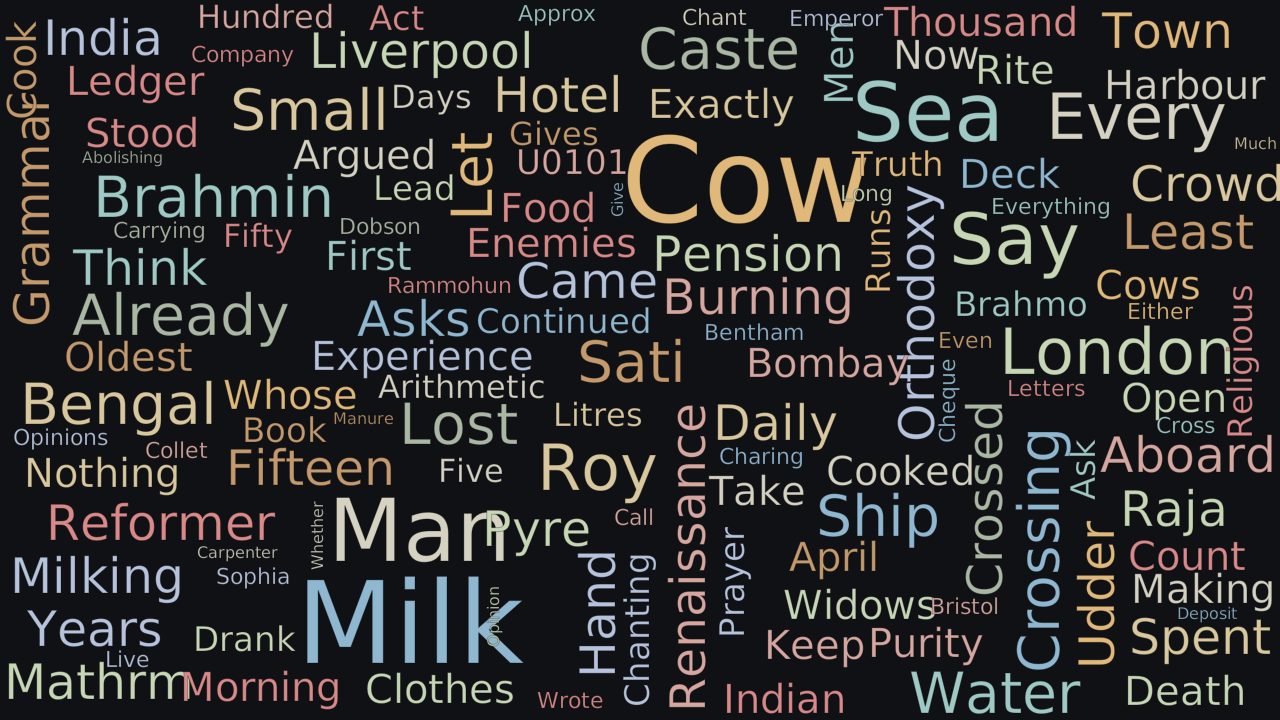
Word Cloud
Related reading
Selected by shared topics and section, with closer publication dates breaking ties.

Comments
Read the conversation or leave a thought for review. Comments load when this section is in view.