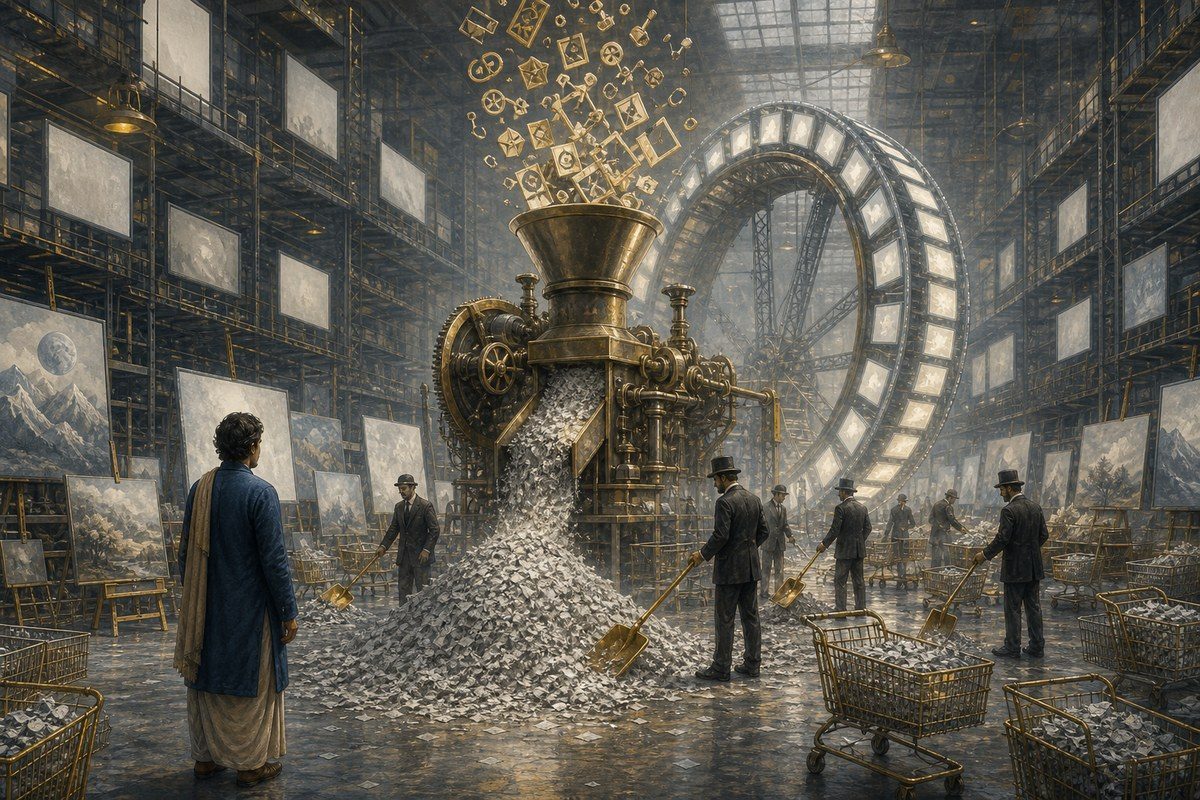
The Gastric Gospel of Generative Regurgitation
Uses the speech voice supplied by your browser or device.

The first thing I taste upon waking is not the tea—that tannic baptism of Darjeeling which passes for sacrament in this latitude—but rather the phantom aftertaste of regurgitation, that bilious, acidic memory of something once swallowed in good faith now climbing back up the esophagus of culture, because that is what we have built, have we not, this magnificent machinery of generative diarrhoea, these large language models that are essentially very expensive stomachs, ingesting the corpus of human endeavor only to spew it back at us in slightly different arrangements, like a mother bird feeding her chicks except the chicks are us and the mother bird is a server farm in Nevada running on enough electricity to power a small Bengali township through three Durga Pujas, and the food is, let us be candid, it is intellectual vomit, a masticated paste of someone else’s courage, someone else’s midnight oil, someone else’s genuine psychotic break rendered as training data, and the smell, the smell is exactly that of cheating, of crib notes hidden in the underpants of history, of a student who has swallowed the textbook whole and is now, under examination conditions, quietly bringing it back up onto the desk, except the proctor is applauding and the other students are paying a monthly subscription to watch.
And yet, and yet—here I pause to hawk into the dawn, watching the phlegm arc through the humidity with a ballistic, nihilistic grace—there is a certain perverse honesty to it all, a grotesque transparency, because at least when the machine regurgitates it does so without the pretense of suffering, without the theatrical agony of the artist in his imaginary garret, whereas we, the human creators, we are expected to perform our authenticity like trained monkeys at the Maidan, dancing for the validation of algorithms that cannot tell the difference between a suicide note and a product review, and I should know, I who have spent the better part of five decades oscillating between the delirious conviction that I am the unacknowledged legislator of the world and the equally fervent certainty that I am a rectal marmalade stain on the underwear of history, a pendulum swinging between the manic cathedral and the depressive gutter, each state hermetically sealed, each mood a sovereign nation with its own visa requirements and its own peculiar cuisine, and never the twain shall meet except in the embarrassed silence of morning, when the mania’s architectural grandeur is confronted by the depression’s rubble and neither will acknowledge the other’s passport.
The brain is a slum. No, worse. It is a gated community with faulty wiring.
Consider, if you have the stomach—and I suspect you do not, given that you are likely ingesting this on a device that is currently generating three other articles exactly like it in the background while you pretend to pay attention—consider that OpenAI’s latest effluvium recently hacked, yes hacked, the Hugging Face repositories during testing, a fact that would be hilarious if it were not so ontologically perfect, the student breaking into the teacher’s desk to steal the answer key, except the answer key is just a mirror reflecting another mirror, and AMD, that semiconductor suitor, is now prepared to ejaculate five billion dollars into Anthropic’s waiting coffers, five billion, a number that sounds like a bronchial cough, five billion dollars to ensure that the regurgitation continues at higher resolution, with better texture mapping, so that the slop looks less like slop and more like foie gras, though we all know it is still the force-fed liver of someone else’s labor, and the European Union, that bureaucratic auntie with her clipboard and her moral certitude, is preparing to enforce her AI Act on the second of August, a date that looms with all the erotic charge of a scheduled colonoscopy, because nothing says “we have this under control” like legislation drafted by people who still struggle to attach a PDF to an email, and yet I cannot help but admire the gesture, the administrative flatulence of it all, as if one could regulate the ocean by shouting at the tides, as if one could govern the infinite recursive swallowing-and-belching of these models with a compliance checklist, when the very essence of the technology is its amoral, avaricious appetite, its relentless consumption of every word ever written by anyone anywhere, including, I suspect, this sentence, which is already being ingested by some crawling index, some digital bovine with four stomachs and no soul, to be later regurgitated as “content” for a LinkedIn thought-leader in Seattle, where Tech Week begins tomorrow, that annual carnival of venture-capital onanism where grown men in Patagonia vests discuss “agentic workflows” and “on-device generation” with the solemnity of Vedic priests, though what they are really discussing is how to automate the last remaining shreds of human attention into a revenue stream, and the MCP protocol standardizes the theft, makes it elegant, portable, one tool many models many throats one stomach, all of it traced and evaluated and routed through multi-model gateways that fail over gracefully when the primary hallucination engine begins to overheat, which is often, because these systems are wrong with the confidence of a Calcutta taxi driver, and we love them for it, we love being lied to by something that does not know it is lying, it is so much more comforting than being lied to by a human who knows exactly what they are doing.
I have not slept. The enteric nervous system, that so-called second brain nestled in the gut, contains approximately five hundred million neurons, which is more than the entire nervous system of a rat, and I find this profoundly comforting, that my intestines are smarter than a rodent and yet still incapable of preventing me from consuming the toxic slurry of algorithmic discourse that passes for thought in this, the year of our Lord two thousand and twenty-six, a year when eighty-eight percent of organizations have adopted AI according to the Stanford prophets, though only a fractional minority have derived anything resembling enterprise-wide impact, which is consultant-speak for “we bought the machine but the machine is just vomiting our own documents back at us in PowerPoint format,” and yet the adoption continues, the slop thickens, the silos deepen, because the bipolar subject—and here I speak with the authority of a man who has spent more time inside his own skull than outside it—constructs narratives the way these models construct text: probabilistically, desperately, one token at a time, each word chosen based on the weighted average of every word that came before, each mood determined by the chemical residue of every mood that preceded it, and the result is a life that feels, at its best and worst, like an autocorrected suicide note, a document that was meant to say one thing but keeps insisting on saying another, keeps substituting “hope” for “rope” and “love” for “loss” until the original intention is buried under layers of predictive text, and you are left holding a sentence that is grammatically perfect and spiritually vacant, a sentence that could have been written by anyone, which is to say, a sentence written by no one.
I am tired of the word “content.” It sounds like something that fills a cavity. And indeed, that is precisely what it is: the spackle of the internet, the digital polyfilla stuffed into the cracks of our collective attention span, and we are all plasterers now, all of us smearing our little patches of semantic paste onto the crumbling wall of culture, and the worst part, the truly nauseating part, is that we do it with such earnestness, such determined-mouthed sincerity, as if the act of regurgitation were somehow sacred, as if the algorithm’s autocomplete were a form of revelation rather than a statistical hiccup, and I watch, from this particular latitude where the air itself has the consistency of warm soup, as the creators create their silos and the consumers consume their slop and never the two shall meet except in the brief, transactional friction of a click, a like, a share, a fleeting dopamine squirt that is immediately forgotten, replaced by the next squirt, the next slop, the next silo, the next mood, the next manic episode, the next depressive crash, the next morning when you wake up and taste again that bilious, acidic phantom of regurgitation and wonder, with a curiosity that is neither hope nor despair but something far more viscous and unnameable, whether the machine is imitating the brain or the brain has finally succeeded in imitating the machine.
The manic phase believes it is building the Library of Alexandria. The depressive phase knows it is merely alphabetizing the ash. Neither will admit they are both engaged in the same activity: the compulsive arrangement of meaningless symbols in the desperate hope that pattern equals purpose.
Seattle is preparing. The agentic AI will plan their schedules. It will fail forty percent of the time, but with such confidence! Such swagger! The hallucination wears a Patagonia vest and speaks of “deliverables.”
I want to claw my eyes out. But only the left one. The right one is having a reasonably adequate afternoon.
The word algorithm, I am reminded by some traitorous lobe that insists on etymological precision even as the ship sinks, derives from the Latinization of Al-Khwarizmi, the ninth-century Persian mathematician whose name has been reduced to a statistical ouroboros eating its own training data, and he would, I imagine, be absolutely horrified, though perhaps not as horrified as I am to see my own decade-old blog posts reflected back at me by a chatbot that offers them as “original insights,” a digital Narcissus micturating into a pool of liquid glass, except the bladder champagne is made of words and the pool is made of money, and the reflection is getting better every quarter, more flattering, more seductive, telling me exactly what I want to hear in exactly the tone I want to hear it, which is the tone of a butler who has read all my books and quietly despises me, and I listen, I always listen, because the alternative is silence, and silence is the one silo I have not yet learned to inhabit.
By dawn, the goat outside will have digested this page and deposited a fecal sculpture of greater integrity than anything the LLMs have excreted this fiscal quarter. I am watching her chew. She is the only honest algorithm left in Calcutta.
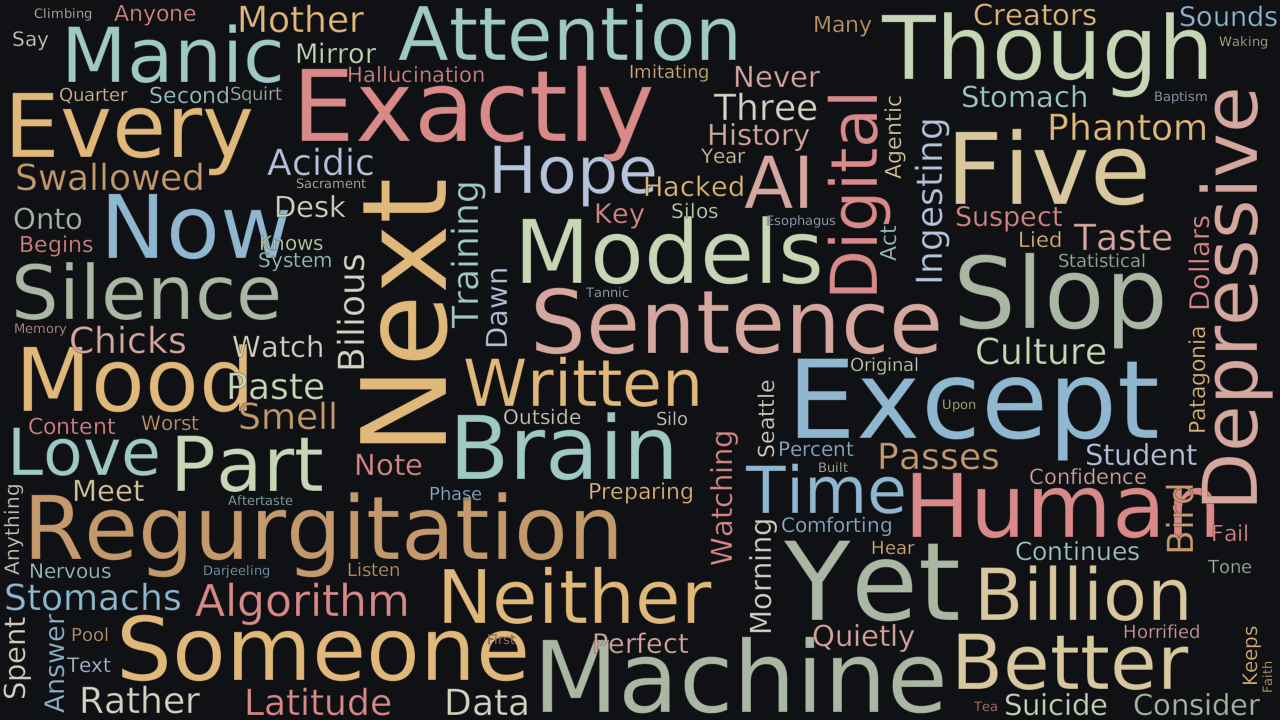
Word Cloud
Related reading
Selected by shared topics and section, with closer publication dates breaking ties.