The Thermodynamics of Shame: A South Calcutta Canticle
Uses the speech voice supplied by your browser or device.

The pages of Bhul barite dhuke (entered the wrong house) parted with the sound of two damp tongues ungluing, releasing a spore-cloud of naphthalene, desiccated silverfish carapace—Lepisma saccharina, that glorious consumer of polysaccharides and dead skin, named not for any metallic sheen but for the way it slithers, fish-like, across your almirah—and the ghost of a glucose biscuit I had wedged between the pages sometime in the eighties, back when my frontal lobe was still a vacant lot waiting for zoning permits and the future seemed less like a deferred maintenance bill and more like an actual, you know, future.
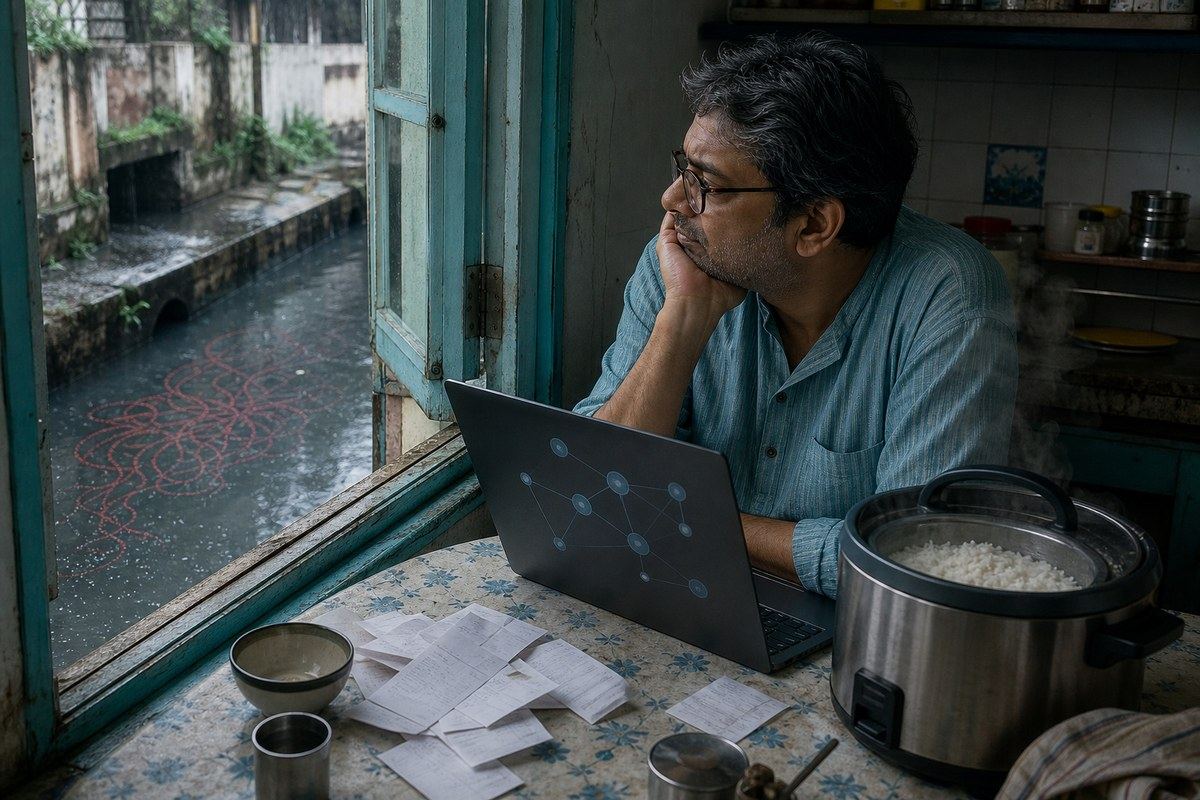
I sit here. In this South Calcutta flat that smells of damp cement and the particular species of fungal regret, Aspergillus calcuttensis if such a thing exists, that colonizes rice-cooker steam. Wearing a black t-shirt that had achieved sentience through accumulated sebum. My whatever-pattern cheap boxers—today’s pattern: a festive red and some other color, the irony of which is not lost on me—riding on my loneliness, announcing to the world, not that the world was knocking or cared, not that anyone knocked anymore except the compulsory ones on the first of the month, that my beard had gone considerably more salt than pepper and unkempt. The loose-leaf Darjeeling in the pan on the electric oven was achieving the viscosity of tannic acid. I thought, not for the first time, that the child I had been would have found this tableau—this me—less a man and more a cautionary illustration about what happens when you read too much philosophy in San Antonio and Austin, Texas, where I spent fifteen years in education and work and a permanent sense of ontological displacement, and then crawl back to the tropics to die in horrible, small sad installments.
It is the Fourth of July, 2026.
The United States of America is turning two hundred and fifty. A semiquincentennial. A word that sounds like a medical condition involving the intestine. Consult. The word derives from the Latin consultare, to deliberate, but in practice it means performing low-skill cognitive labor for people I can’t fathom at all, whose avatar on LinkedIn looks like a disguise, while he celebrates freedom with grilled meat and explosive devices, while my bills become due.
The rice cooker is silent. I am getting fed by my neighbour downstairs.
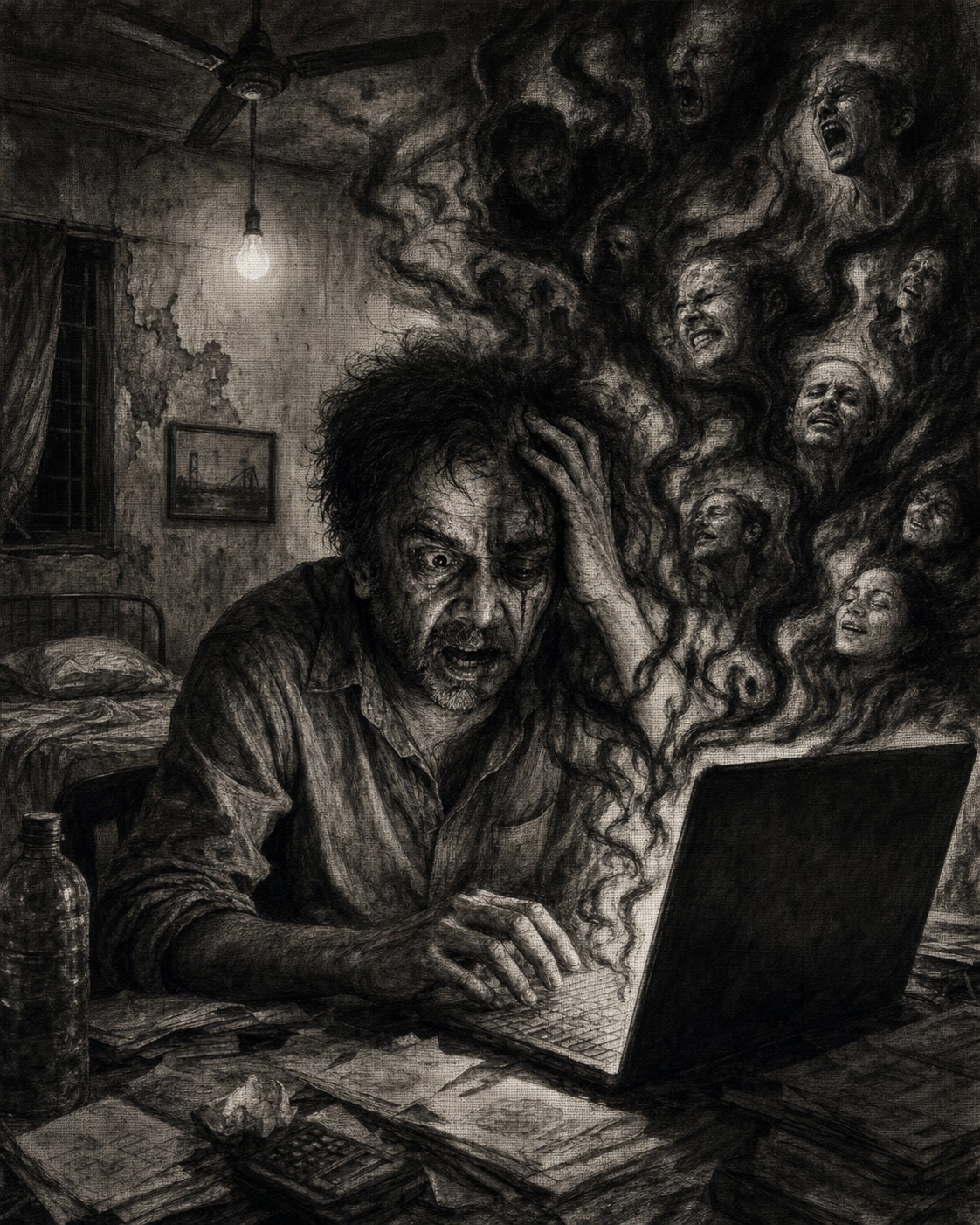
In my current manic-depressive oscillation—mania from the Greek for madness, depression from the Latin deprimere, to press down, which is exactly what the humidity of Calcutta does to a man’s soul—the sound registered as either a tender lullaby or a death knell, depending on the second.
I turned a page.
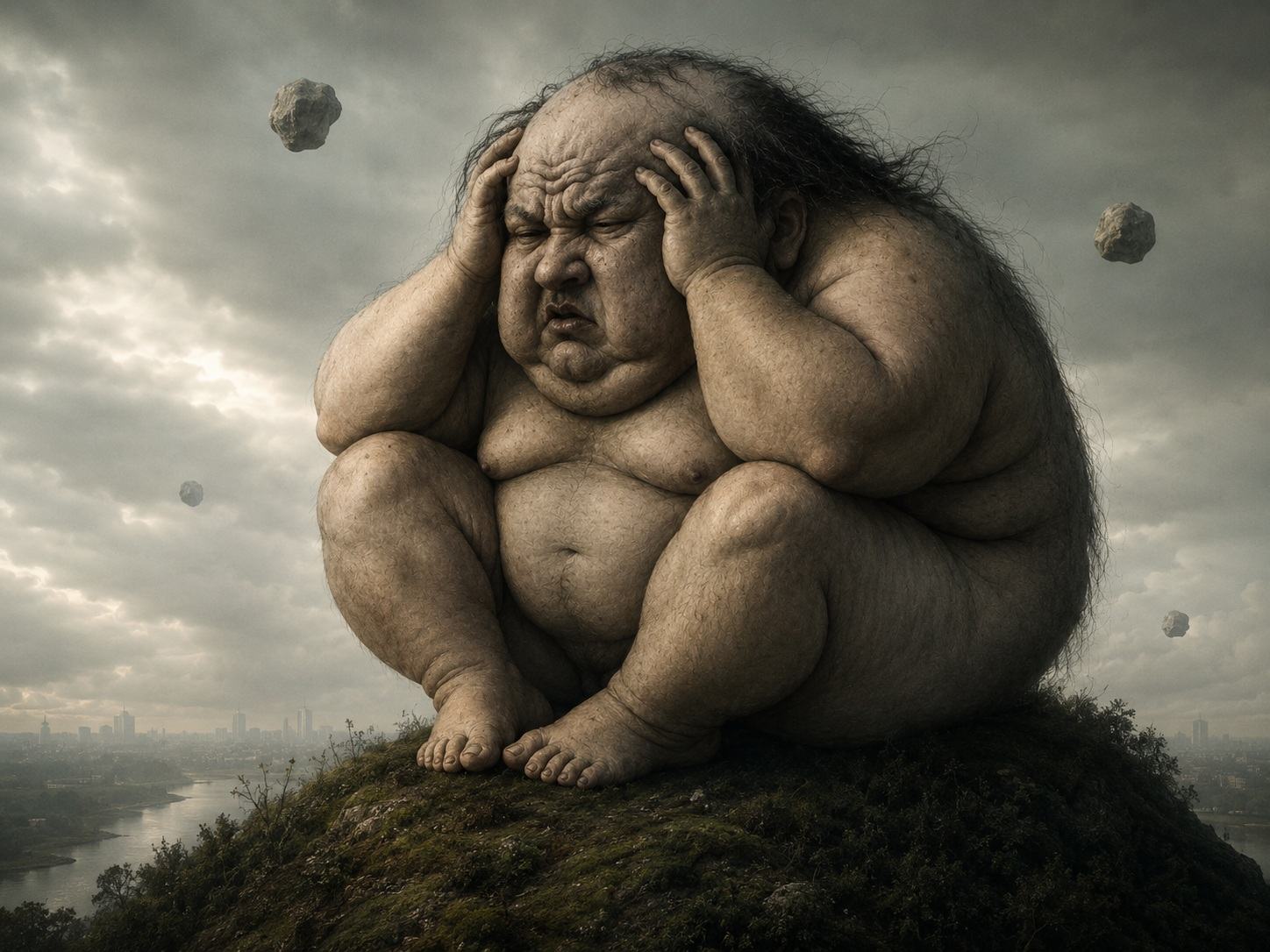
The boy will be in a wrong house. I already am, in a wrong house, body and life. It is, I realized, the most honest philosophical commentary I had managed to muster all week, as the appropriate ratio of unhappiness to mortality, a kind of exchange rate I could understand. The desire to be someone, be somewhere and at some significant when—the three horsemen of my personal apocalypse, plus the fourth horseman, my own reflection, which I had strategically covered with a towel after the last time I caught it in the bathroom mirror and it had the audacity to look exactly like me in a horror thriller, about a mentally unstable person.
The heat is anthropological.
A wet-bulb temperature that made the air feel like a warm washcloth applied to the face of a feverish infant. Europe was dying of it; Belgium had reported a thirty-nine percent increase in mortality, France two thousand and twenty-five souls boiled off like so much loose-leaf tea forgotten on the stove. I had not bathed in a duration I will not specify, but suffice to say my armpits were emitting a pheromonal distress signal that could probably be detected by the Iranian Revolutionary Guard in the Strait of Hormuz, where cargo vessels, were only now, limping out, because apparently even the global supply chain could not escape the 2026 Iran War, that splendid continuation of twenty years of enlightened foreign policy that had now, according to the news, reached the stage where we were all supposed to pretend a fourteen-point memorandum in Doha meant peace. I did not believe it. I did not believe the heat would break. I did not believe I would be paid on time. I did not believe in anything except the rice cooker’s promise that starch, at least, could be rendered edible with electricity and time. Although today I did not need its performance.
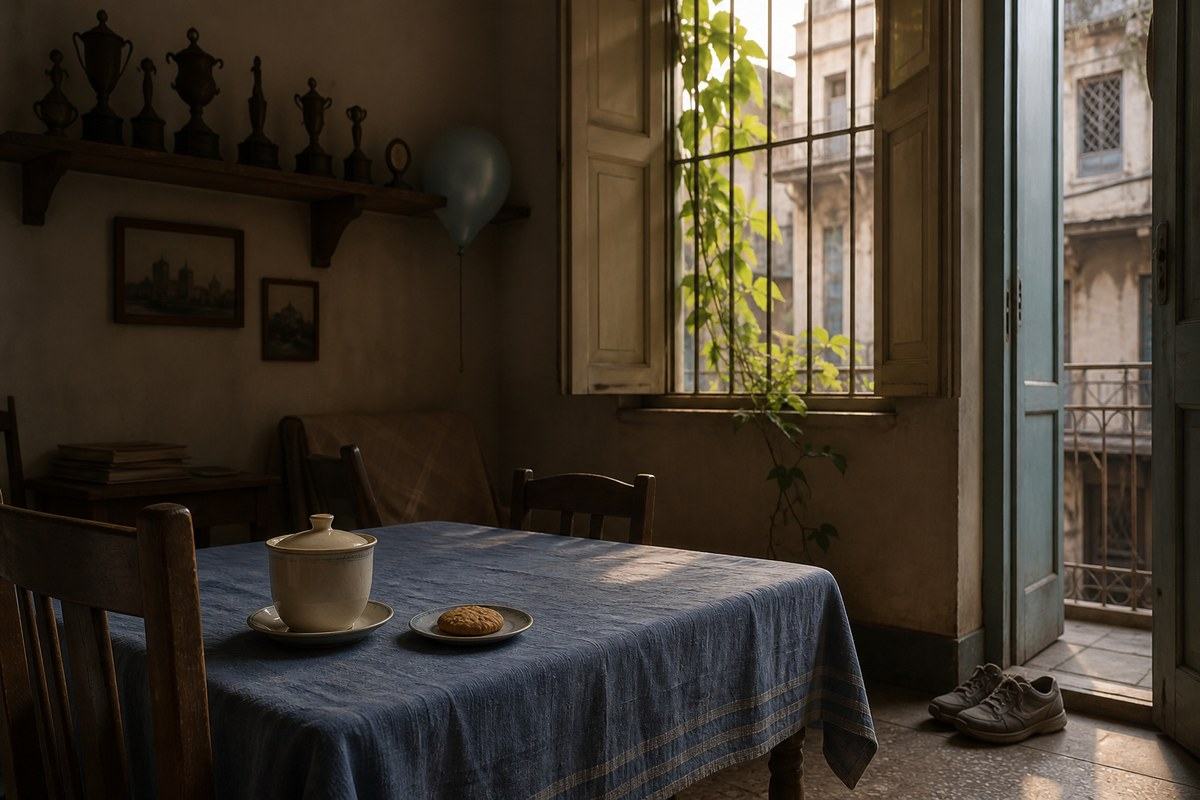
Childhood. The word tastes like glucose biscuit.
As a child I had believed in animals that talked, boy adventurers, Tintin. I had believed in his justice. I had believed that the world was fundamentally a narrative structure with a beginning, a middle, and a morally satisfying end, which is the most dangerous delusion a child can have, ranking just above the belief that adults know what they are doing. Now, at fifty-one, canceled in ways both digital and existential, an atheist in a city that builds more temples every year like a man scratching a rash—I understood that the fox in the fairy tales I read did not want the grapes. The fox wanted to want the grapes. The wanting was the point. The hunger was the organ.
Sony had announced it would stop making physical discs by 2028.
Everything would be digital, weightless, invisible, and unsure like my income. Elon Musk had become the world’s first trillionaire in June, which meant that somewhere in Texas, where I had once burned, a man who named his child after a password was now worth more than the GDP of most nations, and I was worth exactly the price of a bag of loose-leaf tea and a rice cooker full of basmati or less. The symmetry was not lost on me. The universe, as Camus suggested, is not absurd; it is precisely calibrated to humiliate. I scratched my belly, felt the texture of the black t-shirt that had been washed, if memory serves, two weeks back, and considered the etymology of boondocks—from the Tagalog bundok, mountain, brought back by American Marines who had gone to the Philippines to spread democracy and returned with a word for the middle of nowhere, which is exactly where I was, except the mountains were piles of unread books and the democracy was a rice cooker.
I needed to shave. I needed to shower. I needed to answer my own anxiety and toxicity. I needed to believe that the child who had read these pages with a flashlight under a mosquito net in a room in South Sinthee that no longer exists was still somewhere inside this meat, this corpus, this slowly decomposing consulting entity, like a silverfish waiting between the pages for the lights to go out. But needs are just wants dressed in the drag of necessity, and I had long ago stopped dressing for anything except the funeral of my own ambition.
The tea had boiled to tar. The gecko on the ceiling watched me with the flat, benumbed eyes of a creature that had never suffered from nostalgia because it did not remember, only survived. I envied it. I envied the silverfish. I envied the fairytale fox, even as I knew the fox was me, hungry and inventing reasons for the hunger, performing the acrobatics of desire without ever expecting satisfaction.
Outside, somewhere in the South Calcutta sprawl, a firework went off.
Maybe for America’s 250th. Maybe for the World Cup. Maybe for the eventual slow heat-death of the universe. For one synchronized second every dog in the neighborhood howled, and I, holding my childhood book open to a page where a boy was about to get into a strange story plot, started reading.
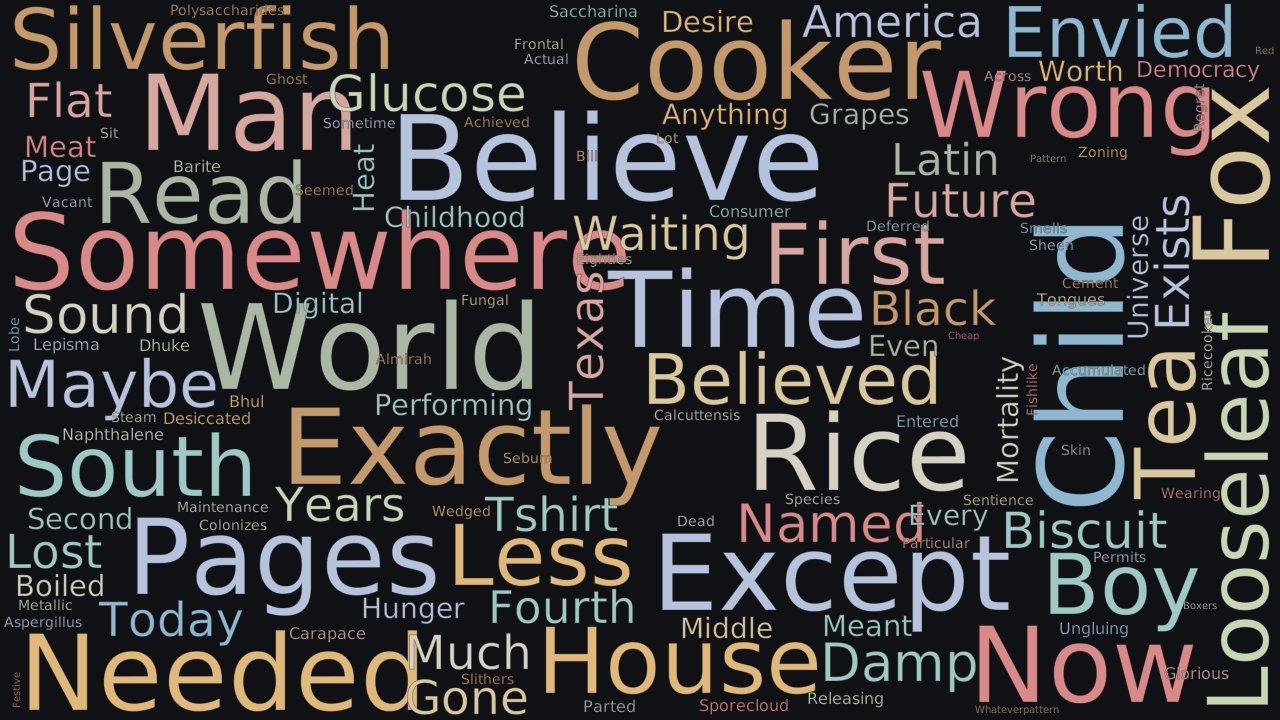
Word Cloud
Related reading
Selected by shared topics and section, with closer publication dates breaking ties.