The Future Runs on a Voltage Stabilizer
Uses the speech voice supplied by your browser or device.

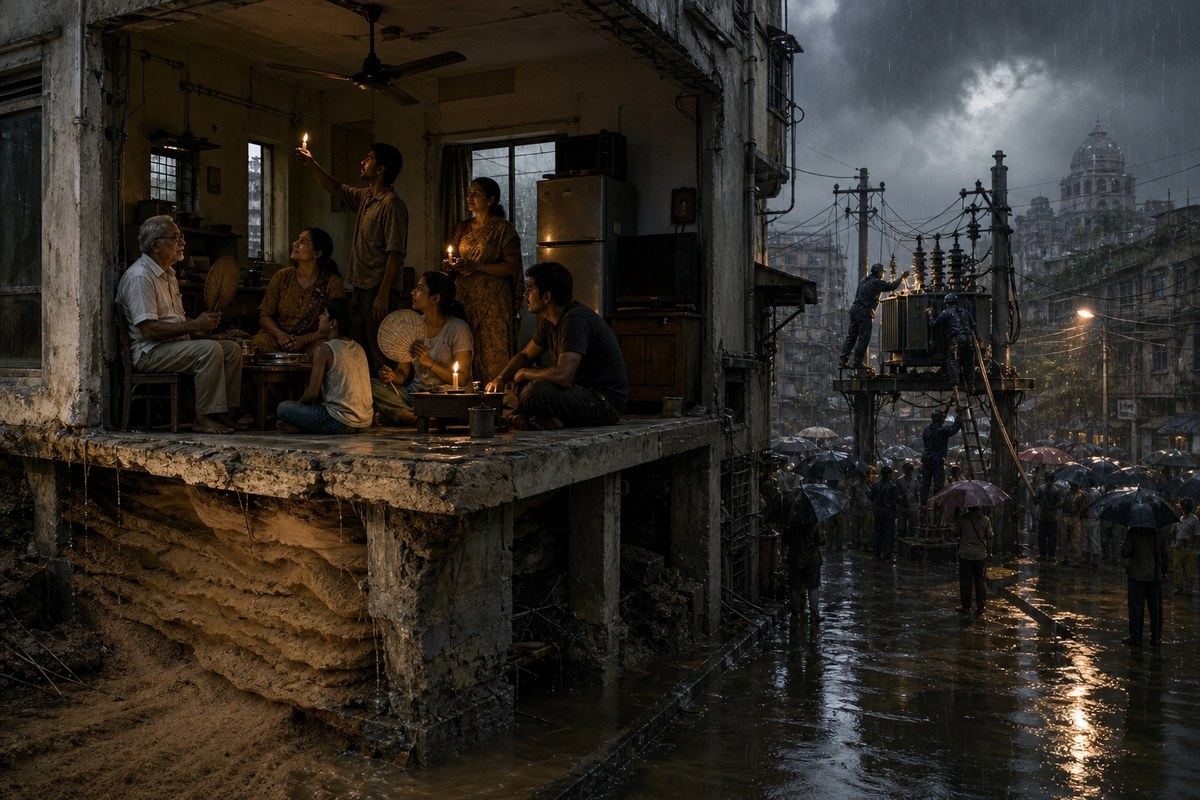
The inverter died with the dignity of a government promise: loudly, briefly, and only after being ignored for years. The desktop’s UPS took over, beeping like a conscience that had read too much Nietzsche and decided to become annoying. Outside, Calcutta was doing what Calcutta does best—being simultaneously eternal and interrupted, a city of tram tracks, thesis anxiety, fish bones, and voltage so moody it could qualify for a Bengali art film. The stabilizer sat there, squat and metallic, its display now dark. Until the supply vanished, it had been humming its one-note bhajan to the god of almost. It was not glamorous. It was not “the cloud.” It was not a keynote slide with gradients and the word democratization spelled by people who have never had to choose between charging a phone and recharging their self-respect.
And yet—there it was. The future, apparently, runs on a voltage stabilizer. Or rather, my little connection to the future passes through one, and even that arrangement comes with qualifications. Before the blackout, it had been negotiating with the wavering mains; now the UPS battery was buying me a few minutes. A stabilizer can adjust voltage within its operating range. It cannot persuade zero volts to reconsider. That requires stored energy, a generator, or divine intervention with an unusually competent service department. The cloud sounds weightless until you follow it down to the socket, and the socket, dear reader, has opinions. The socket has a caste system. The socket has a queue. The socket has a man in a lungi outside the transformer saying, “Ektu por ashun”—literally, “come back a little later”; operationally, “your civilization will resume shortly, maybe, if the babus are in a good mood.”
What does “democratizing AI” mean when reliable electricity, equipment, and uninterrupted time remain unequally distributed? Too often it means the demos gets a login page while the kratos gets a diesel generator. It means a Stanford slide deck ejaculates starlight over a world where too many people are still negotiating with a fan that rotates only when philosophically persuaded. Democratization, my left earlobe. The word comes from Greek demos, people, and kratos, power—lovely, muscular, ideal for a tote bag—and yet in practice it often behaves like a buffet where the poor are invited to smell the food and the rich are invited to patent the smell. You do not need your own GPU cluster to use a chatbot. A modest phone and a connection can give you access to something remarkable. But using the thing, owning the means to run it, and being able to depend on it for your livelihood are three different arrangements. The brochure folds them neatly into one.
I am told the future is intelligent. I am told it is scalable, cloud-native, agentic, multimodal, and probably lactose-free. I am told this by newsletters written in the spiritual equivalent of a scented candle. All evening my stabilizer had clicked with the weary rhythm of a tabla player who knows the audience has not paid. There had been a reboot. There had been a ceiling fan slowing to a contemplative crawl, as if reconsidering the Upanishads. Now the fan had stopped considering anything. Somewhere in a glass campus, a man named Chadsworth or Brayden or possibly just “Founder” was saying that compute is the new oil, and everyone was nodding, because nobody wanted to be the one to ask whether the oil came with a lantern, a matchstick, and a constitutional right to darkness.
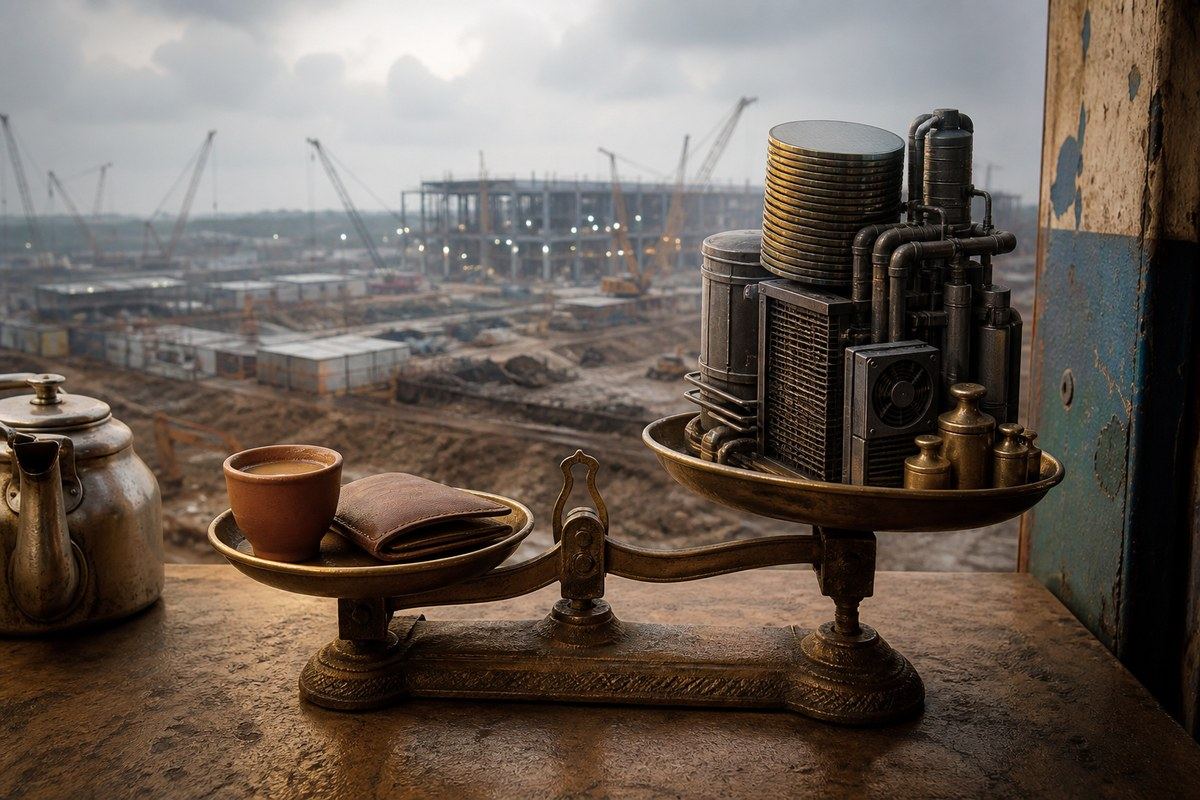
Electricity is the platform underneath the platforms. The App Store, the browser, the blockchain with its cryptographic whoopee cushion—all of them eventually send the bill downstairs. Electricity. The thing that makes the refrigerator hum, the router lie, the monitor glow, and the semicolon feel employable. Without it, the machine running your artificial intelligence is a very expensive paperweight with delusions of LinkedIn. The people building data centers know this perfectly well. They study power supplies with the concentration of a Bengali family examining a prospective son-in-law’s salary. It is the sales pitch that makes electricity disappear: the humble little servant who brings the coffee and is never asked about its own blood pressure. We speak of models, parameters, tokens, embeddings, transformers—ah, transformers, the electrical pun hiding in plain sight like a fart in a meditation hall—and lose sight of the iron-and-copper equipment doing its less publishable work outside.
The cloud is a lie told by real estate. It is a warehouse with a cooling bill, or a collection of such warehouses with an especially talented publicist. It is a building in Virginia, or Oregon, or Singapore, put where electricity, network connections, customers, land, tax arrangements, and a tolerable cooling scheme can be made to agree. Cheap land alone will not do it; a bargain in the middle of nowhere remains nowhere, now with servers. The data center does not float. It squats. It hums. Many use water for cooling; the amount depends on the design and climate, and the power stations supplying them can have their own thirst. It has a security guard named Gary who has never once been asked about the philosophical implications of large language models. And behind Gary, behind the badge readers and the biometric gates and the rows of servers glowing like a cyberpunk morgue, there is a substation, and behind the substation there is a grid, and behind the grid there is a political economy of coal, gas, hydro, wind, solar, nuclear, debt, drought, corruption, ambition, and the occasional suicidal squirrel. The cloud has an armpit. The armpit is called infrastructure.
I have lived in Calcutta long enough to know that, on an evening like this, infrastructure stops being a noun and becomes a rumor. It is the promise of a metro line, the memory of a tram, the optimism of a flyover, the betrayal of a drain. An entire city need not spend every night in darkness for one badly timed interruption to make a mockery of your deadline. And yet, and yet, this city—my impossible, argumentative, adda-drunk city—keeps teaching me something the keynote prefers to skip: intelligence cannot turn a fan by force of personality. The grid goes down and suddenly the smartest man in the room is the one who knows where the candles are. A PhD in machine learning cannot argue the router back to life. The professor and the rickshaw puller may both be sweating, but only one may have the money to purchase an alternative to waiting. Even the darkness does not quite equalize us. Meanwhile avidyā, ignorance, acquires an additional, entirely unauthorized meaning: discovering during a deadline that you do not know how much charge is left.
The democratization question is not only whether everyone can access the model. It is whether everyone can access the conditions that make that access useful. There is a difference, and the difference is the whole game. A free tier is not freedom if the electricity to use it is rationed like affection in a dysfunctional family. A downloadable weights file does not abolish the price of the machine needed to run it. A tutorial on prompt engineering is a peculiar sort of empowerment if the student’s laptop dies mid-sentence and the sentence is “Dear sir, kindly consider.” The digital divide is not a line; it is a gradient, a voltage drop across a corroded wire, and the corrosion is not merely technical. It carries history: colonial extraction, later neglect, present choices about who gets connected, who gets maintained, and who can afford a backup. The old habit of shipping the future to the periphery and billing the periphery for the shipping has survived several changes of management.
Consider the etymology of electricity, which leads back through the Latin electricus used by William Gilbert in 1600 to Greek ēlektron, amber. Rub amber and it can attract light objects: a party trick so innocent it could have been investigated by a cat. Thales of Miletus is traditionally credited with noticing the effect, though the neat little scene involving the philosopher, the fur, and the straw is rather better furnished than the surviving evidence. Two and a half millennia later, we have made electricity the nervous system of civilization, with the usual human elegance: trial, error, electrocution, monopoly, war, and the occasional genius investigating a thunderstorm with a kite. Benjamin Franklin, founding father and industrial supplier of pithy sayings, did not discover electricity. His work helped establish that lightning was electrical. The famous kite collected charge from a storm; it did not have to catch a lightning bolt, which would have shortened the biography considerably. Faraday demonstrated electromagnetic induction in 1831 and built an early generator. Tesla helped develop polyphase AC motors and power systems; he did not invent alternating current. Edison and his team helped make incandescent lighting a practical commercial system, while also finding time for the dark arts of patent litigation. Westinghouse helped bring AC systems into widespread use, and the system brought us the bill. Every watt has a history longer than the parade of great men: assistants, machinists, rival inventors, linemen, somebody’s fried finger, somebody’s eureka shouted over the smell of ozone and burning insulation.
And now the fumbling continues, except the stakes have been upgraded from “will the bulb glow” to “will the model invent a legal precedent while somebody’s future hangs on the paperwork.” The data center is the new cathedral, and the investment pitch has its own arrangements for tithes and blind faith. The AI boom is a gold rush where some of the gold is useful science and some is a PowerPoint presentation wearing a crown, but the shovels are real, the GPUs are expensive, and the meter runs either way. Microsoft, Google, Amazon, Meta—the software empires have developed the appetites of industrial landlords. Think utility barons with better fonts. They sell the future with the missionary confidence of the East India Company selling civilization: at a markup, with the gunboats replaced in this analogy by terms of service, and a promise that the natives will thank them later. The natives, in this case, are all of us, huddled around our devices, refreshing a dashboard that says “All systems operational” while our own little system has stopped operating.
The inequality is not just between nations. It is within them. Picture a professor in South Kolkata with generator backup and a student in North Kolkata with a power bank and a prayer. They could just as easily live on opposite sides of the same landing. Picture a startup founder in Bangalore with redundant power and a gig worker in Patna with a phone that heats up like a griddle; a well-funded hospital with backup systems and an underfunded clinic whose refrigerator depends on one unreliable supply. These are differences in the ability to keep going when something fails, and a map alone will not explain them. “The future is already here—it’s just not very evenly distributed,” said William Gibson, the novelist. He supplied the sentence. The rest of us keep supplying the examples. The future is concentrated, refrigerated, and guarded. The press release, mercifully, is available to everyone.
And yet I love the science. God help me, I do. I love that a transformer—yes, the attention kind, the Vaswani et al. kind, the “Attention Is All You Need” kind that launched a thousand GPU clusters—still depends on machinery whose power supplies and substations contain transformers of the less fashionable sort. The word supplies the pun; the wiring supplies the dependency. The electrical transformer changes voltage through electromagnetic induction: no moving parts in the transformer itself, just windings, a changing magnetic field, and an absolute refusal to manufacture free energy. I love that the same electromagnetism runs through my little electrical arrangements and the data center’s enormous ones. I love that Maxwell’s equations, in their modern four-line shorthand, describe the light traveling from my dying bulb and the light traveling through the fiber optic cable that carries the model’s output to my screen, assuming the screen has power, assuming the screen has not been sacrificed to the grid’s mood. The unity is gorgeous. The distribution is obscene. The juxtaposition is where I live, literally and electrically.
There is a Bengali saying: Loadshedding cholchhe. Er-i naam jibon—the power cuts go on. This is called life. It is not a saying. I just made it up. But it feels true, the way all great lies feel true at 2 a.m. when the inverter is dead and the mosquitoes are holding a symposium on your ankle. We call it loadshedding, though a cut may be a local fault rather than a deliberate reduction of demand. The mosquito is indifferent to the distinction. The point is not that Calcutta is uniquely cursed. It is that an unreliable socket makes the material facts unusually difficult to forget. The grid becomes a negotiation. The voltage stabilizer becomes a relationship, a marriage between expectation and disappointment, renewed whenever the supply misbehaves. It raises or lowers the voltage it receives, within limits; an ordinary stabilizer does not rebuild a mangled waveform or supply power through a blackout. The UPS buys time. Neither device abolishes the need for a working supply. Technology, in this room, is the diplomacy of getting another sentence finished before the equipment files its resignation.
So when I hear that AI will democratize knowledge, I think of my stabilizer. I think of the way it hums, the way it heats, the way it tries to protect the machine downstream from the bad manners upstream. I think that maybe democratization is not merely a product feature but an infrastructure project, and infrastructure is not sexy until someone can put a fence around it and charge admission. The model gets the paper. The household wiring gets attention when somebody smells burning. The data center gets backup upon backup. The man at the other end gets told to check his connection. And the future, that glittering, agentic, multimodal future, arrives in a third-floor apartment in Calcutta through a collection of boxes that cannot agree on whether tonight is a working night, where a man with a bipolar diagnosis and a desktop full of unsaved drafts is typing on borrowed battery time, believing—against experience, against the equipment’s increasingly explicit objections—that the words will survive the night.
The mains return. The stabilizer clicks. The fan resumes. I save the file. Somewhere, a server farm in Virginia inhales. The cloud, that magnificent, weightless, omniscient cloud, is still just a machine that needs to be plugged in. And the plug, comrades, is political.
Word Cloud
Related reading
Selected by shared topics and section, with closer publication dates breaking ties.