The Person Is Not a Machine
Uses the speech voice supplied by your browser or device.

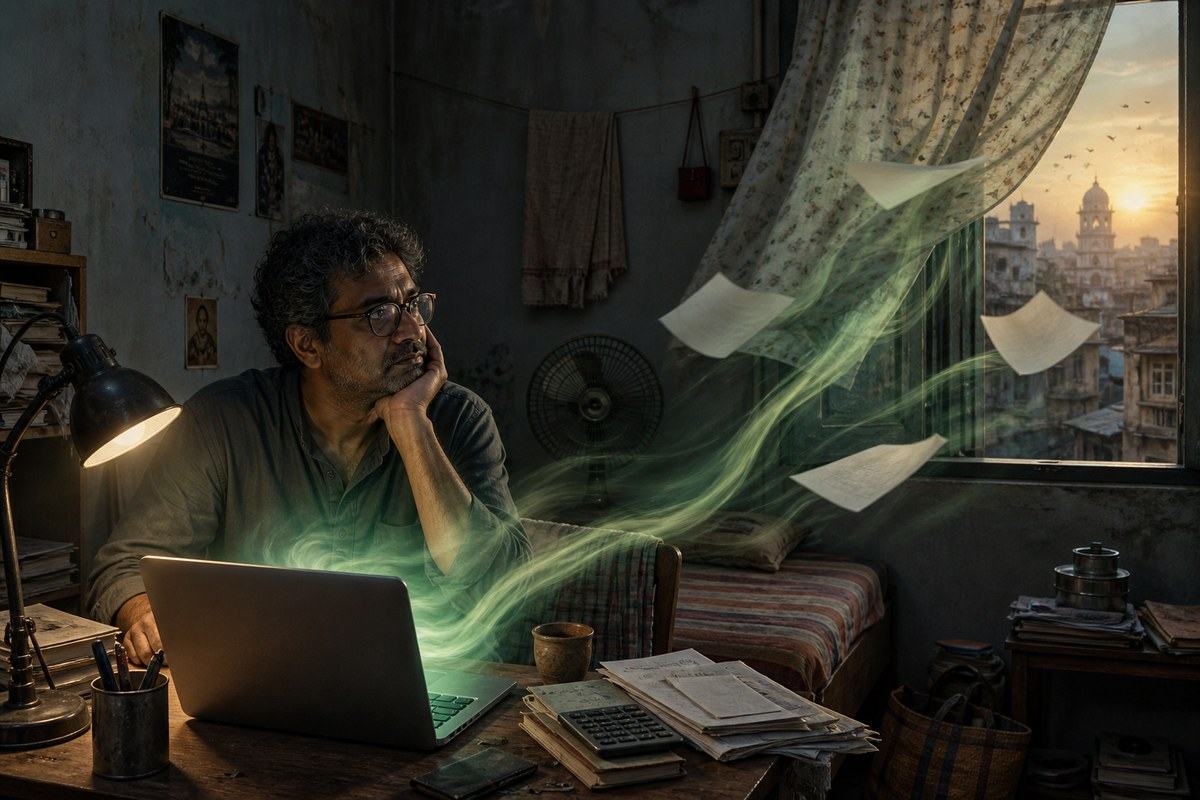
The ceiling fan in my room makes a sound like a small aircraft preparing for an uncertain takeoff. It has made this sound for years. I know because I have counted. Not obsessively, not in any clinical way, but in the manner in which a person who lives alone in a room with a noisy fan comes to know the particular cadence of his own discomfort. The blades wobble slightly—there is a microscopic imbalance somewhere in the assembly that no electrician has ever been able to diagnose, let alone fix—and the resulting oscillation produces a rhythmic thrum that varies with the humidity. On days like today, when the pre-monsoon air hangs in the room like a damp wool blanket, the fan sounds desperate. It is trying. That is the important part. It is trying to move air that does not want to be moved.
I am fifty-one years old. The number does not frighten me, but it does sit there, in the corner of my awareness, like a houseguest who has overstayed his welcome and shows no signs of leaving. I am not running a marathon. I never was. I was never on the hedonistic treadmill either, that peculiar piece of exercise equipment that the modern world seems to have installed in every living room, every pocket, every scrollable surface. I do not say this with pride. Pride would imply a choice, a deliberate opting-out, a moral stance. It was nothing so grand. I simply never found the entrance to the treadmill room. By the time I realized there was a party happening, the music had already changed, the guests had moved on to some other venue, and I was left standing in the hallway holding a coat that did not belong to me.
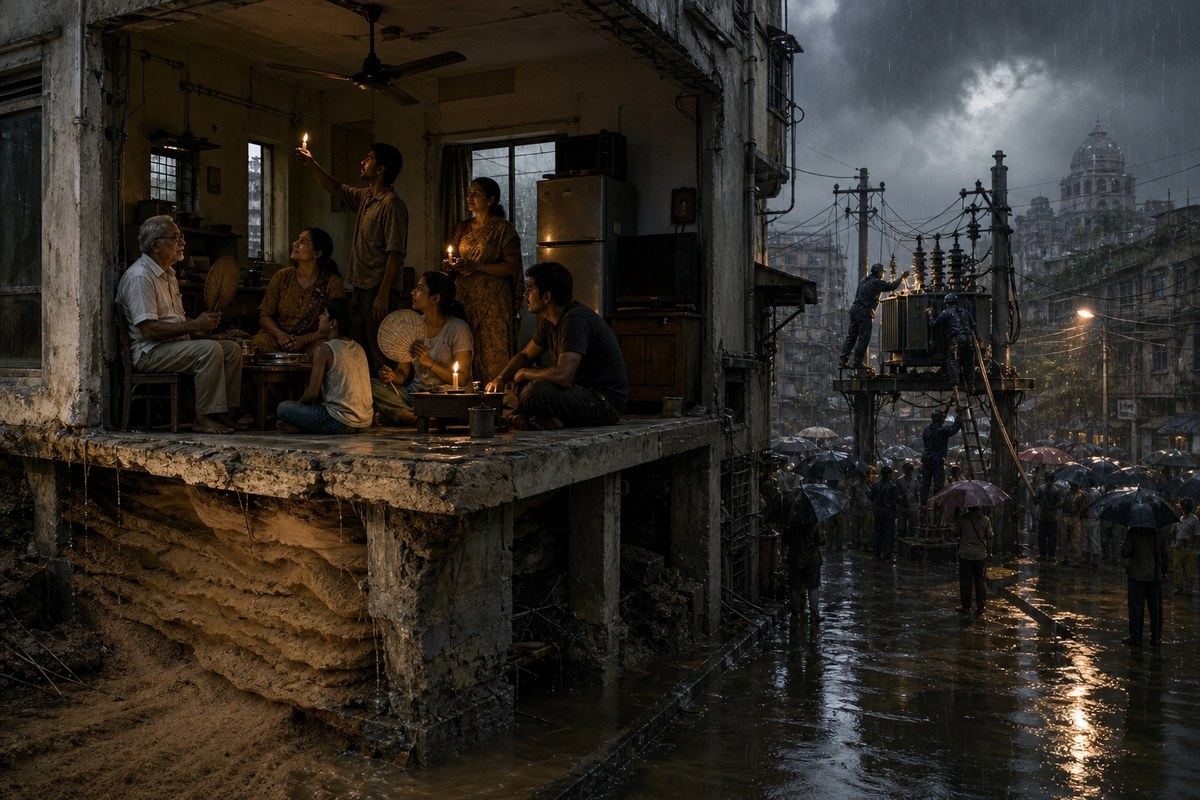
I live in Calcutta. The city is currently experiencing what the meteorologists call a “moderate or heavy rain shower,” which is meteorologist-speak for the sky opening up without warning and depositing several inches of water onto streets that were not designed to receive it, onto power lines that were not designed to withstand it, and onto the spirits of a population that has learned, through long and patient suffering, to treat every meteorological event as a personal insult. The India Meteorological Department reports that the temperature is 30.4 degrees Celsius with 92 percent humidity, which means that the air itself has become a liquid you must swim through rather than breathe. The power has been cutting out with the regularity of a metronome set to a tempo only slightly too slow to be useful. The grid, I read, is under strain. Record demand, they say. Solar abundance by day, catastrophic shortage by night. A 5.4 gigawatt deficit after sunset, which is enough to leave 2.7 million rural homes in darkness, though I am not rural and my darkness is of a more elective, more bourgeois variety. I have a UPS. It beeps when the power goes. The beep is a small, insistent sound, not unlike the fan, and together they form a duet of mechanical resignation.
I write. This is what I do. I write long-form essays, medium-form essays, short-form essays, whatever-form essays. I post them on a blog that receives approximately the same amount of traffic as a lemonade stand located in a desert. I am aware that no one reads walls of text anymore. I have been told this, explicitly, by people who mean well, by people who are trying to save me from myself, from my own anachronistic stubbornness. “Text,” they say, with the gentle condescension of a doctor delivering a terminal diagnosis, “no one reads text.” They say it as if this were a natural law, as immutable as gravity, as if the human capacity for sustained attention had been surgically removed sometime around 2012 and replaced with a craving for seven-second videos of strangers performing choreographed dances in their kitchens.
And yet I write. I write because the word “personal” still means something to me. Because I am still alive. Because the person—the actual, singular, irreducible person—is dying. Is becoming alien. Is becoming fake. Is becoming, in the most precise and terrible sense of the word, a machine.
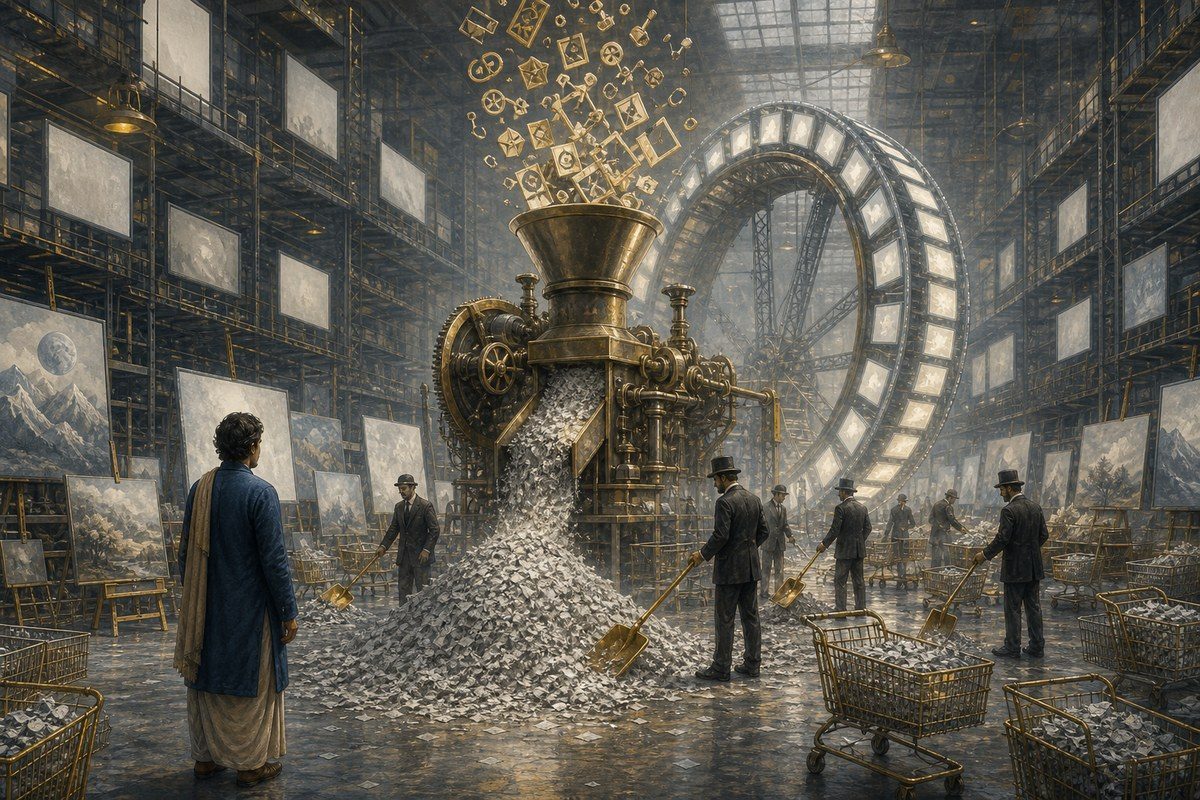
I do not say this as a Luddite. I am not a Luddite. I use the bots. I let them handle the boilerplate, the syntax, the grammar, the image enhancement, the code that I do not have the patience to write by hand. I am not foolish enough to reject a tool that can save me labor. But the core, the germ, the seed of thought—that must be mine. That I will not outsource. That I will not feed into the maw of an algorithm and wait for it to regurgitate something polished, something optimized, something that has been stripped of all irregularity, all texture, all the small awkward bumps and ridges that make a thought feel like it came from a human mind rather than a statistical model trained on the aggregated mediocrity of the entire internet.
The world has become very good at making things look good. The world has become less good at making things be good. There is a difference, and the difference matters, though I am increasingly uncertain that anyone else can still perceive it. We are drowning in what the internet has taken to calling “AI slop”—that peculiar genre of content that is visually perfect, grammatically impeccable, and spiritually vacant. It is the visual equivalent of elevator music. It is the written equivalent of a chatbot’s apology. It is everywhere, and it is making us hungry for imperfection, for mess, for the smudged and the flawed and the authentically human. I read about the “messy girl” trend, about the rebellion against the beige minimalism of algorithmic curation, and I feel a small, reluctant flicker of hope. But then I remember that even the rebellion has been packaged, monetized, turned into another aesthetic to be consumed in seven-second increments, and the hope flickers out, replaced by the familiar dull ache of recognition.
I am not on social media. I say this not as a boast but as a statement of fact, the way one might say “I am not on the moon” or “I am not a professional athlete.” It is simply true, and it is simply outside the range of most people’s comprehension. The absence of a social media presence in 2026 is treated with the same mixture of suspicion and pity as the absence of a telephone in 1950. People assume you are either hiding something or running from something. They do not consider the possibility that you might simply be uninterested in performing your life for an audience of algorithms and strangers. I do not want to perform. I want to think. I want to feel. I want to worry. I want to live, for as long as I am alive, and to tell my story through my own thoughts, in my own way, even if that way is not fancy, even if it is not dressed up in the gaudy, meretricious merchandise of colors and fonts and sickening, febrile, disco-lighted ambient artifice that passes for “content” in the current moment.
My room is small. The walls are stained with the residue of eleven monsoons. There is a patch of fungus in the corner near the window that I have learned to regard with the same resigned affection one might feel for a pet that is not quite house-trained. The air conditioner does not work. It has not worked for three years. I have not had it repaired because the repair would cost more than I can comfortably spend, and because there is something honest about the heat, something that refuses to let me pretend my life is other than it is. The fan continues its wobbling, whirring, desperate rotation. The power cuts come and go. The UPS beeps. Outside, the rain falls on a city that is simultaneously collapsing and rebuilding itself, a city that has been dying for two hundred years and refuses, stubbornly, to finish the job.
I am not poor, not in the way that matters, not in the way that the people who sleep on the footpaths outside the New Market are poor. But to a first-world denizen, to someone for whom a power cut is an inconvenience rather than a weather system, my existence would look like poverty. The AC that doesn’t work. The fan that sounds like a dying engine. The leaky, noisy, damp, fungal infection of a room that I call home. And that is alright. That is what it is. Why say it differently? Why write fibs about this current reality? The situation is already at a point that most people are sort of drunk or anesthetized to the perversion of deceit. The technology, the AI, the capitalism—it makes the masala more efficient, more palatable, more easily digestible. It smooths out the rough edges. It tells you that your life is fine, that your discomfort is temporary, that the algorithm has your best interests at heart.
I do not believe the algorithm has my best interests at heart. I do not believe the algorithm has a heart. This is not a controversial statement, but it feels like one, in a world where people have begun to treat their chatbots as confidants, as therapists, as friends. I read about AI fatigue, about the exhaustion of living in a world where every interaction is mediated by a machine that is trying to predict what you want before you want it, and I recognize the symptoms in myself. The fatigue is not from using the tools. The fatigue is from living in a world where the tools have begun to use us.
So I barricade myself. Not with walls, not with locks, but with books. With a brook of thoughts that runs through my mind, clear and cold and ungovernable, a stream that does not care about engagement metrics or click-through rates or the optimal length for a piece of content designed to be consumed during a commute. I read old books, books written by people who are long dead, people who wrote without knowing that their words would one day be fed into a training dataset, without knowing that their carefully crafted sentences would be reduced to tokens, to vectors, to the raw material from which a machine would learn to imitate the sound of human thought without ever understanding its meaning.
I write about the fan. I write about the fungus. I write about the power cuts and the rain and the heat and the small, persistent, almost invisible fact of being alive in a body that is slowly, inevitably, moving toward its own conclusion. I write because I want to capture this singularity while I can. Not the singularity that the technologists talk about—that grand, apocalyptic moment when machines become smarter than humans, which may or may not happen in my lifetime and which, frankly, seems less frightening than the slow, quiet singularity that is already here, the moment when humans became so accustomed to machine-generated thought that they forgot what their own thoughts sounded like.
I am not popular. I know this. My blog posts are read by a handful of people, most of whom I suspect are bots themselves, crawling the internet for content to ingest, to regurgitate, to turn into more slop for the great digital compost heap. But popularity was never the point. The point was never to be liked, to be shared, to be optimized. The point was to think, and to record the thinking, and to leave some small, imperfect, human-shaped mark on the world before the world finishes its long project of turning everything into data.
The rain has stopped. The fan is still running. The power has not cut out in forty-three minutes, which is something of a record for this evening. I can hear the sound of water dripping from the eaves, a slow, irregular percussion that has nothing to do with any algorithm. Somewhere in the city, a warehouse has collapsed in Taratala, and three people are dead, and the army is digging through the rubble, and the news will be forgotten by tomorrow because the news cycle moves faster than the rain, faster than the fan, faster than thought. I will read about it, and I will feel the appropriate weight of it, and I will return to my small room with its broken AC and its wobbling fan and its fungal corner, and I will write, because that is what I do, because that is what I am, because the person is not a machine, not yet, not while I can still hear the sound of my own mind working against the hum of the world.
The fan wobbles. The night deepens. I am still here.
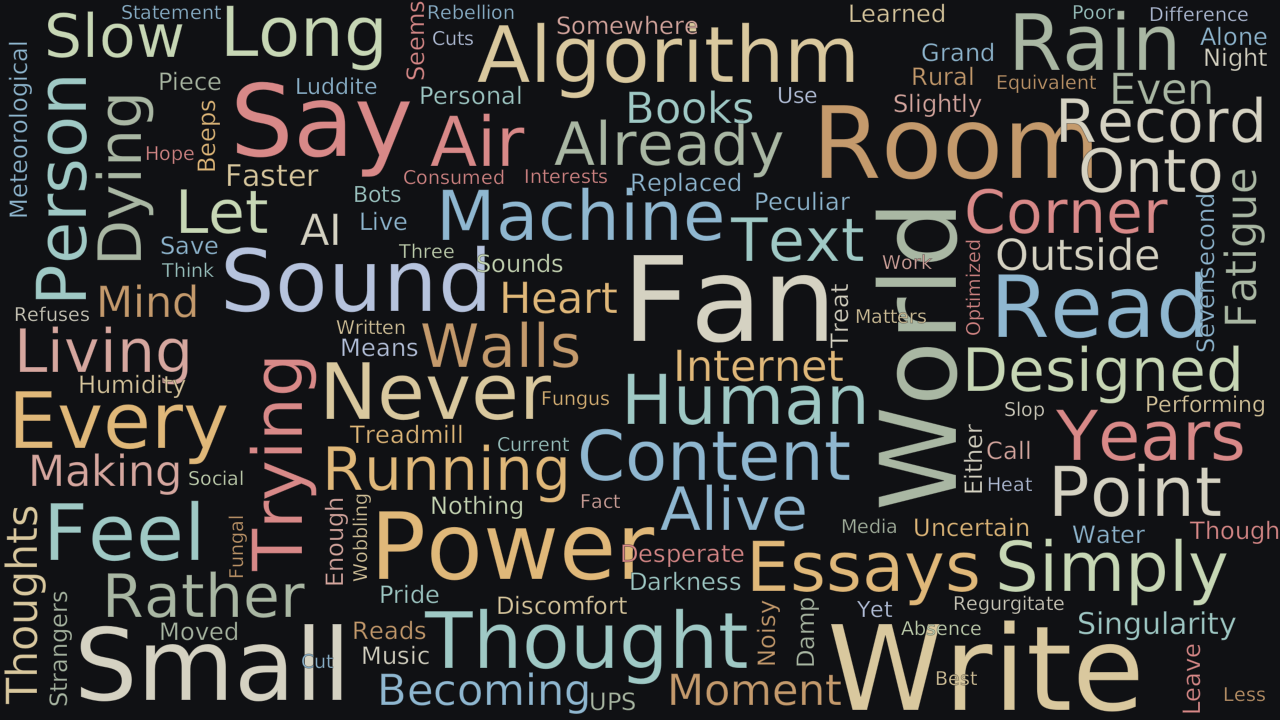
Word Cloud
Related reading
Selected by shared topics and section, with closer publication dates breaking ties.