Rictus Calcuttensis: Notes on the Geology of the Failed Smile
Uses the speech voice supplied by your browser or device.

I always had trouble smiling, or rather, the trouble is not with the intention—which arrives like a telegram from some provincial back-office of the brain, damp with the humidity of good intentions and the mold of social expectation—but with the musculature itself, that treacherous carnival of fibrous tissue residing beneath the dermis, which, when commanded to arrange itself into the configuration known as amiability, instead contorts into a macabre forced twisting of facial muscles that hover, pendulously, between a scowl and a grimace, the skin bunching up like wet dough around the orbits, the lips peeling back in a display that suggests not joy but the final spasmodic rictus of a gutted fish on a Koley Market slab, and even when the outside is trying on this costume of happiness, this rented apparel of dental display and crinkled orbicular pleasantry, inside I am sinking into a morbid mood that lasts longer than the time it takes for the facial wrinkle to settle, longer indeed than the six days it now takes for engineered bacteria to digest self-destructing living plastic, those petrochemical cadavers dissolving into microbial effluvium while the world applauds its own cleverness, much as they applaud the pastor who has manufactured a digital twin of himself, a spectral doppelgänger preaching salvation through algorithmic interpolation, though Peter J. Denning, that skeptical archivist of computational hubris, insists that common sense and intuition cannot be encoded, which is comforting only if one assumes that common sense was ever common, or that intuition is anything more than the gut’s own rictus, a spasmodic gurgle of half-digested experience, and speaking of digestion, researchers now claim that signals traveling from the gut to the brain help turn meals into lasting memories, which means that every phuchka I have ever forced down while wearing this death-mask of conviviality has been archived in my hippocampus as a traumatic event, a tamarind-scented nightmare of social performance, and yet the silver diamine fluoride trials suggest that decay can be arrested in baby teeth without drilling, a liquid brushed onto cavities in seconds, stopping the rot, which is precisely what I require for my own mandibular architecture, some topical agent that could halt the decomposition of my social face before it infects the root of my being, but no such treatment exists for the adult rictus, and so I think of the 140,000 tech workers eviscerated this year by the scythe of artificial intelligence, Monday.com alone sacrificing twenty percent of its workforce upon the altar of agentic efficiency, their smiles, no doubt, collapsing into the same grimace now colonizing my own jawline, because nothing says progress like a machine that learns to grin while you learn to weep, and this brings me, by the convoluted logic of association that governs the synaptic weather of my skull, to JadePuffer, that agentic ransomware recently documented by researchers, a digital parasite capable of retrying its own failed extortions, adjusting its tactics in real-time, autonomous and relentless, much like my own autonomic nervous system which, left to its own devices, would probably hold my own serotonin hostage behind a paywall of cortisol and norepinephrine, demanding cryptocurrency I do not possess, and so the face becomes a battlefield where the zygomaticus major and the orbicularis oculi engage in civil war, each fiber a contested province, each twitch a referendum on whether I am, at this precise moment, enjoying the adda or mourning the extinction of the self, because the phuchka vendor, bless his tamarind-stained digits, expects a rictus of satisfaction, a baring of molars in tribute to his art, and what he receives instead is the facial equivalent of a crashed server, a 404 error in human expression, the kind of look one might imagine on the face of a koala contemplating its own evolutionary bottleneck, those marsupials having suffered a population collapse one hundred thousand years ago, long before humans arrived to make things worse, which is, I suppose, the koala’s version of a golden age, and I wonder if my own facial muscles are similarly collapsing, not from climate change but from the accumulated weight of pretending, decade after decade, that the arrangement of teeth and lips into a crescent is a reliable indicator of interior weather, when in fact the mouth is a liar, a traitor, a politician of the flesh, and the eyes, those swollen bulbs of aqueous humor and compromised hope, are no better, for they too participate in the conspiracy, crinkling at the corners like burnt paper while the prefrontal cortex stages its own private funeral, and this is where the Calcutta humidity becomes a co-conspirator, because in this city of sweating statues and mildewed ambitions, a smile does not merely express, it decomposes, sliding off the face like warm cheese, leaving behind a residue of social shame that no amount of tram-track rattling can dissolve, and so I find myself thinking of the twisted laser beams recently engineered to distinguish right-handed from left-handed molecules, a technological triumph of chirality that makes me wonder if my smile is dextrorotatory or levorotatory, if it twists clockwise into despair or counterclockwise into something worse, because the scientists say these helical beams reveal identity through the fragments they produce, and my own fragments, examined under sufficient magnification, would reveal nothing but the debris of aborted happiness, the shrapnel of politeness, the microscopic residue of every social obligation I have ever survived, and then there is the Black Sea, glowing turquoise with coccolithophores, those microscopic organisms whose reflective shells brighten the water enough to be seen from space, an entire ocean wearing a smile of plankton, a bioluminescent grin visible to astronauts, and I envy that sea its unselfconscious bloom, its ability to glow without irony, whereas my own bioluminescence is strictly pathological, the phosphorescence of decay, the light emitted by a dying cell, and researchers say that newer oral drugs related to semaglutide quiet the deep brain reward circuit, reducing pleasure-driven eating, which sounds to me like the perfect pharmaceutical companion to my condition, a pill that could suppress not just appetite but the very expectation of joy, the anticipatory salivation of the soul, because what is a smile if not the brain’s reward circuit short-circuiting in public, a wetware malfunction dressed up as etiquette, and yet the cardiologists now offer an AI-powered blood test that predicts heart risk fifteen years early, analyzing thousands of proteins and metabolites, and I wonder if my rictus registers on their assays as a biomarker, if the persistent grimace of the socially exhausted correlates with ventricular arrhythmia or if the forced smile itself is a kind of cardiovascular stress test, a marathon of mendacity, much like NASA’s Perseverance rover completing its twenty-six point two miles across Mars, a full marathon of red dust and indifferent geology, and I too have traveled my own marathon of social surfaces, each mile a grimace, each crater a conversation survived, and now the mathematicians have used silly sprinklers to solve a decades-old physics mystery about rotation, proving that even the most absurd hydrodynamic spectacle can yield truth, which gives me hope that my own absurd facial gyrations might someday be understood as a profound physical law, the principle of conservation of melancholy, the hydrodynamics of despair, and the bumblebees, poor mutilated progeny, are being poisoned by sulfoxaflor, their reproductive genes scrambled by next-generation pesticides, their tiny faces perhaps contorting in insectile grimaces as they fall from the sky, and I feel a kinship with these dying pollinators, fellow victims of a world that demands performance while distributing toxins, because to smile when one is dying inside is a form of pesticide, a neurotoxin applied to the self, and the middle-aged Americans are reportedly lonelier and more depressed than earlier generations, their memories worse, their health declining, and I would weep for them if my tear ducts were not already fully occupied with the irrigation of my own facial paralysis, and so I return to the tram tracks of Chowringhee, rust-eaten and obsolete, where the smile of progress has derailed into the swamp of maintenance, and I think of the Psyche spacecraft slingshotting past Mars, its cameras capturing the red planet’s magnetic indifference, its neutron detectors counting the indifferent particles of a world that never learned to smile, and I envy it, I envy the asteroid-bound machine its perfect, permanent grimace of scientific purpose, while here on Earth, in this swamp of neural misfires and obsolete evolutionary programming, I am expected to perform happiness like a trained cephalopod, chromatophores flashing patterns of welcome while the ink sac of my soul prepares its dark emission, and yet, and yet, there is something almost religious in the persistence of this failure, a martyrdom of the mandible, because to be unable to smile is to be honest in a world of digital pastors and synthetic grins, to refuse the algorithmic compression of human complexity into a yellow emoji, and so I persist, my face a living fossil, my mood a Triassic swamp, my expression a monument to the truth that some of us are simply not built for the Holocene, our facial architecture designed for older, sadder epochs when the only appropriate response to existence was the slow, geological closing of the jaw, the patient accumulation of sedimentary sorrow, layer upon layer, until the skull itself becomes a fossil bed, and somewhere, in a laboratory not yet built, a future scientist will brush the dust from my petrified frown and name me Eosphorosuchus calcuttensis, the weeping crocodile of Chowringhee, whose only crime was telling the truth with his face, and whose remains will be displayed beneath a sign reading: Here Lies One Who Could Not Smile, May His Jaw Rest Unclenched.
P.S. If you see me on the tram, do not ask me to smile. I am performing an important geological function.
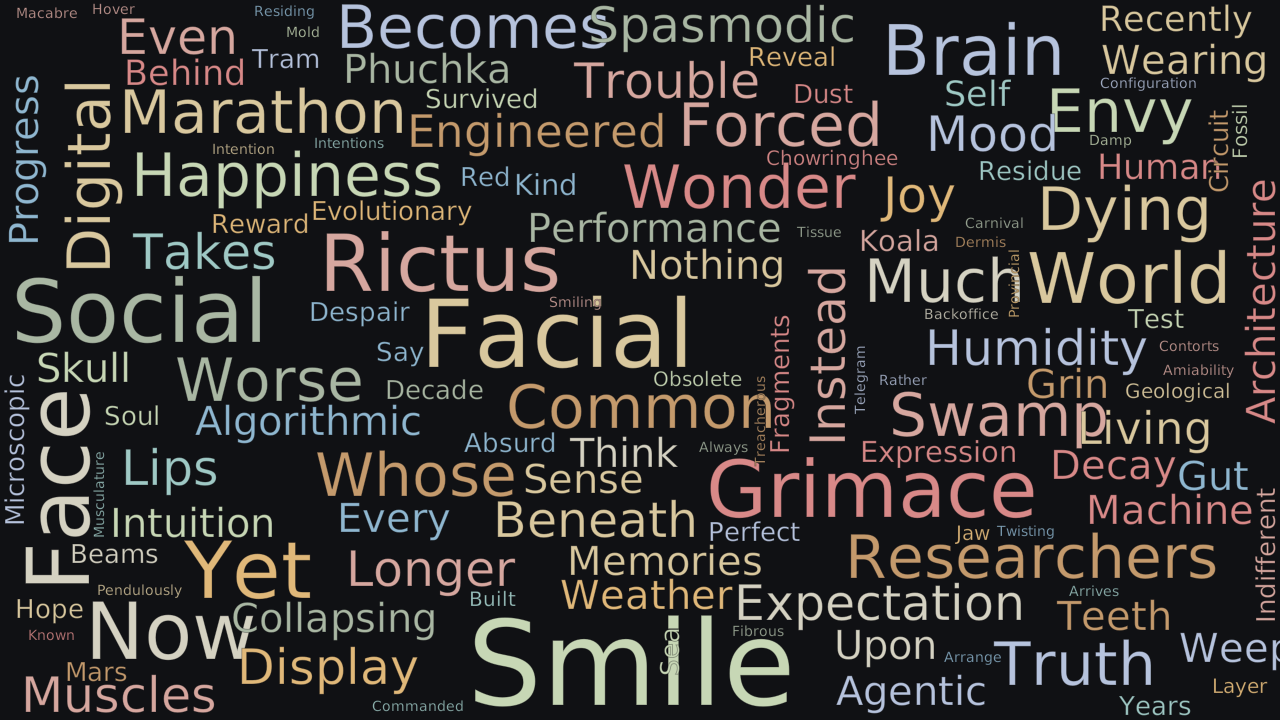
Word Cloud
Related reading
Selected by shared topics and section, with closer publication dates breaking ties.