You made one. Someone wants a thousand. What changes?
Build one.
Now build a thousand.
You made one. Someone wants a thousand. What changes?
Three shaped pieces hold a phone upright while someone works.
One stand: 60 minutes of hands-on work. Ready to send: working day 1. Invented teaching assumptions for one maker. With every decision off, 1,000 stands need 62,000 hands-on minutes and are ready to send on working day 153, including 5 working days waiting for material.
The interactive workshop opens as you approach.
Checking article narration…
A useful little thing
Three shaped pieces of wood hold a phone upright. Someone can glance at a recipe, take a call or keep a drawing beside their work. The object is modest. That makes it a good place to begin.
In this invented workshop, making and packing the first stand takes sixty minutes of hands-on work. The maker can finish it during the first working day. The calculation does not claim that the whole day has disappeared.
Then the order grows. Ten stands still look like the same little object. Yet every cut must fit another piece, every surface needs finishing, and every finished stand must reach somebody. Repetition turns a pleasing object into an obligation.
Preparation arrives before its reward
Try ten stands and enable only the cutting guide. The guide is a prepared reference that helps the maker repeat the cut. It reduces cutting from twenty-five to eight minutes per stand in this model, but it first takes three hours to prepare.
The original ten-stand batch needs 620 hands-on minutes, including its one workshop fix. With the guide alone, it needs 630. The preparation has arrived; the full reward has not. Nothing went wrong with the arithmetic. A useful process choice can still be a poor fit for a small batch.
At larger quantities the same preparation is spread across more stands. It does not become free. It becomes work with enough repetition after it to matter.
The slot inspection is an illustration of inconsistent fit. Its edges are not measured dimensions or a dataset of real products. They help make a familiar consequence visible: pieces that look nearly the same can ask for different amounts of attention.
The pause beside the bench
The starting stock covers twenty stands. Ask for twenty-one and the material drawer empties. Production waits five working days for all the required material to arrive. Cutting faster cannot fill that rack.
This is a deliberately simple rule. Supply and production do not overlap. There are no weekends, holidays or unreliable suppliers. The fixed pause makes waiting visible without pretending to predict a real delivery.
Open the assembly tray. Illustrated instructions take ninety minutes to prepare, then reduce assembly from fifteen to ten minutes per stand. They also change the assumed workshop-fix rule from one fix per ten stands to one per fifty, always rounded down. Each fix takes twenty minutes before the batch is sent.
Instructions belong to the process because someone has to make them, somebody has to use them, and their effect has to appear in the work. A picture in a folder is not automatically a saving.
The person beyond the packing wing
A completed stand on the bench has not yet arrived safely with its buyer. Protective packaging takes eight minutes rather than five for each stand. The fitted liner makes the extra work visible.
The model gives ordinary packing one illustrative delivery problem per twenty stands and protective packing one per hundred, rounded down. These are invented scenario rules. They are neither measured failure rates nor forecasts. A batch of a thousand therefore shows fifty concerns with ordinary packing and ten with protection.
Those concerns happen after sending. They are separate from workshop fixes. The model adds no returns, replacement work or customer-support time. Keeping that limit visible matters: a smaller displayed count does not mean the maker has accounted for every consequence.
One maker still has one day
At a thousand stands, the original setup uses 62,000 hands-on minutes. With all three decisions enabled, the model uses 41,670. The batch moves from ready-to-send working day 153 to working day 105, including the same five-day material wait.
That is a substantial change within these assumptions. It is also a long promise. The maker still has 420 productive minutes per working day. Preparation can reduce repetition; it cannot give one person unlimited capacity.
The comparison keeps quantity, stock and model version the same. It switches the three decisions off for the original setup. Nothing about the comparison estimates wages, money, safety, actual supplier performance or arrival dates. It asks a narrower, useful question: where does the work in this promise go?
Making the object was the first invention. Making it repeatable was the second.
What would need to change before one person could promise this delivery?
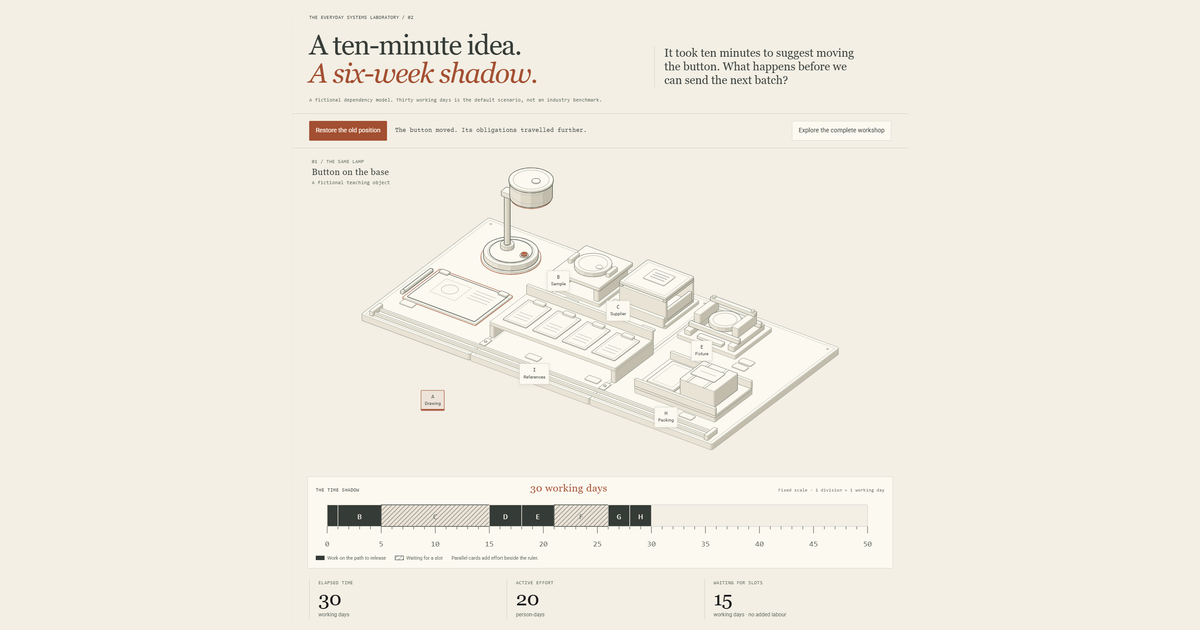
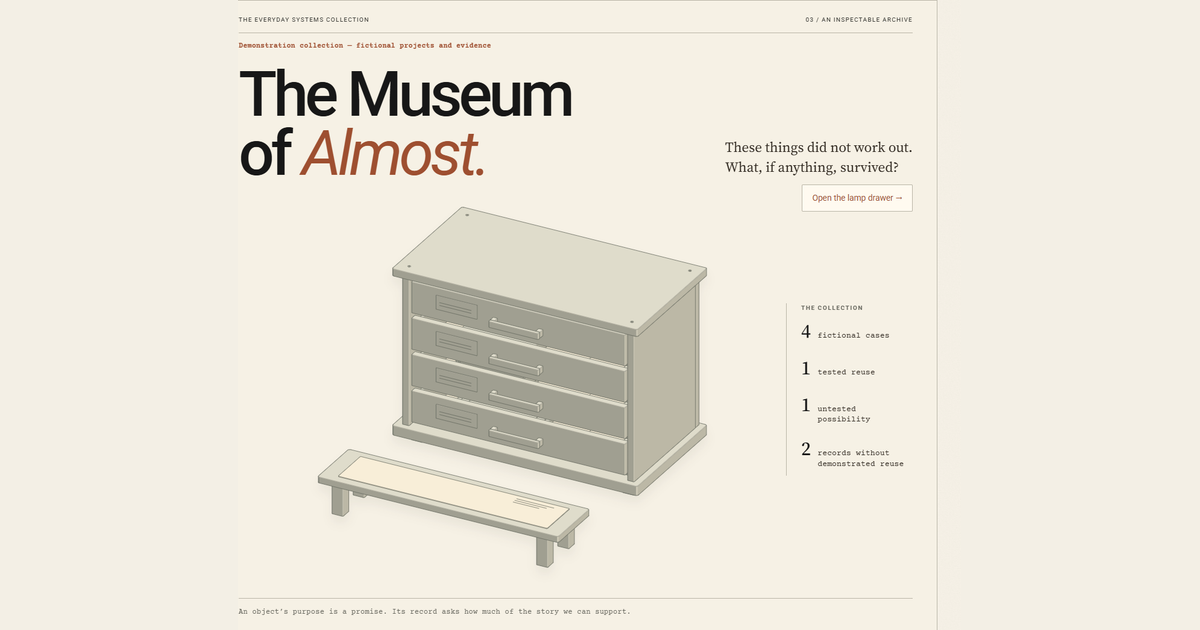
Continue with The Six-Week Shadow, where a tiny product edit travels through the work that depends on it. Then open The Museum of Almost, a clearly fictional collection that asks what the evidence actually supports after an idea stops working.
Quick reference and FAQ
Making one useful object and promising a thousand of them are different kinds of work. This workshop makes the preparation, repetition, waiting and delivery concerns visible, with invented assumptions you can inspect.
Key Terms
- Preparation
- Hands-on work
- Material waiting
- Productive capacity
- Workshop fixes
Frequently asked questions
Is this a real manufacturing estimate?
No. Every rate and delivery-problem rule is an invented teaching assumption for one maker. It is not a quote, measured production data or Suvro Ghosh's manufacturing history.
Why can a cutting guide make ten stands slower?
The guide takes 180 minutes to prepare. At ten stands its cutting savings do not yet recover that preparation time: the guide-only batch needs 630 hands-on minutes, compared with 620 in the original setup.
What does ready to send mean?
It is the working-day number when all material waiting, preparation, production, workshop fixes and packing are complete. It is not an arrival date and does not imply every minute of the final day is used.
Are delivery problems included in hands-on work?
No. They are a separate fixed illustrative rule after sending. Transport time, returns handling and any extra labour are outside this deliberately limited model.
Word Cloud
Related reading
Selected by shared topics and section, with closer publication dates breaking ties.