A Place for Every Idea: Build Your Own Memory Palace
An umbrella springs open and lifts a Calcutta gate into the rain. A mango bursts above the front steps, sending sticky orange juice over them. On the veranda, a bicycle rings its bell with such determination that you almost answer it.
Close the gate in your imagination. Return to the steps. What was there?
The place has begun to ask the question for you. That is the useful promise of a memory palace: give material a sequence of recognisable addresses, then revisit those addresses when you want it back.
Begin with the example: learn the empty route, study the ten words, and attempt recall before revealing an answer. Then try the water-cycle paragraph or bring your own material.
A place for
every idea.
A few words. A familiar walk.
Something to remember at every turn.
Learn the route · Make a scene · Try remembering
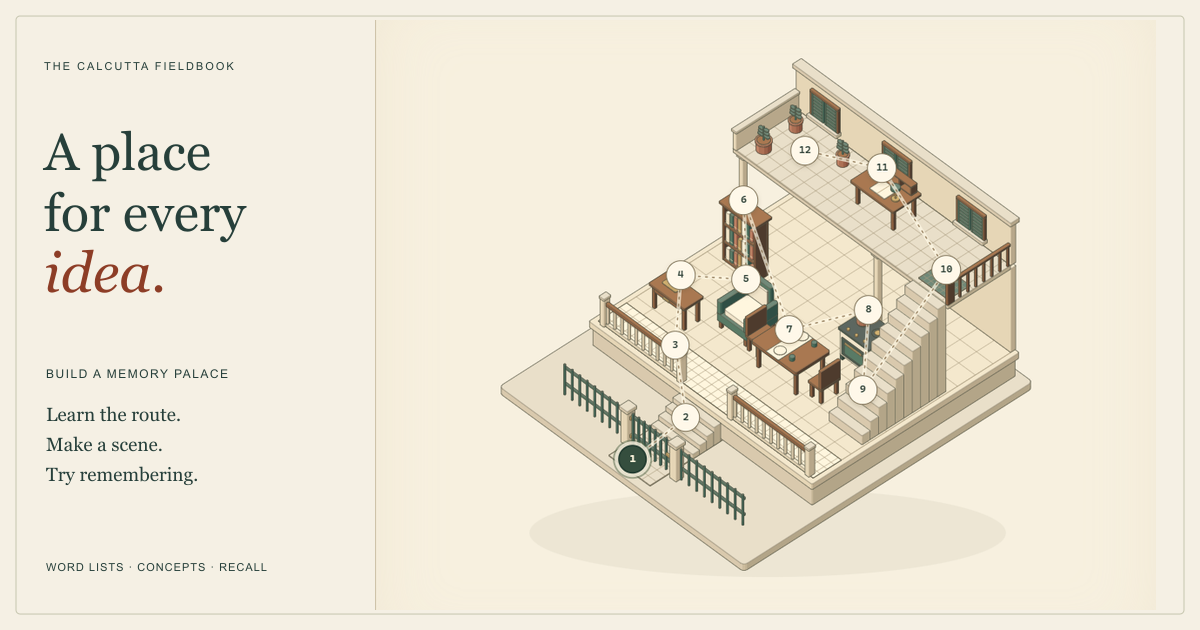
Opening the house. The interactive practice loads as you approach.
Checking article narration…
A route that lends its order to an idea
The method of loci takes its name from the Latin plural of locus: a place. You learn a route through distinct places and attach something worth remembering to each one. Later, mentally following the route gives you an ordered sequence of retrieval cues.
The principle has a long history. The anonymous Roman Rhetorica ad Herennium, Book III, describes an artificial memory built from locations and images, including a distinction between remembering subject matter and remembering words. The surviving text shows that this was already a developed rhetorical practice in antiquity. It does not tell us who first discovered it.
Our house is a teaching route. Your own front door, school corridor or daily walk may eventually supply more familiar landmarks. The important preparation is learning their order before asking them to carry new material. Otherwise you are trying to remember both the route and its contents at once.
Here the route is fixed: gate, front steps, veranda, entrance table, armchair, bookshelf, dining table, stove, staircase, landing, study desk, terrace. Each landmark should feel different from its neighbours. Two nearly identical chairs make poorer addresses than a chair and a staircase.
Walk the empty route until you can anticipate the next stop. Use its numbered list if the drawing is awkward to navigate. During encoding, let the scene act on the landmark: let the umbrella lift the gate, rather than floating it vaguely somewhere near the house.
Decide what a successful memory would contain
A list, an explanation and a quotation ask different things of you.
For an ordered word list, success may mean recovering every word in the correct position. A repeated word is still another occurrence to remember. If the list contains “key” twice, putting it once somewhere in the house does not satisfy both positions.
For a paragraph, success usually means recovering ideas and their relationships. “Energy”, “water” and “cloud” are too thin to stand in for an explanation of evaporation and condensation. The verbs and conditions carry much of the meaning.
For exact wording, the sequence of words itself becomes the target. A palace of main ideas can help you reconstruct an argument without preserving its phrasing. If you need a quotation verbatim, explicitly encode and check that wording. Do not assume that remembering its meaning will reproduce its sentences.
Choose the target before building scenes. In this experience, paragraph practice checks meaning through your own assessment after revealing the reference. It does not pretend that matching a few keywords can judge whether an explanation is correct.
Break material where the meaning turns
In word-list mode, choose a delimiter that matches your input. Commas or new lines keep a phrase such as “front door” together; whitespace mode separates it into two words. Review the resulting cards before proceeding. You can edit, split, merge and reorder them.
Paragraph mode offers sentence or clause fragments. These are mechanical suggestions. They cannot reliably identify the important idea in an unfamiliar passage or decide which qualification matters most. Read the original beside the cards and revise them yourself.
A useful unit answers one manageable question: what changes, what causes it, what condition must hold, or how two things relate? Keep the source passage so that you can check your paraphrase. Give the card a short label, but also write enough explanation to recover the claim.
Meaningful chunking groups material because its parts belong together. Grouping every three words merely imposes a count. “Unless the temperature falls” should not lose “unless” because a counter happens to stop there. Likewise, “may reduce risk” must not become “prevents disease”.
One unit per location is a good starting arrangement, not a law of memory capacity. Related units can share a location if you give them a clear internal order. If the scene becomes a crowded committee, use another location. The interface displays its own input and item limits; those are practical software limits, not measurements of what a person can remember.
Ten words, ten addresses
The first example is deliberately concrete:
umbrella, mango, bicycle, candle, elephant, violin, key, ocean, clock, butterfly.
Each word is its own memory unit. The first ten landmarks carry them; the study desk and terrace remain empty. The scenes are suggestions to personalise, rather than images you must reproduce with photographic clarity.
| Source word and unit | Locus | Scene | Retrieval cue |
|---|---|---|---|
| umbrella | 1. Gate | An enormous umbrella springs open and lifts the iron gate into the rain. | What lifts the gate? |
| mango | 2. Front steps | A giant mango bursts, sending sticky orange juice down all three front steps. | What bursts above the steps? |
| bicycle | 3. Veranda | A bell-ringing bicycle circles the veranda posts without a rider. | What circles the veranda? |
| candle | 4. Entrance table | A towering candle drips warm wax over the round entrance table. | What drips wax on the table? |
| elephant | 5. Armchair | A tiny elephant sinks into the armchair and trumpets from its cushion. | Who occupies the chair? |
| violin | 6. Bookshelf | The books sprout violin strings, and the bookshelf bows them into a tune. | Which instrument do the books become? |
| key | 7. Dining table | A golden key turns in the dining table, winding the whole table like a toy. | What winds the table? |
| ocean | 8. Stove | A blue ocean surges out of the stove, washing its rings with salty waves. | What washes over the stove? |
| clock | 9. Staircase | The staircase becomes a giant clock, ticking loudly with every step. | What does the staircase become? |
| butterfly | 10. Landing | An enormous butterfly fans the landing window with its patterned wings. | What fans the landing window? |
Notice the interaction. The mango’s juice uses the slope of the steps; the key winds up the table. Such choices give you a connection to test. Motion, scale, sound, texture and humour are optional ingredients. Add the smell of a ripe mango if it helps you; leave it out if it adds work without a useful cue.
The final connection is personal. A particular bicycle you rode as a child may give you a stronger association than this example. In the scene editor, explain why your scene reminds you of the target. That small explanation can expose a striking picture with no reliable route back to the word.
A paragraph needs its relationships back
Now use this short, authored explanation:
The Sun supplies energy that turns liquid water into water vapour through evaporation. When moist air cools enough, water vapour condenses into tiny droplets; clouds contain these droplets or ice crystals. When cloud particles grow sufficiently, water falls as precipitation. Some water infiltrates the ground, while some flows over the surface as runoff, returning water towards rivers and the ocean.
This is a simplified learning passage, not a complete account of every pathway or timescale. The US Geological Survey’s water-cycle guide explains the wider network of stores and flows, including groundwater, plants and human influences. Our task is to preserve the claims made in this paragraph.
The seven units below separate linked ideas without throwing away their connectors. The scene is an encoding device: the house itself is not a physical model of weather.
| Source passage → selected unit | Locus and scene | Meaning to retrieve |
|---|---|---|
| “The Sun supplies energy…” → Solar energy and evaporation | 1. Gate: a Sun-shaped lantern warms a puddle on the gate; rising arrows represent invisible water vapour. | Solar energy helps liquid water become water vapour through evaporation. |
| “When moist air cools enough…” → Cooling and condensation | 2. Front steps: a cold mirror beads with droplets only when a cooling dial reaches its marked threshold. | Sufficient cooling enables water vapour to condense into droplets. |
| “clouds contain these droplets or ice crystals” → What clouds contain | 3. Veranda: the cloud-shaped awning holds tiny glass droplets and ice crystals, rather than invisible vapour. | A cloud contains liquid droplets or ice crystals, rather than being simply invisible vapour. |
| “When cloud particles grow sufficiently…” → Precipitation | 4. Entrance table: droplets and ice pieces grow in a basket until its weighted flap opens and they fall. | Cloud particles must grow sufficiently before water falls as precipitation. |
| “Some water infiltrates the ground” → Infiltration | 5. Armchair: some water sinks through a soil-coloured sponge chair into the ground beneath it. | Part of the water enters the ground. |
| “while some flows over the surface as runoff” → Surface runoff | 6. Bookshelf: a different stream runs along a sloping surface gutter, without entering the shelves. | Another part flows over the surface; infiltration is not the only pathway. |
| “returning water towards rivers and the ocean” → Return towards rivers and ocean | 7. Dining table: the surface stream follows a blue river ribbon towards an ocean-shaped bowl. | The described runoff returns water towards rivers and the ocean. |
The conditions “enough” and “sufficiently” matter. A scene in which a cloud immediately rains could conceal them. Make the waiting or growth part of the action. Equally, the two water pathways are alternatives occurring across the system, not a claim that every drop first infiltrates and then becomes surface runoff.
The route supplies an order for retrieval. It does not prove that the process is a single queue. After walking it, close the palace and explain the water cycle to somebody. Ask what provides energy, what changes state, what conditions matter, and where the pathways branch. Those questions test more than the ability to name seven scenes.
Recall begins with an attempt
During study, inspect the target, scene and explanation. Walk forward through the route. Spend more attention on a weak connection than on admiring one you already retrieve easily.
Then switch to practice. The empty landmark becomes the first cue. Type what you remember before revealing the scene or target. If you cannot retrieve it, a hint can help, but the record should distinguish that attempt from recall without assistance.
For words, matching ignores letter case, trims surrounding whitespace and treats repeated internal whitespace as one space. It also normalises equivalent Unicode spellings to NFC, so two technical representations of the same accented letter can match. Accents, punctuation and the remaining wording stay significant: “cafe” differs from “café”, and “key!” differs from “key”. Position matters, and repeated occurrences retain their own positions. For concepts, reveal the reference and choose remembered, partly remembered or missed. Compare your answer with the intended meaning and relationships; be specific about what was missing.
This attempt-before-checking sequence has an evidence base beyond memory palaces. In Karpicke and Roediger’s 2008 vocabulary experiment, continuing to retrieve learned items improved delayed recall, whereas continuing to study them without further testing did not produce the same benefit. That result supports making retrieval an activity in learning; it does not establish that this particular interface or every concept-scoring method is effective.
A revealing error is useful feedback. If you remember the elephant but cannot say what it stands for, repair the connection between scene and target. If you remember the right idea at the wrong landmark, rehearse its address. If your answer misses a condition, encode that condition explicitly. Practise weak items at their original locations so that review does not keep moving the addresses.
What the evidence supports
There is experimental evidence that people can improve performance on memory tasks through method-of-loci training. In Wagner and colleagues’ 2021 study, initially untrained participants practised the technique and showed improved word recall and memory durability compared with active and passive controls. The programme involved sustained, supervised and home-based training; it was substantially more than trying a web demonstration once.
The study also investigated brain activity and connectivity. Those observations do not justify promising a particular brain change to a reader. Nor does better recall of studied words establish better reasoning, general intelligence, or mastery of an unfamiliar subject. Use this house to learn and inspect a strategy, then assess its usefulness on material you actually need.
Review timing matters too. Cepeda and colleagues’ 2008 experiment found that the helpful spacing between learning sessions depended on the later retention interval. There is no single interval that this guide can honestly prescribe for every learner and goal.
As a practical starting experiment, try another short retrieval attempt later today, tomorrow, and several days afterwards. Adjust according to errors and how long you need the material. Those intervals are suggestions for organising practice, not a research-derived optimum for your palace.
When a palace becomes hard to navigate
Similar landmarks cause confusion: sharpen their differences or choose another route. Overloaded locations produce scenes you can describe at length while losing half their targets: split the scene. An association that works only while the answer is visible needs another attempt after a delay.
Reusing a route can also bring earlier contents to mind. Keep important long-term sets on distinct routes where practical, and check for interference before trusting a newly filled palace. Our house is reusable for exercises, but switching examples is not evidence that old associations have disappeared from your memory.
Imagery differs between people. Zeman, Dewar and Della Sala’s 2015 report described people with lifelong absent or markedly reduced voluntary visual imagery. Instructions to “see it vividly” should not become a judgement about effort. Try knowing where the event happens, describing its action aloud, or connecting it to a verbal or other personal cue. These are options to explore, not a claim that every adaptation has equal supporting evidence.
The drawing and its linear list provide the same ordered landmarks. You can use either. Your learning material is processed in the browser; arbitrary passages receive editable scaffolding, not hidden semantic interpretation. Export the study sheet if you want a copy of your route and associations.
Start small enough to check honestly. Learn the addresses, preserve the meaning, make a connection and attempt retrieval. The useful scene is the one that leads you back to the idea when the answer is no longer in view.
Quick reference and FAQ
A memory palace gives each idea a place and a personal cue. Learn a route, turn material into meaningful units, attach a memorable scene to each landmark, then attempt recall before checking. The palace helps you find an idea again; understanding and practice still matter.
Key Terms
- Method of loci
- Memory palace
- Locus
- Retrieval cue
- Meaningful chunking
- Retrieval practice
- Spaced review
Frequently asked questions
What is the method of loci?
It is a memory technique that associates material with distinct locations along a familiar, ordered route. Mentally revisiting those locations supplies cues for retrieving the material.
Can I use a paragraph instead of a word list?
Yes. Review the paragraph, create faithful units of meaning, preserve conditions and relationships, and choose a scene for each unit. Automatic sentence or clause suggestions are only a starting point.
Does the memory palace check whether I understand a concept?
No. Word recall uses visible text-matching rules. For concepts, reveal the intended meaning and assess your answer yourself. Remembering a scene or a few keywords does not establish understanding.
Do I need vivid mental pictures?
People differ in their imagery experiences. You can try spatial positions, spoken descriptions, actions, or other personal cues. This guide does not claim that one approach works equally well for everyone.
Is my paragraph sent to an AI service?
No. This experience processes learning material locally in the browser. Its suggestions use editable scaffolding, rather than an AI service interpreting arbitrary text. You can export your study sheet yourself.
Word Cloud
Related reading
Selected by shared topics and section, with closer publication dates breaking ties.