The Robot Begins as a Loose Wire
Acronyms used in this post: AI [Artificial Intelligence, software methods that allow machines to detect patterns, infer structure, and act from data], LLM [Large Language Model, an AI system trained to predict and generate language], VLA [Vision-Language-Action, AI models that connect visual perception and language commands to robot actions], PID [Proportional-Integral-Derivative, a classic feedback control method that corrects motion using present error, accumulated error, and changing error], GPU [Graphics Processing Unit, a chip designed for highly parallel computation], ROS 2 [Robot Operating System 2, a robotics software framework for connecting sensors, motors, planning, and communication], OpenCV [Open Source Computer Vision Library, a widely used software library for image processing and computer vision], IMU [Inertial Measurement Unit, a sensor that estimates motion and orientation], lidar [Light Detection and Ranging, a sensor that estimates distance using laser light].
Uses the speech voice supplied by your browser or device.

The first robot does not arrive like a polished servant from a Japanese hotel, carrying tea with monk-like grace and Victorian obedience. It arrives as a wheel slipping on dust, a motor screaming like a mosquito trapped inside a ceiling fan, and one loose jumper wire that behaves as if it has joined a political party and now owes loyalty to nobody.
This is not failure.
This is robotics introducing itself.
The popular imagination wants a humanoid. Chrome face. Gentle eyes. Warm voice. Brings tea. Folds laundry. Detects sadness. Does not judge your room. Possibly speaks Bengali with better pronunciation than most call-center scripts. But actual robotics begins in a much humbler republic: plastic wheels, weak batteries, confused sensors, bad timing, wrong screws, burnt fingers, and a small machine turning left when you told it, very clearly and with educational sincerity, to go straight.
That is the first useful disappointment.
And it is a magnificent one.
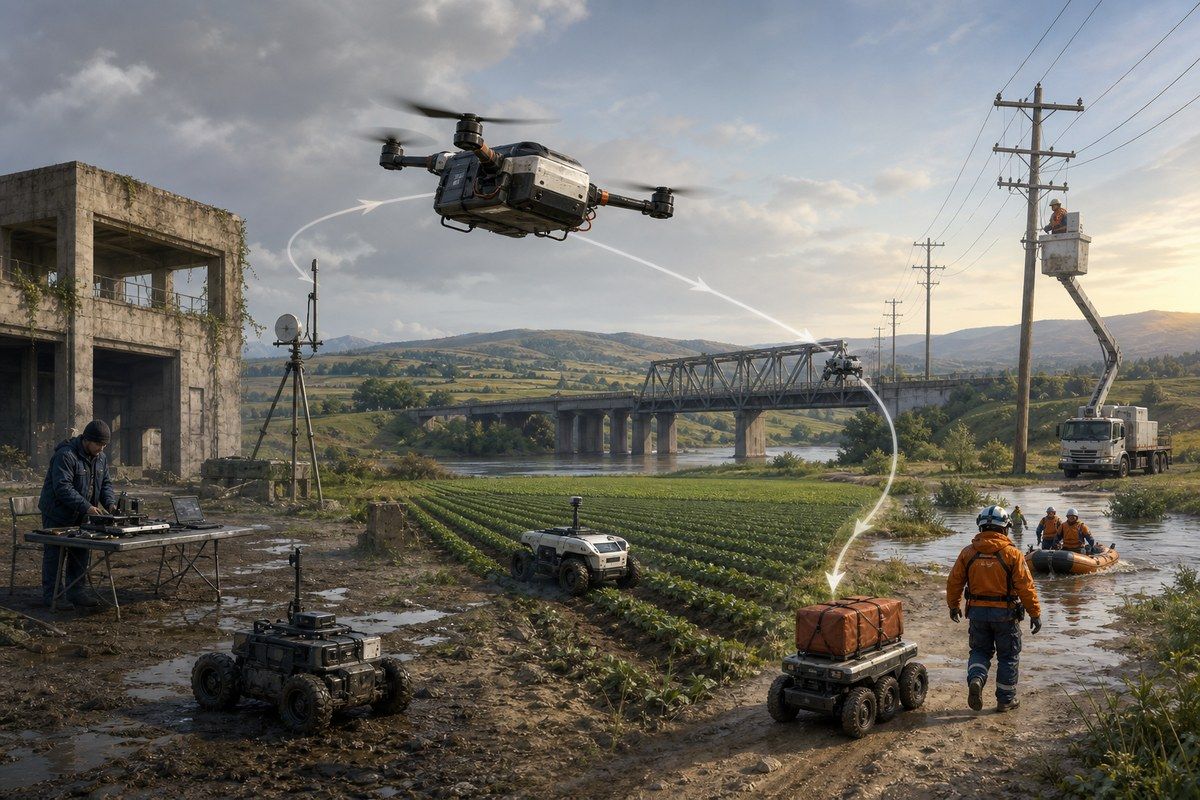
Robotics in 2026 is dazzling in the way a city looks dazzling from an airplane at night. Lights everywhere. Patterns. Movement. Promise. Then you land, take a taxi, and discover the road has been dug up since the reign of Ashoka. Factory arms weld cars with inhuman steadiness. Warehouse robots scurry under shelves like disciplined beetles. Surgical robots help doctors work through tiny openings. Drones inspect bridges, towers, farms, pipelines, and other places where humans traditionally go only after filling out forms and suppressing common sense. Quadruped robots climb industrial stairs. Humanoids now lift, carry, balance, sort, and follow language instructions well enough that one must stop laughing at them and begin laughing nervously.
The old robot was a clerk. If sensor says this, motor does that. If obstacle, stop. If line, follow. If wall, panic in a mathematically respectable way.
The new robot is something stranger. It is being trained. It watches. It imitates. It learns from simulation, video, demonstration, correction, and large models. It takes images, language, depth, joint position, and task instructions, then tries to produce action. In the laboratories and pilot factories of the world, robotics has begun smelling less like a hobby club and more like an AI data center wearing steel shoes.
And still.
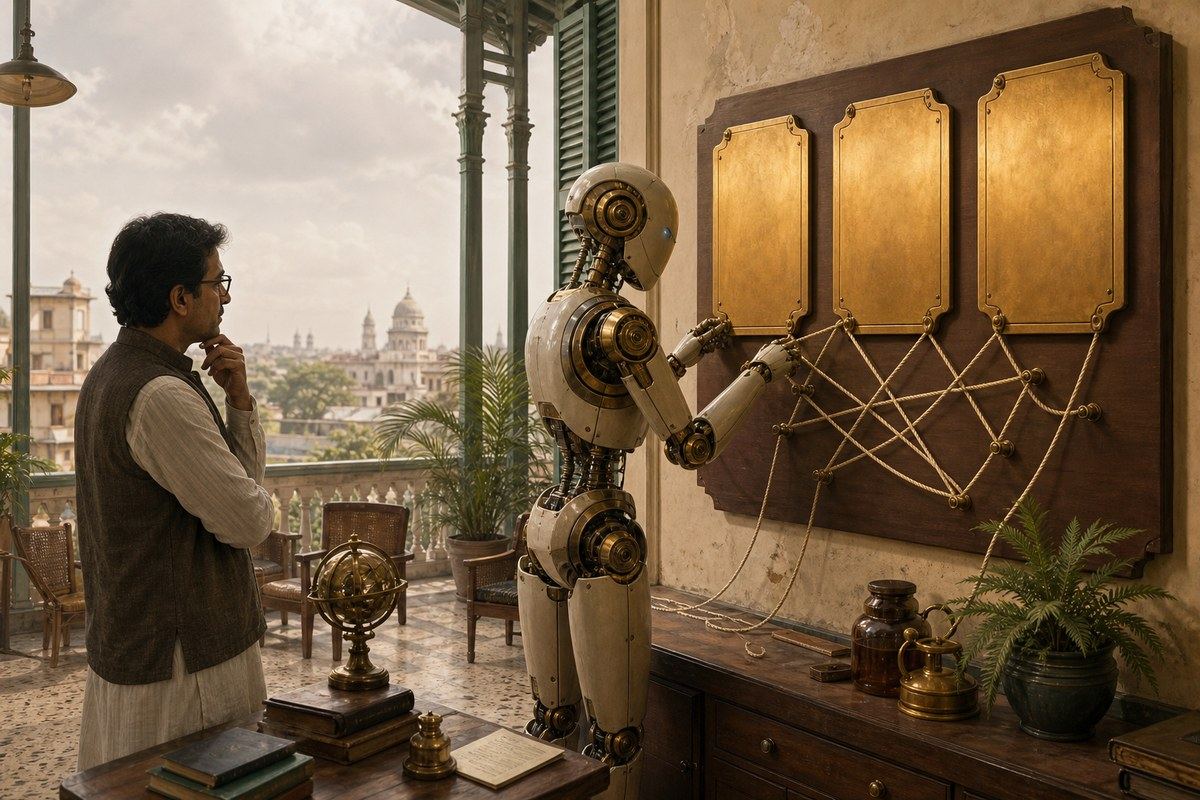
The robot that comes into a Calcutta room, sees the tea cup near the edge of a wobbly table, avoids the plastic stool, picks up the towel that has become one with the chair, notices that the elderly mother may fall, closes the swollen window before the rain comes slanting in, and does not immediately lose its mind because there is a slipper under the bed and a cat-shaped shadow near the door—that robot remains mostly in the future, waving politely from behind a fogged glass door.
The reason is simple enough to fit in a paan shop conversation and hard enough to occupy generations of researchers.
The physical world is badly behaved.
A spreadsheet is polite. A chessboard is polite. A computer game is polite, even when dragons are involved. An LLM may lie with the confidence of a lawyer at a wedding, but it still lives in symbols. Words. Tokens. Probabilities. It does not have to lift a wet towel from a chair in June humidity while one wheel has picked up dust and the battery is quietly developing philosophical objections.
The world has friction. Weight. Heat. Dust. Bad light. Shadows. Slippery floors. Loose wires. Cheap plastic. Objects that bend, sag, roll, crack, tear, bounce, spill, bruise, and fall into places where no respectable object should go. A shirt is not one object. It is a conspiracy of cloth. A cup is not a cylinder. It is a breakable lawsuit with a handle. A banana is not a fruit. It is a soft yellow negotiation with gravity.
This is why robotics is hard.
Not because engineers are fools. Engineers are many things, including underpaid, sleep-deprived, occasionally overconfident, and prone to naming software packages like minor Soviet satellites, but they are not fools. Robotics is hard because intelligence, once forced into matter, must obey all the little tyrannies that pure thought escapes.
A robot has five organs.
The first is the body. Motors, gears, wheels, arms, legs, frames, bearings, springs, belts, cables, grippers, screws, and the little mechanical sins hiding inside the chassis. This is where fantasy is beaten with a spanner. A robot arm does not merely “move.” It must move with enough torque, speed, stiffness, repeatability, and endurance. A leg is not a leg because it looks like one. It must keep a moving mass balanced over a small changing patch of floor. Walking is not walking. Walking is continuous bankruptcy prevention.
You know this from your own body, though you rarely give it credit. Get up at night during load-shedding, half asleep, looking for water. Your foot finds the edge of a mat. Your knee adjusts. Your hand touches a wall. Your spine negotiates with gravity. Your toes, those poor ignored clerks, file reports upward. You survive the journey to the bathroom without a press conference. A humanoid robot must do this as an engineering problem.
The second organ is sense. Cameras, depth sensors, lidar, IMUs, encoders, microphones, force sensors, tactile pads. Modern vision has become astonishing. A robot can now detect objects in a scene that would have confused older systems. It may know there is a cup, a table, a hand, a box, a door, a chair, and possibly a human being regretting earlier purchases.
But seeing is not understanding.
A robot may detect a cup and still fail to pick it up because the handle faces away, the surface is wet, the cup is too close to the edge, the light is poor, or the cup is made of that mysterious thin ceramic which breaks if you merely speak to it in a stern voice. Humans understand objects through a lifetime of small gossip. This cup is heavy. That mug is slippery. This plastic bucket will bend. That old wooden window sticks in the monsoon. This cheap charger cable will fail exactly when needed, like a government website before a deadline.
A robot must learn this, or be told, or infer it. Each method has traps.
The third organ is control. This is the kingdom of feedback. PID control does not sound glamorous. It sounds like something printed on the back of a washing machine manual in a font designed by a prison committee. But without feedback a robot is just a motorized fool.
Feedback is the robot asking, again and again: Where am I? Where should I be? How far off am I? Am I getting worse? Should I correct gently or with the enthusiasm of a bus driver entering the wrong lane?
This question becomes voltage, current, pulse width, torque. The loop runs fast. Hundreds or thousands of times per second. It is philosophy reduced to motor correction. Descartes said, “I think, therefore I am.” A robot says, “I overshot by 3.2 degrees, therefore reduce current.”
Not poetic.
Very useful.
The fourth organ is planning. Take the sentence “bring me the red mug.” It sounds harmless. A child can understand it. A half-awake uncle can understand it. A robot hears it and enters a maze. Which mug? Where is it? Is it reachable? Is the path blocked? Is the mug empty? Is the handle needed? Will the gripper hit the table? Can the robot lift without tipping? Can it turn without knocking over the water bottle, the newspaper, the charger, and the small mountain of objects that every Indian household grows naturally, like moss?
Human beings solve this in silence. We should be less proud of our speeches and more proud of our elbows.
The fifth organ is learning. This is the new volcanic land. Imitation learning, reinforcement learning, simulation, synthetic data, foundation models, VLA models. The old robot had to be programmed like a clerk with a rulebook. The new robot is trained more like a dog, a student, or a slightly dim apprentice electrician: show it many examples, let it try, correct it, simulate it, try again, deploy it cautiously, then discover it has failed in a way nobody had imagined because reality is a gifted sadist.
This is the big shift.
Robotics is no longer only about better motors and stronger metal. It is about transfer. Can a robot learn from video? Can language become action? Can a skill learned in simulation survive the real world? Can training on one robot body help another robot body? Can a machine trained to pick up boxes also learn towels, cups, packets, fruit, tools, and the strange object category known as “things lying near the door for no clear reason”?
The dream is a robot foundation model: something like the physical cousin of an LLM. Not predicting the next word, but the next useful action.
Pick. Place. Walk. Turn. Grip. Pause. Re-plan. Don’t crush the mango.
That last one matters more than people think.
Because the stumbling blocks remain wonderfully crude.
Hands are the first scandal. Human hands are obscene masterpieces. Bones, tendons, skin, pressure, temperature, pain, nails, micro-slips, tiny corrections, old habits, learned caution, and the memory of every object ever mishandled since childhood. Your hand knows the difference between a steel glass, a biscuit, a soap bar, a mosquito coil, a fish spine, a hot pressure cooker lid, and an onion that has begun negotiations with decay.
A robot hand may look impressive. But picking up a coin, peeling tape, tying a knot, folding cloth, washing utensils, handling wet vegetables, or separating two thin plastic bags can still reduce a proud machine to the moral level of a confused goat. This is why many useful robots avoid general hands. They use simple grippers. They restrict the task. They make the world easier.
That is not cheating.
That is engineering.
Batteries are another wall. Humans are absurdly efficient biochemical machines. We eat rice, dal, fish, tea, biscuits, and occasional despair, then walk around all day making decisions of wildly varying quality. Robots carry stored electricity like a thirsty man carrying water in a cracked bucket. Humanoids are especially energy-hungry because legs are costly, balance is costly, and moving an entire body to do what a fixed arm could do from a bolted base is often economically silly.
Unless the world is already built for humans.
This is the argument for humanoids. Not that two legs are always best. They are not. Wheels are often better. Tracks are often better. Fixed arms are often better. But our homes, factories, staircases, handles, shelves, switches, doors, and tools were made for the human shape. A humanoid is an expensive attempt to enter a world that refuses to redesign itself.
Safety is worse. A chatbot can embarrass you. A robot can crush your toe, slap a worker, drop a box, puncture a battery, push an elderly person, or set fire to its own dignity. This is why stage demos lie by omission. The room is clean. The lighting is kind. The floor is level. The task is rehearsed. The audience wants to believe. In the real world, a cable is loose, the floor is wet, Wi-Fi drops, a child runs in, someone has moved the table, and reflective tape has convinced the vision system that a portal to another universe has opened near the storeroom.
Cost then arrives like the landlord.
The robot must not merely work. It must work cheaply enough, safely enough, long enough, predictably enough, and with little enough maintenance to beat human labor, existing automation, or simply doing nothing. A humanoid that moves boxes for fifteen minutes is interesting. A humanoid that moves boxes for two shifts a day, five days a week, with low maintenance, easy repair, auditable safety, and a boringly positive return on investment is a product.
The word “boring” is important. In technology, boring often means mature. Electricity is boring until it goes away in June. Running water is boring until it smells like a drain. Elevators are boring until they stop between floors. A useful robot must become boring in this noble sense. It must stop being a spectacle and become an appliance.
That is still difficult.
For the hobbyist, this should not depress you. It should free you.
Do not start with a humanoid. That is like learning arithmetic by building a moon rocket out of wet cardboard and personal delusion. Start with a small mobile robot. Two driven wheels. One caster. A microcontroller. A motor driver. A battery. Encoders if possible. A distance sensor. Then a camera when you are ready.
Make it drive straight.
This will insult you.
One wheel will be slightly stronger. The floor will disagree. The battery voltage will sag. The chassis will twist. Your code will assume a clean universe, and the robot will reveal that the universe has been chewing paan and spitting red stains into your assumptions.
Then make it stop before hitting a wall. Then make it follow a line. Then make it map a room badly. Then make it chase a colored ball. Then add a tiny servo arm. Then make it fail again.
Failure is the curriculum.
A beginner robot teaches the whole field in miniature. The motors teach power. The wheels teach friction. The battery teaches disappointment. The sensor teaches noise. The code teaches timing. The chassis teaches geometry. The first uncontrolled spin teaches humility. The first successful autonomous turn feels absurdly grand, as if you have created a small animal from mathematics and solder smoke.
Use the modern stack, but do not worship it. Arduino, ESP32, Raspberry Pi, Jetson, ROS 2, Python, OpenCV, small neural networks, cheap cameras, printed brackets, salvaged motors, discarded toys, broken printers, old power supplies—these are enough to enter the temple. Once your robot has more than one process, ROS 2 becomes useful: one node for the camera, one for motors, one for planning, one for visualization. Simulation helps because real robots break, batteries drain, and debugging motion in the physical world can become a slow nervous disease.
But keep the robot small enough that failure remains funny.
Not financially fatal.
This matters in India. We do not have the luxury of pretending every curious child has a garage, a lab bench, a 3D printer, imported parts, and a father who says, “Excellent initiative, beta, here is a grant.” Many have a dining table that must become a study table, repair bench, and family argument zone by evening. Many have heat, dust, noise, exams, coaching-center culture, and the constant national talent for murdering curiosity and then holding a seminar on innovation.
Still, robotics is possible.
Perhaps more possible now than ever.
Because robotics is not one subject. It is mechanical engineering, electrical engineering, control theory, AI, embedded systems, materials, probability, geometry, computer vision, operating systems, and a little black magic from the drawer where lost screws go. A robot is not a machine with intelligence added. It is intelligence forced to pay rent inside matter.
That is why it is beautiful.
A robot does not allow you to remain a pure thinker. It drags your idea down into dirt and asks whether your elegant algorithm can survive a loose wire, a scratched lens, a weak battery, and one wheel slightly larger than the other. It makes Platonists into mechanics. It makes coders smell burning plastic. It takes the grand abstraction called autonomy and gives it the body of a nervous beetle on a plywood table.
The near future will be uneven. Warehouses will get robots before bedrooms. Factories before kitchens. Farms before drawing rooms. Hospitals, laboratories, inspection sites, defense, disaster response, eldercare trials, and logistics will see more machines before ordinary homes do. Industry can simplify reality. Homes cannot.
A factory says: pick this part from this bin under this light.
A home says: find my glasses, but not those glasses, the other ones, perhaps under the newspaper, unless I left them in the bathroom, and also do not step on the dog.
That sentence is the whole problem.
So build a robot not because the future is solved, but because it is not.
Build one because there are still open doors everywhere. Better low-cost hands. Better tactile sensors. Better navigation in dirty rooms. Better elder-assist devices. Better agricultural robots for small farms. Better sewer and drain inspection robots. Better educational robots for Indian classrooms where a child’s curiosity should not have to die under multiple-choice questions. Better robots that do one modest thing reliably instead of pretending to be a chrome domestic servant with TED Talk cheekbones.
The first robot you build will be stupid.
Excellent.
So was the first airplane, the first computer, the first steam engine, and half the men running the world. The difference is that your robot can be improved with a screwdriver, a sensor, and a better loop.
That is no small thing. In a world full of unrepairable institutions, a stupid little robot on your table may be one of the few creatures honest enough to fail in public and improve when corrected.
P.S. References: Google DeepMind Open X-Embodiment work; OpenVLA research; NVIDIA Isaac GR00T materials; ROS 2 documentation; Arduino documentation; Raspberry Pi documentation; OpenCV documentation; IEEE and robotics research literature on robot learning, manipulation, locomotion, and embodied AI.
Word Cloud
Related reading
Selected by shared topics and section, with closer publication dates breaking ties.