Frog in the Robot Century
Acronyms used in this post: AI — Artificial Intelligence, meaning software systems that can learn patterns, generate language, make predictions, recognize images, write code, and automate tasks once thought to require human judgment.
Uses the speech voice supplied by your browser or device.

The future is not arriving in a silver flying car; it is arriving as a glass of tap water that makes you pause and ask whether your intestine has sufficient democratic resilience for the afternoon.
That is civilization at street level. Not speeches. Not statues. Not some minister’s laminated smile on a hoarding. Water. Power. Drainage. Mosquitoes. Heat. A working fan. A toilet that does not smell like an archaeological discovery. A tap you can trust without first performing kitchen chemistry like a half-naked Bengali Pasteur in a rented room.
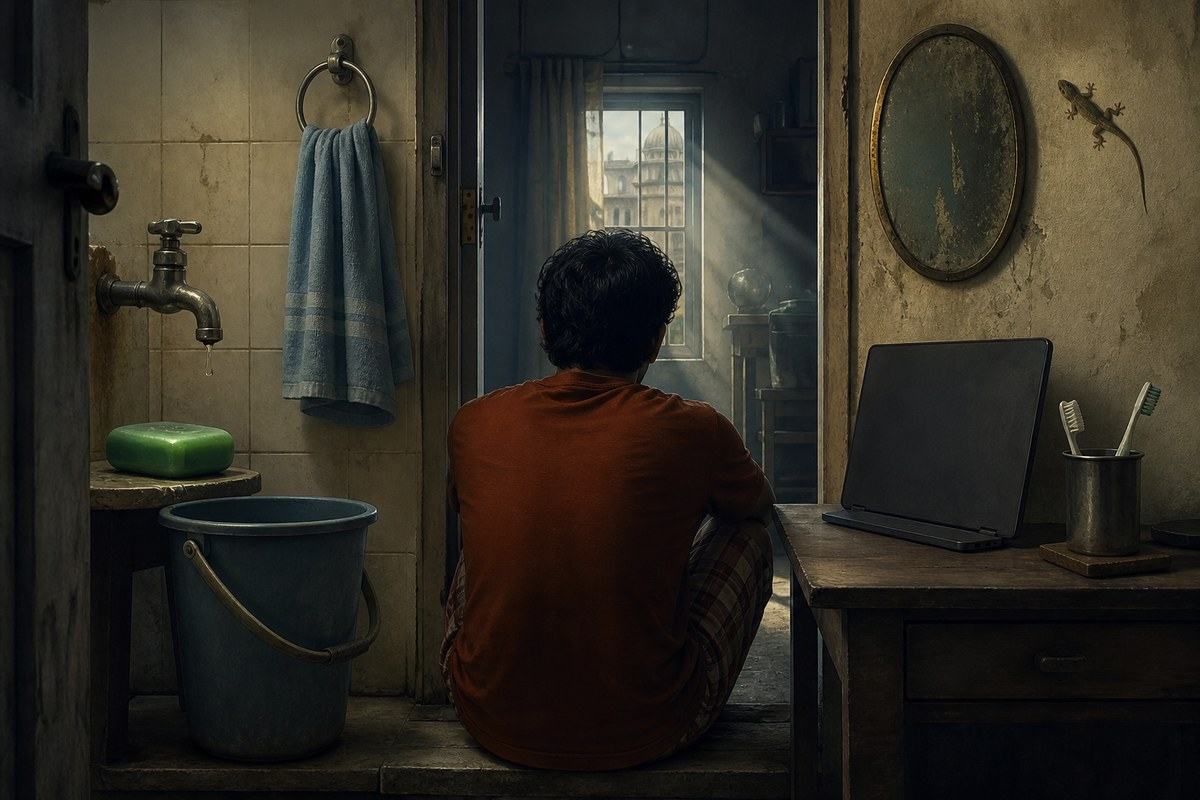
The water comes out pale and suspicious, carrying that faint municipal perfume of pipe, rust, algae, bureaucracy, and old neglect. I stand there in my underwear, stomach already making small Bengal monsoon noises, and think, magnificent. Here we are in 2026. Metro city. Smartphone country. Digital dreams. And one middle-aged man is wondering whether today’s glass contains enough invisible sewage to turn his lower intestine into a television debate.
Outside, the heat is not weather anymore.
It feels like policy.
Feels-like forty-five degrees Celsius presses on the city like a large sweaty wrestler who has no intention of moving. The ceiling fan chops the air into useless slices. Then the electricity goes off, as if it has remembered another appointment. Somewhere a transformer sighs. Somewhere a dog gives up. Somewhere a man in a baniyan says, “Current chole geche,” with the calm of a philosopher announcing mortality.
And somewhere else, in San Francisco, Shenzhen, Hangzhou, Boston, Seoul, or some bright little laboratory where the floor is cleaner than most Indian hospitals, people are training machines to fold laundry, move boxes, write code, read scans, fly drones, optimize warehouses, design molecules, translate languages, drive cars, and build the next layer of the machine century.
Meanwhile, I am looking at a mosquito on my ankle and wondering whether it is an ordinary mosquito or a tiny dengue courier with wings and career ambition.
This is not a gap.
A gap is what you find between salary and rent, between two teeth, between what your relatives say you are capable of and what the market actually pays you. This is something larger and nastier. This is a geological fault. The earth is opening under countries that think mobile data, mythological chest-thumping, cheap video, and a few payment apps equal modernity.
They do not.
A country is not modern because its citizens can order biryani on an app while the drain outside behaves like a dead buffalo with civic responsibilities.
A country is modern when boring things work.
The light comes on. The water is safe. The bus arrives. The bridge stays up. The school teaches. The hospital disinfects. The form has a purpose. The record matches the person. The clerk does not become a small emperor because he owns a stamp pad. The child can learn mathematics without being minced into examination sausage by coaching factories that treat curiosity as a behavioral disorder.
This is where the great split begins.
One world is building the machine century. Chips, batteries, sensors, robotics, AI, synthetic biology, logistics, clean energy, automation, manufacturing discipline, data centers, precision tools, and institutions that may be ugly but can still keep a lab cold, a factory powered, and a supply chain measured.
The other world is developing frog-in-a-well optimism.
You know the frog. We all know him. He lives in three inches of ancestral dampness and has strong opinions about the sky. The well is all he has seen, so naturally the well becomes the universe. With enough confidence he may even call it civilization. With enough television he may call it ancient wisdom. With enough politics he may call outsiders rootless lizards. With enough social media he may start a channel called Deep Amphibian Truths and explain that the well already had quantum computing in the moss.
Very good.
Now please ask the moss to fix the drainage.
The thing about wells is that they do not feel dramatic from inside. Inside the well there is routine. Morning damp. Afternoon echo. Evening croak. The frog is not necessarily miserable. He may be quite cheerful. He may say, “We are rising.” He may say, “Others are jealous.” He may say, “Our civilization is five thousand years old,” which is a fine sentence until the tap water makes your stomach sound like a broken harmonium.
Physics, unfortunately, does not care for cultural confidence.
Technology cares even less.
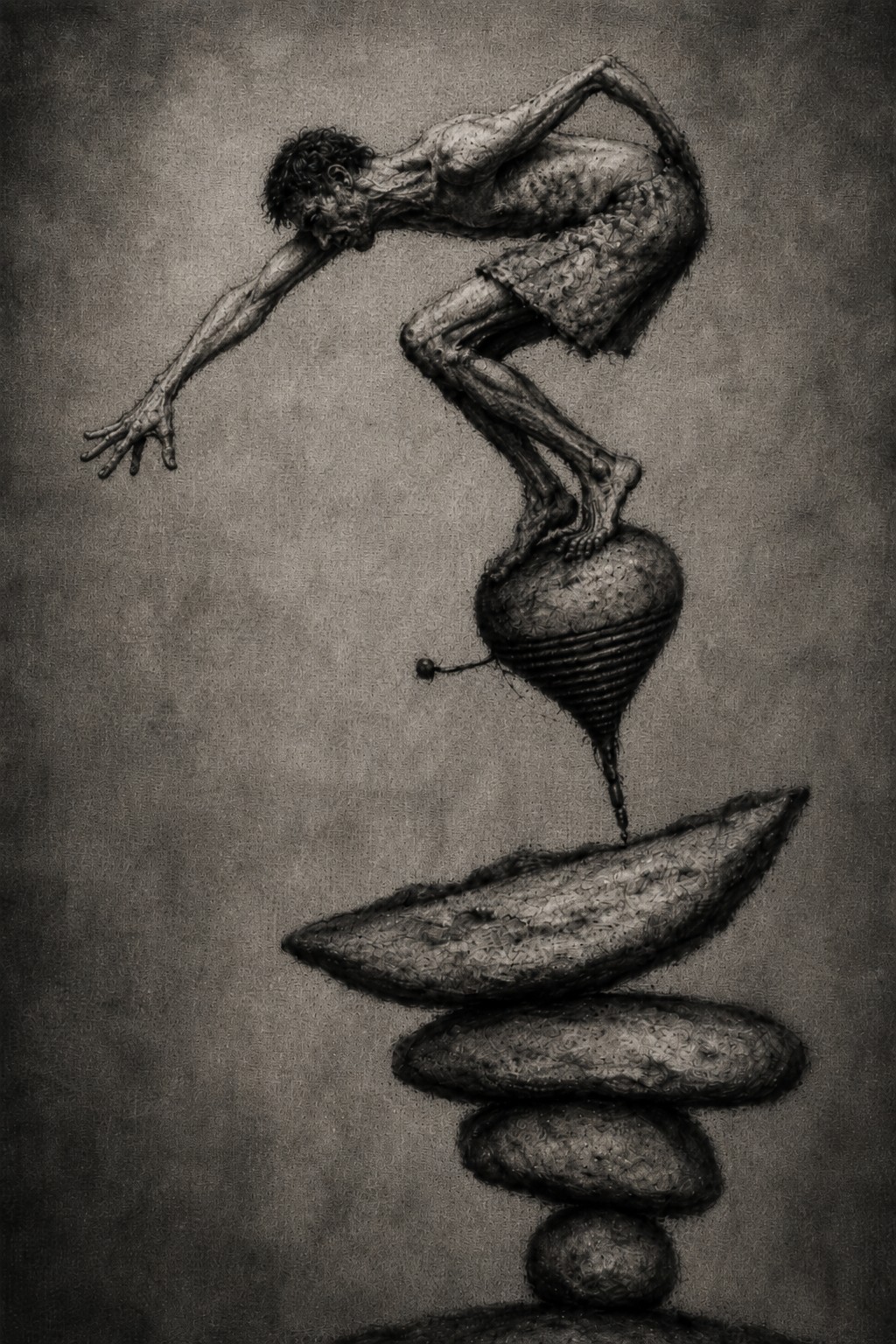
You fall behind slowly, then suddenly. First you miss one year. Then five. Then a platform shift. Then a language. Then a tool. Then an entire job category quietly gets wrapped in software and shipped past you like a parcel you were too proud to track.
You laugh at AI.
Then AI does not laugh back. It simply stops needing you.
This is the part people miss. Progress rarely arrives with drums. It arrives like damp on a wall. At first you ignore the stain. Then you put a calendar over it. Then the paint bubbles. Then the plaster gives way. Then one day a chunk falls into your tea and everyone says, “Suddenly the wall collapsed.”
Nothing was sudden.
The wall had been writing its autobiography for months.
Alan Turing once asked whether machines could think. It was a grand question, neat and British and full of clean mathematical furniture. The dirtier question now is whether human beings can stop pretending. Claude Shannon gave us a way to think about signal and noise. Norbert Wiener reminded us that systems correct themselves only when feedback is honest. That is the small, cruel catch. A system that cannot sense its own errors becomes an expensive idiot.
And we have become experts in not sensing ours.
We are not only corrupt in the envelope-under-the-table sense. That is too small. Almost charming now. A black-and-white film villain taking two hundred rupees while stroking his mustache.
We are corrupt in calibration.
The weighing machine lies. The builder lies. The résumé lies. The coaching center lies. The contractor lies. The uncle lies. The client lies. The politician lies with surround sound. The priest lies with incense. The app lies with design. The investor lies with a slide deck. The citizen lies to himself most efficiently of all and calls the whole thing adjustment.
Adjustment is the national deodorant sprayed over rot.
The smell still comes through.
And here is the catch: the machine century has very little patience for adjustment. A robot arm does not say, “Dada, little extra cash and I will tighten the bolt spiritually.” A chip factory does not improve because somebody’s grandfather said India invented zero. A battery supply chain does not stabilize because a television panelist shouted loudly enough to disturb migrating birds. A model does not become accurate because the local strongman blocked the road with bamboo, chairs, and ego.
Modernity is not glamour. It is maintenance.
Standards. Calibration. Documentation. Uptime. Clean rooms. Clean water. Stable electricity. Honest measurement. People who can say, “This failed,” without immediately searching for a nephew to blame.
That is why the future is not merely AI. AI is the shiny word. The real future is the boring machinery underneath it. Power. Cooling. Data. Manufacturing. Education. Public health. Trust. If those things fail, AI becomes another decorative sticker on a cracked wall.
A country cannot build the future while boiling drinking water like it is fighting a medieval siege.
This is why I get irritated when I hear that everything is fine because everyone has smartphones. A smartphone is not modernity. It is a small glowing rectangle through which modernity may occasionally wave from a distance. It can deliver knowledge. It can also deliver nonsense, lust, rage, fake history, discount headphones, political indigestion, and a man dancing in sunglasses while your ceiling leaks on the laptop.
Rectangle nirvana.
Thumb-scrolling moksha.
People sit in heat, drinking suspicious water, inhaling dust, watching algorithmic pelvis and patriotic thunder, dreaming of civilizational domination over Muslims, Chinese, Europeans, Americans, Martians, or whoever the daily circus requires. The body is collapsing, but the fantasy has biceps. The drain is clogged, but the speech is muscular. The stomach is loose, but the nation is hard.
This is what decline feels like from inside.
Not a trumpet.
A slight fever.
You ignore it because everyone else also looks yellow.
I do not say this from a mountain of success. Let us not decorate the goat. I am fifty-one, lower-middle-class, Bengali, single, anxious, depressed, educated past the point of immediate usefulness, and living in the shanty edges of Calcutta with a consulting income that arrives with the confidence of winter sunlight. I have fifteen years of American work fossilized inside me like a good shirt preserved in a leaking trunk. Healthcare IT, data systems, hospitals, records, research, migrations, broken production systems, all that. Useful once. Still useful perhaps. But not automatically.
Nothing is automatic now except decline.
In America I saw systems that were maddening, expensive, bureaucratic, and often stupid, but they usually had one saving grace: the machine could still be made to run. A meeting might be foolish, but the server room had power. A manager might speak in corporate porridge, but the data pipeline could be fixed. The hospital system could be cruel, but the disinfectant existed. The elevator worked often enough for civilization to keep its shirt tucked in.
In Calcutta, the day begins with negotiation. With heat. With water. With mosquitoes. With the local shopkeeper’s mood. With whether the broadband has remembered its profession. With whether the client who promised payment has vanished into the sacred Indian cloud called “next week.” With whether your own brain, that slightly damaged old ceiling fan, will rotate today or only hum ominously.
So when I say learn, I am not speaking like a shiny motivational poster. I dislike motivational posters. They look like lies printed in good fonts.
I am speaking as a man who has slipped.
Do not make my mistake.
Do not assume the world will wait because you are intelligent in theory. Intelligence without traction is just a polite noise in a library. Do not assume degrees will save you. Degrees are paper boats in an AI flood unless you keep learning like a frightened animal with a notebook. Do not assume nationalism is a career. It is emotional chewing gum. Sweet for three minutes, then jaw pain.
Do not assume your English, your caste, your family name, your old rank, your old job, your old pride, your city, your college, your nostalgia, your political anger, your philosophical refinement, or your ability to quote Tagore while the bathroom smells like a criminal investigation will rescue you.
Nothing rescues a man who refuses to look at the slope beneath his feet.
And the slope has changed.
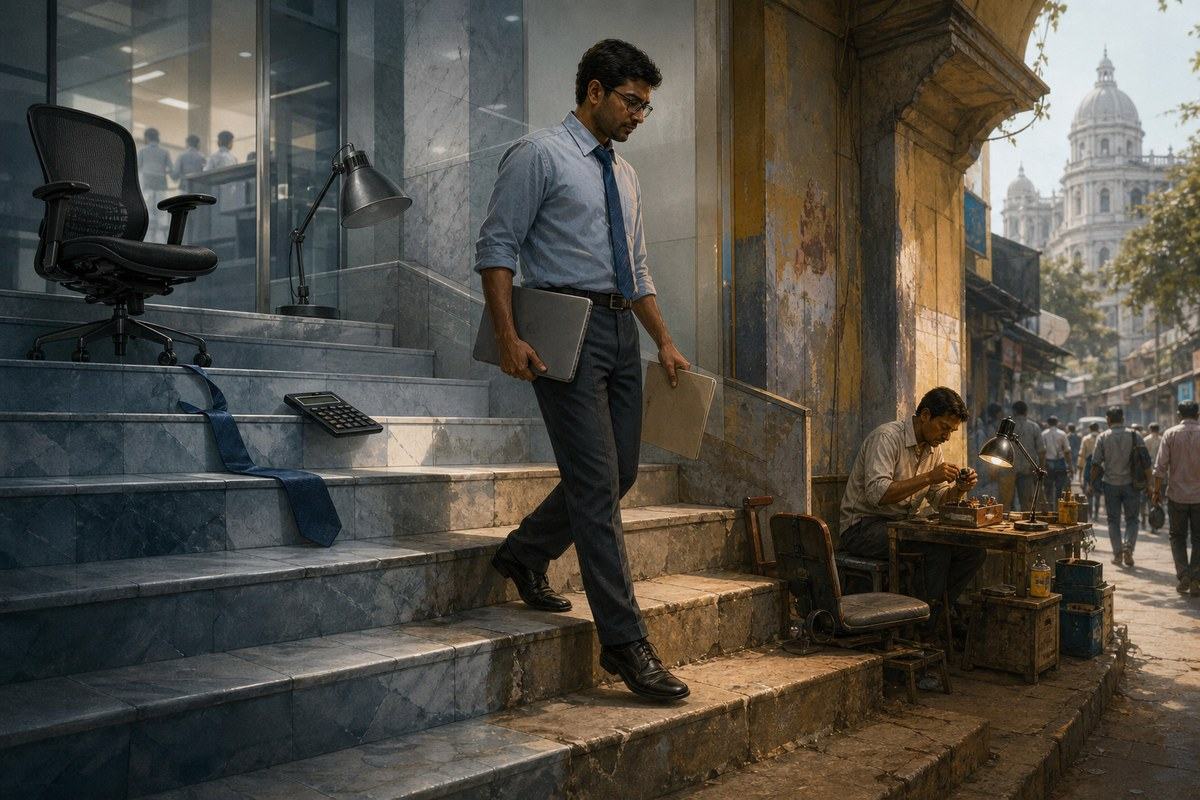
Earlier, if you fell behind, there were still shabby ladders leaning against the wall. Teach tuition. Open a small shop. Learn accounting. Become a clerk, agent, salesman, broker, typist, operator, analyst, fixer, consultant, whatever. The ladder was ugly, but it existed.
Now the ladders themselves are becoming software.
The rungs are being automated, patented, platformed, compressed, outsourced, and sharpened by people who sleep better, drink cleaner water, and live in systems where the machine does not first need to negotiate with three cousins, one inspector, two political flags, and a power cut before doing its job.
The future poor will not merely have less money.
They will have less interface with power.
That is the new wall around the well. Not barbed wire. Interface. Language. Computation. Capital. Robotics. Clean infrastructure. Time. The machine will decide your loan, your job, your diagnosis, your insurance, your education, your visibility, your fraud score, your police risk, your medical priority, and perhaps one day even your romantic ranking, because humiliation, once digitized, will not politely stop at the groin.
And if you cannot understand the machine, you will not even know which door is locked.
A man can be imprisoned by a wall he cannot see. The most elegant prison is the one he calls destiny.
So look. Look hard. Look without devotional cataract. Look without party flag, temple bell, corporate brochure, parental fantasy, and that old Indian masterpiece of saying “somehow it will happen” while the ceiling leaks directly into the extension cord.
Learn the tools. Learn AI. Learn data. Learn robotics if you can. Learn biology, energy, logistics, design, language, mathematics, repair, documentation, anything real. Do not enter the machine century like a tourist taking selfies in front of someone else’s revolution.
Enter like a rat in a famine.
Gnaw.
Steal knowledge. Practice. Measure. Build. Fail privately before the world charges entry tax.
Not everyone can become a genius. Fine. Most geniuses are also unbearable and badly dressed. But everyone who can still think must learn to touch the machinery of the time. Not worship it. Not fear it. Touch it. Open it. Use it. Break small things. Fix smaller things. Ask stupid questions early, while stupidity is still cheap.
Because later it becomes policy.
As for me, I will boil the water again. That is my grand strategic adaptation for the afternoon: one tea pan, one rented kitchen, one middle-aged Bengali conducting microbiology beside the sink, trying not to die of some diarrheal opera before lunch. The fan stops. The room thickens. Sweat gathers under my chest like a small defeated pond. A mosquito sits on my ankle with the calm confidence of a venture capitalist examining an undervalued blood market.
Outside, the machine century moves.
Inside, the water begins to boil.
Word Cloud
Related reading
Selected by shared topics and section, with closer publication dates breaking ties.