GDP—Grossly Deceptive Product: The Great Indian Fable
Checking article narration…

In 1934, Simon Kuznets, a pioneer of national income accounting, warned the US Congress that a nation’s welfare could scarcely be inferred from its national income. The man whose work helped give us GDP knew the number was no substitute for knowing how people actually lived. Naturally, we turned it into a national dick-measuring contest.
Gross Domestic Product is a mathematically masturbatory masterpiece—India’s greatest numerical epic, written not by Vyasa but by a squad of overpaid statisticians who wouldn’t recognize reality if it shit on their calculators. It’s an elaborate game of hide-the-truth that rivals any tantric contortion in the Kama Sutra. GDP, as every economically literate child pretending to study in Calcutta cafés knows, stands for “Grossly Deceptive Product”—a national pastime that has replaced cricket and pissing openly as the country’s most cherished sport.
Long before GDP, there was the Sanskrit Arthashastra, a treatise on wealth and statecraft attributed to Kautilya, who knew a thing or two about fooling a king. Today, we have inherited a different sort of beautiful bullshit as the foundation of measuring national economic health, even though it makes less sense than Bengali uncles discussing quantum mechanics after half a bottle of Old Monk. GDP measures value through the sum total of goods and services produced, a calculation more rigged than the meter of a Calcutta taxi running on adulterated fuel.
Take the way India calculates GDP, for instance. It’s cooked like a roadside egg-roll—with greasy optimism, questionable hygiene, and the fervent hope that no one checks what’s inside. First, you count everything from the steel made by Jamshedpur steelworkers sweating their asses off to the money made by software engineers in Bangalore sweating their asses off virtually. Then, you sprinkle in agriculture, where every cow’s fart and farmer’s tears (because God forbid anyone address farmer suicides) inflate the numbers just enough to show growth but not enough to reveal truth. Finally, top it with the frothy cappuccino revenues of Starbucks outlets that Indians visit mainly to pretend they’re somewhere else.
But wait, there’s more! The beauty of GDP is how hard it finds it to capture accurately the vast informal sector—run by people who’ve never filled out a fucking income-tax form, never heard of GST, and whose existence is remembered only during election promises or when the “slumdog millionaire” cliché resurfaces. The chaiwala, the sabziwala, the shoemaker under Gariahat Bridge—estimated through surveys and proxies, but too easily blurred into a statistical haze—emerge briefly during political rallies as “backbone of Bharat,” only to vanish again faster than your credibility at a Calcutta adda when you claim you’re dating a model from Park Street.
And let’s not even talk about GDP’s fetish for infrastructure spending, which often boils down to building roads that look beautiful until the monsoon turns them into Venice-like canals navigable only by SUVs and submarines. Every year, the government proudly announces a trillion-rupee project to build some hyper-loop-quantum-bullet-train nonsense that, by divine comedic intervention, will transport citizens at warp speeds between two obscure towns you’ve never heard of. Predictably, these projects vanish quietly under the suffocating embrace of red tape, corruption, and incompetence—the holy trinity of Indian governance.
Yet, paradoxically, GDP is worshipped as the ultimate measurement of national virility—economics as a Viagra substitute. Politicians wave GDP growth around like drunk uncles at a wedding dance, shouting numbers—7%! 8%! 12% (after recalibration)!—that rise suspiciously whenever an election looms. Meanwhile, ordinary citizens stand there, scratching their heads, staring at empty wallets, clogged drains, and potholes deep enough to serve as communal toilets.
And for fuck’s sake, GDP counts the cleanup after destruction as economic activity. Got a cyclone flattening the Sundarbans? Fantastic news! Reconstruction means economic growth. Potholes wreck your brand-new SUV’s suspension on the EM Bypass? Great—car repairs increase GDP! That’s right: every disaster, from demonetization debacles to nationwide riots, gets gloriously spun into economic activity—it’s capitalism’s version of Stockholm Syndrome.
Of course, there’s always a miserable minority—the economists cursed with integrity—who timidly whisper that perhaps GDP isn’t exactly accurate. But their voices vanish faster than a politician’s election promises, drowned out by TV anchors who use louder volume to compensate for smaller brains.
So, next time some pompous prick tries to dazzle you at a Calcutta cocktail party, flaunting GDP growth as if it were a gold-plated codpiece, smile politely, sip your drink, and remember: in India, statistics are like bikinis—they reveal everything except what matters.
#suvrotica #suvroghosh
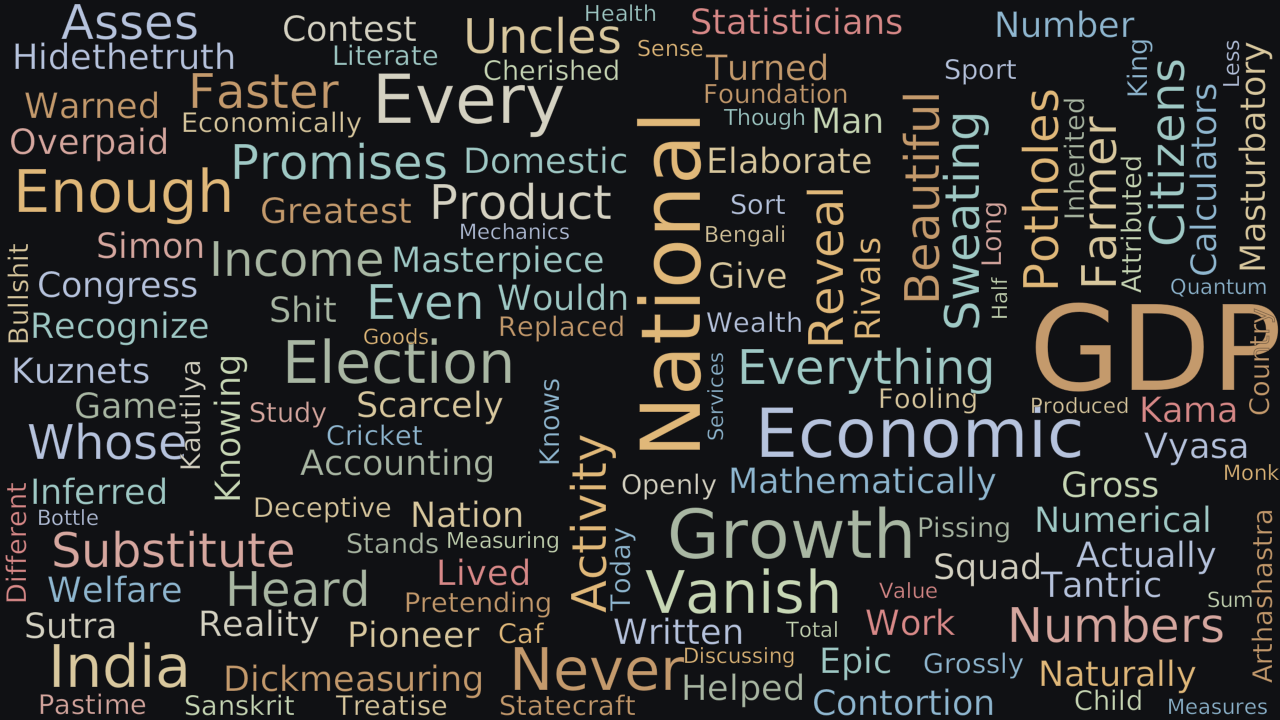
Word Cloud
Related reading
Selected by shared topics and section, with closer publication dates breaking ties.

Comments
Read the conversation or leave a thought for review. Comments load when this section is in view.