Attention Scarcity
Checking article narration…

I remember the seventies, which is a lie, because I was born in 1975 and I was a child, but I remember them the way a man remembers a colonoscopy he never had, through the inherited trauma of people who did. Nineteen seventy-one, to be precise, when Herbert Simon, a man who looked like a disappointed owl and thought like a malfunctioning computer in the best possible way, sat down and wrote Designing Organizations for an Information-Rich World, which is a title so boring it could curdle milk, and yet buried in that bureaucratic compost heap was a sentence that detonated quietly and has been poisoning the groundwater of civilization ever since: a wealth of information creates a poverty of attention.
Read it again. Let it sit in your mouth like a lozenge made of broken glass. A wealth of information creates a poverty of attention. Simon was an economist and a political scientist and a cognitive psychologist and probably a part-time wizard, and he understood something that the rest of us are still too stupid or too hopeful or too busy refreshing our feeds to grasp, which is that attention is the one resource that does not scale, does not multiply, does not care about your startup, your novel, your YouTube channel, your heartfelt Substack about healing. You can manufacture content the way a dysentery patient manufactures regret, endlessly, voluminously, catastrophically, but you cannot manufacture the hours in a human head to receive it. The skull stays the same size. The clock stays the same speed. The eyeball can only absorb so much photonic nonsense before it declares independence and rolls back into the socket out of sheer self-preservation.
Here is the mathematics of the apocalypse, and I use the word apocalypse the way a chef uses salt, liberally and without apology. Let us say, because I am feeling charitable and my medication has not yet worn off, that the average human has sixteen waking hours, minus eight for the job that slowly liquidates their soul, minus two for commuting through what can only be described as a Hieronymus Bosch painting with traffic lights, minus three for the basic maintenance of the meat vehicle, eating, bathing, staring at the ceiling wondering where it all went wrong, which leaves approximately three hours of discretionary consciousness. Three hours. One hundred eighty minutes. Ten thousand eight hundred seconds of potential attention, and that is if the person does not have children, or a mortgage, or a chronic illness, or a Bengaliness so profound that family obligations alone consume approximately forty percent of the available temporal budget. Now multiply the content. Multiply it by ten, by a hundred, by the infinite screaming void of the algorithmic feed. The numerator of human attention remains stubbornly, stupidly, beautifully finite, while the denominator of content approaches infinity, and the fraction that results is the value of your creative labour, which is to say, asymptotically, bugger all.
This is the bottleneck. I call it the great constipation of culture, where everything is produced and nothing is digested, where we are all simultaneously vomiting into the river and dying of thirst downstream, where supply has gone through the roof while demand lies there flatter than a chapati under a steamroller, and yet we persist, oh how we persist, in believing that our particular contribution, our little gem of insight, our carefully crafted video essay about the semiotics of eighties cartoon villains, will be the one that breaks through, will capture the gaze, will matter. It will not. It will drown in the flood with all the others, and the flood does not even notice, because the flood is not sentient, the flood is just us, multiplied by our own desperation, a recursive nightmare of creative diarrhoea where the plumbing was designed by a sadist.
But wait. But wait. Because it gets worse, and it gets worse in a way that Simon, for all his owlish prescience, did not fully map, which is that the scarcity of attention is not evenly distributed, nothing is ever evenly distributed, not wealth, not luck, not sanity, certainly not the ability to command the gaze of the masses. There is asymmetry here, a grotesque and widening asymmetry, and I am not talking about the mild asymmetry of a face that photographs better from the left, I am talking about the asymmetry of a universe that has decided some voices shall be heard by millions while others shall scream into a pillow for eternity. The attention economy does not have a free market; it has a cartel. A handful of platforms, a handful of algorithms, a handful of imbecilic nerd narcissists with the emotional intelligence of a damp sock and the social conscience of a tapeworm, these are the ones who decide what gets seen, and their logic is impeccable only in the sense that a drunk man driving into a tree has an impeccable trajectory right up until the moment of impact. They have built machines that reward the loud, the immediate, the outrageous, the false, because outrage and falsity generate engagement, and engagement is the metric, and the metric is the god, and the god is a golden calf made of click-through rates and session duration, and we are all dancing around it while Moses is still up the mountain trying to download the terms of service.
I am a broke, unemployed, middle-class, middle-aged Bengali man in Calcutta, and I say this not for pity, because pity is currency I cannot afford to spend, but for context, because context is everything and I have nothing else. My circumstances are getting so dire that the word dire itself has started looking for a more extreme synonym. I am the numerator in this equation, the finite resource, the three hours of discretionary consciousness stretched so thin it has become transparent, invisible, negligible. And I am also, paradoxically, the denominator, the content producer, the fool who writes, because what else is there to do when the job market has decided you are obsolete and the society has decided you are invisible and your own brain chemistry has decided to stage a coup every few months, what else but to add your voice to the flood, to scream into the void and hope the void screams back, knowing it will not, knowing the odds, knowing the mathematics.
The singularity is coming, they say. The great convergence, the rapture of the nerds, the moment when the machines become smarter than us and either save us or turn us into paperclips, depending on which imbecilic nerd narcissist you ask. And I think about this, in my more manic moments, which is to say most moments before the lithium kicks in, and I wonder whether I will live to see it, whether the exponential curve of technological progress will intersect with my own personal exponential curve of decline, and the answer, the probable, statistical, cold-blooded answer, is no. No, I will not make it. I will be squeaking my silly last breath before the singularity can go through my haemorrhagic sphincter, to use the technical medical terminology, and the machines will arrive and find only my bones and my blog posts, and they will scan them and conclude that this particular human died of a broken attention span and an unbroken spirit, which is the worst combination, really, the absolute worst, because hope without resources is just cruelty wearing a fancy hat.
Simon won a Nobel Prize, of course. They gave it to him in 1978, for his work on decision-making in economic organizations, including bounded rationality, which is a fancy way of saying humans are stupid and we know it, and the attention scarcity principle was part of that, the recognition that we do not optimize, we satisfice, we muddle through, we grab the first acceptable option and call it a day because the cognitive budget does not allow for a thorough search of the possibility space. And now, half a century later, we have built an entire civilization on the assumption that humans are rational optimizers with infinite processing power, and we have connected them to a firehose of information that would make a supercomputer weep, and we wonder why everyone is anxious, why everyone is fragmented, why the political discourse has the intellectual depth of a puddle in a parking lot. We are running bounded rationality on unbounded input, and the result is a species-wide kernel panic, a blue screen of the collective soul.
There is a story, probably apocryphal, probably too good to be true, about a king who asked his wise men to invent something that would make him happy when he was sad and sad when he was happy, and they gave him a ring inscribed with the words this too shall pass. I would like to give the attention economy a ring that says this too shall be scrolled past, because that is the truth of it, the bitter, bilious truth, that everything we make, everything we write, everything we film and record and paint and code, is just another item in the infinite feed, another drop in the flood, another grain of sand on the beach of digital detritus, and the tide does not care, the tide has never cared, the tide is just the aggregate of a billion other desperate voices all shouting me, me, me into the same indifferent wind.
And yet. And yet. I write this. You read this, perhaps, if the algorithm has decided to bless us both with a moment of mutual recognition, a brief intersection of attention giver and attention seeker, the sacred and profane commerce of the gaze. Simon was right, is right, will always be right, because he was describing not a trend but a law, as fundamental as thermodynamics, as inescapable as gravity. A wealth of information creates a poverty of attention, and we are all impoverished now, billionaires of content and paupers of focus, and the library of Alexandria burns continuously, every day, in every notification, in every refresh, and we call it progress because the fire is backlit and the interface is intuitive.
I do not have a solution. I am not a solutions kind of person; I am a problems person, a connoisseur of collapses, and this particular collapse is exquisite, is it not, the way it masquerades as abundance. But I will say this, in my pouty, poetic, entirely unhelpful way: the attention you are giving me right now, these minutes you have spent inside my skull, walking the dusty corridors of my particular madness, this is real, this is scarce, this is expensive, and I am grateful, in my dour, habitual, self-deprecating fashion, grateful that you chose to be poor in attention here, with me, rather than rich in distraction elsewhere. It is not much. It is everything. It is all we have, this trading of finite hours between finite beings, while the machines learn to think and the flood rises and the singularity approaches like a dawn we may not live to see.
P.S. Simon, H. A. (1971). Designing Organizations for an Information-Rich World. In M. Greenberger (Ed.), Computers, Communications, and the Public Interest. Also, Simon, H. A. (1978). Rationality as Process and as Product of Thought. American Economic Review, 68(2), 1-16.
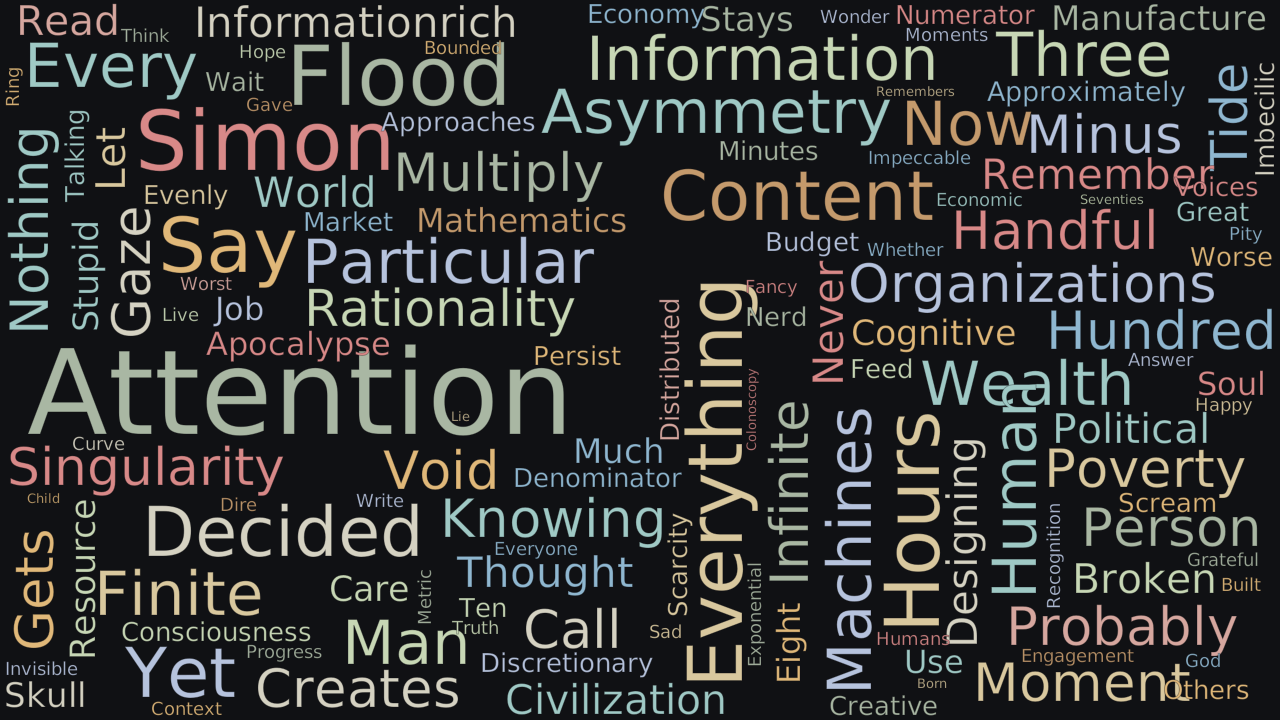
Word Cloud
Related reading
Selected by shared topics and section, with closer publication dates breaking ties.
Comments
Read the conversation or leave a thought for review. Comments load when this section is in view.