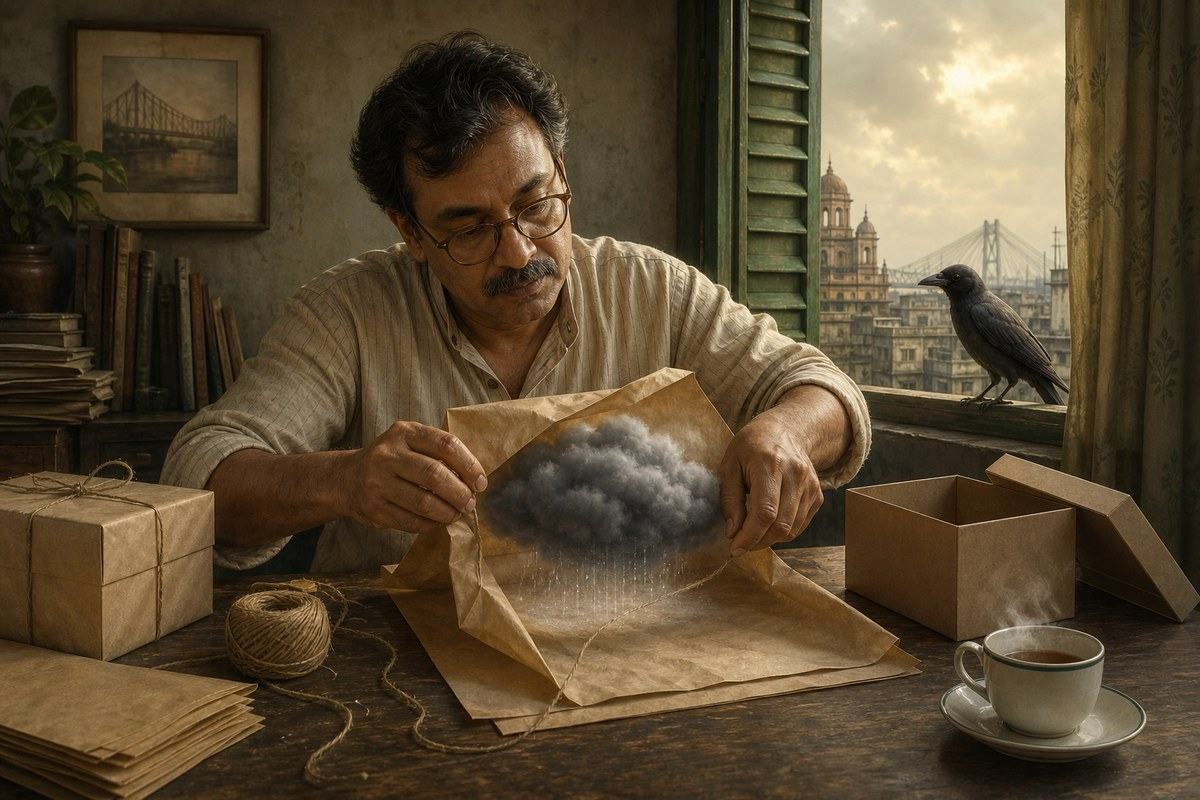
The Moat Has Mosquitoes
Uses the speech voice supplied by your browser or device.

My future does not have a road in front of it; it has a moat, and unfortunately the moat has mosquitoes.
Not the noble sort of moat from school history books, where some king with an imperial moustache sits behind stone walls while crocodiles do outsourced security work. Mine is a Calcutta drain-moat. Greenish. Patient. Mildly philosophical. A plastic gutkha packet floats in it like the national flag of a defeated republic. On some mornings, before the tea boils, before the first bus coughs itself awake, before the neighborhood dogs finish their night shift, I can almost smell it.
That is when the day begins.
A person like me does not fall with drama. There is no thunder. No violin. No one says, “Behold, the collapse of a once-promising man.” A person like me descends by staircase. One polite rung at a time. Wearing a washed shirt. Carrying certificates in a folder as if they were dead relatives who still must be shown respect.
Once upon a time, people said white-collar man.
What a charming fraud that phrase is.
White collar, as if class were a laundry condition. As if dignity came from starch and not from money arriving in the bank account with that tiny electronic sound of survival. White collar is no longer a permanent identity. It is a costume. A rented blazer. A chair in an office that can vanish faster than a fish fry at a Bengali wedding.
I have the education. That is the comic part. The comedy with molars.
I have enough education to understand the trap. I can explain systems, databases, statistical uncertainty, medical information flows, identifiers, standards, vocabularies, and why most modern institutions resemble a cupboard where everyone has stuffed their old clothes and then blamed the cupboard. But ask me what I will do next month for money, and I become a goat looking at algebra.
There is no neat equation for this: older Bengali man in Calcutta, overeducated, underpaid, anxious, depressed, proud, tired, and professionally misplaced somewhere between LinkedIn optimism and local contempt.
The market asks, can you still run?
The body says, I can barely restart Windows inside my skull.
Then society brings its helpful suggestions. Society is always helpful in the way a leaking roof is musical.
Take a smaller job, it says.
Some clerkish thing. Some office where a young man with gel in his hair and the emotional range of a stapler says, “Sir, actually you need to be flexible.” By flexible he means fold yourself smaller. Become a bedsheet. Become a receipt. Become a man who can fit into a salary meant for a twenty-three-year-old whose father still pays the electricity bill.
Or do tuition.
Tuition is the last monastery of the educated broke Bengali.
Somewhere in Bengal, at this very minute, a child is failing mathematics, English, physics, parental expectation, or all of them together in a neat little bouquet of disaster. Somewhere a mother is shouting, “Sir, please make him serious.” Somewhere a father is pretending not to panic. Somewhere a fan with one bent blade is making a sound like a small helicopter giving up.
And somewhere a man like me is sitting under that fan, explaining fractions, while privately calculating rice, rent, medicine, internet, and whether one can continue being a civilized person on two eggs and a headache.
Tuition has dignity, yes.
But dignity has a dosage problem. Too little and you collapse. Too much and everyone starts pretending poverty is character development. “At least you are teaching,” people say, as if teaching one bored boy quadratic equations while his mother scolds the maid in the next room is the same as recovering from the slow industrial accident of life.
Children are not the problem. Children are just children, tragic little homework animals with schoolbags heavier than their understanding of the universe. The tuition economy is the real X-ray. It shows frightened parents, broken schools, credential panic, exam terror, social climbing, and the old Bengali belief that if a child can be made miserable enough before sixteen, he may become respectable by twenty-eight.
Respectability is often trauma with lamination.
Then there is physical labor, and here my body laughs like a cracked drainpipe.
I do not have the muscles to pull a rickshaw through Calcutta streets. This is not snobbery. This is fact. A rickshaw puller is not a romantic figure from a foreign photographer’s rain-soaked guilt album. He is a man whose tendons have signed a business agreement with asphalt. His calves know more about economics than many panelists on television. His lungs bargain every day with dust, heat, passengers, potholes, police, hunger, and time.
The human body is a machine that turns food into force. Mine is more like an old ceiling fan that needs two slaps and a prayer I do not believe in.
I cannot pull another human being through traffic.
I can barely pull myself through Tuesday.
Newton said a body at rest remains at rest unless acted upon by an external force. In my case, this has become autobiography. Depression increases inertia. Age increases friction. Shame adds weight. The external forces are unpaid invoices, tooth pain, fear, and sometimes bladder pressure. Society stands nearby with a notebook and asks why the object has not accelerated.
Because the net force is zero, my friend.
Because the engine is coughing.
Because even the battery has begun to suspect the driver.
And hawking?
Ah, hawking.
The pavement university of India. The open-air business school. The blue-plastic-sheet economy. Inventory, bargaining, rain, police, municipal anger, party flags, local toughs, customer insult, broken change, sweating coins, spoiled stock, and the fine art of vanishing at the correct moment.
I do not have the business instinct to become a hawker. This is not modesty. This is a weather report. I would buy the wrong stock, sell at the wrong price, trust the wrong supplier, annoy the wrong policeman, and end the week sitting beside twenty-seven phone covers for a model discontinued in 2018.
Also, health.
People say hawking is small business, which is like calling a cyclone “wind with ambition.” Hawking is standing all day. Hawking is shouting without losing your throat. Hawking is watching ten directions at once. Hawking is knowing when to smile, when to argue, when to fold, when to flee, when to pay, when to become invisible street furniture.
It is capitalism without a chair.
No toilet. No sick leave. No air-conditioning. No polite email beginning with “hope you are doing well.” No HR lady with fragrant sanitizer and the voice of a well-trained executioner.
And now, after years of harder politics, hawking feels more radioactive than before. Perhaps it always was and I am only old enough now to notice the smell. At pavement level, legality is not a law-book thing. It is a mood in uniform. The vendor is useful during elections, picturesque during festivals, a nuisance during beautification, illegal during drives, and suddenly called encroachment when the city must be cleaned up for people who travel in cars with tinted windows and leave before the drains introduce themselves.
India loves poor people in speeches.
In practice it wants them useful, grateful, decorative, and removable.
The country can build an entire mythology around the tea seller and still kick an actual tea seller’s kettle into the gutter because some convoy needs visual hygiene. It can praise enterprise while criminalizing the only enterprise available to a man whose capital is his knees. It can call itself civilizational and spiritual while treating a hawker’s stool as a greater threat than fraud, poisoned air, broken schools, superstition, unpaid labor, and television men who look like blood pressure wearing a tie.
But let me not become too grand.
That is how Bengalis become unbearable. Give us one cup of tea and one social problem and we are immediately halfway to a manifesto.
The real matter is smaller.
A man in a room.
A rice cooker.
A laptop.
A plastic chair that has heard too much.
A future that looks less like a road and more like standing water.
A moat is not a river. A river goes somewhere. A moat exists to stop crossing. On the other side are salaries, meetings, passwords, insurance, polite emails, elevators, pantry coffee, and people who say “let us circle back” as if time were a pet dog. On this side there is me, in the Calcutta boondocks, checking messages, checking invoices, checking my own pulse of usefulness, wondering whether I have become an overqualified insect trapped in yesterday’s tea.
Biology is no help.
The body was not designed for long-term symbolic unemployment. The body understands tiger, fever, flood, wound, hunger. It does not understand “client has seen your invoice but has not replied.” Cortisol rises for a tiger that never appears. Dopamine waits at the door like a fool for a reward with no tracking number. The brain keeps predicting tomorrow, and tomorrow keeps returning marked undeliverable.
After a while the whole organism becomes a post office of disappointment. The clerks are asleep. The ledgers are damp. Rats have chewed the stamps.
Still, one must eat.
Eating is where philosophy loses its necktie.
All high thinking eventually comes down to dal. Plato may keep his forms, Kant his categories, Hegel his staircase to nowhere. In Calcutta the question is more immediate. Is there rice? Has the egg gone bad? Has the potato sprouted like a small green accusation? Can cooking oil be bought without feeling that civilization has personally overcharged you?
A man may read science, history, economics, and literature and still be defeated by a vegetable vendor saying, “Dada, ajke daam beshi.”
That is the insult of material life.
The abstract always sends its bill in small notes.
People say reinvent yourself.
Into what exactly?
A motivational cockroach?
A subscription-based uncle?
A despair consultant with weekend pricing?
Reinvention is a rich man’s word. Poorer men do not reinvent. They downgrade. They convert. They strip copper from the old machinery of the self. The white-collar man becomes tutor. Tutor becomes proofreader. Proofreader becomes content filler. Content filler becomes errand body. Errand body becomes waiting body. Waiting body becomes medical file.
This is not transformation.
This is salvage.
Even hope now has a smell. Not rain. Not jasmine. More like damp cardboard near a leaking window.
I am not saying I am too good for small work. That would be a lie wearing perfume. I am saying every work requires a matching body, a matching social role, a matching little fraudulence, and I have become mismatched to all of them. Too educated for the stall, too broke for retirement, too old for entry level, too tired for hustle, too proud for begging, too angry for obedience, too physically weak for heroic labor, too honest for easy business, too impatient for spiritual entrepreneurship, and too alive, inconveniently, to become a clean statistic.
That last part is the nuisance.
Alive.
Still here.
Like a stain on a municipal wall that has survived three governments, four paint jobs, and one inspirational slogan.
Some mornings I imagine the future as a recruitment office run by crocodiles. One asks, can you sell insurance? Another asks, can you code twelve hours? Another asks, can you teach Class X science? Another asks, can you stand in heat? Another asks, can you smile at people who deserve furniture thrown at them? Finally, one polished crocodile wearing spectacles asks, can you demonstrate resilience?
Resilience.
What a word.
It is what society praises after it has removed support. It is the garland placed around the neck of the man carrying the bridge on his back. It is applause given to the rickshaw puller instead of the pension he should have had. It is neglect dressed for a conference.
Still the moat remains.
Green.
Patient.
Buzzing.
I stand on my side of it with my qualifications, illnesses, jokes, stubborn pride, unpaid invoices, and remaining animal heat. The tea cools. A crow makes a noise like a badly tuned political debate. Somewhere a pressure cooker whistles. Somewhere a child opens a textbook and loses the will to live for forty-two minutes. Somewhere a man on television explains the nation with the confidence of someone who has never had to choose between dental work and rent.
I decide what the day requires.
Application?
Tuition notice?
Rice?
Shaving?
Or simply the advanced patriotic act of not collapsing before lunch?
A mosquito lands on my ankle and drinks with more confidence than I have ever shown in business.
I slap it.
Miss.
Even the mosquito has a better exit strategy.
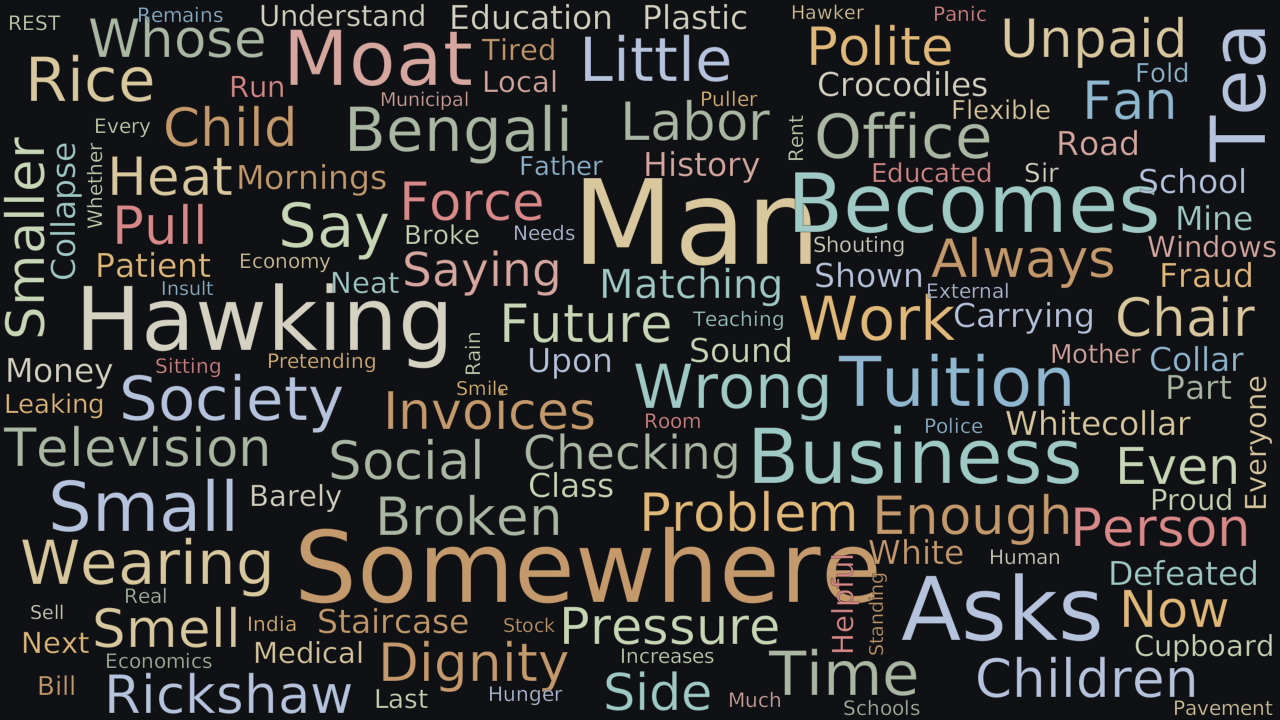
Word Cloud
Related reading
Selected by shared topics and section, with closer publication dates breaking ties.