Sinusoidal Dementia
Uses the speech voice supplied by your browser or device.

The Audio-Technica ATH-M20x Over-Ear Professional Studio Monitor headphones, those malignant pleather-padded clamping engines of auditory imprisonment, have been locked around my skull like a vice engineered by a sadistic audiologist for three hours now, cultivating a tropical greenhouse of sebum, hair pomade, and what I can only describe as a bacterial effervescence in the circumaural creases that would shame the backroom of a College Street bookshop, and through this sweat-basted circumaural cavern the FM waves are pouring eighty-six megahertz of Kishore Kumar directly into my temporal lobe, which is, at this exact moment, attempting to digest both the melancholy of Mere Sapno Ki Rani and the simultaneous, crushing certainty that my neurotransmitters are staging a mutiny that no SSRI has the parliamentary majority to quell.
Normal people—those smug, serotonin-saturated oligarchs of emotional homeostasis—walk through their days with the flat, unremarkable topography of a Bandel churchyard, their anxieties modest, their grievances proportionate, their happy memories lounging comfortably in the parlor like overstuffed zamindars smoking huka; but my brain, this treacherous, cauliflower-shaped insurgent squatting in the petri dish of my skull, operates on an entirely different cartography, one where the wounds and stabs and deformities of three decades rise like the Howrah Bridge at dusk—massive, rusted, unignorable—while any memory that might have once contained the faintest blush of pleasure is suffocated, crowded out, dwarfed into a postage-stamp ghetto by these rising colossi of bitter ruminations that reproduce, amoeba-like, in the dark.
The colors are trying, though.
Through the static and the sweat, the old melodies—Hemanta Mukhopadhyay crooning something about monsoon and separation, or Asha Bhosle navigating the octaves of a forgotten Bappi Lahiri disco nightmare—are sending these faint, pleasant chromatic signals, little watercolor insurgents attempting to loosen the stifle, the mute oblivion that has calcified around my past like the lime deposits in the tea-stained kettle of a Park Circus bachelor; but it is a pathetic, almost laughable resistance, like a single hand-pulled rickshaw attempting to tow a derailed tram up the incline of Chowringhee, because the ruminations have already won, they have the numbers, they have the artillery, they have the high ground of the amygdala and the prefrontal cortex is under siege, negotiating terms of surrender with the chemical equivalent of a white flag made of reuptake inhibitors.
The word rumination itself, derived from the Latin ruminare, meaning to chew the cud, to bring up partially digested matter for re-mastication—how perfectly, how grotesquely apt, because that is precisely the bovine, mechanical, jaw-grinding horror of it: the same bitter cud of a humiliation from 1997, regurgitated, re-chewed, swallowed, brought up again, a digestive infinity loop that produces neither nourishment nor excretion but merely the endless, swollen, gassy discomfort of the mind chewing on its own gastric acids, a process as erotic and satisfying as watching one’s own intestinal tribute dry in the Calcutta sun.
Neuroscience tells us, with the cheerful sadism of a discipline that profits from describing pain without curing it, that the bipolar brain exhibits a phenomenon called ‘kindling’—not the romantic campfire variety, but the progressive sensitization of neural circuits wherein each mood episode lowers the threshold for the next, a kind of emotional arthritis where the synapses grow brittle and inflamed, until eventually the brain is a dried-out sponge, a desiccated shingara left too long in the display case of a Gariahat sweet shop, ready to crumble at the slightest atmospheric pressure; and I can feel it, this kindling, this slow calcification, as the eighties melodies attempt their pathetic watercolor assault on the fortress of my bitterness, only to be repelled by the well-fortified artillery of my default mode network, that traitorous constellation of self-referential brain regions that lights up like a defective neon sign whenever I am not actively distracted by the necessity of biological survival.
The FM receiver, that miraculous anachronism, is pulling in signals from a transmitter that may or may not still exist, broadcasting melodies recorded on magnetic tape in studios that have probably been converted into call centers or boutique coffee shops, and there is something profoundly, almost obscenely comforting about this technological necrophilia, this insistence on communing with the dead through electromagnetic radiation, as if Kishore Kumar’s voice, preserved in ferric oxide and broadcast through the ether, could somehow function as a neural prosthetic, a temporary bypass around the damaged circuitry of my anterior cingulate; but the comfort is short-lived, always short-lived, because the song ends, the DJ speaks, the advertisements for real estate and diabetes medication intrude, and I am returned, with the violent elasticity of a snapped rubber band, to the present moment, to the clamping pressure, to the sweat, to the bacterial bloom in the pleather creases, to the realization that even nostalgia has become a form of masochism, a self-inflicted wound that I reopen nightly with the religious devotion of a priest performing arati before an idol that has already been melted down for scrap.
And then, because my brain cannot simply suffer in dignified silence but must always escalate, must always find the cosmic punchline, I start thinking about the transhumanists, those glistening, venture-capitalized prophets of the generated world, who promise that by 2040 or whenever the next funding round closes, we will all be living in simulated paradises, emotionally connecting through brain-computer interfaces that will render the meat-prison obsolete; I read yesterday, in one of those infinitely scrolling necropolises of tech journalism that pass for contemporary thought, that NVIDIA’s Cosmos platform has learned to model physical environments from multimodal data, that AI systems can now reason through situations they have never encountered, which is, I must note, exactly the opposite of my own neurological achievement, since I have encountered every single one of my traumas personally, intimately, with the thoroughness of a Bengali civil servant auditing a disputed inheritance, and yet I reason about them endlessly, recursively, with all the innovation of a tram stuck in the same loop of the Esplanade track.
They speak of exosome drug delivery, of personalized mRNA cancer vaccines synthesized from our own tumor mutations, of quantum simulations that can predict how a drug candidate will fold and bind before it ever touches a human cell, and I read these pronouncements with the same mixture of awe and contempt that a hand-pulled rickshaw wallah might feel upon reading about hyperloop trains, recognizing the ingenuity while knowing, in the calcified wisdom of his own knees, that he will not live to see the station; so it is with my brain, this obsolete, carbon-based, neurotransmitter-guzzling rickshaw of an organ, huffing and puffing through the cognitive streets while the sleek, silicon hyperloops of artificial empathy whiz past, carrying their cargo of well-adjusted, emotionally optimized, bacteria-free passengers toward a horizon where suffering has been deprecated, where the very concept of a ‘mood disorder’ has been patched out in the next software update, along with death, taxes, and the common cold.
Depression, I have come to understand, is not sadness but viscosity—a state in which time ceases to flow and instead accumulates, layer upon layer, like the silt of the Hooghly at Babughat, brown and thick and smelling of dead fish and industrial effluent, until you are not moving through your life but standing still while the mud rises to your chin, and the people with normal brains, those buoyant, well-adjusted vessels of emotional hydroplaning, skim over the surface of this same river without ever noticing the drag, the undertow, the centuries of sediment that we, the ruminators, must wade through merely to reach the tea stall of the morning.
Mania, by contrast, is the delusion that you can fly.
So you jump.
You always jump.
And then you fall into the same mud, only from a greater height, with more velocity, and the impact leaves a crater that the ruminations happily colonize, building new housing projects of regret upon the scorched earth of your temporary omnipotence, erecting fresh monuments to your own stupidity while the normal people watch from the shore, sipping their tea, occasionally remarking on the weather.
Today is July the twelfth, twenty-twenty-six, and somewhere in the world scientists have mapped Earth’s magnetic field from space using a grapefruit-sized quantum device, and somewhere else a new plant species has been identified after a century of mistaken identity, and somewhere else still the algorithms are learning to predict molecular behavior with the cold, dispassionate accuracy of a mother-in-law assessing a prospective bride; and here I am, in the sweltering, petri-dish humidity of a Calcutta evening that feels less like weather and more like a biological experiment conducted by a vindictive deity, listening to eighty-six megahertz of obsolete melodies through headphones that have become a culture medium for bacteria, wondering whether the transhumanists will remember, in their glorious generated futures, to generate a version of sanity that includes the right to be magnificently, grotesquely, unproductively insane.
But the transhumanists, in their silicone optimism, in their quantum-computed hubris, assure us that soon, very soon, the mentally disordered will not be so miserable, so fundamentally, cosmically misunderstood; we will upload our dysregulated limbic systems to the cloud, where algorithms will smooth out our serotonin spikes like a bureaucrat ironing the wrinkles from a dhoti, and we will live in generated worlds where the colors are always pleasant, where the FM radio never plays a minor chord, where the past is not a mute oblivion but a customizable user interface with adjustable nostalgia sliders; and I want to believe it, I want to believe it with the desperate, pathetic hunger of a street dog eyeing the macher jhol through the grilles of a Bhawanipore kitchen window, but I cannot, because I know, with the bone-deep, marrow-curdling certainty of fifty-one years spent inside this malfunctioning apparatus, that even in a generated world, even in a simulated paradise of infinite emotional bandwidth, my brain would find a glitch in the code, would stand in the virtual rain and obsess over the exact angle of a remembered insult, the precise tonal frequency of a rejection, the molecular structure of a shame that predates the simulation itself.
The battery dies at 3:17 AM, and the ATH-M20x, now a warm, moist, perfectly cultured petri dish of bacilli and regret, slips from my sweat-lubricated skull and lands on the sheet with a sound that I can only describe as a wet, mucosal sigh of relief; and in the sudden, absolute silence that follows, I realize that the transhumanists have already won, that they have generated my world, that I am already living in it, and that the only bug in the code is me, sitting here in the dark, listening to the static where the eighties used to be, waiting for a software update that will never arrive because the developers have all gone home to their normal brains and their happy memories and their well-adjusted, well-ventilated, bacteria-free ears.
Good night.
Good luck.
Don’t forget to clear your cache.
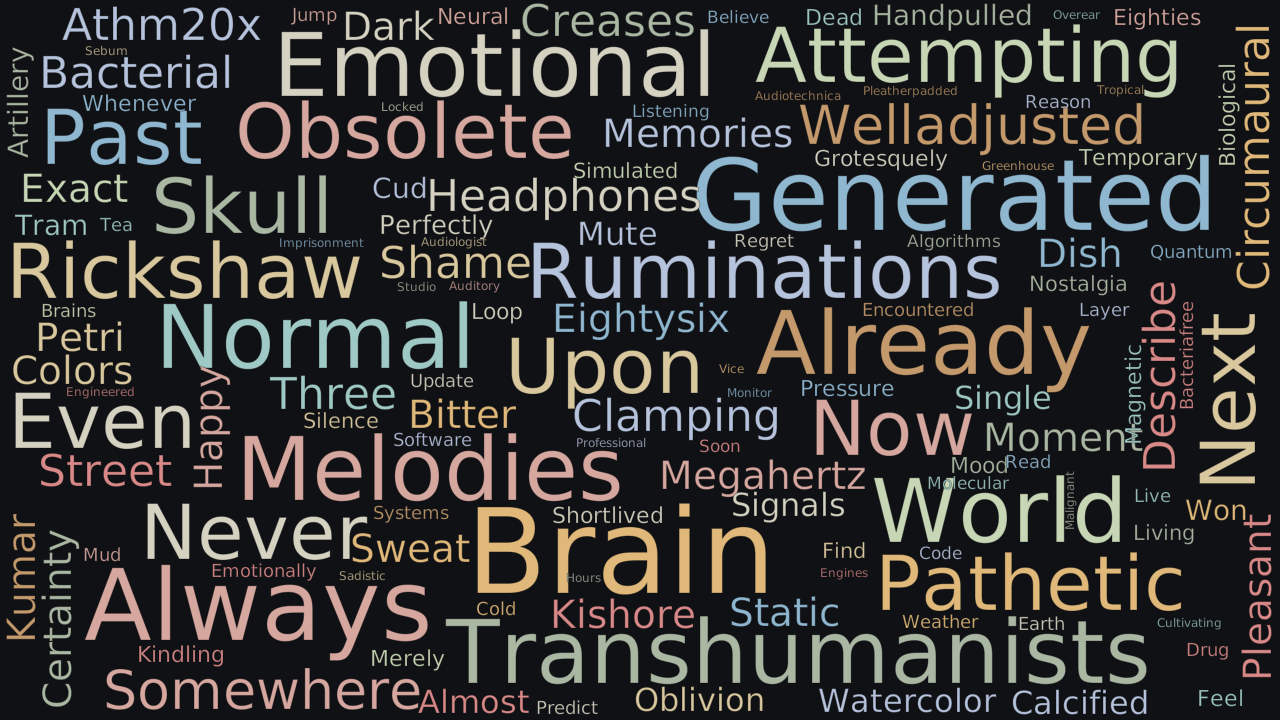
Word Cloud
Related reading
Selected by shared topics and section, with closer publication dates breaking ties.