The Glandular Weather
Uses the speech voice supplied by your browser or device.

The glandular weather of July fifteenth, 2026, is not merely meteorological; it is a conspiracy of humidity and neural chemistry, a collusion between the 35.3°C maximum and the 28.5°C minimum that conspires to make my skin feel like a damp envelope that has been licked by a thousand bureaucratic tongues, and I am sitting here in this city that the British once called Calcutta and we now call Kolkata with the same phonetic indifference with which we call a spade a spade or a municipal drain a municipal drain, and the irritation is not stamped, it is not labeled in fluorescent ink, it does not come with a certificate of authenticity from the American Psychiatric Association or the DSM-6 or whatever grotesque manual they are currently using to categorize the ineffable squirming of the human soul into neat little diagnostic boxes that fit neatly on insurance forms, no, the irritation is a worm, a dysphoric worm in the gut, an imbalance of chemicals in the brain, a network problem, an insistent me-me loop in the short-circuited ruminative centers of the brain, and I just feel irritated and I want every one, well, the very minute fraction of the human population that reads a bla-bla blog of a Bengali bad mad man, to know that this irritation is not a reaction to the UK-India Free Trade Agreement entering into force today, worth £4.8 billion to the UK GDP, with whisky tariffs cut from 150% to 40%, which is the kind of economic minutiae that makes my eyes glaze over like a fish in a market stall, nor is it a reaction to the fact that Canada is strengthening its regulation of immigration consultants today, which is the kind of bureaucratic constipation that makes me want to defecate metaphorically all over the concept of nation-states and their petty regulatory obsessions, no, the irritation is deeper, it is ontological, it is the irritation of a man who has lived fifty-one years in this city of sweat and poetry and political necrosis, this city where the monsoon rains fall with the enthusiasm of a disappointed lover and the humidity clings to you like a relative who has overstayed their welcome by approximately three decades.
I am irritated by the fact that OpenAI has launched GPT-Live, a real-time conversational voice AI that can listen and speak and reason simultaneously, which means that soon there will be machines that can mimic the exact timbre of my manic ranting and my depressive muttering, machines that will be able to replicate the particular cadence of a Bengali man saying “arre baba” with the exact mixture of exasperation and affection that has taken me half a century to perfect, and this irritates me because I have spent my life cultivating this voice, this grotesque, swollen, cynical voice that is part Tagore and part taxi driver and part the kind of man who reads Proust while eating street food and gets the pages greasy with mustard oil, and now a machine can do it, a machine can do it with full-duplex architecture, which is a term that sounds like something a urologist would diagnose, and I am supposed to be grateful for this progress, this march of the artificial intelligences that are now so numerous that they are like the neutrinos from the Milky Way’s stars, about 1,000 of which pass through a thumbnail every second, and my thumbnail, my particular Bengali thumbnail, is currently being bombarded by both neutrinos and the electromagnetic radiation from the Wi-Fi router that is feeding me these grotesque tidbits of information about the world, and I am irritated because I cannot tell the difference between the neutrinos and the Wi-Fi, between the cosmic background radiation and the background radiation of my own thoughts, which are currently emitting at a frequency that could be described as “manic-depressive with a side of existential nausea.”
The weather today is partly cloudy with a 57% probability of rain, which is a probability that seems to me to be the exact mathematical expression of my own emotional state: partly cloudy, 57% likely to precipitate into something messy and inconvenient, and the UV index is 9.1, which is extreme, which is the kind of extremity that I aspire to in my own emotional life, the kind of extremity that makes a man stand on a rooftop in the monsoon and scream at the clouds, not because he is insane, but because he is so thoroughly sane that the sanity has become a kind of madness, a hyper-lucidity that sees through the veil of social convention and recognizes that we are all, every one of us, walking around with our own personal monsoons inside our skulls, our own private storms of serotonin and dopamine and norepinephrine that make us feel, at any given moment, either like gods or like worms, and there is no in-between, no temperate zone, no comfortable 22 degrees Celsius with a gentle breeze, no, it is either the scorching 35.3°C of manic exultation or the clammy 28.5°C of depressive lassitude, and the humidity, the humidity is always there, the humidity is the constant, the humidity is the medium in which both the mania and the depression swim like bloated fish in a stagnant pond.
I am irritated by the autonomous umbrella that follows its owner, developed by a Canadian engineer named John Tse, which uses computer vision and intelligent sensors to provide hands-free rain protection, and I am irritated not because it is a bad idea, but because it is a good idea, because it is the kind of idea that makes me feel obsolete, that makes me feel like a man who has spent his entire life holding his own umbrella, sometimes with both hands when the wind is particularly vindictive, and now there is a machine that can do it for me, a machine that can follow me like a loyal dog, except that dogs are not loyal, dogs are merely dependent, and this umbrella is not dependent, this umbrella is autonomous, which is a word that comes from the Greek “autonomos” meaning “self-governing,” from “autos” meaning “self” and “nomos” meaning “law,” and I am thinking about the law of the self, the nomos of the autos, the self-governance of the irritated Bengali man who is currently trying to govern himself and finding that the government is in a state of perpetual insurrection, that the cabinet of his mind is constantly reshuffling itself, that the ministers of reason and passion are engaged in a civil war that makes the partition of Bengal look like a minor boundary dispute.
And then there is the news that Toto, the Japanese toilet maker, famous for their hi-tech heated thrones, has seen its shares jump nearly 10% in one day because their “electrostatic chucks” are a key component in the semiconductors powering the artificial intelligence revolution, and I am sitting here in this city where the toilets are decidedly not hi-tech, where the concept of a heated toilet seat is as exotic as a polar bear in a sauna, and I am thinking about the grotesque irony of the fact that the same technology that warms the buttocks of celebrities like Drake and the Kardashians is also the technology that is powering the AI that will eventually replace me, that will eventually write this blog post with more coherence and less profanity and fewer digressions into the etymology of Greek words, and I am irritated by this, I am irritated by the fact that my obsolescence is being funded by the electrostatic chuck, by the very device that ensures that a semiconductor wafer remains perfectly positioned during the etching process, and I am thinking about etching, about the way that time etches itself into the face, the way that the fifty-one years of my life have etched themselves into the topography of my skin, creating a landscape of wrinkles and pores and occasional pustules that is as complex and as unreadable as a circuit board, and I am wondering if there is an electrostatic chuck that can hold my life in place, that can prevent me from drifting, from etching myself into obsolescence.
The monsoon is coming, or perhaps it is already here, the 57% probability is becoming a 100% certainty as I write this, and the rain is falling on the corrugated tin roof of the building next door with a sound that is like the applause of a disappointed audience, and I am thinking about the fact that the World Santa Claus Congress is currently gathering in Aalborg, Denmark, in the height of summer, which is the kind of surreal juxtaposition that appeals to my manic sensibility, the idea of Santas and Mrs. Clauses and elves gathering in July, wearing their red suits in the Danish heat, sweating under their white beards, negotiating the geopolitics of Christmas in a world where the AI is getting better at being naughty or nice than any human could ever be, and I am irritated by the fact that I am not in Aalborg, that I am here in this city of perpetual summer and perpetual disappointment, this city where the Santa Claus Congress would be a daily occurrence, where every day is Christmas and every day is a letdown, where the gifts are wrapped in the newspaper of yesterday’s news and the ribbons are made of the same humidity that is currently making my shirt adhere to my back like a second skin that I never asked for and cannot remove.
I am irritated by the giraffes in Barcelona who may be capable of rudimentary math, because if a giraffe can do math, then what is the point of my entire education, what is the point of the years I spent memorizing the multiplication tables and the quadratic equations and the calculus that I have never used except to calculate the rate at which my life is deteriorating, and if a giraffe can do math, then perhaps a giraffe can also write a blog post, perhaps a giraffe can also feel the manic irritation of a July afternoon in Calcutta, perhaps a giraffe can also look at the sky and wonder why the clouds are shaped like the faces of people who have disappointed it, and I am irritated by the fact that I am now identifying with a giraffe, that my empathy has extended to the animal kingdom in a way that is either a sign of profound spiritual growth or a symptom of the kind of dissociative disorder that makes a man talk to pigeons and believe that they are answering him in the language of cooing and head-bobbing.
The UK-India trade deal is entering into force today, and I am supposed to care about this, I am supposed to feel some kind of patriotic enthusiasm or economic optimism, but all I feel is the irritation of a man who knows that the £4.8 billion boost to UK GDP will not trickle down to him, that the tariff cuts on whisky will not make the whisky in his glass any cheaper, that the bilateral trade of £25.5 billion every year will not buy him a single moment of peace, a single moment of the kind of serenity that is advertised in the wellness apps that are probably being powered by the same electrostatic chucks that are warming the buttocks of the Kardashians, and I am irritated by the fact that I am thinking about the Kardashians, that they have invaded my consciousness like a virus, like a malware that has been installed in my brain by the algorithms of the attention economy, and I am trying to uninstall them, I am trying to perform a cognitive defragmentation, but the Kardashians are persistent, they are like the humidity, they are the medium in which all other thoughts must swim.
The Meta AI agent development is progressing more slowly than expected, according to Mark Zuckerberg, which is the kind of admission that gives me a perverse satisfaction, the satisfaction of knowing that even the masters of the universe are struggling, that even the men who control the electrostatic chucks and the autonomous umbrellas and the GPT-Lives are finding that the world is more complicated than their algorithms can handle, that the human mind, the particular Bengali mind that is currently writing this sentence, is still more complex than any artificial intelligence, still more recursive, still more capable of the kind of syntactic unfolding that makes a sentence begin in one place and end in another, that makes a thought begin with the weather and end with the Kardashians, that makes a life begin with birth and end with the slow, humid dissolution of the self into the monsoon air.
I am irritated by the fact that the EU has reinstated Chat Control 1.0, allowing online platforms to voluntarily scan unencrypted messages to detect child sexual abuse material, which is a noble goal that has been achieved through ignoble means, through the erosion of privacy, through the establishment of the precedent that the state can look inside your messages, can read your thoughts before you have even fully formulated them, and I am irritated because I know that this is the thin end of the wedge, that Chat Control 2.0 is coming, that the voluntary will become mandatory, that the exception will become the rule, and that soon we will all be living in a world where our every word is scanned and categorized and flagged by algorithms that have been trained on datasets that include the entire corpus of human communication, including this blog post, including this very sentence, and I am wondering if the algorithm that scans this will understand the irony, will understand the recursive self-awareness, will understand that the man who is writing about the erosion of privacy is simultaneously contributing to the dataset that will be used to erode it further.
The rain is falling harder now, the 57% probability has become a deluge, and the sound on the tin roof is no longer applause but something closer to artillery, to the bombardment of a city that has been under siege for centuries, besieged by the British and the monsoon and the mosquitoes and the political parties that come and go like the seasons, each one promising relief and delivering only more humidity, more of the same sticky, clinging, inescapable dampness that makes you feel as though you are being slowly dissolved, as though your body is a sugar cube in a cup of tea that is being stirred by a spoon wielded by an indifferent god.
I am fifty-one years old, and I have lived through enough monsoons to know that they always end, that the rain always stops, that the sun always comes back, and I have lived through enough manic episodes to know that they always end too, that the exultation always collapses into the lassitude, that the 35.3°C of the spirit always cools to the 28.5°C of the soul, and I have lived through enough depressive episodes to know that they also end, that the lassitude eventually gives way to something else, to a restlessness, to an irritation, to the kind of manic energy that makes a man write a 1500-word blog post in a single sitting, a blog post that is grotesquely swollen with adjectives and adverbs and metaphors that mix the bodily and the cosmic, the personal and the geopolitical, the humidity of Calcutta and the electrostatic chucks of Japan.
And I am irritated by the fact that I am writing this, that I am contributing to the noise, that I am adding one more voice to the cacophony of the internet, one more bla-bla blog to the infinite scroll of human expression, and I am wondering if anyone will read this, if anyone will make it to the end, if anyone will understand that this is not a blog post about trade deals or AI or autonomous umbrellas, but a blog post about the weather, about the glandular weather of July fifteenth, 2026, about the way that the weather inside the skull and the weather outside the window are the same weather, the same monsoon, the same 57% probability of precipitation that is also a 57% probability of emotional precipitation, of the kind of crying that is not sadness but something more complicated, something that involves the entire history of Bengal, the entire history of colonialism, the entire history of the human attempt to make sense of a world that refuses to make sense, that insists on being partly cloudy with a chance of rain, that insists on being 35.3°C and 28.5°C and 83% humidity all at the same time, a world that is as contradictory and as unresolved as this sentence, which is ending now, not with a period but with a kind of dissipation, a kind of evaporation, the way that the rain on the tin roof will eventually evaporate, the way that this irritation will eventually evaporate, leaving behind only the residue, the salt, the mineral deposit of a life that has been lived in the monsoon, that has been lived in the humidity, that has been lived in the constant, unrelenting, glandular weather of being a Bengali man in Calcutta in the year 2026, waiting for the rain to stop, waiting for the sun to come out, waiting for the mood to shift, waiting for the next manic episode, waiting for the next depressive collapse, waiting for the next sentence, the next word, the next breath, the next heartbeat, the next neutrino passing through my thumbnail, the next electrostatic chuck warming my metaphorical buttocks, the next autonomous umbrella following me through the streets of a city that is always partly cloudy, always 57% likely to rain, always, always, always irritated.
P.S. The World Santa Claus Congress in Aalborg, Denmark, is currently in session. The Santas are sweating. The elves are unionizing. The AI that will replace them is being trained on a dataset of chimneys and reindeer and the particular acoustics of “Ho ho ho.” The electrostatic chucks are warm. The monsoon is here. I am still irritated. The probability of rain is now 100%. The probability of me shutting up is 0%. This is the glandular weather of July fifteenth. This is the weather of being alive. This is the weather.
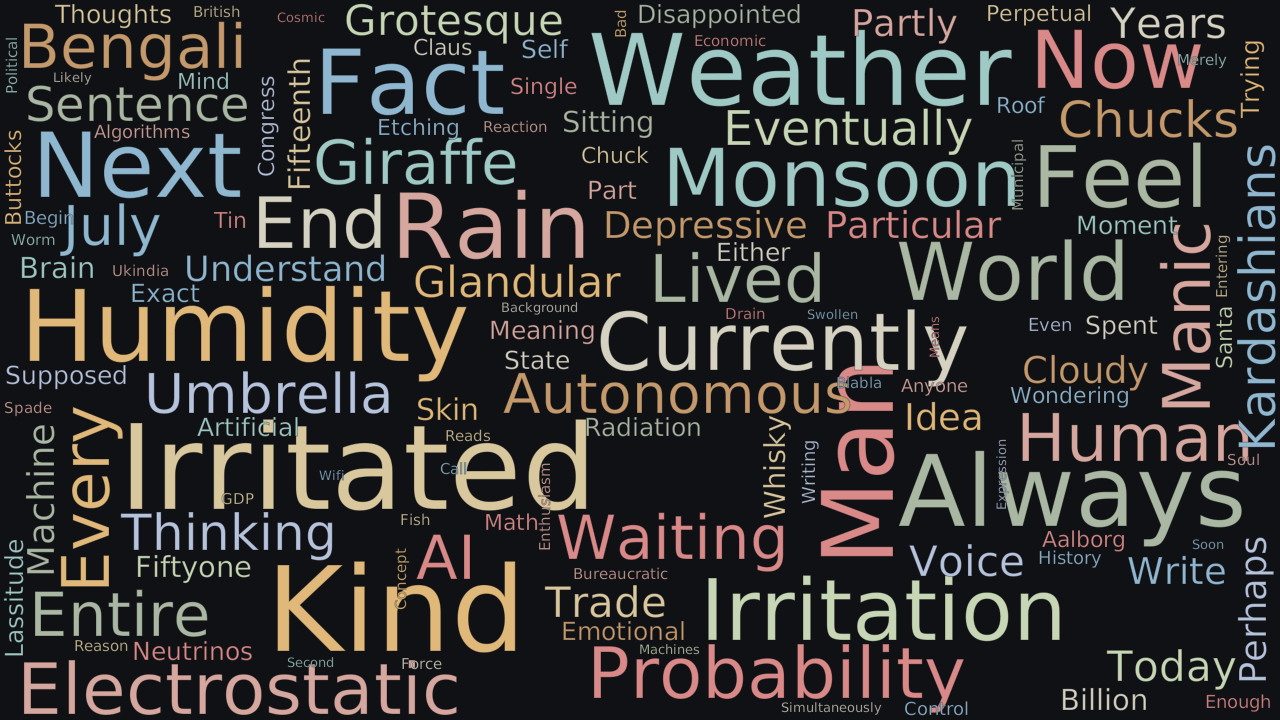
Word Cloud
Related reading
Selected by shared topics and section, with closer publication dates breaking ties.