Neel Soda
Uses the speech voice supplied by your browser or device.

THIS IS A WORK OF FICTION
The afternoon the blue drink arrived in their lane, Keya was buying mosquito coils at Bimal-da’s stall when a delivery van with a painted palm tree and the words NEEL SODA—ZERO SUGAR, FULL TASTE backed into the open gutter with a hiss of brakes. The van’s exhaust coughed black into the humidity. Bimal-da, who had been complaining about the price of milk to a rickshaw puller, straightened his oil-stained vest and began unloading crates of thin glass bottles filled with liquid the colour of ink mixed with dishwater. It was a shade Keya had never seen in a food: electric, fraudulent, deeply sad, the blue of cheap hospital corridors and festival lights left out in the rain.
“Diabetic special,” Bimal-da said, tapping a bottle with his yellowed fingernail. “New launch. Tastes like Rooh Afza had a baby with a swimming pool. Five rupees cheaper than Diet Coke.”
Keya’s father, Nihar, had been diabetic for eleven years. He was a retired postal clerk with a pension too small for real fruit and a sweet tooth that had outlived his marriage, his colleagues, and most of his vanity. He spent his afternoons on the cracked balcony of their second-floor flat reading the same four Bengali novels and staring at the tram wires as if waiting for a message that would never come. The doctors at the government hospital had forbidden him sugar. Keya had forbidden him lies. Still, she found empty packets of mishti hidden behind the almirah, sticky fingerprints on the balcony railing, granules of sandesh dissolved in the seams of his chair. Guilt had made him furtive; age had made him careless.
She bought two bottles. They cost less than a cup of tea.
That evening she served him one with dinner—lau chingri, rice, the usual resentful silence that passed for devotion between them. He drank it in three long gulps, his Adam’s apple bobbing. His eyes, milky with cataracts, widened.
“Not bad,” he said. “A little chemical. But sweet.”
“It’s not sweet,” Keya said. “It’s artificially sweetened. There’s a difference.”
“To my tongue, Keya, there is no difference. To my tongue, it is only relief.”
He was wearing a long-sleeved kurta though the apartment was thirty-eight degrees and the ceiling fan turned uselessly. She noticed but said nothing. Old men had their tics. She had hers: she checked his blood sugar every morning with a glucometer she could barely afford, catalogued his lies, and counted the hours until she could sleep.
Within a week, Nihar was drinking three bottles a day. The flat began to smell of it—a sharp, saccharine fog, like crushed aspirin dissolved in rose water and left to ferment. Keya found it everywhere: on the bathroom tiles, in the pockets of his trousers, staining the crocheted doily on the armrest where he sat like a blue bruise. She told herself it was harmless. The label claimed natural berry extract, zero glycemic index, approved by a European consortium no one had heard of. On television, a minor celebrity in a white tracksuit jogged along the Maidan holding a bottle, smiling at the camera as if the drink had cured his loneliness and his mortgage.
Keya taught English to schoolchildren in other people’s flats, carrying her grammar books through lanes that smelled of jasmine and open drains and yesterday’s fish. She was forty-two. A marriage had been arranged twelve years ago, then cancelled when her father’s kidneys began their slow protest and she could not leave. The groom was now a manager in Bangalore with two children and a wife who posted photographs of vacations in Singapore. Keya had seen his profile on Facebook, a life that looked like a brightly lit advertisement for everything she had failed to become. She did not hate her father for this. Hatred would have been clean, almost refreshing. What she felt was a damp, clinging exhaustion, the kind that grew in the gaps between duty and desire, like fungus on a north-facing wall.
She bought the drink because it was cheap, because it kept him docile, because it meant she did not have to argue about sweets at the end of a day that had already taken everything else from her.
The first lump appeared on his left forearm. She saw it when he reached for his spectacles during a power cut: a raised, pale protrusion the size of a marble, just under the skin. He pulled his sleeve down quickly.
“It’s a mosquito bite,” he said.
“It’s July,” Keya said. “Mosquitoes don’t bite under sleeves.”
“Then it’s old age. Let me read my paper in peace.”
But the lumps multiplied. She found them on his shoulders, his thighs, his soft, ruined belly. They were not red. They were the colour of wet dough, slightly translucent, and they moved when she pressed them—not like fluid, but like something firmer. Packed cotton. Small stones waiting to hatch.
She told herself it was diabetic lipohypertrophy from his insulin injections. She told herself he was eating sweets on the side and lying to her, as he had always lied. She told herself a great many things because the alternative was to admit that the blue liquid she had been pouring down his throat was doing something the label had not advertised, and that she had chosen not to see it because seeing it would require her to act.
The lane began to change.
Old Ashim, who lived two doors down and had not spoken to Nihar since a dispute over a rainwater pipe in 2014, began to swell. His cheeks filled out like a trumpet player’s, then his neck, then his hands. Then Mr. Das from the ground floor, the retired bank guard who fed stray cats. Then Bimal-da himself, whose stomach, once flat from decades of cycling to the wholesale market, ballooned against his plywood counter. They all drank Neel Soda. You saw the bottles in their hands now the way you once saw tea glasses: a natural extension of the afternoon, a credential of belonging. The colour had become normal. The blue looked almost medicinal, trustworthy, the hue of a promise no one expected to be kept.
Keya stopped buying it. Nihar began sending the neighbour’s boy, Ratan, to fetch it in secret. She found the empties under his bed, lined up like sleeping soldiers, labels peeling. She confronted him in the yellow light of the balcony.
“Why?” she asked.
“Because it makes me feel full,” he said. “For the first time in years, Keya, I feel full. Not of food. Of something else.”
“You’re bloated. It’s water retention. It’s poison.”
“It’s mine,” he said, and his voice cracked in a way she had not heard since her mother’s funeral. “It’s the only thing in this house that is mine.”
She took the bottles to the kitchen and poured them down the sink. The liquid stained the porcelain a faint, stubborn azure that would not scrub clean no matter how hard she tried. She used bleach. The stain remained, patient as grief.
Three days later, Ashim-uncle died on the pavement outside the cooperative bank.
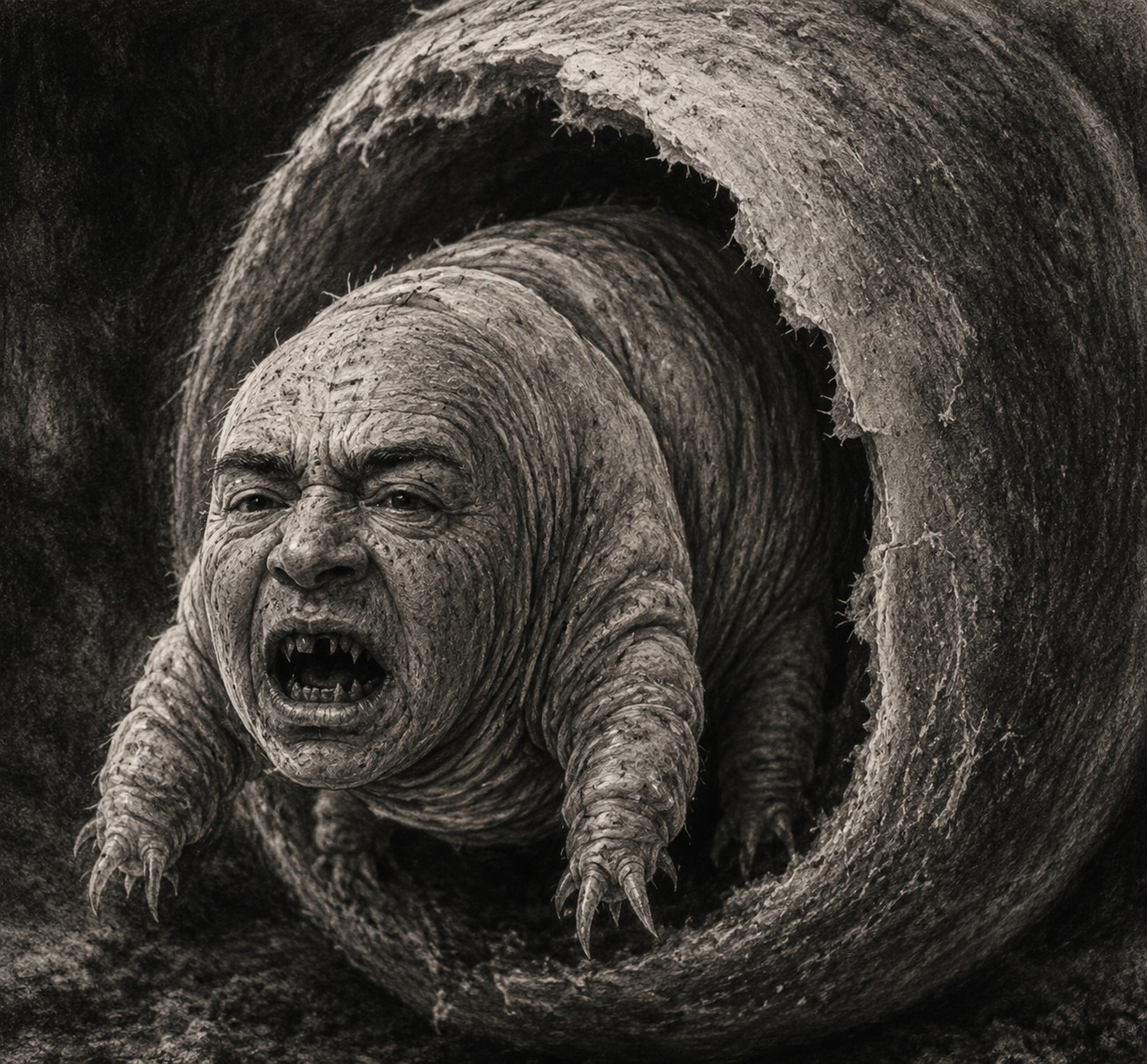
Keya was coming home with groceries in a plastic bag that was cutting into her wrist when she saw the crowd. Ashim was sitting upright against a parked scooter, his eyes open, his mouth a perfect O of surprise. But it was not his mouth that held the crowd’s attention. It was his arms. Small, round perforations had opened in his skin—dozens of them, perfectly circular, lined with what looked like tiny white nubs. Teeth. Baby teeth, or the suggestion of them, arranged in neat rings. From each hole seeped a thick, bright blue fluid that pooled in the dust and refused to mix with the grime. It looked deliberate. It looked designed. It looked like the body had tried to grow new mouths to scream, and when the screams failed, it wept the drink instead.
The police came and went. A constable wrote in a ledger that the deceased was a diabetic male, sixty-nine, probable cardiac arrest. The blue fluid was noted as “unusual discharge, possibly dye from clothing.” The crowd dispersed. The pavement was hosed down by a municipal worker who smoked a bidi and yawned as if he had seen this before, or worse.
Keya stood in her balcony that night and watched the lane. The power had cut out, as it did every evening now that the transformer was dying and no one had the influence to fix it. Candles flickered in windows like uncertain hearts. She saw Mr. Das on his veranda, shirtless, his torso lumpy and grotesque in the candlelight. He was drinking Neel Soda from a bottle, tilting it carefully, as if administering medicine to a child who would not survive the night.
She went inside. Her father was asleep in his chair. His breathing was wet, laboured, the sound of water draining from a clogged pipe. She rolled up his sleeve. The lumps had grown. They were the size of eggs now, clustered along his arm like a string of malformed pearls. She touched one. It was warm. Beneath the skin, something shifted, adjusting itself to her touch.
She did not sleep. She sat in the dark and listened to him breathe and thought about the years she had spent feeding him, cleaning him, managing his decline like a failing business that consumed her capital and gave nothing back. She thought about the cancelled wedding, the flat that smelled of camphor and old man, the way her students’ mothers looked at her with a mixture of pity and relief that she was available, that she had no life to interrupt. She had stayed because she was decent. Decency was a trap. It closed slowly, like a door with a warped frame, until one day you realized you were on the inside and the handle had been removed from your side.
In the morning, she found the perforation.
It was on his lower back, just above the waistband of his dhoti. A hole the diameter of her little finger, the edges not torn but neatly defined, lined with hard white ridges that caught the light. It wept blue. Not blood. Something thinner, more luminous, with a chemical sweetness that made her gag. When she wiped it with a cloth, the cloth turned stiff and crusty, like sugar left in the sun.
She called Dr. Sen, the general practitioner who still made house calls for families he had known for decades and who had watched Keya grow from a girl with scraped knees into a woman with scraped expectations. He came with his leather bag and his permanent expression of mild disappointment in the world.
He examined Nihar in silence, pressing the lumps, listening to the wet breath. Then he took Keya to the kitchen and closed the door.
“There have been five now,” he said quietly. “All in this para. All diabetic. All drinking that blue filth. The hospital will not admit them all. The beds are full. The health officers say it is a dietary issue, a lifestyle issue. They send them home with paracetamol.”
“Why isn’t anyone stopping the drink?”
Dr. Sen opened his palms. They were trembling. “The company has papers. The health department is understaffed and underpaid. And the victims—” He stopped.
“The victims are old and poor and no one cares if they die a little earlier or a little bluer,” Keya finished.
“The fluid isn’t blood. It’s the drink. It’s replacing the plasma, organ by organ. The body is trying to expel it, but it can’t. So it grows… outlets. The teeth are calcified ducts. The body is trying to speak, Keya. It has no other language left.” He wiped his glasses. “I’m sorry. I truly am.”
After he left, she searched the flat with a systematic fury she did not know she possessed. She found the bottles everywhere: in the shoe rack, behind the toilet tank, inside the hollow of an old radio that had not worked since her mother was alive. Thirty-seven bottles. And then, in the locked drawer of his desk where he kept his pension passbook and her mother’s death certificate, she found the list.
It was written on the back of an electricity bill in his cramped, clerkly hand. Names. Amounts. Small sums—fifteen rupees, thirty rupees, sixty. The names were all from the lane. Old men. Widowers. Retired clerks like himself. Next to some names, he had written “credit.” Next to others, “paid.” At the bottom, a total: four hundred and twenty rupees.
He had been selling it.
Not for profit. The margins were laughable, pathetic. He had been buying crates from Bimal-da at a discount and distributing them to the old men who could not walk to the stall, who were ashamed to be seen buying something so childish, so desperate for sweetness. He had become the local supplier. The blue drink had given him a role. A purpose. A reason for the boys to call him Nihar-kaku and the old men to knock on his door with their empty bottles.
He had been poisoning his neighbours because it made him feel necessary. Because it made him a man who had something people wanted.
She stood in the room and listened to the ceiling fan click in its broken rhythm. The list trembled in her hand. All the afternoons she had thought he was napping, he had been running a tiny, deadly economy from his armchair, extending credit to men poorer than himself, building a network of bloated, grateful customers who depended on him for their daily sweetness. He had found his vocation in the distribution of his own death, and he had been good at it.
She did not confront him. What would she say? That his kindness was a vector? That his loneliness had turned septic and spread through the lane like damp?
Instead, she went to Bimal-da’s stall. It was closed. A handwritten sign said “Family Emergency.” She knocked on the shutter. No answer. A woman from the adjacent tailoring shop told her Bimal-da had been taken to NRS Hospital that morning. His wife had found him in the store room at dawn, his stomach distended to the size of a petrol drum, blue fluid leaking from perforations in his neck that opened and closed like fish mouths gasping for air.
Keya walked home through the lane. The humidity had thickened into something you could chew. The tram wires sagged under the weight of the sky. She passed Ratan, the neighbour’s boy, carrying a fresh crate of Neel Soda on his head, the bottles clinking like church bells in a language she was only now learning to read.
In the flat, her father was awake. He had dragged himself to the chair by the window. His kurta was soaked with blue. The lumps had burst through the cloth in places. She could see the perforations on his arms, his chest, his throat—small, hungry mouths, weeping the drink he had consumed for weeks, the drink he had shared like prasad.
He looked at her. His eyes were still hers, still the eyes of the man who had taught her to ride a bicycle on this very lane and to be suspicious of easy things.
“I found the list,” she said.
He nodded. It was not a gesture of confession. It was recognition, the acknowledgment of a debt finally called in.
“They came to me,” he whispered. “They were ashamed to buy it themselves. I gave them credit. I told them it was medicine. I told them it was safe because you bought it for me.”
“It’s killing them.”
“It’s killing me,” he said. “I know. I have known since my urine turned blue three weeks ago. But for one month, Keya, one month, I was not a burden. I was not a pension. I was a man with something people wanted.”
She knelt before him. The blue fluid had pooled on the floor, sticky and bright. It smelled of the drink—artificial, obscene, desperately sweet.
“I’m sorry,” he said. “For the wedding. For your years. For this.”
She took his hand. It was cold, the fingers swollen like sausages. She thought of all the bottles she had poured down the sink. She thought of Ashim-uncle on the pavement. She thought of the list in her pocket, the names like a litany of her own failures.
“I’ll call an ambulance,” she said.
“No,” he said. “Stay. Let me finish.”
She stayed. The afternoon wore on. The power cut came. The flat filled with the blue-dark of a Calcutta evening, the kind of dark that makes you forget what season it is. She held his hand and listened to the wet, rasping breath, the sound of a body trying to speak through perforations that were not meant for words, only for weeping.
When he died, it was quietly. The blue fluid stopped weeping. The small mouths closed. She sat with him until the heat began to turn and the mosquitoes found the sweetness on his skin and gathered in a cloud.
Then she went to the kitchen. She took the last bottle from the back of the fridge—the one she had hidden there three days ago, telling herself it was for a student, for a guest, for anyone but the truth. She had drunk half of it on Tuesday afternoon, standing at the sink, weeping with a fury she could not name. She had wanted to know what he tasted. She had wanted to know what fullness felt like.
She rolled up her left sleeve. In the dim light of the kerosene lamp, she found it: a small, pale lump, no bigger than a lentil, just above her elbow. It was warm to the touch. Beneath the skin, something stirred, tasting her.
Keya took the list from her pocket. She spread it on the kitchen table. She picked up the phone and dialled the first name. It was past nine. The line was busy. She hung up and dialled again. Outside, the lane was quiet, but she could hear the clink of bottles somewhere in the dark, the sound of a city drinking itself to sleep, one sweet, blue mouthful at a time.
She touched the lump on her arm. It did not hurt. Not yet. It only waited, patient and full, like everything else in Calcutta.
Word Cloud
Related reading
Selected by shared topics and section, with closer publication dates breaking ties.