The Humidity of Proof
Uses the speech voice supplied by your browser or device.

The ceiling fan above this Park Street establishment rotates with the exhausted diligence of a man who has already submitted his retirement papers and is now merely serving out the fortnight, and I am sitting beneath it with a glass of beer that has begun to weep against the varnished wood, watching a single bead of condensation travel southward with the solemn attention I usually reserve for descending elevators, tax notices, or the final stages of a chess game in which I have already lost my queen but remain too stubborn to resign.

Let’s say may be, it is the twenty-seventh of June, 2026. Outside, Calcutta performs its annual miracle of converting air into soup. The FIFA World Cup is currently unfolding across three North American time zones—an event I am not watching, though the flatscreen behind the bar insists on showing it, and every twenty-three minutes the room erupts in a brief, performative groan whenever Argentina, or Germany, or some other nation whose colonial history intersects inconveniently with our own, fails to convert a penalty. I have never understood the religious devotion inspired by twenty-two men chasing a sphere. But I understand the groan. It is the same sound the city made three days ago when a warehouse in Taratala collapsed and buried eighteen men under concrete that had apparently been poured by contractors who understood engineering the way I understand tensor calculus: I have read the words, I can pronounce them, and I would not trust myself to build anything more structurally ambitious than a sandwich.
Three dead. Eighteen trapped. The Chief Minister stood at the rubble and spoke into microphones with the gravity such occasions demand, and I sat in this same chair the following evening reading about it on my telephone, which is a device that now delivers tragedy and stock prices with identical chirpiness. The India-US trade talks had concluded the same day—Jamieson Greer and Piyush Goyal reviewing market access and non-tariff barriers while Washington’s temporary tariff loomed like a monsoon cloud with a July 24 expiration date. I do not understand trade negotiations. I understand that my electrician charges more when it rains.
I am fifty-one. The body has begun to negotiate its own trade agreements, mostly surrender terms.
My telephone, that flat little glass parliament, also informs me that DeepSeek—the Chinese AI company that built its reputation on capital efficiency and open models—is now raising 7.4 billion dollars at a valuation of 59 billion, which is approximately 59 billion more than the valuation of my own capacity to comprehend why anyone would pour that much liquidity into a system designed to predict the next word in a sentence. Alphabet, not to be outdone in the current frenzy of corporate hydration, has announced an 80 billion dollar stock sale to build more AI infrastructure, as if the problem with human civilization were insufficiently vast data centers. SpaceX, meanwhile, has launched its IPO at a fixed 135 dollars per share, targeting 75 billion dollars and a 1.75 trillion dollar valuation, which is a number so large it no longer describes wealth so much as it describes a theological category, like the grain of sand in Buddhist metaphysics or the number of mosquitoes in Salt Lake.
I sip my beer. The fan continues its lazy orbit.
I live in a city that has been renamed, re-renamed, debated, defended, and occasionally disowned by people who do not live in it. I have watched the metro expand southward like a cautious relative visiting from the suburbs, seen flyovers grow across the skyline with the patient inevitability of fungus, and observed the slow migration of my contemporaries from addas at tea stalls to addas at bars that charge three hundred rupees for a plate of peanuts and call it “bar nibbles.” I am not complaining about this migration. Migration is what cities do. People move. Tastes change. The tea stall with its plastic stool and its one-burner philosophy does not disappear; it simply shares the landscape now with places where the lighting is dimmer, the chairs cost more, and the menu reads like a collaborative poem written by three people who have never agreed on anything in their lives.
What I am trying to understand, sitting here beneath my indifferent fan, is how a person moves between these worlds without feeling, at every transition, like a passport holder whose documents are being examined by an official who has already decided the answer is no.
Because that is what bar English does. It examines you. It stands at the counter with its arms crossed and waits to see whether you know the passwords.
And the passwords are not difficult. They are merely specific. They are the accumulated residue of other people’s confidence, other people’s histories, other people’s decisions about what words should mean what things in what order. Every subculture develops this. I spent enough years in information technology to know that a “cache” is not where you hide your money, that “refactoring” does not mean rebuilding your house, and that when someone says “the deployment failed,” what they mean is that several human beings are about to have a very bad afternoon. Every field has its shibboleths. The bar is no different. The only distinction is that the bar expects you to perform its vocabulary while standing in public, possibly in front of people you are trying to impress, possibly while holding a wallet that has already suffered enough indignities this month.
So let us begin with the physical fact of the drink itself, the thing that arrives in the glass, the thing you are actually paying for.
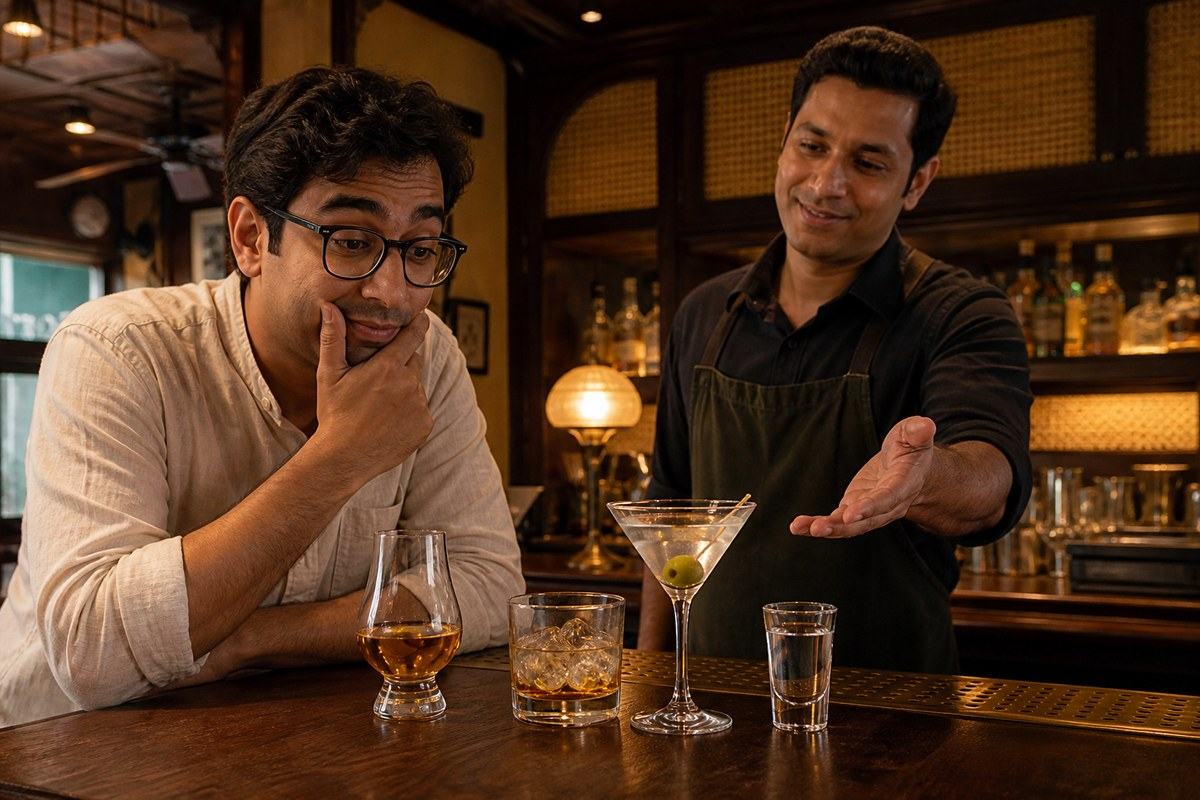
“On the rocks.” The phrase sounds geological. It sounds as if you are ordering a piece of the Himalayas with your alcohol. What it means is ice. Whiskey on the rocks is whiskey poured over ice cubes. The rocks are not rocks. They are frozen water, usually machine-made, sometimes hand-carved in establishments ambitious enough to charge extra for the geometry of their frozen water. The etymology is American, emerging from the early twentieth century, possibly from the literal appearance of ice chunks in a glass, possibly from the earlier slang use of “rocks” to mean ice in general. The Oxford English Dictionary traces it to 1946 in print, though spoken usage was undoubtedly earlier. What matters is this: when you say “on the rocks,” you are requesting coldness, dilution, and the slow transformation of your drink as the ice melts and the whiskey gradually surrenders its intensity to the water that once held it apart.
If you do not want this surrender, if you want the whiskey to remain exactly what it is, uncut, unsoftened, unapologetic, you say “neat.”
A neat drink is alcohol poured into a glass with nothing else. No ice. No soda. No fruit performing acrobatics on the rim. The word “neat” in this context is related to the older sense of the word meaning clean, unadulterated, pure—though the connection to the Old French net and Latin nitidus (shining, bright) is perhaps more etymological romance than practical necessity. What matters is the experience: the whiskey enters your mouth at full strength, at whatever temperature the bottle has achieved in the bar’s storage, and you taste it without mediation. This is not always pleasant. Full-strength alcohol can be aggressive, can announce itself with the subtlety of a municipal notice about property tax. But it is honest. It is the drink as the distiller intended, before the ice, before the mixer, before the human desire to make things easier than they are.
And sometimes, after the neat drink has done its work, has kicked the furniture of your throat around and left smoke in the room, you want something to follow it. Something to apologize. Something to sweep up. That something is a chaser.
A chaser is a soft drink, water, juice, or any non-alcoholic liquid consumed immediately after a shot or a neat pour of hard liquor. The word derives from the older sense of “chase” meaning to pursue, to follow—and indeed, the chaser pursues the liquor down your gullet, trying to catch it before it does too much damage. There is no shame in a chaser. The shame is performative, invented by people who are either nineteen years old, lying about their tolerance, or so dead inside that they have forgotten what it feels like to have a throat that still registers sensation. I have used chasers. I will use chasers again. My liver is not a laboratory, and my pride is not so vast that it cannot accommodate a glass of water after a glass of whiskey.
Now we arrive at a small word that carries more weight than its two syllables suggest: “shot.”
In standard bar English, a shot is a small serving of spirits, typically thirty to forty-five milliliters, intended to be consumed quickly in one or two swallows. The word’s origin is debated—possibly from the Old English sceotan (to shoot, to project), referring to the quick, projectile nature of the consumption; possibly from the measured charge of a firearm, a small concentrated burst; possibly from German Schuss, with similar connotations. What is certain is that a shot is designed for speed. You do not nurse a shot. You do not examine it like a man reviewing land records. You lift it, you drink it, and you try not to make the face of someone who has just discovered that colonialism has a liquid form and it is sitting in your mouth.
But here, in Calcutta, the word has a second life that the standard guides do not mention. In certain night economies, in certain lanes where the lighting is neon and the commerce has fewer curtains, “shot” has acquired a meaning that has nothing to do with alcohol and everything to do with a different kind of transaction, a different kind of measured exchange. Language is like the drainage system of this city: it has channels that are not on any official map, currents that flow in directions the municipal authorities did not anticipate. Before you use the word “shot” at a tea adda, at a bar, or in the wrong lane at the wrong hour, you must read the room. Context is cheaper than dental repair, and considerably cheaper than the explanations you might otherwise find yourself making.
A “double” is simpler. It means twice the standard measure. A double whiskey is not two separate glasses; it is one glass containing twice the usual amount of alcohol. This is useful on days when the afternoon has the cheerful musical quality of a ceiling fan with one bent blade, when the boss has been foolish, when the month has been financially insulting, or when your life, like mine on certain afternoons in the shanty boondocks of this city, feels less like a narrative and more like a prolonged administrative error. But the bill doubles too. This is where many Bengali souls discover tragedy. We are a people who love abundance but resent invoices. We want extra aloo in our biryani, extra jhol with our kosha mangsho, extra time before paying the rent, extra sympathy during illness, and extra logic when we are losing an argument. Bars, alas, are run by people who have studied arithmetic. The double is not a gift. It is a multiplication.
Then there is the cocktail, that mixed creature, that composite being, that drink which has surrendered the purity of its alcohol to the company of juices, syrups, bitters, sodas, herbs, limes, egg whites, smoke, foam, fruit, and whatever else the bartender’s imagination has dragged in wearing perfume. The word “cocktail” itself has a disputed etymology—possibly from the practice of docking horses’ tails, the mixed breed being symbolized by a cock’s tail; possibly from the French coquetier, an eggcup used for serving; possibly from the ginger suppositories once used to stimulate horses, the mixed drink being similarly stimulating. What is certain is that the cocktail emerged in the American nineteenth century, flourished during Prohibition when the need to mask the taste of poor-quality illegal alcohol made mixing essential, and has since become a global vocabulary of its own.
At its best, a cocktail is balance. It is the negotiation between sweet and bitter, strong and weak, familiar and strange. At its worst, it is Rasna that went abroad, returned with an accent, and now charges service tax. I have had cocktails that were revelations and cocktails that were insults. The difference is usually proportion. A cocktail is not a garbage bin for whatever liquids happen to be behind the bar. It is a recipe, a ratio, a small engineering problem solved in liquid form. When it works, it works because someone understood that two parts of this and one part of that and a dash of something else would produce an experience greater than the sum of its components. When it fails, it fails because someone thought that pouring everything together and shaking it was the same as making a drink.
The mocktail is the cocktail’s sober sibling. It contains no alcohol. It is a cocktail without the poison, a mixed drink for people who want the ritual without the consequence. Some people treat ordering a mocktail as a moral failure, as if abstaining from alcohol were a confession of weakness rather than a simple preference. This is absurd. People do not drink for many reasons. They are driving. They are on medication. They do not like the taste. They do not like the effect. They have seen what alcohol does to people they love, or to people they used to be. A virgin mojito is a mojito without rum. That is all. It is not a horoscope category. It is not a statement about your character. It is a cold drink with mint and lime, and if you want to hold something in your hand while the people around you slowly become worse versions of themselves, that is your right and your choice.
“Up,” or “straight up,” means the drink has been chilled with ice and then strained into a glass without the ice. This sounds, on first hearing, like madness. Why introduce ice only to remove it? Why chill the drink and then discard the chilling agent? The answer is that human civilization is a long series of such decisions. We iron clothes that will crease in ten minutes. We buy white shoes in a country where the dust has achieved sentience. We print wedding cards heavy enough to stun a pigeon. We chill a drink with ice, we remove the ice, and we call it sophistication. And yet, there is a practical logic here: the drink receives the cold without receiving the dilution. The ice does its work and then departs, like a competent bureaucrat who knows when to exit. It is a small victory. In a life of large defeats, small victories should be noted.
The martini family is where bar English begins to wear a monocle. A “dry” martini contains less vermouth. A “wet” martini contains more. An “extra dry” martini may involve so little vermouth that the bartender merely waves the vermouth bottle in the general direction of the glass, like a priest blessing a bus before a dangerous mountain journey. The word “dry” in this context refers to the relative lack of sweetness—vermouth, being a fortified wine, carries sugar, and reducing it makes the drink drier, sharper, more austere.
Vermouth itself deserves a moment of attention, because it is often misunderstood. It is not a spirit like whiskey or gin. It is a fortified aromatized wine. “Fortified” means that additional alcohol, usually a neutral grape spirit, has been added to the wine base, raising its strength and preserving it. “Aromatized” means that it has been flavored with a complex mixture of botanicals: herbs, roots, bark, flowers, spices, citrus peel, and other plant materials. One of the traditional ingredients was wormwood, which is where the name originates: the German Wermut means wormwood, and the word “vermouth” is simply the French adaptation. There are two broad categories: sweet vermouth, usually reddish-brown, richer and slightly bitter-sweet, used in drinks like the Manhattan and the Negroni; and dry vermouth, pale, lighter, sharper, used in martinis. In a martini, gin or vodka provides the alcoholic backbone, while vermouth contributes the herbal, wine-like seasoning. Too much vermouth, and the drink becomes soft, wet, almost apologetic. Too little, and you are basically drinking chilled gin while pretending that a herb garden was consulted in the preparation. Think of vermouth as the kasundi of certain cocktails: not the main food, but without it the thing loses its intended bite, its necessary sharpness, its sense of place.
A “dirty” martini contains olive brine. This makes it taste as if gin had a private conversation with pickle water and decided to continue the relationship. It sounds dreadful when described, but so does phuchka water if you approach it scientifically: tamarind fluid, street temperature, served from a metal vessel by a man whose towel has seen history, touched by hands that have touched money, touched by air that has touched buses. Yet we eat it and feel briefly immortal. Human beings are not rational animals. We are condiment animals. We are creatures of acquired taste, of habit, of the slow conversion of the initially repellent into the deeply desired.
“Well drinks” are made with the bar’s standard, cheaper house liquor. If you order “rum and Coke” without specifying the rum, you will receive the well rum. This is not automatically bad. It is simply ordinary. It is the public bus of alcohol. It will get you where you are going, though it will not ask about your dreams, your disappointments, or whether you have considered changing careers. “Top-shelf” liquor is the costlier stuff, traditionally stored on the higher shelves behind the bar where it is visible, impressive, and slightly harder for the bartender to reach. It suggests prestige, scarcity, status, and the faint possibility that you are being charged for the story as much as for the liquid. A top-shelf whiskey may be excellent. It may also be a liquid wearing a blazer, performing importance without necessarily possessing it. I have drunk expensive whiskey that tasted like regret and cheap whiskey that tasted like honesty. Price is not always truth.
When the bartender asks, “What’s your poison?” do not panic. It is bar slang for “What would you like to drink?” It is not a murder plan, though to be fair, alcohol has always been honest enough to travel with danger. That is why the slang works: it flatters you while warning you. It treats you as an adult who can handle the truth about what you are consuming. It is a small snake in a velvet bag, and it has been asking this question in English-speaking bars since at least the nineteenth century.
A “mixer” is the non-alcoholic liquid added to alcohol: soda, tonic water, cola, ginger ale, juice. The mixer is the disguise department. It puts a false moustache on the liquor and tries to convince your tongue that nothing serious is happening. This is how people get into trouble. A sweet drink smiles at you. It tastes like friendship, like celebration, like the soft drink you had at a childhood birthday party. Then, two hours later, your legs file a resignation letter and your judgment departs for a destination it does not disclose. The mixer hides the alcohol until the alcohol can no longer be hidden.
A “highball” is liquor with a carbonated mixer in a tall glass. Gin and tonic. Rum and Coke. Whiskey soda. Vodka soda. The word may derive from the practice of serving such drinks in tall glasses on railway dining cars, where the “ball” was a signal for the train to proceed, and a “highball” was a tall drink served quickly. Or it may come from the ball of ice that once floated in the glass. Whatever the origin, the highball is simple, tall, fizzy, and understandable. It is a drink with no desire to become literature. It wants to refresh you, to relax you, and to leave you alone.
A “back” is a small non-alcoholic drink served beside your main drink. A whiskey with a water back means whiskey plus a separate glass of water. Think of it as an umbrella carried on a cloudy day. You may not need it. The sky may hold. But when the rain comes, you look wise. And you should drink the water. This is not uncle advice. This is engineering. Alcohol is a diuretic. It causes your body to lose water, to expel fluid faster than it takes it in. Your morning mouth, without water, will feel like someone stored old newspapers in it overnight, like a room that has been closed too long, like the inside of a forgotten drawer. Water is not weakness. Water is maintenance.
“Last call” means the bar is about to stop serving. Order now or accept that the evening has reached its natural terminus. It is not a debate topic. It is not an invitation to negotiate. Bengalis have a natural difficulty with endings. We can turn “I am leaving now” into an opera of doorways, slippers, forgotten bags, one more cup of tea, a final political comment shouted from the staircase, and a promise to return that everyone knows will not be kept until next month. Bars do not honor this tradition. Last call means the circus is folding the tent. The elephants are going home. If you want a drink, order it. If you do not, leave. The simplicity is almost violent.
Now we must discuss the most ridiculous little mathematical swamp in the bottle: alcohol percentage, proof, and why two countries looked at the same drink and decided to confuse humanity differently.
ABV—Alcohol by Volume—is the plain one. If a bottle says 40% ABV, roughly 40% of that liquid is pure ethanol by volume. That is the number most ordinary drinkers should look for. Beer may be 4% to 8% ABV. Wine often sits around 12% to 15%. Many spirits hover around 40%. These numbers are not medals. They are warnings printed in small type, small concessions to the human need for information even when the information is rarely heeded.
But then someone invented “proof,” because apparently drunkenness was not enough confusion; we needed arithmetic confusion too.
The word “proof” has an old British history. In earlier centuries, when spirits were taxed and traded and supplied to navies, people needed a way to determine whether the alcohol was strong enough to deserve the name. One famous test involved gunpowder. The spirit was poured over gunpowder. If the gunpowder would still ignite after being soaked, the alcohol had “proved” itself strong enough. It was a very British solution: mix alcohol, military supplies, fire, and taxation, then call it administration. Later came more formal measurement. The old British proof system made 100 proof equal to approximately 57.15% ABV. So a spirit at 40% ABV was about 70 proof under that system.
Then the American system took a different route. In the United States, proof is simply twice the ABV. Forty percent ABV becomes 80 proof. Fifty percent becomes 100 proof. Clean. Mathematical. Still unnecessary, but at least consistent within its own logic.
Notice the mischief. A bottle at 40% ABV could be 80 proof in America but approximately 70 proof under the older British system. Same liquid. Same strength. Different arithmetic costume. This is why old labels, imported bottles, British references, American movies, and half-educated bar talk can create a fog thick enough to hide a tram. If someone says “100 proof,” you must ask: American or old British? In modern practical life, especially when you are buying or drinking in a country that uses the metric system and has enough confusion of its own, look for ABV. It is the sane number. Proof is the uncle at the family gathering who once had an important job and now mostly confuses the younger people with stories about how things used to be measured.
Craft beer brings its own vocabulary circus, and nowhere is this more evident than in the IPA. India Pale Ale. The name sounds as if India should receive royalties. We do not. Historically, pale ales brewed in Britain were heavily hopped to survive the long sea voyage to India during the era of the East India Company and the Raj. The hops acted as a preservative. The beer arrived intact, if altered, and a style was born. In modern times, the term was reborn in America, adopted by craft brewers, and transformed into a badge of bitterness, a statement of hop-forward intensity, a drink for people with beards and opinions and the willingness to pay premium prices for something that tastes like a rejected lover writing poetry on Facebook at two in the morning.
An IPA is usually bitter. Sometimes pleasantly bitter, like shukto, like neem, like black coffee handled bravely. Sometimes bitter like a bureaucratic file that has been licked. If you enjoy the taste of disappointment managed with dignity, you may enjoy an IPA. If you expect beer to be cold, mild, and friendly, the first sip may feel like an argument you did not start and cannot win.
“Happy hour” means drinks are cheaper during a fixed period. That is the entire miracle. No philosophy required. Happy hour understands Bengalis at a genetic level. We are not ashamed of discounts. We approach them with seriousness, with memory, with elbows, with the strategic planning of a military campaign. A Bengali who ignores happy hour without medical, financial, legal, or emotional reason should be studied by anthropologists. It is not merely about saving money. It is about the principle of saving money, the moral satisfaction of paying less for the same thing, the ancient conviction that the world is overcharging us and any reversal of this trend is a small victory worth celebrating.
A “tab” is a running bill. You open a tab, you keep ordering, and you pay at the end. In Bengali terms, it is udhar wearing aftershave. It is credit with better lighting. This is dangerous because a tab grows quietly. It accumulates. One drink. Then one more. Then something for the table. Then one heroic mistake with imported gin whose name you cannot pronounce. Then the bill arrives like a court summons folded in leather, and you realize that your evening of relaxation has become an evening of financial reckoning. The tab is the enemy of awareness. It allows you to forget, temporarily, that every drink has a price, that the price is multiplying, and that multiplication does not care about your feelings.
There are smaller phrases too, the vocabulary of the margins. “House wine” is the standard wine served when you do not name a bottle, the default option, the wine that the establishment has chosen to represent itself when you have chosen not to represent yourself. “Draft beer” is beer poured from a tap rather than served from a bottle or can, usually fresher, usually cheaper, usually requiring a system of kegs and lines and maintenance that the customer never sees but occasionally tastes when the lines have not been cleaned. “Bottle service” is paying an extravagant amount for an entire bottle so that you and your friends can sit around it like villagers around a newly installed tube well, performing prosperity for yourselves and for anyone watching. “Garnish” is the lemon twist, the olive, the cherry, the mint sprig, the edible decoration trying to make the drink look employed, trying to justify its price with visual effort.
Here is what I have come to understand, sitting beneath this fan, in this humidity, in this city that has seen me grow from a boy who thought adulthood would be clearer than it is into a man who knows that clarity is mostly a trick of the light.
Bar English is not intelligence. It is local knowledge. Every place has its passwords. Hospitals have forms in triplicate. Courts have Latin phrases that mean simple things complicatedly. Government offices have stamps that must be applied in the correct order or the entire transaction collapses. Computer people say “clear the cache” with the calm cruelty of men who know you cannot argue because you do not know what you are arguing about. Bars have neat, up, dry, double, proof, and last call. Once you know the passwords, the room becomes less hostile. Not noble. Not wise. Just less hostile. The furniture is still the same furniture. The prices are still the same prices. The people are still the same people, with the same loneliness, the same performances, the same need to be somewhere other than where they were an hour ago. But the vocabulary no longer excludes you. You can order without hesitation. You can pay without surprise. You can leave without having felt, for the entire evening, like a student who has wandered into the wrong examination hall.
The real trick is not to sound American. Please avoid this. Nothing good happens when a Bengali man in Kolkata tries to order like a Netflix character with acidity. The accent does not travel well. The performance is visible. The bartender knows, you know, and the whiskey does not care either way. The trick is to know what you are asking for. On the rocks means ice. Neat means no ice. A shot is small and fast. A double is larger and costlier. A cocktail is mixed. A mocktail is sober. Dry means less vermouth. Well means cheaper house liquor. Top-shelf means pricier liquor. ABV is the number that tells you the actual alcohol strength. American proof is double the ABV. Old British proof is a historical pothole. Last call means stop composing your personality and order now.
And after learning all of this, after accumulating this vocabulary like a tourist accumulating phrases in a foreign country, you may still decide that the best drink in the world is tea in a chipped cup beside a frying pan full of telebhaja, while rainwater gathers near the lane, one scooter coughs itself into despair three streets over, and a man with no evidence explains the world economy with the confidence of someone who has never once been correct but has never once been deterred.
Fair enough.
I am not here to convert you.
I am a fifty-one-year-old Bengali in Calcutta. Some days I can barely convert oxygen into optimism. Some days the humidity wins, the traffic wins, the bills win, the news wins, and the only victory available is the small one of having made it to evening without having said something to someone that cannot be unsaid. I have sat in bars and I have sat in tea stalls and I have learned that both are theaters, both are refuges, both are places where people go to be slightly less alone than they would be at home.
But should you find yourself under dim lights, facing a bartender with polished glasses and professional boredom, and he asks, “What’s your poison?”, you can now answer calmly.
Whiskey neat.
Then drink slowly.
Pay the bill.
Drink water.
And leave before your stomach forms a union and demands better working conditions.
The fan is still turning. The afternoon has become evening without my permission. The glass of water has stopped sweating, having reached room temperature, which in June in Calcutta is still warm enough to qualify as a minor meteorological event. Outside, the city continues its endless negotiation between what it was and what it is becoming, between the tea stall and the bar, between the old passwords and the new ones. I will go out soon, into the humidity, into the noise, into the particular orange light that falls on these streets when the day is almost finished but not quite. I do not know what I will order, or whether I will order anything at all. That is not the point. The point is knowing that I could, that the words are available, that the room does not have to be hostile, that a person can move between worlds without losing himself in the translation.
The ceiling fan completes another rotation. The air does not cool. But something shifts, slightly, in the understanding of what it means to sit beneath it, in this city, at this age, with this accumulation of vocabulary and doubt and the stubborn, inexplicable persistence of hope.
On the subject of etymology and proof: the gunpowder test, while colorfully described in many sources, is historically attested though its practical regularity remains debated among liquor historians. The American proof system was standardized by the U.S. government in the mid-twentieth century. The old British proof system was based on the specific gravity of alcohol solutions compared to water. ABV became the international standard through EU regulations and general trade practice in the late twentieth century. Vermouth’s wormwood connection is well-documented, though modern vermouths often use the name without the ingredient due to regulatory changes. The origin of “cocktail” remains genuinely uncertain, with at least five competing theories in the historical literature, none definitively proven. The “highball” railway origin is the most commonly accepted but not the only explanation. IPA history is extensively documented in beer scholarship, particularly the work of Martyn Cornell and others. Happy hour originated in American naval slang in the 1920s, referring to scheduled entertainment periods, before migrating to bars in the 1950s and 1960s. I have checked none of these facts today; they are drawn from memory accumulated over years of reading things I did not need to read, which is, I suspect, how most knowledge is acquired.
I look at the television. A player has fallen. The replay shows the fall in slow motion, which is the only way we seem to enjoy suffering now: frame by frame, with commentary.
Microsoft has unveiled something called Project Solara, an operating system for AI-powered agent devices—desk gadgets, wearable badges, persistent little electronic familiars that will attend meetings and take notes and perhaps one day file our taxes and inform our spouses that we have stopped loving them, all without the messy intervention of human hesitation. Scout, another Microsoft agent, will read your emails, your calendars, your chats, your files, and “coordinate work across entire software stacks,” which is a phrase that sounds like liberation until you realize it is also a description of surveillance wearing a necktie. And indeed, an Instagram AI chatbot was recently manipulated into granting attackers access to prominent accounts, because we are automating the sensitive functions faster than we are hardening them, which is the technological equivalent of installing a toilet on the roof and wondering about the water pressure.
The bartender asks if I want another. I do not.
I am drinking beer. It will not convert my liver into a test kitchen.
I think about the word agent. From the Latin agens, present participle of agere, to do or to drive. An agent is one who acts on behalf of another. But an agent is also a thing that acts upon something else—a chemical agent, a biological agent, a disease agent. The same word serves delegation and infection. Language, like Kolkata drainage, has many channels, not all of them shown on the map.
Anthropic has launched Project Glasswing, deploying an AI model called Claude Mythos Preview to discover vulnerabilities in critical software. It found thousands of high-severity flaws, including decades-old zero-days in every major operating system and browser. The defenders are now using the same tools as the attackers, which is not a new story—archers on castle walls used bows identical to those of the besiegers—but the speed is new. The compression of time. Cisco has announced it will release security disclosures twice monthly instead of once, because AI can now scan codebases faster than human teams can triage the wounds. We are living in an era of automated laceration.
The bead of water has reached the bottom of my glass and formed a small, temporary lake on the table. I wipe it away with my thumb. It returns immediately. This is the second law of thermodynamics expressed in domestic form: entropy increases, tables get wet, and no amount of wiping will defeat the humidity of a Calcutta June.
The EU has unveiled a Digital Sovereignty Plan. Europe wants its own chips, its own clouds, its own AI, less dependent on American hyperscalers and Chinese supply chains. I sympathize. I too would like sovereignty—over my attention, my calendar, the 4.7 hours I apparently spend daily looking at a screen according to the screen itself, which reports this statistic with the cheerful self-awareness of a pickpocket returning your wallet minus the cash.
Baidu is spinning off its chip unit, Kunlunxin, to list in Hong Kong. Tencent is preparing to launch an AI agent inside WeChat, turning China’s super-app into a platform for automated commerce. The CREATOR Act in America seeks to protect visual artists from AI systems that imitate their styles without permission. Focused Energy has raised 240 million dollars for laser-powered fusion. Orbital data centers are being proposed—computers in space, because we have run out of land, water, and patience down here.
And three days ago, in Taratala, a warehouse fell down.
I do not know how to reconcile these scales. I do not know how to hold the 1.75 trillion dollar valuation of a rocket company and the three dead men in the same thought without the mind simply refusing, the way an old operating system refuses to run new software. Perhaps that is the point. Perhaps the human mind is the last legacy system still running, full of decades-old zero-days, patched weekly by sleep and routine, but fundamentally unable to process the current architecture.
The fan completes another rotation. The World Cup continues on the screen, men running after a ball that is also, in its way, a proof—a proof that twenty-two people can agree on the rules of a meaningless contest and invest it with significance, which is perhaps the only real miracle we have ever achieved.
I pay my bill. The arithmetic is simple. The seat was free but not the beer. The thoughts were complimentary, though they will cost me later, in the small hours, when the ceiling fan in my bedroom performs the same exhausted orbit and I lie awake wondering whether the algorithms have finished reading my emails yet.
I leave before last call. The sky outside is the color of a bruise that has begun to heal. Somewhere, a scooter coughs itself into despair. The monsoon is coming. It always is.
Word Cloud
Related reading
Selected by shared topics and section, with closer publication dates breaking ties.