The Atrophy of Attention
Uses the speech voice supplied by your browser or device.

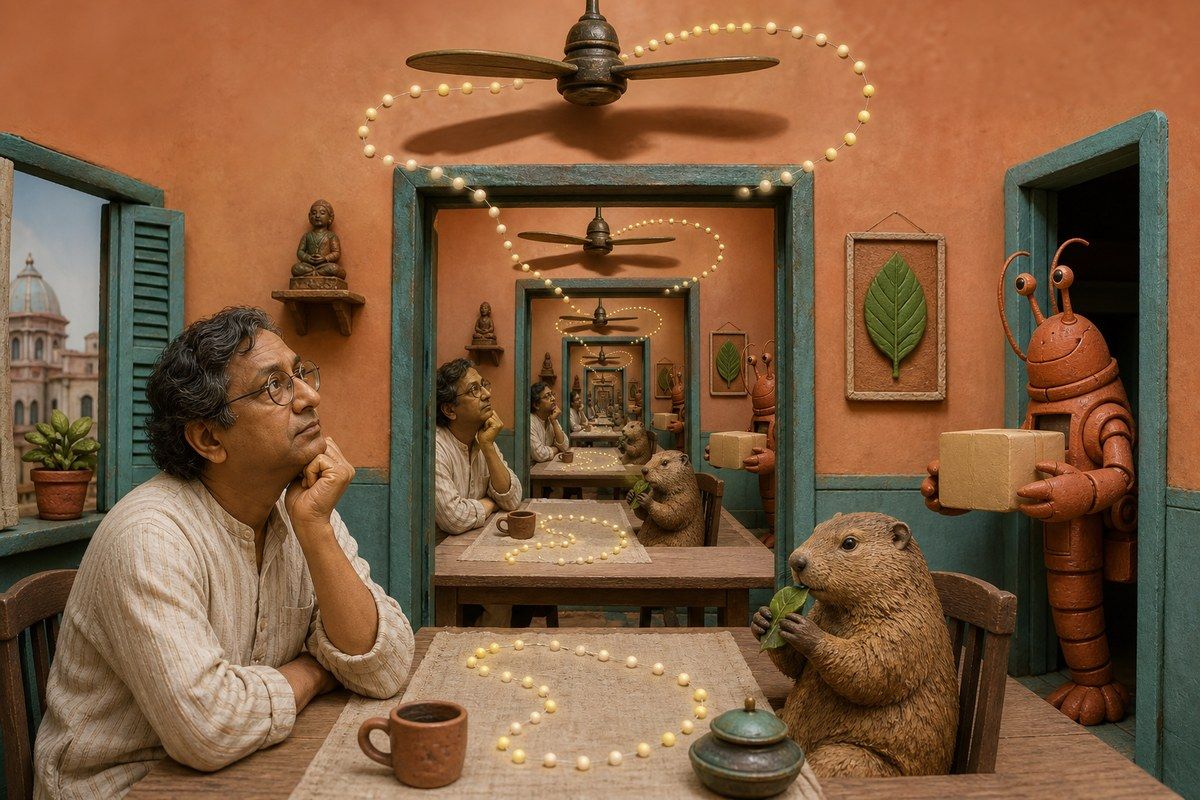
I can understand from the rebound rate of my site that most people don’t find my diarizing writing or my interests worthwhile but I also understand this is not a glitch but a feature of endless supply this frittered attention span, this diluted interest, and I sit here in the gelatinous humidity of a Calcutta July afternoon, the kind of afternoon where the air itself seems to have surrendered to entropy, where the sweat pooling in the small of my back feels less like a biological function and more like a geological process, a slow accretion of moisture and despair, and I think about the fact that Jensen Huang’s leather jacket just sold for nine hundred and sixty thousand American dollars, nine hundred and sixty thousand dollars for a garment that has cradled the armpits of a man whose entire life’s work has been to make human cognition obsolete, and I wonder if there is a more perfect symbol of our era than this, this fetishistic commodification of the very skin that sheathed the prophet of our collective intellectual euthanasia, and I am not angry, or rather I am angry but it is a tired anger, a rheumatic anger, the kind of anger that creaks when it moves, and I think about the rebound rate, the bounce rate, the analytics that tell me with mathematical precision that my words are unwanted, unloved, unread, and I understand, I truly do, that this is not a failure of my prose but a triumph of the algorithm, a triumph of the infinite scroll, a triumph of the dopamine drip that has replaced the slow digestion of thought with the rapid ejaculation of content, and I am fifty-one years old, a Bengali man in Calcutta, and I have lived long enough to remember when attention was not a currency but a gift, when reading was not a transaction but a communion, and now I watch as the world outsources its thinking to machines that do not think, that cannot think, that merely simulate the architecture of thought with the hollow precision of a ventriloquist’s dummy, and I think about the nursery rhymes.
The nursery rhymes, yes, those saccharine little ditties that we coo to our infants, those melodic poison pills that we administer with the benign ignorance of parents who have never bothered to read the fine print on the bottle, and I think about “Ring Around the Rosie,” that cheerful circle of children holding hands and falling down, and I think about the Black Death, the bubonic plague that ravaged Europe in the fourteenth century, the ring around the rosie being the rosy rash that signaled infection, the pocket full of posies being the herbs carried to ward off the stench of death, the ashes, ashes, we all fall down being the cremation of bodies, the mass graves, the annihilation of a third of the continent’s population, and we sing this to our babies, we sing this to our precious, unblemished babies, and we do not know, or we do not care, or we have forgotten, or we have never learned, because learning is hard, learning requires effort, learning requires the slow, grinding, masticatory process of chewing on facts until they become knowledge, and who has time for that anymore, who has the cognitive bandwidth for that anymore, when the algorithm can do it for us, when the large language model can summarize it for us, when the chatbot can think it for us, and I think about the fact that Apple has just unseated Nvidia as the world’s most valuable company, a passing of the torch from one architect of our intellectual diminishment to another, and I think about the fact that Moonshot has just launched Kimi K3, another iteration of the machine that will make us all a little more stupid, a little more dependent, a little more like the brain-dead zombies that I know we are becoming, and I am not a Luddite, or rather I am a Luddite but a sophisticated one, a Luddite who understands that the problem is not the machine but the abdication, the voluntary, eager, almost erotic abdication of our cognitive responsibilities, and I think about the firecrackers.
The firecrackers, yes, those deafening, sulfurous explosions that rock Calcutta every time some country that most of the celebrants will never visit, that most of the celebrants could not locate on a map, wins a World Cup match, and I think about the vicarious nationalism of it, the borrowed triumph of it, the pathetic, almost touching need to belong to something larger than oneself, even if that something larger is a geographical abstraction, a colored shape on a map, a team of strangers kicking a ball, and I have always found some aspect of Calcutta everywhere I have traveled, certainly when I lived in San Antonio, not so much in Austin where I was part of the small close-knit Bengali community, and I think about the fact that I am working on some visualization projects on this blog because I like to see reality or for that matter fiction rendered mathematically, because mathematics is just another language and it has always been my friend, and I think about the grisly histories of some of the things we have accepted as standard pleasant things, the nursery rhymes with their morbid backdrops of a time and place parents can scarcely comprehend, and I think about the fact that the same is true of the best conveniences of our day, the smartphones, the search engines, the recommendation algorithms, all of them built on the large monstrosities of exploitation, depravity, and corporate or societal greed, and I think about the fact that in this miasma we have this atrocious atrophy of cognitive load being summarily offloaded to an AI, the attention was already dying, now it will be dead, and with that any way of retaining the human proclivity to learn or be intelligent, and I think about the fact that ultimately AI will become a misnomer because most everyone alive will be as dumb as a door knob, alive yes, biological yes, but intelligent not so much, just a few generations and we will have brain-dead zombies in the most literal sense, and I think about the fact that I am one of the last generation that will remember what it felt like to think, to really think, to feel the slow, grinding, almost physical effort of working through a problem, of holding multiple variables in my mind at once, of feeling the synapses fire and the connections form, and I think about the fact that my children, if I had any, which I do not, and perhaps that is a mercy, perhaps that is a small act of resistance against the coming idiocy, my hypothetical children would never know this feeling, would never know the pleasure of the solved equation, the pleasure of the understood paragraph, the pleasure of the thought that took ten minutes to think instead of ten seconds to Google, and I think about the fact that the EU has just told Google to share its search data, as if the problem is the monopoly and not the search itself, as if the problem is who controls the offloading and not the offloading itself, and I think about the fact that we are all complicit, we are all collaborators, we are all eager participants in our own diminishment, and I think about the fact that I am writing this on a computer, that I am posting this on the internet, that I am using the very tools of my own destruction to lament that destruction, and the irony is not lost on me, the irony is a heavy, suffocating thing, like the humidity of this Calcutta afternoon, like the sweat pooling in the small of my back, like the slow, inevitable, almost geological process of my own atrophy.
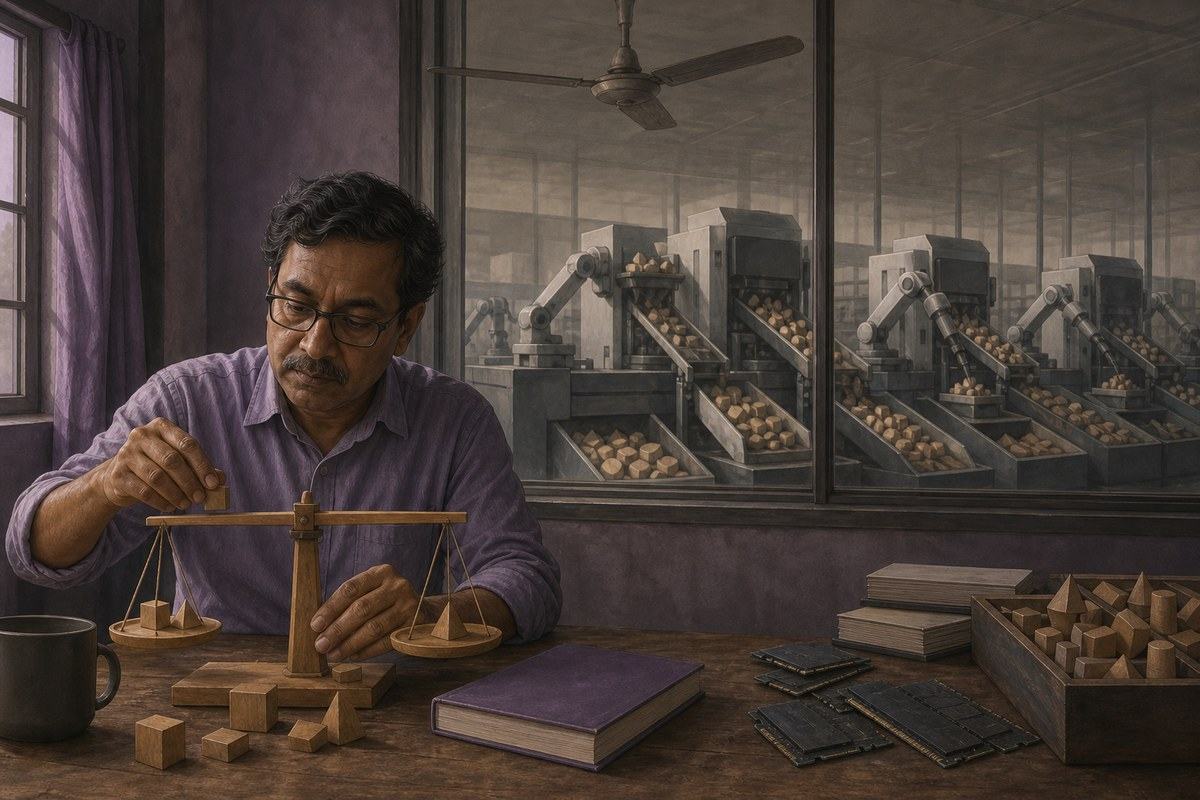
And I think about the fact that Changzhou is building China’s first city-level green token factory, expected to churn out sixty trillion tokens a year, driving the country’s AI clean-power ambitions forward, and I think about the fact that a token is not a thought, a token is a statistical approximation of a thought, a token is the ghost of a thought, the shadow of a thought, the afterimage of a thought that someone else once had, and sixty trillion of these ghosts, these shadows, these afterimages, will be produced every year, and they will be consumed by machines that do not consume, that cannot consume, that merely process, and the humans who consume them will become a little more ghostly, a little more shadowy, a little more like afterimages themselves, and I think about the fact that small firms in mainland China are adopting AI more readily than large ones, and I think about the fact that this is because small firms are more agile, more desperate, more willing to trade their cognitive autonomy for a marginal competitive advantage, and I think about the fact that this is the logic of the addict, the logic of the junkie, the logic of the man who sells his kidney for a fix, and I think about the fact that we are all junkies now, we are all addicts now, we are all selling our kidneys, our frontal lobes, our capacity for independent thought, for the fix of convenience, the fix of speed, the fix of not having to think, and I think about the fact that the rebound rate of my site is not a measure of my failure but a measure of my honesty, a measure of my refusal to cater to the algorithm, a measure of my insistence on writing sentences that are too long, too convoluted, too demanding, too much like the slow, grinding, masticatory process of thought itself, and I think about the fact that this is a small, pathetic, almost invisible act of resistance, but it is the only act of resistance I have, the only act of resistance left to me, the only act of resistance left to any of us who still remember what it felt like to think, to really think, to feel the slow, grinding, almost physical effort of holding a thought in our minds until it became something else, something larger, something that mattered, and I think about the fact that the firecrackers are starting again, somewhere in the distance, celebrating some victory that is not theirs, some triumph that is not theirs, some belonging that is not real, and I think about the fact that I am still here, still writing, still thinking, still sweating in the gelatinous humidity of this Calcutta afternoon, and I think about the fact that this is enough, that this has to be enough, that this is all that is left, this small, pathetic, almost invisible act of resistance, this insistence on the long sentence, the convoluted thought, the demanding paragraph, the slow, grinding, masticatory process of being human in a world that is rapidly, eagerly, almost erotically becoming something else, something less, something that does not think, that cannot think, that merely processes, and I think about the fact that Jensen Huang’s leather jacket is worth nine hundred and sixty thousand dollars, and I think about the fact that my thoughts are worth nothing, and I think about the fact that this is the world we have made, the world we are making, the world we will leave behind, a world of leather jackets and tokens and firecrackers and brain-dead zombies, and I think about the fact that I am still here, still writing, still thinking, still sweating, and I think about the fact that this is enough, that this has to be enough, that this is all that is left, and I think about the fact that the nursery rhymes are still being sung, the babies are still falling down, the ashes are still accumulating, and I think about the fact that we are all falling down, we are all falling down, we are all falling down, and the humidity is still here, and the sweat is still pooling, and the thought is still grinding, and the sentence is still long, and the resistance is still small, and the world is still ending, and I am still here, and that is enough, that has to be enough, that is all that is left.
P.S. The etymology of “atrophy” is from the Greek a- (without) + trophe (nourishment), which seems fitting, as we are all slowly starving our brains of the nourishment of effort, of struggle, of the slow, grinding, masticatory process of thought itself. Also, the WHO reports that Ebola is spreading in the DRC faster than previous outbreaks, because of course it is, because why would anything slow down, why would anything stop, why would anything not accelerate into the abyss with the same eager, almost erotic enthusiasm with which we are accelerating our own cognitive atrophy. And the fact that a literary prodigy in China just lost a master’s degree over plagiarism, sparking two hundred million views, seems like the perfect coda to this whole miserable business: we have become a species that values the simulation of thought over thought itself, the performance of intelligence over intelligence itself, the appearance of knowledge over knowledge itself, and we are all, every single one of us, guilty of this plagiarism, this theft of cognition, this abdication of the only thing that ever made us human, and I am still here, still writing, still thinking, still sweating, and that is enough, that has to be enough, that is all that is left.
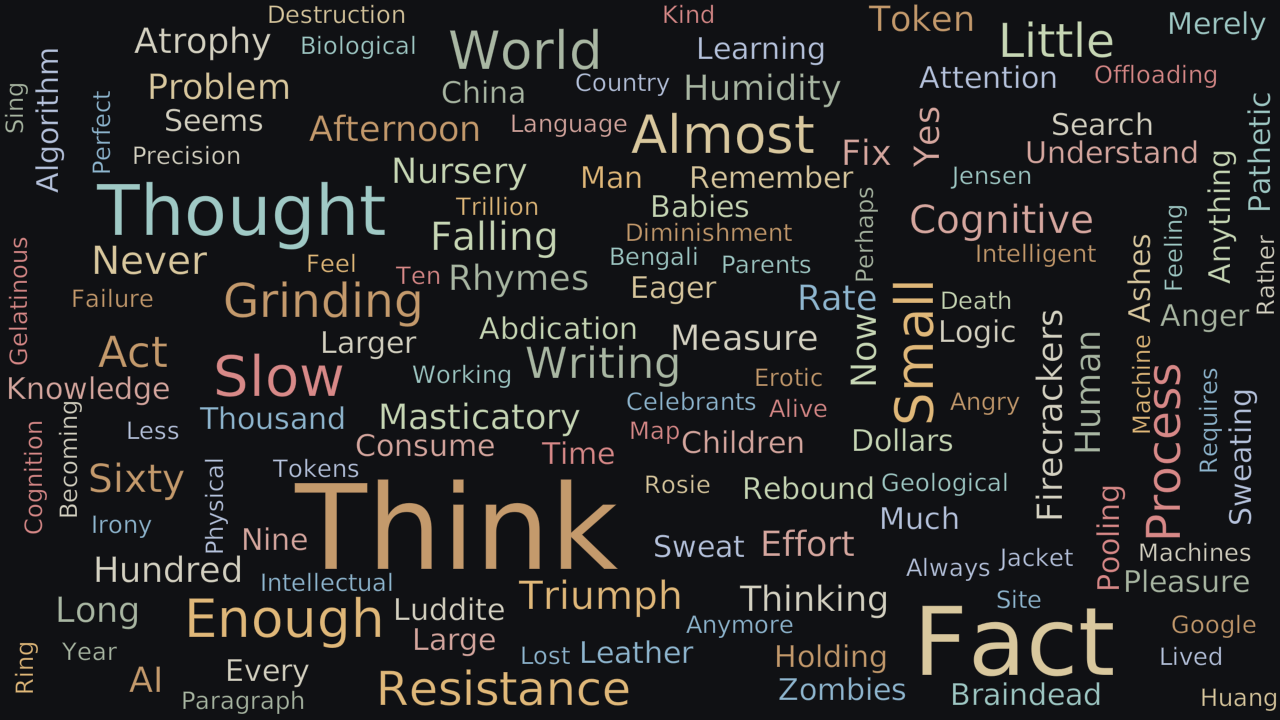
Word Cloud
Related reading
Selected by shared topics and section, with closer publication dates breaking ties.