rainy day motivation
Checking article narration…

The rain has forgotten its calendar. It is November, or whatever the Gregorian calendar calls this particular stretch of the rock’s trip around the sun, and the sky is leaking like a government office ceiling, dripping its bureaucratic gray onto a city that has already forgotten what color the buildings were supposed to be. I am sitting here, a Bengali meat-sack of mostly water and disappointment, watching the moisture breed on my window with the same enthusiasm that mold breeds on forgotten cheese, and I am thinking—no, wait, “thinking” is too generous a word for what is happening inside my skull. I am not-thinking with great effort. I am actively avoiding the electrical storm that would be required to make my neurons fire in the specific pattern necessary to finish the visualization I promised myself I would complete today. The science part of my brain, that arrogant, temperamental prima donna, has locked itself in its dressing room and refuses to come out until it is inspired, or until someone slips a sufficient quantity of caffeine and existential dread under the door.
It is a peculiar form of slavery, this relationship with one’s own cognition. I am the master and the slave simultaneously, the plantation owner and the cotton, the whip and the welt. My prefrontal cortex, that gelatinous tyrant, decides on a whim whether today I shall be a functional human being who contributes to the collective knowledge of the species, or whether I shall instead lie here like a beached whale, contemplating the ceiling fan and wondering if it would support my weight if I decided to become a very ugly chandelier. The fan, for its part, spins with the lazy indifference of a bureaucrat who knows his pension is secure, and I envy it. I envy the fan its single-minded purpose. I envy the rain its ability to fall without questioning whether it is really fulfilling its potential, whether it could perhaps be raining better, more efficiently, with greater impact factor.
I had plans. Oh, the hubris of the previous night’s self, that optimistic idiot who believed that morning-me would be a creature of discipline and vigor! Previous-me is a sadistic architect who designs impossible structures for present-me to inhabit, and present-me is a squatter who has set fire to the blueprints and is using the ashes to warm his hands while he does absolutely nothing of consequence. The visualization awaits, glowing on my screen with the passive-aggressive patience of a disappointed mother-in-law, all those unrendered data points and unsmoothed curves, and I cannot drag my mind to it. Not because it is difficult—difficulty I could forgive, difficulty I could wrestle with the sweaty determination of a man who has nothing left to lose—but because my brain has decided that today, it shall operate on the energy budget of a dying flashlight, flickering weakly in the dark, illuminating nothing but its own imminent extinction.
This is the dirty secret they hide in the fat textbooks, the one they bury under the glossy pictures of Einstein sticking his tongue out and the sanitized biographies of Newton sitting under apple trees like some kind of gravitational monk. The history of science is not a majestic procession of geniuses striding toward truth; it is a cesspool of procrastination, depression, petty rivalry, and men staring at ceilings for decades while their wives wondered why they couldn’t just get a normal job in accounting. We package it now as “The Wonder of Science,” that antiseptic phrase, but behind every elegant equation is a man who probably smelled bad, who probably forgot to eat, who certainly had days where he looked at his own brilliant work and felt nothing but a vast, echoing emptiness, the acoustic properties of which he could have calculated but chose not to because what, pray tell, is the point?
I am tired. Not the noble tired of the laborer who has built something with his hands, nor the satisfying exhaustion of the athlete who has pushed flesh to its limit. I am the tired of the hamster who has been running on the wheel of his own consciousness for fifty-some years and has just realized, with the slow-dawning horror of a man stepping in something warm and unidentified, that the wheel is not attached to anything. It does not generate electricity. It does not move the cage forward. It simply spins, and squeaks, and occasionally the hamster vomits out a blog post about entropy or information theory that three people will read and one will misunderstand. The air outside is damp and polluted, a soup of particulate matter and unfulfilled potential, and I am breathing it in, letting it settle in my lungs like a tenant who refuses to pay rent but also refuses to leave.
The rain continues, uncharacteristically, incorrectly, like a joke told at a funeral or a smile from a tax auditor. It does not care that I am lonely. It does not care that I am sick of my own company, that I have memorized the cracks in my ceiling with the intensity of a scholar studying the Rosetta Stone, searching for meaning in the plaster. The clouds are a blanket that someone has pulled over the city’s head, smothering it with wet wool, and I am suffocating underneath with the rest of the population, all of us pretending that this is fine, that we are not, in fact, slowly mildewing like forgotten bread in the back of a cupboard. Time is going away. I can feel it, that thief, that embezzler of hours, slipping seconds into his pocket while I am distracted by the sheer effort of existing. I am getting older, lonelier, sicker, and tireder, and the worst part—the absolute cherry on this sundae of existential sewage—is that I am aware of it. I am fully conscious of the theft as it occurs. I am the security guard who watches the robbery happen on the monitor and waves at the camera because at least someone is paying attention, even if it is only me, and I am not enough.
Where is the inspiration? Where is that lightning strike, that divine madness, that hypomanic phase that the psychiatrists warn about but which at least has the decency to make me feel like a god for a few days before the crash? It is absent. It has taken a sabbatical. My dopamine receptors have gone on strike, demanding better working conditions, and I do not have the energy to negotiate. I look at the mathematics I love—that beautiful, crystalline language that describes the universe with such obscene precision—and it looks back at me like a dead fish on a slab, eyes glassy, scales dull, smelling faintly of the void. The equations are still true. The science is still magnificent. The universe is still expanding, entropy still increases, and I am still sitting here, a collection of atoms that has somehow become conscious enough to realize that it is unhappy, which is perhaps the cruelest joke the cosmos has ever played on itself.
I wanted to show the wonder. That was the point of this blog, this “raw” corner of the internet where I could strip away the academic varnish and show the blood and guts and seminal stains of discovery. I wanted to take the unpronounceable words—thermodynamics, neurotransmitter, electromagnetic induction—and show that behind each one is a story of a human being fumbling in the dark, tripping over his own shoelaces, accidentally grabbing a handful of truth while reaching for his trousers. But today, the wonder feels like a fraud. Today, the magic trick has been revealed, and I can see the mirror, the trapdoor, the assistant hiding behind the curtain, and I am not impressed. I am bored. I am boring. I am the party guest who has overstayed his welcome in his own life, and the host is too polite to ask him to leave.
So I sit. I watch the rain. I calculate the probability that I will accomplish anything meaningful today and arrive at a number so small it would make a physicist weep, a decimal point followed by so many zeros that you would need a microscope to find the digit that finally admits to being something other than nothing. And yet. And yet, there is a flicker, a spark, the tiniest of rebellions in the meat-machine. Perhaps tomorrow. Perhaps the prima donna will emerge from her dressing room, perhaps the hamster will discover that the wheel is actually a turbine, perhaps the rain will remember that it is November and retreat to wherever unseasonal rain goes when it realizes it is not wanted. Perhaps I will wake up and the science will be there again, glowing not like a dead fish but like a live wire, and I will grab it with both hands and let it shock me back into something resembling vitality.
But that is tomorrow’s delusion. Today, I am the king of a kingdom of damp socks and empty teacups, the emperor of a realm where nothing gets done and the clock ticks with the menacing rhythm of a predator that has already eaten but enjoys the hunt. The clouds press down. The air thickens. I remain. Uninspired. Unproductive. Unrepentantly, unapologetically, unproductively, un-in-everything-that-matters-ly, here.
P.S. The visualization remains unrendered. The universe remains indifferent. I remain, unfortunately, awake.
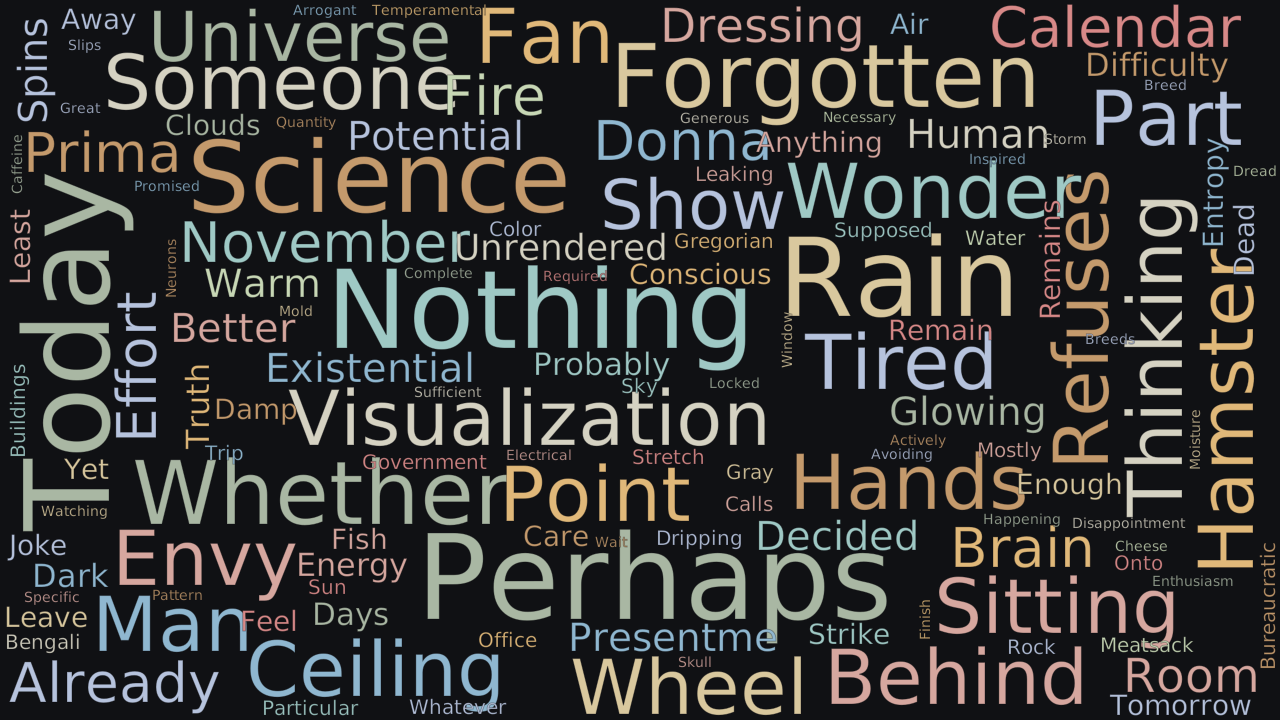
Word Cloud
Related reading
Selected by shared topics and section, with closer publication dates breaking ties.

Comments
Read the conversation or leave a thought for review. Comments load when this section is in view.