August Fifteenth
Uses the speech voice supplied by your browser or device.

It is the fifteenth of August, and my sister Smita—born Ghosh, now Sarkar—turns another year older. I have grown distant from everything I once called my own, yet I wish her good health from the silence I have made my home, a silence so complete it feels less like solitude than like a rehearsal for disappearance. We were children together in South Sinthee, where the walls stayed damp through every season, where the plaster bloomed with soft gray maps of moisture that I now understand were the first geography I ever learned. That dilapidation I call my childhood: the peeling paint, the corridor light that flickered like a failing pulse, the way rain found its way through windows we thought we had sealed. She moved through those rooms with a patience I did not possess, and I remember, with the particular sharpness that memory reserves for what we have lost, that she was the best supporting sister I could have wished for—not in grand gestures, but in the way she knew when to speak and when to let the damp quiet of the house do the talking for her.
Now we are old, though oldness arrives differently for each of us. She has built the life that was expected: a full house, a gentle husband, two children who have become software engineers and are now writing the start of their lives with the clean syntax of code and the optimism of those who still believe the present tense will hold. I watch from afar, a shadow in the frame of a photograph I was never present for, and I feel no envy, only the strange weight of witnessing a life that branched so thoroughly from our shared root. The genes that made us, I think, produce such different beings—she, the one who stayed and thickened into the world; I, the one who thinned out, who became translucent, who disappeared into what feels like my own obituary, writing itself in advance, sentence by sentence, absence by absence.
And this day, her birthday, is also India’s Independence Day, which means the city will dress itself in saffron and green, will fill the air with a nationalism so loud and unapologetic it feels like theater performed by people who have forgotten the script but know the gestures by heart. The jingoistic farce will unfold in endless repetition: the speeches, the anthems, the synchronized clapping of those who are normal, who know how to belong to a collective emotion without questioning its cost. I am not one of them. I will worry instead about the flags I will see strewn across the streets near my house, the cheap polyester triangles that will clog the drains by evening, turning celebration into debris, patriotism into something the sewers must swallow. This is how I experience the day—in the texture of refuse, in the aftermath that no one photographs.
My mother, now very fragile, moves through what remains of our family with a hopelessness that has settled into her bones like the damp of South Sinthee once settled into ours. She is hopeless about any new change in our familial bonds or trajectories, and I cannot blame her. The string of melancholy that runs through us does not need new causes; it has found its source in my disappearance, in the way I have receded so thoroughly into my own obituary that I sometimes wonder if my family remembers my voice, or if it has become one of those sounds that linger in a room after the person has left, indistinguishable from the hum of the refrigerator or the traffic on the street below.
So the emotions swirl, and they stay in thoughts, and they stay in swirls—like the frost decoration on the cake I am sure her daughter will buy for her, that delicate white piping that mimics snow in a city that has never known it, sugar spun into the illusion of coldness. I imagine my sister cutting that cake in a room full of light and voices, her husband beside her, her children leaning in with the easy confidence of those whose lives are still being written in the present tense. And I am there, and not there, a thought that rises and dissolves like breath on a mirror, like the damp that once covered our walls and has now, in my memory at least, become the only wallpaper I can truly call home.
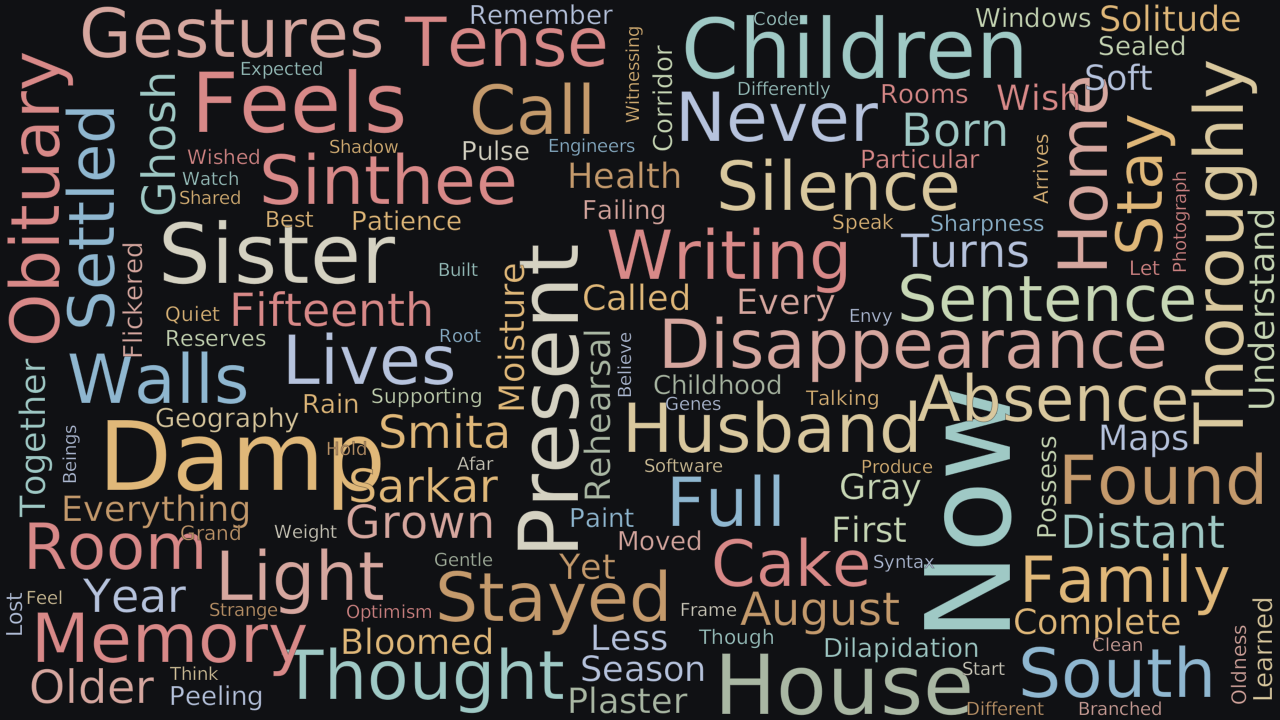
Word Cloud
Related reading
Selected by shared topics and section, with closer publication dates breaking ties.