The Baroque Minutiae
Uses the speech voice supplied by your browser or device.

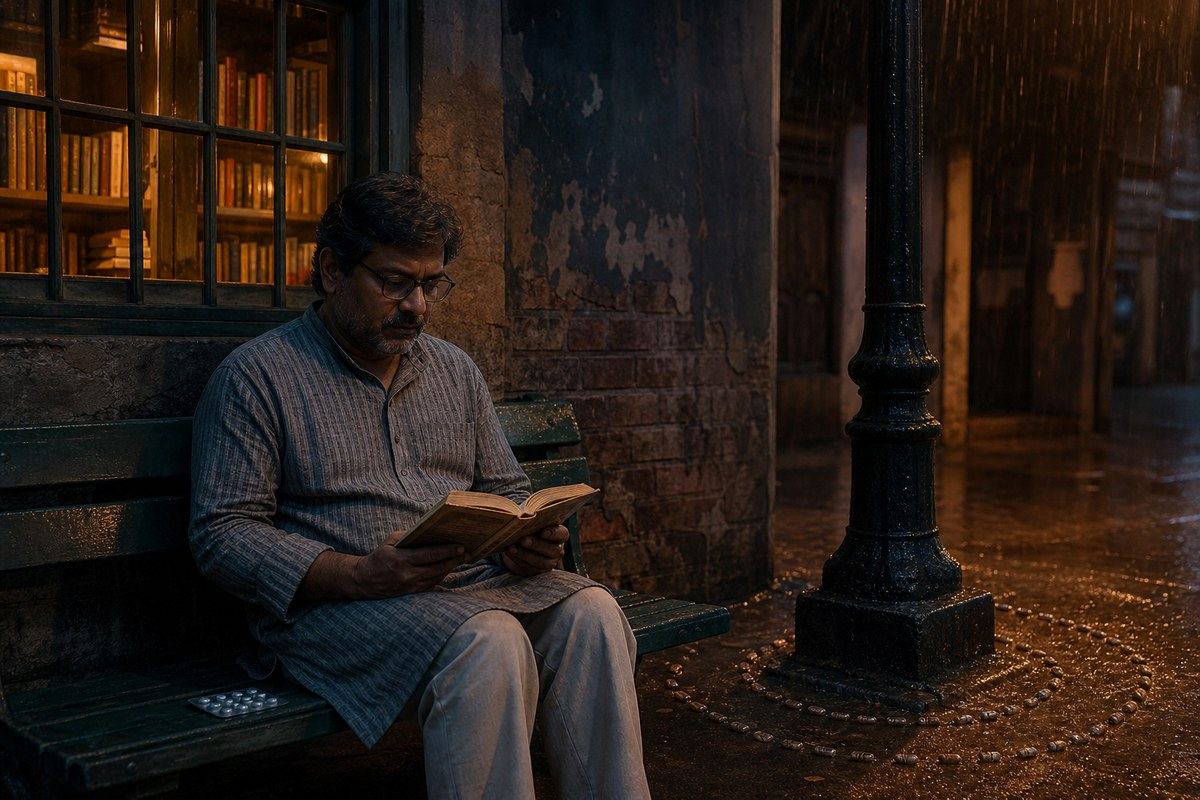
The pill is a small white oval, and it has opinions about my serotonin, which is to say the molecule whose name comes from the Greek serein, to make clear, to calm, as in a sky clearing after rain — and the irony, if irony were something I could afford, is that the drug makes the sky clear in the way a bulldozer clears a field, by removing everything including the trees you did not know you wanted back. It is working, sort of. Sort of is doing all the heavy lifting in that sentence. Sort of is the word for a man standing on one leg in a hurricane and calling it balance. I hope it keeps working, which is to say I am hoping, which is to say I have installed a small prayer engine into my skull and it runs on fumes and denial and the particular Calcutta humidity that makes everything damp with expectation.
And the soporifics. The sleep-drugs, the chemical curtains drawn over the theater of consciousness so that the show can be postponed rather than cancelled. I take them at night like a man taking morphine for a broken bone he cannot afford to set properly, and sometimes — sometimes — they work, and the spirals do not spiral, and the thoughts do not get caught in the spines of interrupted pasts and ambitions, and I wake up and the day is merely a day, merely a rectangle of hours that can be walked through without the particular nausea of being inside my own skull watching it malfunction. And some days are better. Some days are bad. Some moments are livable. Mostly irritable. A sort of hostility for the person inside the bag of skin I cannot change or the trajectory he is on.
The inner restlessness. Still pretty bad. It is not a thought, it is a texture, a grain in the wood of attention, the particular frequency at which the ADHD brain flits — from one worry to another, from one really bad worry to another still worse, like a fly buzzing around a light that is also a threat, circling, circling, never landing, never able to stop the buzzing even when the light goes out. I have done fifteen years of healthcare research in the United States, fifteen years of staring at data until my eyes bled and my marriage frayed, and what I know about systems, about feedback loops, about how a perturbation in one node propagates through the network — I know that the mind is not a system you can debug by adding more compute. You cannot think your way out of a thought. The thought is the compute.
The baroque minutiae. That phrase keeps coming back to me like a splinter, and it fits because the fact is baroque: no money, no future, no peace of mind, each one a separate ornament on the facade, each one a gilded detail that would be charming if the building were not also collapsing. No money — the wallet weeping its little tears of interest. No future — the horizon receding at a rate that makes the treadmill look optimistic. No peace of mind — the mind itself a small room with no windows and a radio that only plays static, and the static is getting louder because the exacerbated mental distortions are not just noise, they are signal, they are the system trying to find a pattern in the white noise and finding patterns that are worse than the noise.
It is like stepping on the same turd over and over again in an everlasting cycle. And sometimes I feel fed up. Fed up is the word. Not despair — despair has a certain architectural dignity, a cathedral quality. Fed up is smaller, more domestic, more accurate: the feeling of a man who has been eating the same stale bread for three years and one morning simply sets it down on the table with a sound that says I am not doing this anymore, and then picks it back up because what else is there. The cycle does not break. The cycle is the architecture. You do not escape the cycle; you learn to walk it at a different pace, or you stop walking, which is its own kind of escape but requires a courage I have not yet budgeted for.
The etymology, because when you are broke and desperate you think of etymologies: restless comes from Old English ræstlēas, rest without, the Germanic compound that built my condition into a word before I was born, rastlos in German, rusteloos in Dutch, the whole Northern European linguistic family agreeing that this particular state has a name, a small dedicated noun for the man who cannot stop moving because stopping is the same as dying. And anxiety — Latin anxietas, from angere, to choke, to strangle — so the Romans knew, the imperial bastards who built roads and aqueducts and the entire concept of institutionalized paranoia, they understood that anxiety was not a feeling but a physical act, a hand around the throat that is your own hand but you cannot remember hiring it. I choke, therefore I am. Descartes got it wrong; it is not cogito ergo sum, it is suffoco ergo sum, I suffocate, therefore I exist, and the proof of my existence is the very act of gasping.
The bipolar type II — not the grandiose mania of the movies, not the beautiful destructive energy that poets write about, but the grinding, churning, low-grade fever of existence, the hypomania that makes you think you can write your way out of this, that makes you think if you just stay up for three more hours, if you just send one more email, if you just explain yourself clearly enough the world will see your value and save you from the chorus of pretensions that is swelling like a tumor in the cloud — and then the depression that says no, they will not, you are nothing, you are a small rude noise in the vast silence of the universe, a puff of breath escaping a mouth that forgot it was still attached to a face.
Some days I am livable. Some days I am not. The pill works sort of. The soporifics work sometimes. The restlessness is still pretty bad. The worries spill over. The spirals spiral inward furiously, spinning slow then fast then out of control, and I am inside the bag of skin, watching the trajectory, unable to change it, hostile toward it, fed up with it, stepping on the same turd in the everlasting cycle.
And yet I write. And yet the cursor blinks. And yet the day is merely a rectangle of hours that can be walked through. The baroque minutiae perpetuate themselves. The mental distortions exacerbate. The spines of interrupted pasts and ambitions catch the thoughts like a rake catches leaves, gathering them into a pile that is also a tomb.
I am still here. Still making sounds. Still hoping, despite everything, despite the evidence, despite the arithmetic of my bank statements and the geometry of my shrinking prospects. The pill is working sort of. I hope it keeps working. Sort of is all I have.
P.S. References: angere (Latin, “to choke”); serein (Greek, “to make clear”); Old English ræstlēas; René Descartes, Meditations on First Philosophy.
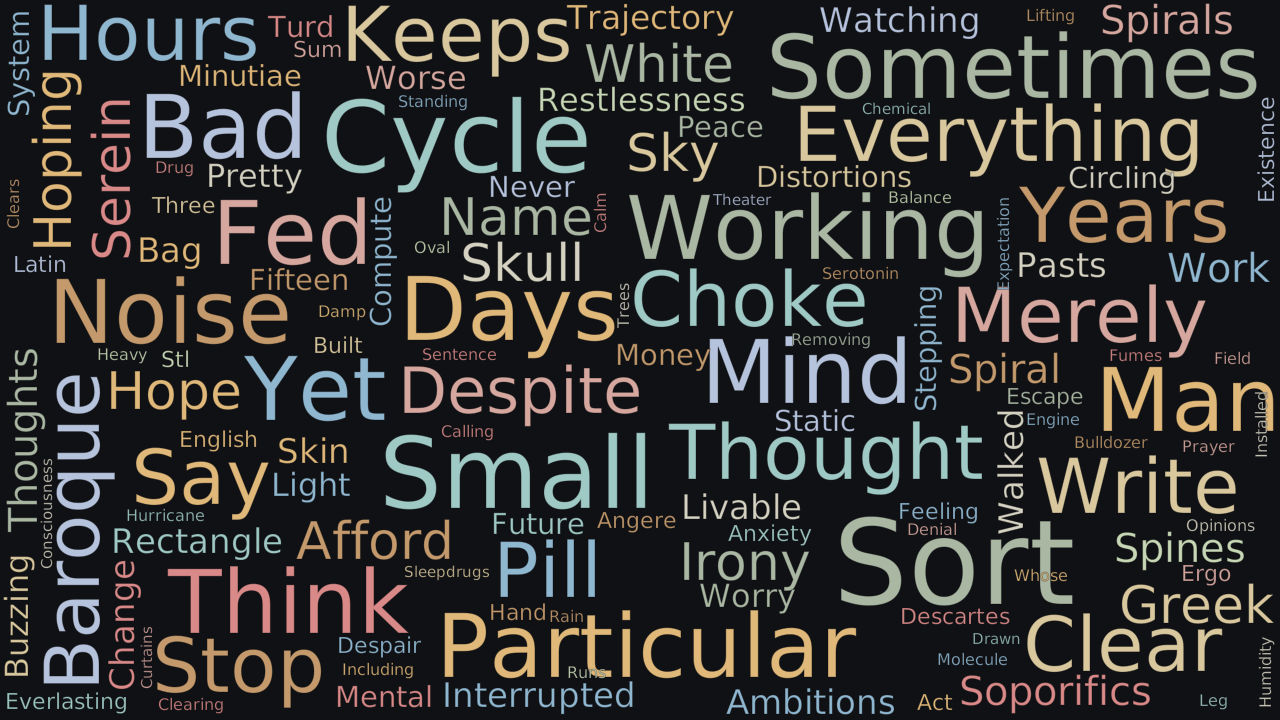
Word Cloud
Related reading
Selected by shared topics and section, with closer publication dates breaking ties.