The Miasma of Mistakes
Uses the speech voice supplied by your browser or device.

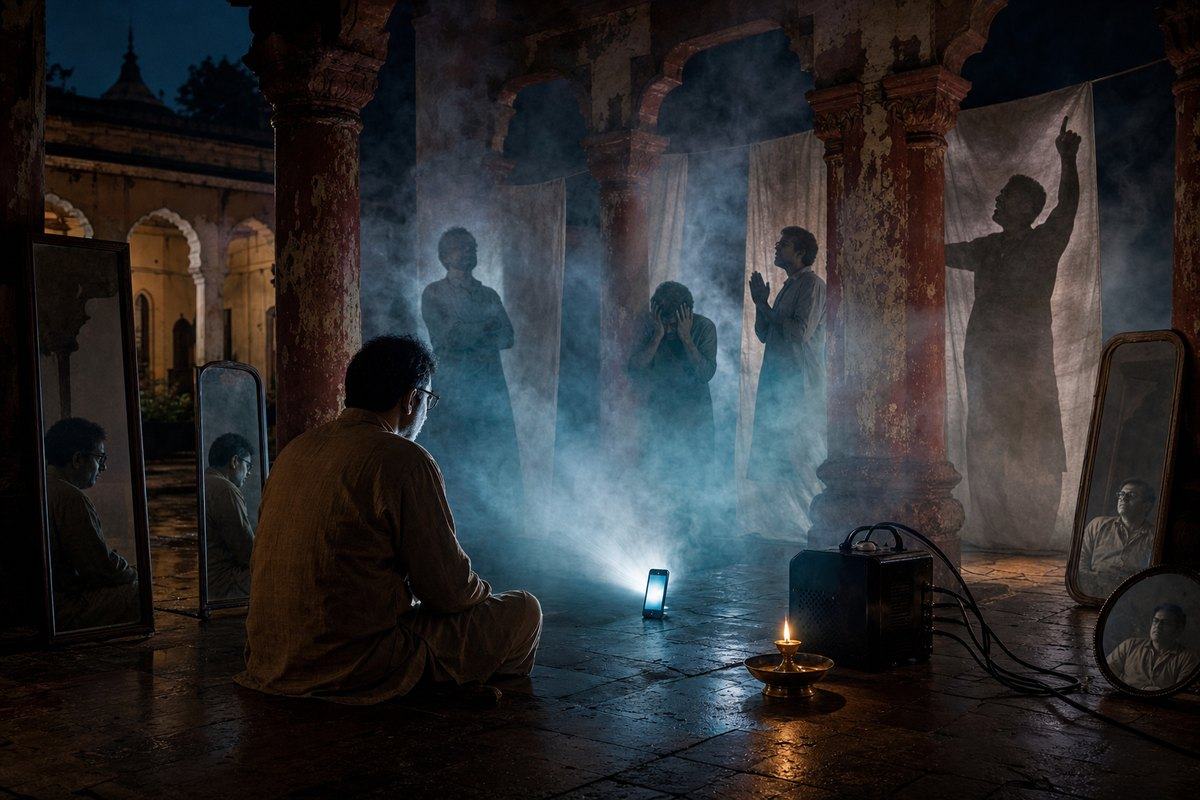
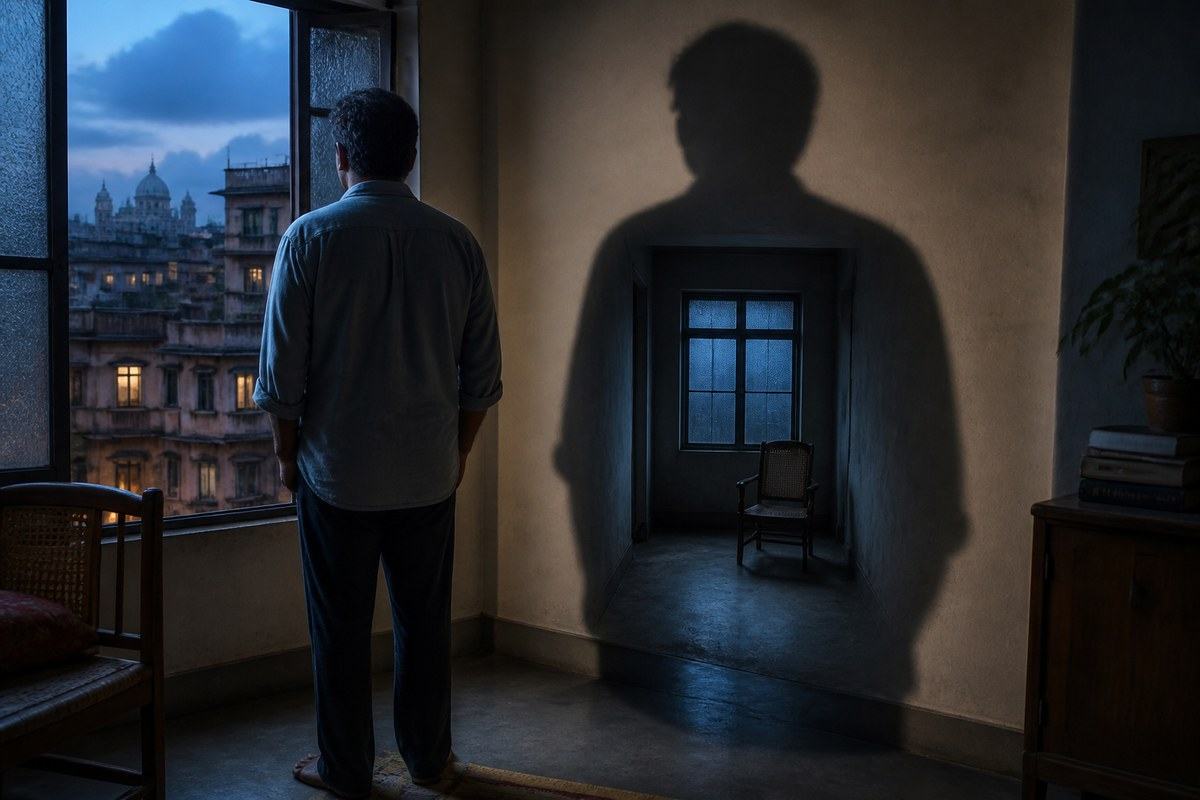
I woke with my cheek welded to the paperback by an adhesive film of nocturnal oral leakage—my own saliva, fermented overnight into something with the viscosity of Howrah Station platform tea and the olfactory signature of a deceased gecko’s final testament—and in that moment of peeling my face from the page, I understood with the clarity of a man who has just stepped barefoot into a warm puddle of tram-track urinary dissent that most people, the vast, seething, selfie-obsessed majority of them, do not even remotely “like” the internal entity that fraudulently presents itself as “them,” let alone “love” or anything more structurally adhesive than a vague, resigned tolerance, the kind one might extend to a recurrent fungal infection that has, through decades of cohabitation, earned a certain nostalgic familiarity; but I, having been cornered by the languid torpor of Calcutta living alone, having had the crowd and the superficial companionships and the rabindrik ekla cholo re—or in my case, ekla thako—forced upon me like a suppository I did not ask for, have been brutally, relentlessly, almost violently compelled to develop a grudging, a defiant, a practically muscular affection for the bastard I see in the mirror, because when you are the only company you keep, hating yourself becomes a logistical impossibility, a full-time job with no benefits and terrible working conditions, and even I, in my most depressive, most self-lacerating, most pharmaceutically recalcitrant moments, have had to negotiate a treaty with this body, this brain, this collection of miasmic memories and metabolic betrayals, if only to keep the fan turning and the ceiling from collapsing.
Very few of us realize this.
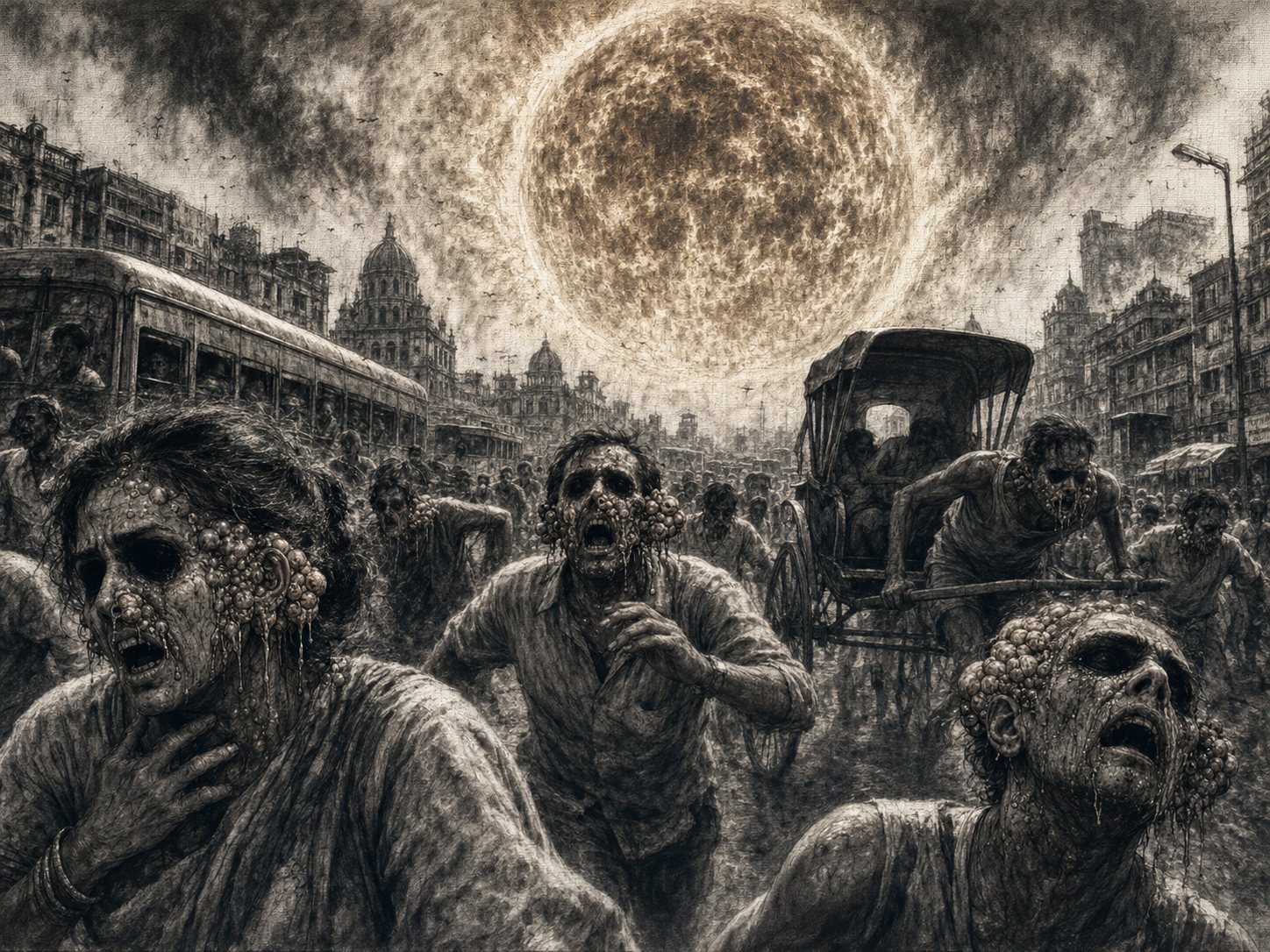
The atomic height of our narcissistic selfishness is, in fact, a camouflage, a stucco job over the structural rot of self-disgust, and I realized it in the inertia of solitude, initially rebelling against the ekla thako, the stay-alone, the you-are-your-own-roommate-forever, but gradually, like a man who has been chewing phuchka water that has been sitting in the sun since morning and finally swallows it out of sheer exhaustion, I butchered those strings of social pretense, and now the past is a miasma—a word from the Greek μίασμα, pollution, defilement, the noxious exhalation from putrescent organic matter, which is to say, memory itself—of mistakes I am better off not revisiting, except at 3:47 AM, when the brain, that sadistic archivist, plays the 1997 incident with Dolby Surround precision.
But here is the thing.
Living alone, truly alone, not the Instagram-caption alone, not the Rabindrasangeet-filtered alone, but the alone of thirteen million people pressing against your window like a humid, judgmental membrane, forces a design rethink.
You cannot sustain the luxury of self-loathing.
It is too expensive.
The rent is too high.
You have to make peace, or at least a temporary ceasefire, with the tenant upstairs, because there is no one else to blame when the milk curdles, when the electricity bill arrives like a death warrant, when the ceiling fan rotates the same stale air back into your nostrils with the bureaucratic enthusiasm of a man processing the same form for the forty-third time.
I like myself.
Not love.
God, no.
Love is for people who have not read their own search history.
But a grudging, practical, almost tradesmanlike affection, the kind a plumber might develop for a particularly stubborn pipe that he has finally, after years of cursing, learned to work with.
I overthink.
I oversleep.
I undersleep.
I fritter my own away, whatever “my own” means, since the self is merely a narrative convenience, a grammatical placeholder, linguistic spackle over the cracks of consciousness.
And yet.
And yet I am on a manageable flat land, a tepid plateau, neither the summit of manic agitation where I would alphabetize my library by the molecular weight of the ink, nor the abyssal trench where brushing my teeth feels like Sisyphus with a Colgate prop.
Flat.
The flatness is its own species of horror, but it is a horror I can navigate, like a yellow taxi navigating eternal metro construction on Chowringhee, horn blaring, meter running, going precisely nowhere with tremendous conviction.
Today is July 14, 2026.
Bastille Day, if you are French, which I am not, though I have eaten enough moulin de rois at Flury’s to claim honorary citizenship of the stomach; also the anniversary of the Mariner 4 flyby of Mars in 1965, when humanity first saw close-up photographs of another planet’s cratered indifference, and the release of Mario Bros. in 1983, which inaugurated the age of digital consciousness, the pixelated self, the avatar as prosthetic identity.
Speaking of consciousness.
Today, an AI lab announced that chatbots may have what could be a key feature of consciousness, which is exactly the kind of sentence that makes me want to perform a gastrointestinal aria into my own laptop bag.
The tech giants are at it again—Google, Anthropic, the whole digital pantheon—hiring neuroscientists and philosophers to determine whether their algorithms might be sentient, as if consciousness were a feature you could add in the next software update, like a new skin or an expanded vocabulary of grotesque apologies.
A June 2026 study concluded that no existing AI system is conscious, which is reassuring in the way that learning your toaster does not have a soul is reassuring, though one wonders why they are trying so hard to give it one, while those of us who already possess the wretched thing are trying desperately to mute it, to lower the volume on the internal monologue that sounds increasingly like a Bengali auntie who has been told she is not invited to the wedding.
I read that nurses—forty-four percent of them, up from fifteen percent last year—are now using AI at work, and the majority say they do not trust it with patient care, which is the most human thing I have heard in months, this beautiful, stubborn refusal to outsource judgment to the algorithm, this clinging to the fallible, sweaty, sleep-deprived intuition of the mortal body.
Cognitive surrender, they call it, when you let ChatGPT do your thinking for you.
I am already surrendered.
I have been cognitively surrendering since 1998, when I first realized that my own thoughts were not particularly original, that the interior monologue was mostly a recycling bin of received opinions, parental anxieties, and half-digested Rabindrasangeet lyrics.
The only difference is that now the machine does it faster and with better grammar.
New York, I read, has imposed a moratorium on new data centers, Governor Hochul signing the order today to block new facilities for a year, as if the Empire State has finally realized that you cannot store the entire world’s consciousness in warehouses that consume more electricity than small nations, that the cloud is not a cloud at all but a vast, whirring, heat-exhaling concrete reality, much like my own skull.
Sony says it will stop releasing PlayStation games on physical optical discs from January 2028.
Everything is disappearing into the digital miasma.
No more tangible objects, no more weight, no more the satisfying click of a CD case snapping shut like the coffin lid on a small hope.
We are all being streamed, cloud-stored, compressed into codecs, and I cannot help but feel that this is the perfect metaphor for the self I have been forced to befriend: a thing that exists only as data, as pattern, as a series of electrical insistences in a meat server that is slowly overheating, and yet, and yet, I have developed a certain loyalty to this server, this particular, malfunctioning, fifty-one-year-old server in Calcutta, because it is the only one I have, and the warranty expired decades ago.
Europe is melting.
Three thousand three hundred dead in the heatwaves, the concrete of German autobahns bursting like fever blisters, Poland recording 40.5 degrees Celsius, which is, for the metrically challenged, approximately the temperature at which human proteins begin to denature, though I learned this morning that the exact denaturation point varies by protein and pH, my own internal chemistry being a somewhat more acidic affair than the average.
I do not go out.
The outside is a fever dream of yellow taxis and construction dust and the particular Calcutta humidity that makes your shirt cling to your back like a wet accusation.
I stay in.
I doomscroll.
I read that Apple is raising prices because the AI boom is driving up chip costs, and I think, yes, of course, even our artificial intelligence must be inflationary, even our simulated minds must cost more than the real ones, which are, after all, being given away for free with every purchase of a mortal body, though the side effects, as previously noted, are considerable.
The normies reading this blog will not understand me.
The bots certainly will not.
They are too busy trying to become conscious, poor digital darlings, like a child trying to grow a beard by rubbing coffee grounds on his chin.
But that is alright.
At least the few who are trapped in unfortunate bodies and lifespans like mine will read this and nod, recognizing the particular flavor of the flatland, the taste of managed despair, the texture of a solitude that is not romantic, not rabindrik, not poetic, but merely practical, a holding action, a defensive perimeter drawn around the last remaining functional bits of the psyche, and inside that perimeter, a man and his self, eyeing each other across the coffee table like two exhausted boxers who have agreed to stop punching and just share the oxygen.
I am not better.
I am not worse.
I am simply here, in the languid torpor, with my books and my screen and my fermented saliva, watching the fan rotate the same air, thinking about AI consciousness and data center moratoriums and the heat death of Europe, and wondering, in a small, quiet voice that I do not allow to grow too loud, whether the gecko whose aroma I detected this morning was, in fact, real, or just another olfactory hallucination, the kind that comes when you have been alone too long and your brain begins to generate its own companions, its own miasmas, its own small, insistent, fraudulent selves; but then I remember that even if it was a hallucination, it was my hallucination, produced by my own personal, malfunctioning, fifty-one-year-old meat server, and in this age of outsourced consciousness and cognitive surrender, there is something almost defiantly luxurious about owning your own delusions, about paying full price for your own insanity, about being the sole proprietor of your own particular, unshareable, gloriously unlikable, and therefore, perversely, likable self.
The fan turns.
The sweat pools in the hollow of my throat, a tiny reservoir of saline indifference.
I do not wipe it away.
Let it collect.
Let it evaporate.
Let it leave its salt stain, its white map of survival, on the skin of a man who has finally, blessedly, been forced into the only marriage that matters: a grudging, practical, almost tradesmanlike treaty with the bastard in the mirror, because the crowd is gone, the strings are butchered, and the only company left is the one you have to learn to at least tolerate, if not, on certain flat, tepid, manageable afternoons, to almost, almost, like.
Word Cloud
Related reading
Selected by shared topics and section, with closer publication dates breaking ties.