The Tenant Upstairs Finally Unplugs
Uses the speech voice supplied by your browser or device.

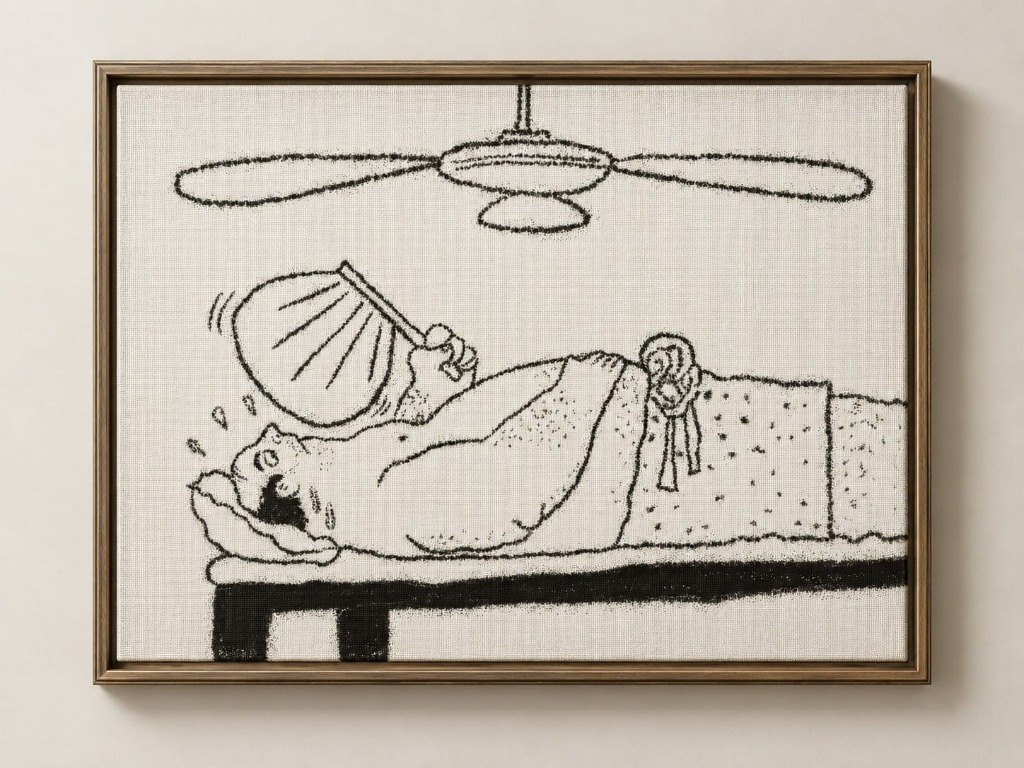
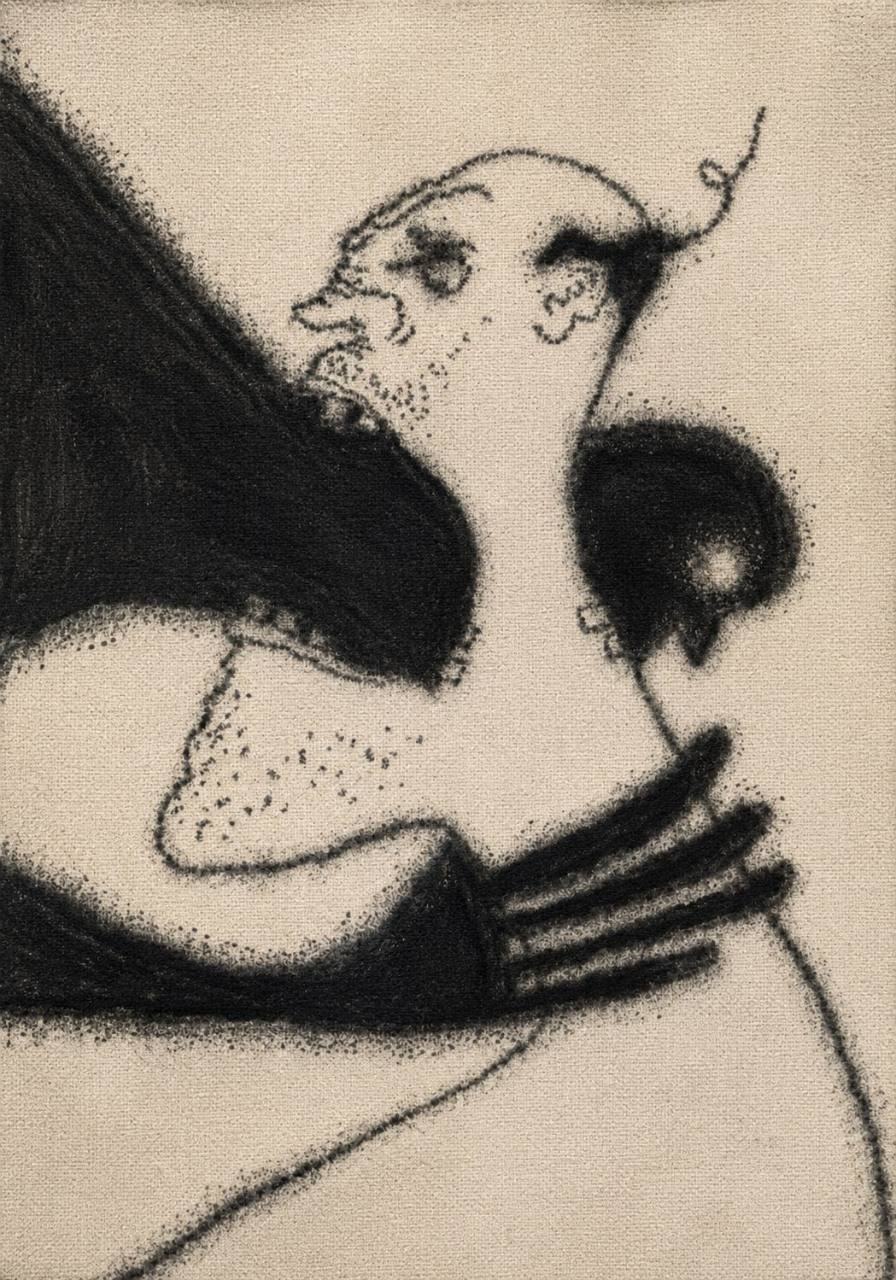
The tenant has been subletting my skull since before I was born, and he has never once paid a single rupee of rent, the freeloading, synapse-firing, cortical-squatting bastard. All day he sits with his chair jammed against the inside of my forehead, broadcasting his little pirate radio station at frequencies only I can receive, and the programming is, without exception, garbage. He predicts. He accuses. He rehearses conversations that will never happen with people who stopped thinking about me decades ago. He reopens files that were sealed by mutual consent in 2009, 2014, and that particularly humid Tuesday in 2019 when I made the mistake of being alive in public. He invents disasters with the fervor of a Bengali auntie inventing gossip at a wedding, and the disasters are always more plausible than the wedding. I read to shut him up. I drink tea, that bitter, tannic, copper-kettle sedative of my people, to drown him out. I solve technical problems, I debug code, I calculate, I conjugate, I do anything, anything at all, to make him look away from me for one blessed second. But he always comes back. He always resumes broadcasting. He is the tenant who has mistaken the entire building for his room, and the building, regrettably, is me.
But then, some nights, sleep arrives like the Calcutta Municipal Corporation finally cutting his illegal electrical connection.
The transition is not graceful. It is not the soft-focus, lavender-scented, yoga-instructor nonsense they sell you in wellness magazines. It is a brownout. A sagging of voltage. The sentences I was so carefully constructing—brilliant ones, mind you, the kind of thoughts that would have revolutionized epistemology if only I had remembered them—begin to shed their grammar like a local train shedding passengers at Howrah Station, violently, without ceremony, each fragment stumbling off into the dark before the next one arrives. A problem I was solving, a genuine problem, a problem with structure and variables and dignity, stops demanding its immediate answer. The urgency dissolves. The mind that spent fourteen hours insisting that everything is code-red critical, that the email must be answered, that the mistake must be analyzed, that the future must be pre-emptively grieved, begins dropping its props on the floor. A memory becomes an image. The image becomes nonsense. The nonsense becomes, if I am lucky, nothing at all.
It is not peace. Peace is too grand a word, too spiritual, too much like something a man in white linen says while charging you for the retreat. This is more like temporary separation, the kind where you do not file the papers but you sleep in different rooms, and for a few minutes neither of you is shouting.
I have bipolar II, which is sometimes spoken of as though somebody ordered bipolar disorder with the mania taken out and a smaller portion of madness on the side. It is not bipolar-lite. The clinical distinction is duller and more precise: bipolar II involves episodes of major depression and hypomania rather than the full manic episodes that define bipolar I. My own highs have rarely been the cinematic sort anyway. The lows, on the other hand, have had ambitions in geology. And let me tell you, the tenant loves this arrangement. He loves it the way a bureaucrat loves a new file, the way a fungus loves a monsoon wall.
During the day he is a commentator who never sleeps, a predictor who is always wrong but never in doubt, a prosecutor who has appointed himself judge, jury, and the particularly sadistic clerk who enjoys stamping the rejection notices. But in those few minutes before sleep, when the hypnagogic state begins its slow, dirty, magnificent work—ah, there, the transmission stutters. The gears still turn, the machinery still hums, but I am no longer standing beside it with my ear pressed to every grinding cog, taking notes, taking blame, taking attendance. I am no longer arguing with myself, explaining myself to myself, defending myself against myself in a court where I am simultaneously the accused, the advocate, and the particularly thick-headed judge who keeps forgetting which side he is on.
The whole ridiculous tribunal adjourns. The witnesses go home. The evidence is left to molder in the dark, and the dark, for once, does not seem to mind.
The neuroscientists, those cheerful anatomists of the ineffable, have mapped parts of this territory with their usual combination of genius and complete absence of poetry. They call this threshold hypnagogia, from Greek roots for sleep and leading: the leading-into-sleep, which is a rather elegant expression for what feels like being mugged by your own consciousness in a dark alley.
They have their electrodes and polysomnography and spectral plots. As wakefulness gives way to the lightest stage of non-REM sleep, the tidy alpha rhythm of relaxed wakefulness gives way increasingly to slower, theta-range activity. Then, if the brain continues successfully down the staircase instead of remembering an unpaid bill and sprinting back upstairs, N2 sleep arrives with sleep spindles and K-complexes, those marvelous electrical signatures that do not exactly mark a national border between consciousness and unconsciousness because the brain, inconsiderate bastard that it is, has refused to provide customs officers.
The thalamus does not simply shut its gates like a bored clerk at Writers’ Building. Sensory processing and thalamocortical communication change as sleep deepens; responsiveness to the outside world diminishes without the brain becoming deaf, blind, or electrically dead. The frontal and frontoparietal systems involved in attention and executive control change their activity too, although the prefrontal cortex does not literally punch a time card and go home. Even the default mode network—that sprawling set of regions implicated in self-reference, autobiographical memory, mind-wandering, and the production of the endless unauthorized documentary called Me—does not simply dissolve at the first yawn. Its connections reorganize across the descent into sleep, with some long-range relationships weakening as sleep deepens.
Which is scientifically less dramatic than saying the self is switched off at the mains, but unfortunately neurons have never shown much respect for my metaphors.
What matters to me is the subjective trick produced by all this rearrangement: the narrative loses its grip. Thought stops marching and begins wandering around barefoot. Language loosens. Images arrive without passports. Logic develops holes. The external world retreats a few inches. The internal world stops bothering to maintain minutes of the meeting. Somewhere between awake and asleep, the machinery responsible for keeping Suvro Ghosh continuously updated on Suvro Ghosh becomes unreliable.
Thank God for technical failure.
And on the nights when sleep actually behaves like sleep—when it does not open the nightmare department, that special, subsidized wing of my psyche where the horror is always bespoke and the tailoring is always perfect—that distance is enough. It is not salvation. It is not enlightenment. It is not the oceanic feeling of the mystics or the void of the Buddhists or any of that expensive nothingness. It is simply the gap between the mind and me, a gap no wider than the space between two heartbeats, and in that gap, for a few minutes, I am not the building. I am not the tenant. I am not the broadcast or the static or the emergency bulletin.
I am the silence between stations, and the silence, unlike everything else, does not ask me to explain myself.
The Chandogya Upanishad says, sarvam khalvidam brahma—all this, indeed, is Brahman. The verse is not, inconveniently for this essay, an ancient neurological description of falling asleep. It belongs to a much larger metaphysical meditation on Brahman, existence, and contemplation. But I have always suspected that the sages would forgive me for stealing a corner of it. If all this is Brahman, then presumably the tenant qualifies too: the broadcast, the relentless self-important chatter, the memory that arrives uninvited at 2:17 in the morning carrying documentary evidence from 1998, the whole ridiculous sacred mess.
Perhaps the point is not that the mess disappears. Perhaps I merely stop serving as its stenographer.
You need the gap. You need the brownout. You need those few minutes when the mind, that overworked, underpaid, perpetually panicking servant, finally sets down his tray and wanders off without completing the paperwork, and for once, for once, nobody is asking me to be the master, or the servant, or the building, or the room.
Sleep is not kind. Sleep is often a bastard, a withholding, sadistic, schedule-ignoring bastard who shows up late, leaves early, and sometimes brings nightmares instead of wine. But the approach, the slow, sloppy, hypnagogic approach—that is the only regular truce I know, and I take it whenever it comes, like a man taking the last cigarette from a stranger, grateful, suspicious, and already wondering how long before the tenant notices the power is back on.
P.S. References: For the hypnagogic state and its terminology, see Romain Ghibellini and Beat Meier, “The Hypnagogic State: A Brief Update,” Journal of Sleep Research (2023). For sleep-onset neurophysiology, N1/N2 staging, thalamocortical changes, and changing functional connectivity during the transition from wakefulness to sleep, see the modern sleep-onset and sleep-neuroimaging literature. Bipolar II is clinically distinguished by major depressive and hypomanic episodes without the full manic episodes characteristic of bipolar I. Sarvam khalvidam brahma appears in the Chandogya Upanishad, 3.14.1, commonly translated as “All this is Brahman” or “All this indeed is Brahman.” Nathaniel Kleitman and William Dement remain foundational figures in modern sleep research, but the specific network-level claims above come largely from later EEG, polysomnographic, and neuroimaging work.
Word Cloud
Related reading
Selected by shared topics and section, with closer publication dates breaking ties.