The Chair and the Drain
Uses the speech voice supplied by your browser or device.

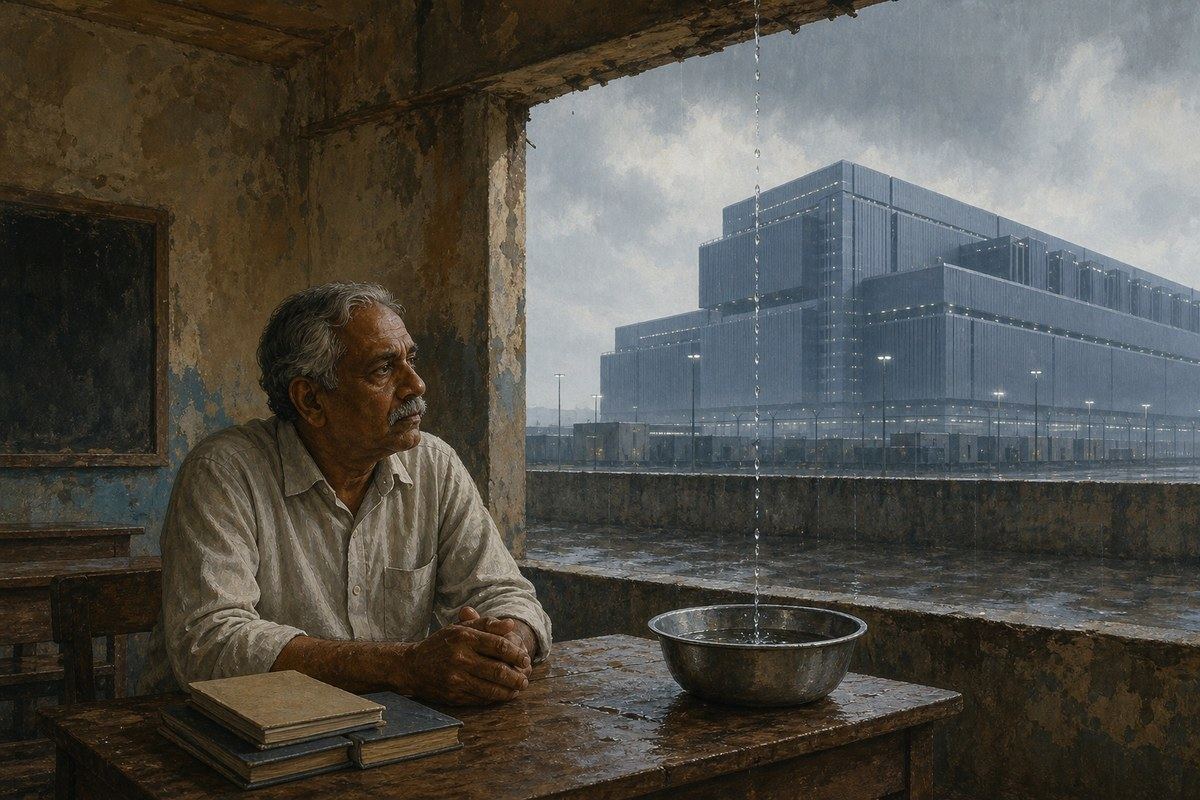
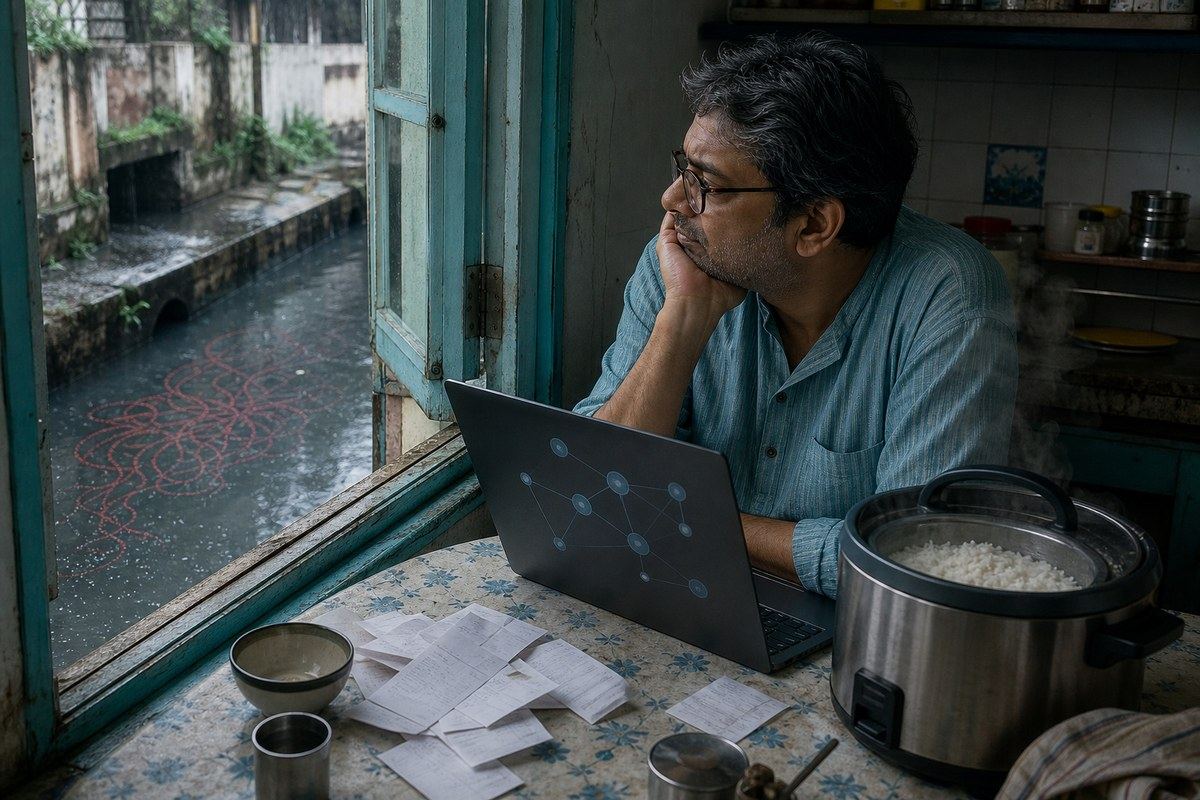
The smell comes through the window first, always the smell, a vegetal thickness of rotting paper and warm polyethylene and something older, something that reminds you that Calcutta was built on a delta, that the Hooghly is not far, that all drainage here is theoretical. I live in a building on a lane off main road and the municipal drain below has been open for eleven months. They came in August last year, the gentlemen from the Kolkata Municipal Corporation, with their helmets the color of faded limes and a backhoe that wheezed like an emphysema patient, and they dug, and they laid new pipes, or so the corrugated tin sign proclaimed, and then they left, and the monsoon arrived, and the water simply decided not to move. It sits there now, a viscous, malachite soup in which you can observe, if you lean out far enough and squint through the humidity, the occasional plastic bottle performing a slow, dignified rotation, and sometimes a dead rat, bloated, cruising with the serene indifference of a pensioner on a ghat. This is the image I wake to. This is the image I return to when I read, on my laptop with the cracked hinge, that Micron has shattered earnings estimates and global AI optimism has been reignited, that Morgan Stanley expects AI-related debt issuance to top five hundred billion dollars this year, that the hyperscalers—Alphabet, Amazon, Microsoft, Meta—are spending seven hundred billion dollars on infrastructure in 2026 alone.
Seven hundred billion. I look down at the drain. The numbers do not seem to belong to the same species of reality.
But they do. They do because I have watched the industry, or rather been adjacent to it, close enough to understand the machinery, the vast, thrumming back-office apparatus of Indian IT, that extraordinary machine which convinced the world that labor arbitrage was a business model and that English-speaking graduates in cheap cotton shirts could be repackaged as “knowledge workers” with sufficient PowerPoint animation. Body shopping, we called it in the corridors, though never to clients. The brown arbitrage. The overnight delta. Send five engineers to New Jersey for the price of one local hire, rotate them every six months before they develop an accent or a preference for daylight, and pocket the spread. It was not sustainable. Everyone knew it was not sustainable. But it was comfortable, in the way that a chair with one broken leg is comfortable if you do not shift your weight too suddenly.
Now the chair is being replaced, or rather, we are being told to sit in a new one. An AI chair. The Nifty IT index is down twenty-five percent year-to-date. The reports say that nearly thirty percent of the industry is at risk of GenAI-led deflation, that traditional services revenues could shrink by two to three percent annually for the next few years, that the effort-based pricing model—which is to say, the model of charging by the human hour, the model upon which the entire edifice was constructed—is dissolving like a sugar cube in the tea of automation. HCLTech’s CEO says AI currently accounts for four percent of business but could reach two and a half to three billion dollars. The language is careful. “Could.” “Incremental TAM.” “Back-ended opportunity.” These are the sounds of a man describing a life raft while standing on a deck that is, technically, still above water.
I close the laptop. The ceiling fan wobbles. It has wobbled for six years. I do not fix it because fixing it would require a carpenter, and the carpenter would require a conversation, and the conversation would require an acknowledgment that I have surrendered to the inertia of this city, this flat, this life of watching things happen to other people in other places while the humidity curls the pages of my books.
The books are important. I read them because they remind me that thinking was once a slower process. That epistemology did not require a subscription to an API. That the word “intelligence” once meant something that accrued over decades, not something that could be summoned by a prompt. But I am not a Luddite. I am too tired for Luddism. Luddism requires a muscular certainty, a faith that smashing the loom will restore the weaver. I know better. I know that the weaver is already gone, and that the loom is now a large language model trained on the collective text of humanity, and that the text includes everything I have ever written and everything you have ever written and everything that has been written about Calcutta’s drains, which is, I suspect, very little, because some things are too persistently embarrassing to document.
The embarrassment is the point. The drain is the point. The drain is not a metaphor for the IT sector; it is simply a drain, and it stinks, and it is there every morning, and the IT sector is also there every morning, and both are the result of planning that is reactive, municipal, and fundamentally incurious about root causes. When the body-shopping model began to crack—not from AI, initially, but from visa restrictions, from geopolitical tension, from the slow realization that clients preferred not to have their software maintained by a rotating cast of exhausted twenty-three-year-olds in fluorescent-lit cubicles—the response was not to build. It was to rebrand. Digital transformation. Cloud migration. Agile at scale. The words changed. The arbitrage remained. The brown body was still the product, only now it was a “cloud solutions architect” instead of a “software engineer,” and the markup was slightly different.
Now comes AI. And the response is the same. The government announces the India Semiconductor Mission 2.0 with an initial outlay of one thousand crore rupees, which sounds substantial until you convert it to dollars and realize it is less than one hundred and twenty million, which is what a single hyperscaler spends on a modest data center campus. The MeghRaj cloud platform has expanded from three hundred and forty-two departments to two thousand three hundred and twenty-three, which is a statistic that sounds like progress until you ask what those departments are actually doing on the cloud, and whether the cloud is sovereign, or whether it is simply AWS with a saffron sticker. Ninety-six percent of Indian professionals now use generative AI daily, which is not a measure of mastery but of dependence, of the same anxious overuse that characterized our initial embrace of Excel and then of Google and then of Slack, each tool promising efficiency while quietly erasing the skill it was meant to augment.
The word arbitrage, I recall from some half-forgotten reading, derives from the Latin arbitrari, meaning to judge or to decide, which is ironic because the entire premise of the brown arbitrage was to remove judgment from the equation, to replace the skilled local technician with a fungible offshore unit whose decisions were pre-approved by a playbook written in a conference room in New Jersey. The word drain, older, from the Old English dreahnian, means to filter or to empty by degrees, which is precisely what the sector has failed to do—empty itself of the illusion that filtering American capital through Indian labor constitutes a technology strategy.
I am not exempt. I use the tools. I ask the model to summarize papers I am too lazy to read. I watch it generate code that I half-understand and then debug. The dependence is real. The vulnerability is real. The studies show that women in the Indian IT workforce report higher dependence and higher vulnerability to AI, which is not surprising because the industry has always been stratified by gender in ways that are politely unspoken, with women concentrated in QA and documentation and client servicing, the roles most immediately threatened by automation, while men occupy the coding tracks that claim to be more defensible. But defensibility is a transient property. The models are improving. The agentic AI is coming. The “human in the loop” is becoming the human watching the loop from an increasingly distant periphery.
Anthropic has accused Alibaba of AI model abuse. The news flickers across my screen like a lizard on the wall—there is a lizard on the wall, actually, a gecko, motionless, prehistoric, indifferent to my concerns about foundation models. The accusation is geopolitical. The AI is geopolitical. The chips are geopolitical. The US-Iran memorandum of understanding has reopened the Strait of Hormuz, and Brent oil has slumped, and the global markets are rallying, and none of this has anything to do with software engineering except that it does, because the seven hundred billion dollars the hyperscalers are spending requires cheap energy, stable shipping lanes, and a global financial architecture that prints debt like a fever. Morgan Stanley says the issuance will top five hundred billion. The debt is the chair. We are sitting on it. We do not own it.
And that is the crux, if there is a crux, which there probably is not, because cruxes imply a narrative neatness that reality resists. India does not control the foundational models. It does not control the GPUs. It does not control the cloud stacks, not really, not the ones that matter. It controls the labor, or it did, and the labor is now being automated by the very tools that the labor was supposed to implement. The irony is not lost on me. It is not lost on anyone. But irony does not pay rent. Irony does not fix drains. Irony does not create a semiconductor fab capable of producing chips at a node smaller than twenty-eight nanometers, which is where we currently stand, proudly, as if twenty-eight nanometers were not a decade behind the curve.
The National Supercomputing Mission has deployed thirty-eight supercomputers with a combined forty-seven petaflops, an achievement that is genuinely impressive until you realize that a single training run for a frontier model requires infrastructure measured in exaflops, and that the gap between petaflops and exaflops is not merely arithmetic but existential, the difference between a bicycle and a jet aircraft, and we are still polishing the bicycle while the jets are being financed by debt issuance that could fund the GDP of a midsize nation.
The gecko moves. It catches a moth. The moth does not see it coming. This is not a metaphor for anything. It is simply what happens in Calcutta in June.
I think about the future, or rather, I try not to, because the future as it is currently presented has the quality of a PowerPoint deck delivered by a man who has already booked his flight to Dubai. The NITI Aayog report says the sector needs to reach seven hundred and fifty to eight hundred and fifty billion dollars by 2035. The current trajectory suggests a shortfall of two hundred and fifty to three hundred billion. The gap is the drain. The gap is the open, stinking, perpetually unaddressed space between ambition and execution. The government’s response is to announce more missions, more schemes, more tax holidays until 2047, as if tax holidays were the missing ingredient, as if the reason we do not build foundational models is that the tax code is insufficiently generous. The reason we do not build foundational models is that foundational models require a culture of sustained, high-risk research, of tolerating failure, of funding curiosity without immediate quarterly returns, and that culture was systematically dismantled in the very same IT sector that we now expect to pivot gracefully into AI leadership.
You cannot pivot from body shopping to basic research in a single budget cycle. You cannot pivot from body shopping to basic research in a single generation. The IITs produce brilliant engineers who go to work for Google and Meta and Anthropic, not because they are unpatriotic but because the chairs there are ergonomically designed and the drains are covered and the research budgets do not require fifty-three signatures from the Ministry of Finance. The brain drain is not a leak. It is the main flow. The drain is working perfectly. It is the retention that is clogged.
Outside, the rain starts again. Not the dramatic monsoon of cinema, but the tired, persistent drizzle that characterizes the actual season, the kind of rain that makes everything slightly worse without making anything dramatic enough to warrant a headline. The water in the municipal drain will rise by an inch. The plastic bottles will rotate more quickly. The rat, if it is still there, will float higher. I will make tea. I will open the laptop again. I will read that the AI Breakthrough Awards are being presented in Los Angeles, celebrating the world’s most innovative AI technologies and companies, none of which, I note without bitterness, are headquartered in Calcutta.
The tea is too sweet. I always put too much sugar. It is a habit from a previous life, or from the general Bengali conviction that bitterness must be counteracted at every opportunity. The bitterness here is not about technology. Technology is simply what it is: a tool, a lever, a chair. The bitterness is about the posture. The way we sit in the chair without asking who built it, who owns it, who can remove it, and whether the floor beneath it is solid or whether it is, in fact, a drain that has been open for eleven months and shows no sign of closing.
I read that the recovery in Indian IT is projected for fiscal year twenty-eight-end or twenty-nine. Two years. Three years. The gecko will still be here. The drain will still be here. I will still be here, older, squinting at the same screen, watching the same water move in the same direction, which is to say, not moving at all, simply sitting there, green and patient, waiting for the next monsoon, the next mission, the next chairman’s letter promising transformation.
The fan wobbles. The moth is gone. The tea cools. Somewhere in Hyderabad, a data center hums. Somewhere in San Francisco, a model trains on data that includes this essay, or something like it, and the model will generate a summary that captures none of the humidity, none of the smell, none of the particular, located, ungeneralizable fatigue of being in Calcutta watching the world build chairs you are not allowed to design.
The drain gurgles. It is not a word. It is a sound. It does not need to be anything else.
Word Cloud
Related reading
Selected by shared topics and section, with closer publication dates breaking ties.