Bengali Life Through Impressionist Brushstrokes
On this page
A person in a terracotta shirt walks past a vegetable stall. A yellow shopping bag hangs beside one leg. A rust-red awning sits over several marks of green. Bring up Brush size and watch some of those marks merge. The person stays in the same place. How much of the shirt, the bag and the stall do you need to see before you know what is going on? Open the Calcutta street.
I find it easier to look at the bag and the leg together. There is a light shape at about the height a hand can carry it, beside the dark line of the trousers. Move your attention a little further back and the stall helps make sense of the bag. Look up and the edge of the awning gives the stall a place in the street. You can follow that chain without seeing a face clearly. Some of the information comes from the things near the person.
A street to try twice
The street in this example uses the seed calcutta-27. A seed is a value the program uses to repeat its choices. Here it keeps the buildings, people and light in the same arrangement while you try different ways of painting them. In Controls, change one setting at a time. If the painting is still being drawn, choose Finish now so you can look at the finished marks.
- Start with Brush size at 45%, Stroke density at 65%, Light warmth at 58% and Edge softness at 35%. Look at the walker and the shaded shopfront behind the stall.
- Raise Brush size to 78%. Look at the produce and the clothing. Smaller color changes have to fit into larger marks, so the groups of color start to do more of the work. See the street with broader strokes.
- Return Brush size to 45% and lower Stroke density to 28%. There are fewer finishing marks across the frontage and pavement. The areas of light and shade that hold the street together are still there.
- Restore Stroke density to 65% and raise Edge softness to 72%. Look where the pale lane meets the blue-gray shadow to the right of the walker. The color changes more gently across that boundary, while the marks inside the shadow still have a clear direction.
When I look back and forth between the second and third versions, I pay attention to different places. The bigger brush makes the individual piles on the stall harder to tell apart. The lower density gives me more stretches of wall and pavement where I can rest my eye. The street can withstand both changes because the awning, the pedestrian and the open lane already have definite places in the composition.
Places where people have something to do
A person waiting for a boat has a reason to stand near the water. A person reading on a veranda has a reason to pull a chair into the shade. Those are small decisions in a painting. They determine where the figures face, what sits within reach and what lies between them and us. For a street scene, a shaded vegetable stall gives a pedestrian something to pass and gives the lane a patch of color at ground level. An upper balcony and a low awning can share a building while doing very different jobs.
The four settings are imagined places. The Hooghly-side landing puts steps, a boat and a waiting figure against a long reach of water. The water leaves a little room around each upright shape. Courtyard and veranda has less room to spare. A doorway can occupy a good part of the view, and the distance between two chairs matters. In Pond, path, and fields, the position of the bank determines where somebody can walk. The cultivated ground continues beyond them. A different scene gives a broad brush a different problem to solve.
An ordinary Calcutta lane can hold an older balcony, a newer shirt and a shopping bag in the same view. Each has its own shape and scale. The pleasure for me is in seeing how few of those details can be painted clearly while their particular arrangement still feels like a place somebody has a reason to be.
How the marks describe a place
In nineteenth-century France, the artists we now call Impressionists took various approaches to painting contemporary life and the effects of light. In April 1874 a group that included Claude Monet, Berthe Morisot and Edgar Degas held an independent exhibition in Paris, outside the official Salon and its jury. That gave artists with different ways of working a place to show work on their own terms. Monet’s broken marks could give light a visible presence. Morisot painted scenes of domestic life. Degas painted dancers in rehearsal rooms. Their pictures give us several ways to think about modern life and about what a painted mark can carry.
In Monet’s The Thames below Westminster, long strokes help give the sky its haze, while broken marks suggest movement and reflections in the river. The jetty, bridge and buildings give the misty view a structure. Their placement is as consequential as the handling of the paint. I like looking at the Hooghly scene with this in mind. The marks at the foot of the steps run across the water, while the edge of the landing has to hold its shape against them. It takes both directions to see where one surface gives way to the other.
Bengal has its own histories of painting. The Bengal School took shape in early twentieth-century Calcutta amid a nationalist movement for cultural reform. Abanindranath Tagore was one of its central figures. Its artists took up conventions from traditions including Pahari and Mughal miniature painting, and Tagore developed an approach that drew on Japanese wash techniques, visible in The Poet. This generator uses selected ideas from French Impressionism to paint imagined scenes of Bengali life today. The Bengal School belongs to a distinct artistic history.
From a scene to a painting
The program lays out a scene before it makes a brushstroke. It sets the edge of the water against the steps, puts shade under the shopfront and places a walking figure’s feet on the road. A seated person has a chair to sit on. Nearby objects can cover parts of things further back. Changing the brush size leaves all those relationships in place. That gives you something steady to look at while the paint changes.
Each mark takes color from the area it covers. A mark in a wall can pick up several nearby tones. At the edge of a doorway, a broader mark has more of a chance to pick up something from both sides. Water favors strokes that run along its surface. Leaves can take shorter, more angled marks. A little more definition goes into the places where it helps you read what someone is doing. Raising the density admits more marks from the same list, with each mark keeping its place. Bringing the softness up lets adjacent forms share more paint along their edges.
Try Light warmth in the courtyard. Compare the open floor with the shade inside the doorway. Color shifts on both sides, with the direction of the light and the position of the shadow held in place. Under More settings, Paint texture lets you look more closely at what happens within a mark. A quiet weave runs across the canvas. Slight gaps and narrow lines along the strokes suggest where bristles might leave uneven coverage. These are drawn effects that suggest the surface of oil paint.
Replay starts with the canvas and lays the same marks down again. Broad patches establish the color of the place, smaller marks bring the objects into view, and a few accents arrive late. That order is designed for watching this particular application. Finish now takes you to the end of the same sequence, and Save image renders that finished painting even if you are still watching it form.
Back on the street, I keep looking at the small stroke of yellow beside the dark trousers. It ends just before the foot. The bag has somewhere to hang.
P.S. References
- The Metropolitan Museum of Art, Impressionism: Art and Modernity
- National Gallery of Art, 1874: The Birth of Impressionism
- National Gallery, Claude Monet’s The Thames below Westminster
- The Metropolitan Museum of Art, Abanindranath Tagore’s The Poet
Generated examples
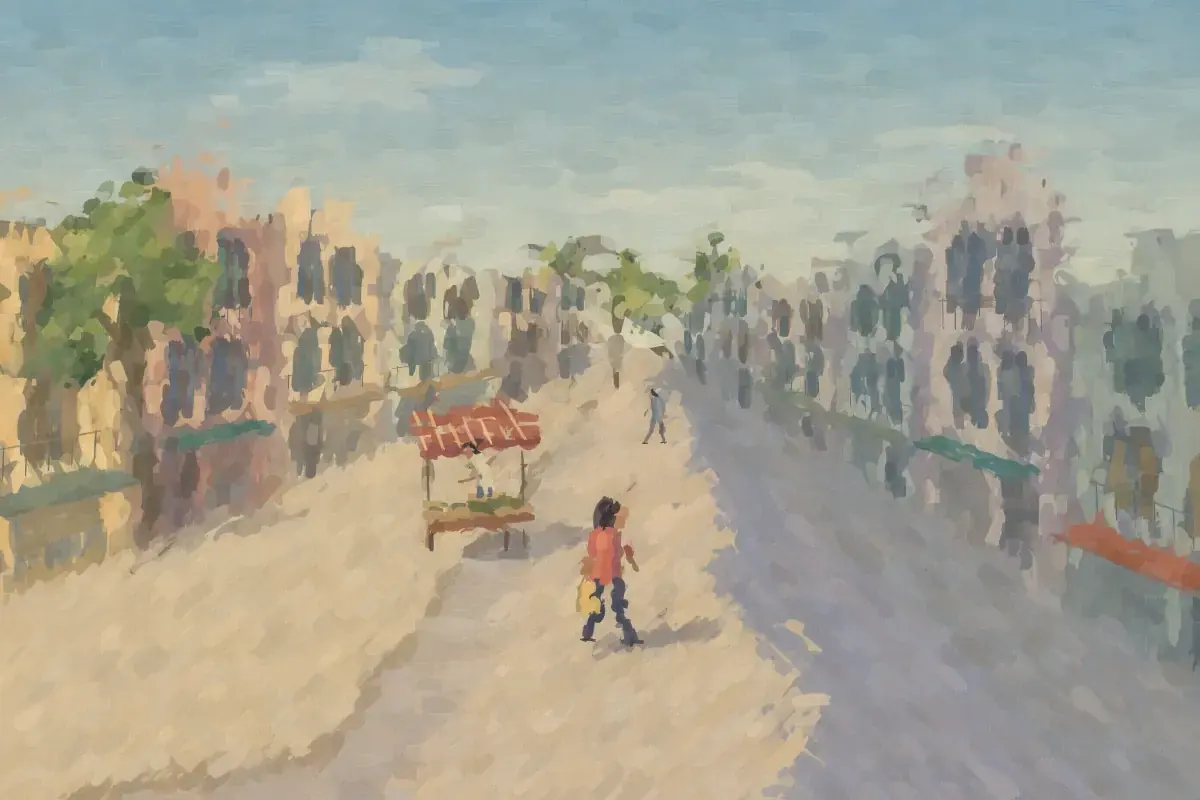 Calcutta street, finer brushwork
calcutta-27 · Brush size 45%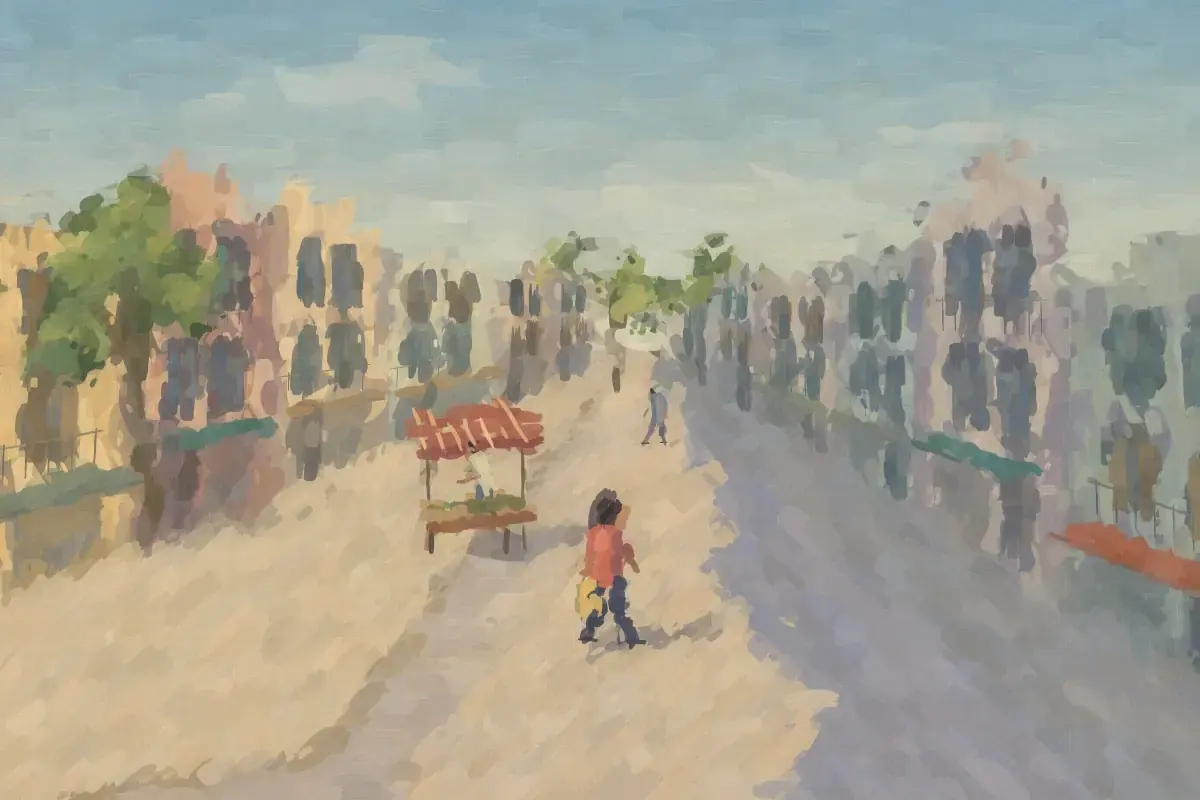 Calcutta street, broad brushwork
calcutta-27 · Brush size 78%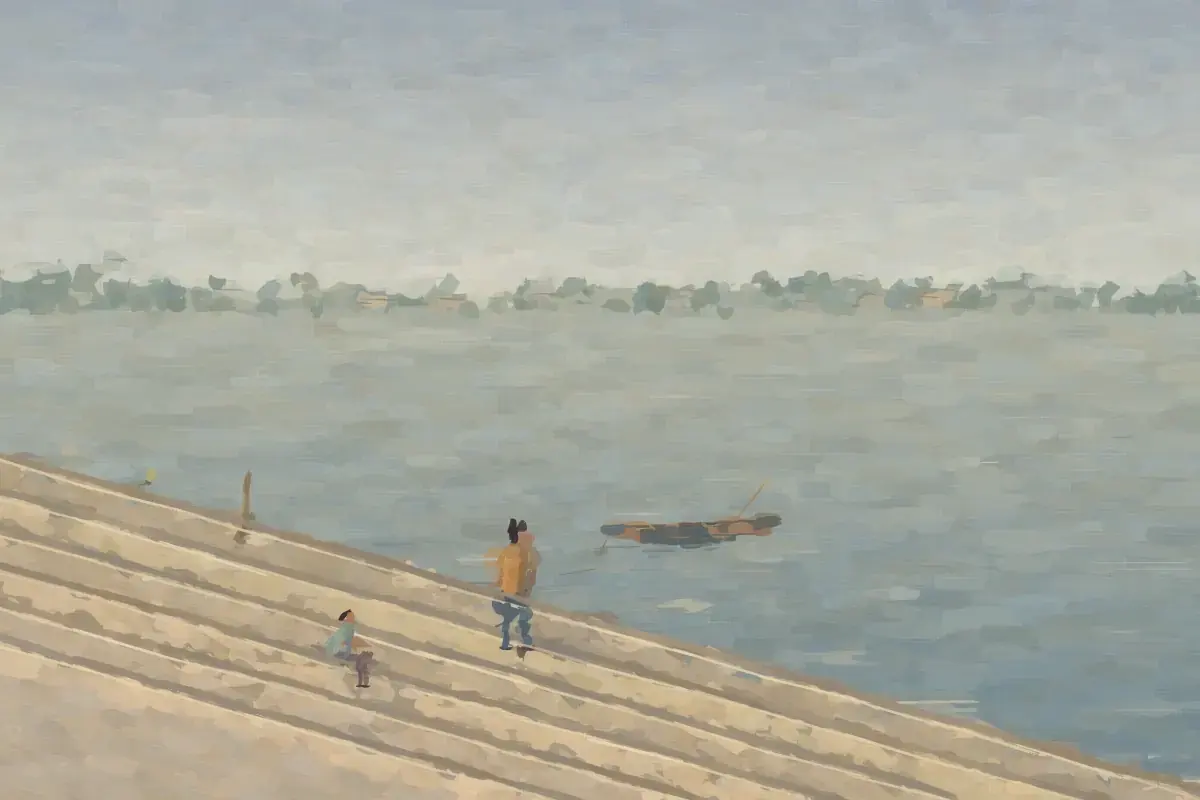 Hooghly-side landing
landing-12 · Brush size 45%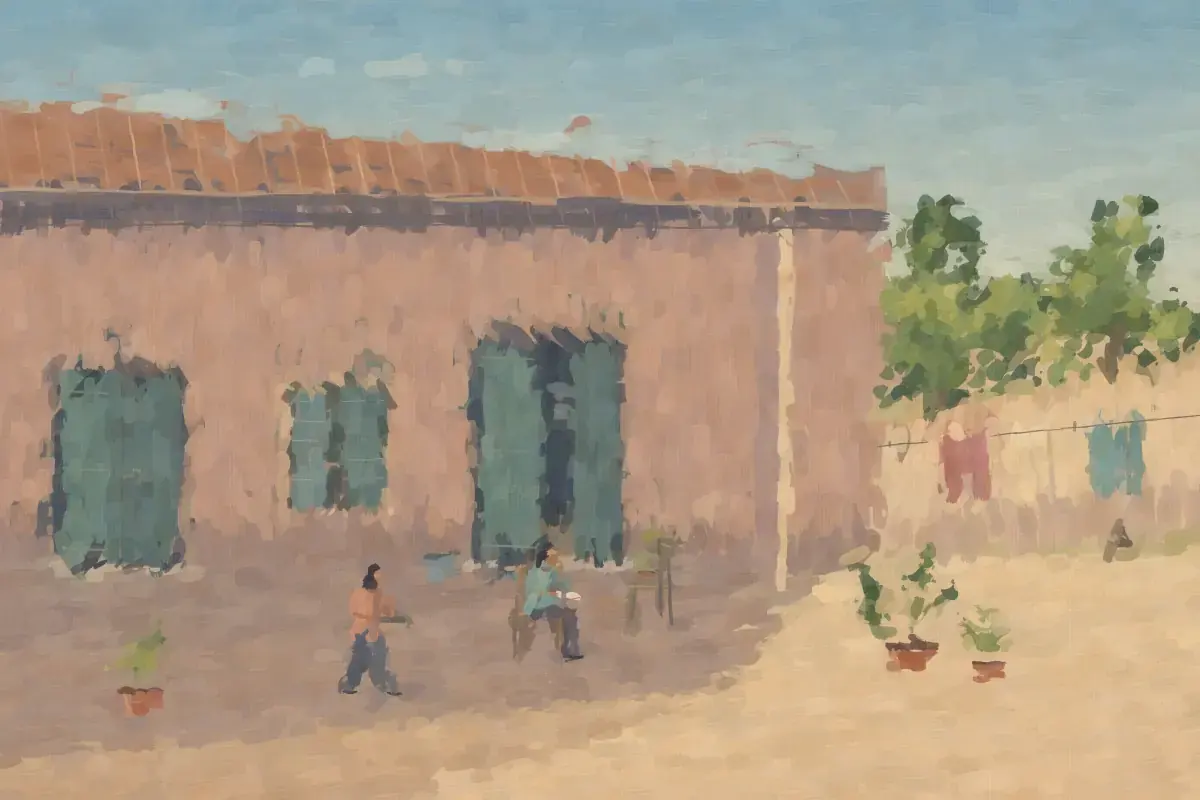 Courtyard and veranda
veranda-18 · Brush size 45%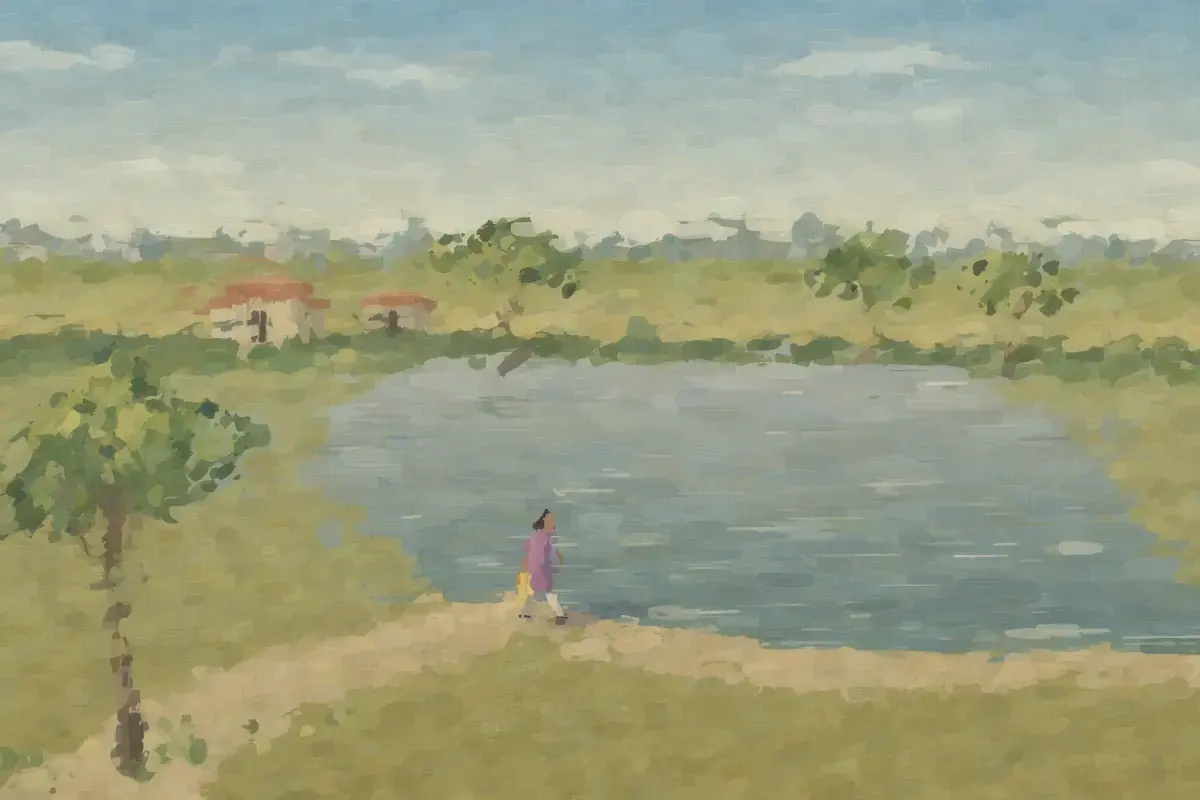 Pond, path, and fields
pond-32 · Brush size 45%Word Cloud
Related reading
Selected by shared topics and section, with closer publication dates breaking ties.

Comments
Read the conversation or leave a thought for review. Comments load when this section is in view.