The Toolbox Theory of Thinking
Uses the speech voice supplied by your browser or device.

A good idea is not a statue in a museum. It is a screwdriver, a kitchen knife, a torch, a mosquito net, sometimes even a small Bengali umbrella that turns inside out during the first proper Nor’wester but still saves your shirt. The best models of thinking are not meant to be worshipped. They are meant to be picked up, tested, used, and occasionally thrown back into the drawer with a muttered complaint.
This is the useful spirit behind what Michel Foucault called, in effect, a toolbox approach to ideas. Foucault was not asking people to memorize theory like multiplication tables recited before a stern uncle. He wanted concepts to be usable. Take a sentence. Take a model. Use it to loosen a jammed assumption. Use it to cut a bad argument into pieces. Use it to measure whether your beautiful plan has quietly become a bamboo tower tied with optimism.
The central concept here is simple: as the world becomes more complex, our desire for simplicity rises sharply. Not because we are lazy. Not because we are stupid. But because the human mind has limits, time has limits, attention has limits, and life does not pause politely while we organize our thoughts into labeled folders.
Imagine a graph. On the horizontal axis is “complexity of our world.” This means the growing mess of choices, systems, apps, rules, passwords, bills, diagnoses, school forms, bank notices, office politics, family obligations, and public nonsense. On the vertical axis is “desire for simplicity.” At first the curve rises gently. A little complexity is tolerable. Then the curve bends upward. More forms. More choices. More hidden rules. More tabs open. More people saying, “It is very simple,” which is usually the first sign that it is not. Finally, the curve climbs steeply. The more tangled the world becomes, the more desperately we want clean handles.
That rising curve is not a childish wish. It is an architectural fact about the mind.
Several famous models sit inside this toolbox. Miller’s Law comes from psychologist George A. Miller’s 1956 paper, “The Magical Number Seven, Plus or Minus Two.” Miller argued that short-term memory can hold only a limited number of chunks at once. The exact number is debated today, but the practical lesson survives: if you give people too much information at once, their brain does not become noble and heroic. It drops things.
Then comes the Paradox of Choice, popularized by psychologist Barry Schwartz in his 2004 book of the same name. The idea is that more choice is not always more freedom. After a point, choice becomes work. Anyone who has tried to buy a phone, choose a streaming movie, compare health insurance plans, or order toothpaste online knows this truth in the marrow. You begin wanting mint toothpaste and end up wondering whether civilization was a mistake.
Occam’s Razor is older and sharper. It is associated with William of Ockham, a medieval English philosopher and theologian from the fourteenth century. The rough modern version says: do not multiply explanations beyond necessity. In ordinary English, when two explanations fit the facts, start with the simpler one. Not the lazier one. Not the comforting one. The simpler one that still explains what must be explained. If your Wi-Fi stops working, first check the router before developing a theory involving Russian satellites, angry neighbors, and cosmic punishment.
Gall’s Law comes from John Gall’s 1975 book “Systemantics.” It says that a complex system that works is usually found to have evolved from a simple system that worked. A complex system designed from scratch rarely works and cannot be patched into working order by good intentions alone. This is one of those laws that should be printed above the entrance of every software office, government department, school board, and family WhatsApp group.
John Maeda’s “Laws of Simplicity,” published in 2006, brought this family of ideas into design and technology. Maeda’s work is not about making things dumb. It is about making them graspable. Reduce what can be reduced. Organize what remains. Hide complexity only when hiding it does not create danger. Give the user a door handle, not a philosophical debate about hinges.
The common thread is this: simplicity is not the enemy of intelligence. Simplicity is intelligence that has done its laundry.
We often misunderstand simplicity because we confuse it with shallowness. A simple thing can be deep. A railway timetable, when well designed, is simple. But beneath it lie tracks, signals, maintenance crews, clocks, unions, electricity, weather, budgets, and human error wearing a cap. A good medicine label is simple. But behind it sit chemistry, dosage studies, regulation, packaging, supply chains, and a pharmacist who has seen too much to be impressed by decorative confusion.
The trick is not to remove complexity from the world. That is impossible. The trick is to place complexity where it belongs.
In school, this matters because students are often crushed not by the difficulty of the subject but by the way the subject is presented. A teacher who explains fractions with ten definitions, four symbols, and a face like a tax notice will lose the room. A teacher who says, “A fraction is a way of sharing one thing into equal parts,” has not made mathematics childish. He has built a bridge.
At work, this matters because meetings often fail from cognitive overload. Everyone brings charts, acronyms, deadlines, exceptions, dependencies, and one person brings a spreadsheet large enough to qualify as a minor geological formation. Miller’s Law whispers from the corner: chunk it. Group the problem. Show the three decisions needed today. Put the rest in the appendix before someone’s soul leaves the body.
In shopping, the Paradox of Choice appears like a small demon in polite clothing. Ten options can help. Two hundred options can paralyze. That is why good shops organize by need: budget, size, use, reliability, warranty. They do not merely display abundance. They reduce the cost of choosing.
In family life, Occam’s Razor can save an evening. If someone is quiet at dinner, the explanation may not be betrayal, resentment, or a secret plan to move to Pune. It may be tiredness. It may be acidity. It may be the office. Start simple. Ask kindly. Do not build an emotional Supreme Court case from one sigh and half a chapati.
In technology, Gall’s Law is almost painfully useful. Many failed apps and systems begin with grand architecture: dashboard, automation, artificial intelligence, personalization, integration, analytics, mobile-first experience, and the usual festival of expensive nouns. But the basic workflow does not work. The login fails. The address field rejects real addresses. The search cannot find “Dr. Sen” unless you type “SEN, D.” A working small system beats a majestic broken one every time.
A health example fits naturally here because health is where complexity becomes personal. A patient may receive test results, medicine instructions, diet advice, insurance messages, appointment reminders, and app notifications from different places. Each piece may be correct, but the total experience can become fog. A simple discharge instruction sheet that says what to take, when to take it, what danger signs to watch for, and whom to call is not “less medical.” It is better medicine reaching the patient without wearing a lab coat made of barbed wire.
The common mistake is thinking simplicity means deleting detail. That is not it. Bad simplicity removes important truth. Good simplicity preserves the truth but changes the shape so a human being can use it. A map is simpler than a city, but a good map still gets you home. A bad map removes the river, the railway line, and your neighborhood, then smiles like a consultant.
There is also a darker mistake: using simplicity as a weapon. “It’s simple,” says the person who does not want questions. “Just follow the process,” says the form that was designed by three committees and a printer demon. Real simplicity invites understanding. Fake simplicity demands obedience.
The useful lesson is to treat models as tools, not commandments. Miller’s Law reminds us that attention is limited. The Paradox of Choice warns that abundance can become burden. Occam’s Razor tells us not to decorate explanations like wedding pandals. Gall’s Law tells us to build working small systems before dreaming of magnificent large ones. Maeda’s Laws of Simplicity remind us that design is not what something looks like; it is how much unnecessary suffering it removes.
The world will not become less complicated just because we are tired. But we can become better carpenters of thought. We can choose the right tool. We can cut the problem into pieces. We can ask what must remain, what can go, what should be hidden, and what must be made visible.
Simplicity is not a small idea. It is how a finite mind negotiates with an infinite mess and still manages, somehow, to make tea, answer email, pay the bill, help a child with homework, choose the correct bus, and not entirely lose its dignity before lunch.
P.S. References: George A. Miller, “The Magical Number Seven, Plus or Minus Two” (1956); Barry Schwartz, “The Paradox of Choice” (2004); John Gall, “Systemantics” (1975); John Maeda, “The Laws of Simplicity” (2006); William of Ockham’s principle of parsimony, commonly known as Occam’s Razor.
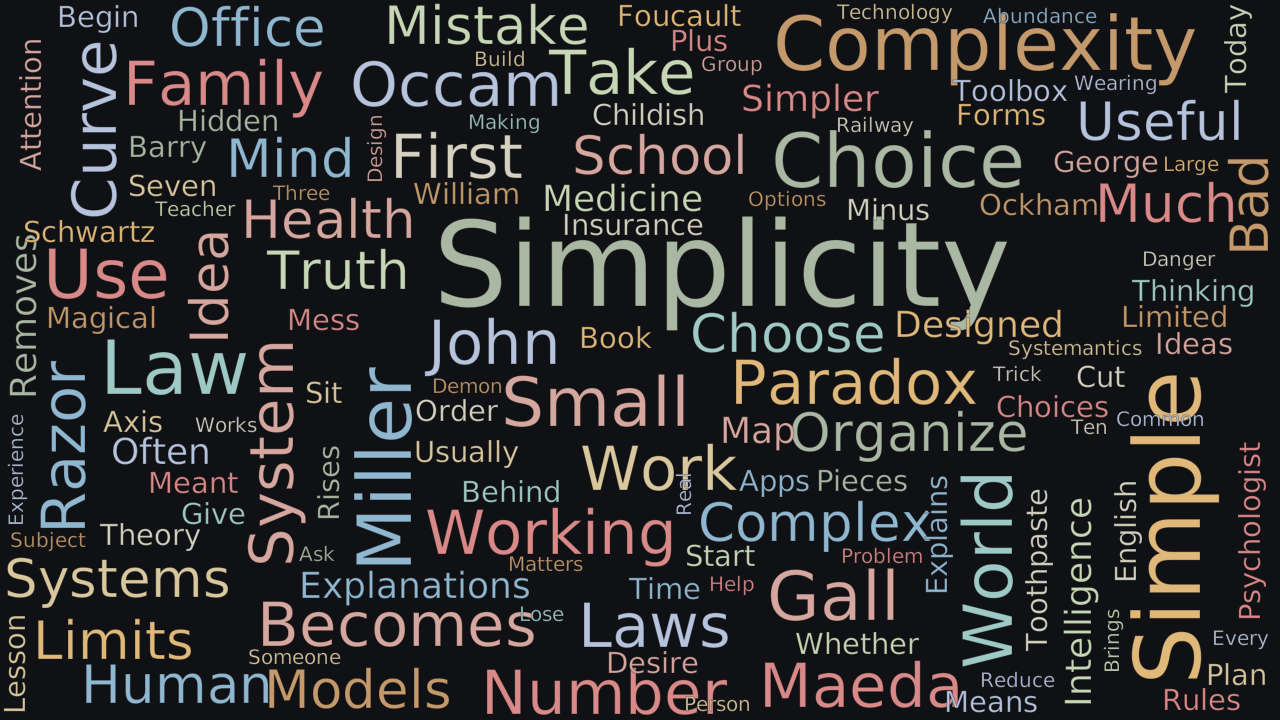
Word Cloud
Related reading
Selected by shared topics and section, with closer publication dates breaking ties.