Slow Poisoning Republic
Uses the speech voice supplied by your browser or device.

Acronyms used: UPI [Unified Payments Interface, India’s instant digital payment system for bank-to-bank transfers through phones]; GDP [Gross Domestic Product, the money value of goods and services produced by an economy]; BOD [Biochemical Oxygen Demand, a measure of how much oxygen polluted water consumes as organic matter breaks down].
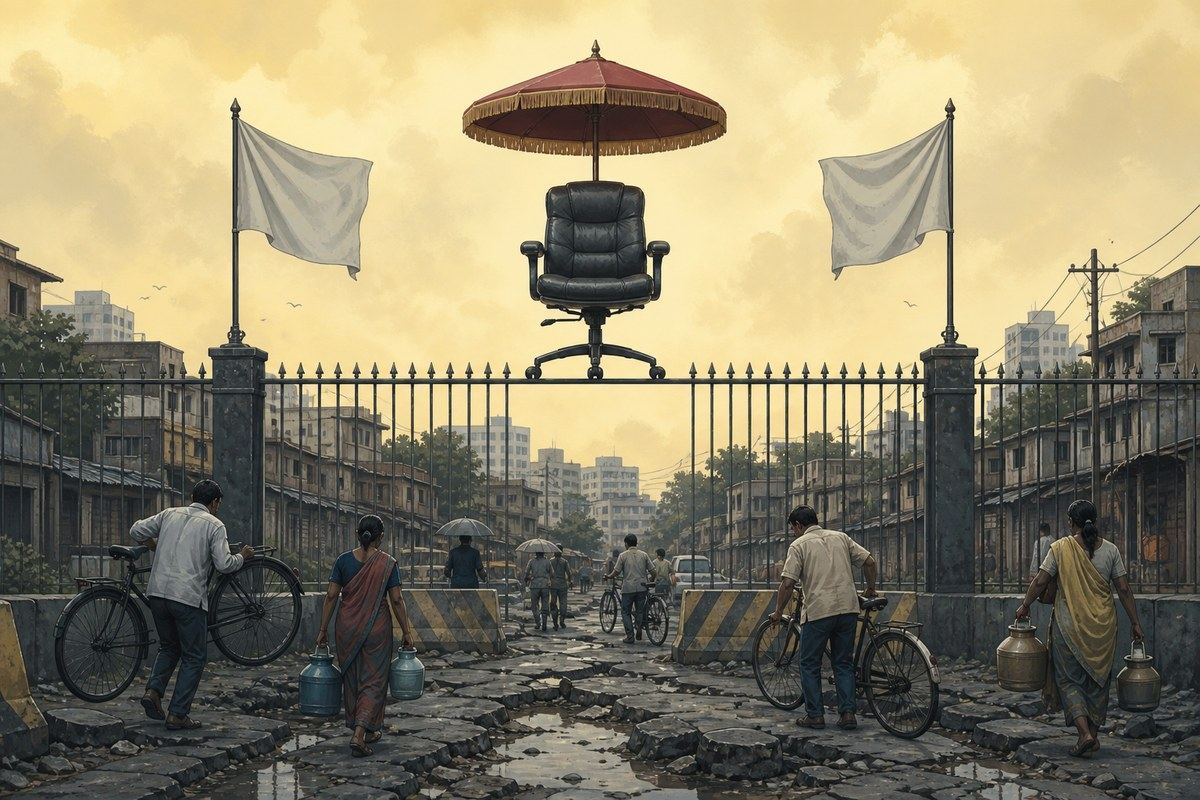
The tap water arrives with a smell that has clearly lived a full life.
Rust. Damp pipe. Old algae. A faint suggestion of municipal resignation. You turn the tap, fill the steel glass, hold it up to the light, and there it is: civilization, slightly yellow around the edges.
This is the India that interests me now.
Not the India from speeches, drone shots, temple corridors, startup festivals, government hoardings, patriotic television graphics, or those soft-focus videos where a river, a cow, a satellite, a soldier, and a smiling child are arranged like items in a national thali.
No.
I am interested in the India of the small cheat.
The five-hundred-rupee lie. The delayed payment. The “tomorrow, dada” that means “please begin your slow journey toward madness.” The fake emergency. The padded bill. The unpaid consultant. The contractor who saves money by reducing cement, as if gravity is a foreign conspiracy. The shopkeeper who rounds up. The client who disappears. The clerk who delays the file. The teacher who sells hope. The doctor who sells fear. The news channel that sells noise and calls it national feeling.
This is not a grand villain story.
That would be easier. Grand villains at least have capes, horses, helicopters, theme music. What we have is worse because it is smaller. It wears sandals. It borrows your pen. It calls you dada. It says, “Don’t worry,” in exactly the tone by which worry gets its ration card.
A country does not become dishonest only because of big corruption. Big corruption is only the tiger in the zoo. You can point at it. You can photograph it. You can say, “See, that is the animal.” But the real jungle is smaller. It is mosquito-sized. It hums near the ear at night.
One man cheats another and calls it smartness.
One shopkeeper cheats a customer and calls it business.
One employer cheats a worker and calls it cash-flow.
One worker cheats time and calls it adjustment.
One builder cheats materials and calls it margin.
One politician cheats the public and calls it development.
One family cheats a daughter and calls it tradition.
One godman cheats grief and calls it faith.
One intellectual cheats language and calls it nuance.
One nation cheats itself and calls it culture.
Then we sit with tea, muri, and a face full of injured dignity, wondering why nothing works properly.
The answer is not hidden in some ancient cave under the Himalayas.
It is arithmetic.
A lie adds. That is the terrible thing. It does not stay politely in the mouth of the liar. It travels. It enters the deal, the bill, the tender, the classroom, the marriage, the office, the building, the drain, the bridge, the medicine, the exam, the vote.
A lie becomes a brick.
Enough bricks become a house.
Enough houses become a neighborhood.
Enough neighborhoods become a country where everyone locks the door, suspects the neighbor, checks the change twice, records phone calls, takes screenshots, saves receipts, and still gets cheated by a man with better confidence and worse grammar.
This is why distrust is so expensive.
People think trust is a moral luxury, like sandalwood soap or a window that closes properly. It is not. Trust is infrastructure. It is like drainage. You notice it only when it fails and the entire lane starts smelling like history has taken off its socks.
In America, where I lived and worked for fifteen years, there was plenty of fraud too. Let us not become fools in reverse. They had Enron, subprime mortgages, medical billing games, corporate smiles sharp enough to shave a coconut. But ordinary trust worked more often. A contract had some weight. An appointment meant something. A check arrived. A complaint could sometimes move. Not always. But often enough that life did not require you to become a private detective before buying a ceiling fan.
In Calcutta, even hope asks for an advance payment.
I say this from a small room on the shanty edge of the city, not from a walnut desk in a policy institute. I say it as a fifty-one-year-old Bengali man with a rice cooker, a tea pan, a great education that now often behaves like a framed certificate awarded to a goat, and an income stream so delicate it should be watered with an eyedropper.
I am not outside the swamp.
I have tolerated lies because confrontation costs money. I have smiled at cowards because rent exists. I have waited for payments that had entered the afterlife. I have believed promises even after the promise had started smelling like a fish market in June. I have adjusted, postponed, swallowed, rationalized, and watched my own spine behave like overcooked lau in a pressure cooker.
So this is not a sermon.
This is sewage speaking to sewage.
But even sewage has truth. You can test sewage. You can measure BOD, fecal bacteria, arsenic, lead, and, if someone ever invents the right instrument, the number of confident lies per square kilometer.
That is the problem with national decay. It is not always dramatic. The bridge does not always fall on Tuesday at 4:17 p.m. with television cameras ready. Sometimes things rot quietly. A little rust here. A small leak there. One payment delayed. One rule bent. One cheat admired because he is “our man.” One bully tolerated because he is useful. One fraud invited because he has connections. One coward praised because he is practical.
Then one day everyone says, “What happened to the country?”
Nothing happened.
Everything happened.
Slowly.
There is a phrase people love: changing leaders will change the country. Of course leaders matter. Law matters. Policy matters. Institutions matter. Only a fool or a television panelist would deny that.
But a country is not only ruled from Delhi or Nabanna or some air-conditioned room where a man with a microphone explains sacrifice from behind seven security layers.
A country is manufactured from below.
Every day.
At the tea stall. In the queue. At the counter. In the apartment committee. In the school admission office. In the doctor’s chamber. In the police station. In the family WhatsApp group, that open sewer of emotion where facts go to die wearing a flower garland.
This is the part nobody wants to discuss, because it is rude. It points the finger not only upward, toward ministers and billionaires and senior officials with faces like well-fed files. It points sideways. At cousins. Uncles. Clients. Neighbors. Teachers. Builders. Priests. Influencers. Employers. Employees.
At us.
Very inconvenient.
We prefer the grand explanation. Colonialism. Capitalism. Socialism. Religion. Caste. Class. Neoliberalism. Foreign hand. Internal enemy. Media. Algorithm. China. America. Pakistan. The British, who have been gone long enough that even their ghosts must be tired of being blamed for the bathroom tap.
These things matter. History matters. Power matters. Institutions matter.
But there is also the small private calculation before every act: can I get away with it?
That question is the little matchstick.
Can I delay him?
Can I underpay her?
Can I scare them?
Can I fake the document?
Can I use religion as a blanket?
Can I use poverty as a shield?
Can I use nationalism as deodorant?
Can I shout loudly enough that truth leaves the room?
This is where the republic is quietly poisoned. Not by one bottle poured into one well, but drop by drop, like a leaky tap at night. You can ignore one drop. You cannot ignore ten years of drops. Eventually the bucket fills, overflows, stains the floor, and the landlord says you should have informed him earlier.
Meanwhile, the rectangle glows.
That phone in the hand has become the new public square, private cinema, political rally, temple loudspeaker, gossip bench, dating market, betting den, and psychiatric ward. A man may not have clean water, reliable electricity, decent drainage, fair wages, or courage in public, but he has a phone. On that phone he can watch a girl dance, a godman shout, a minister perform outrage, a historian invent furniture for ancient empires, a businessman grin, and a patriot explain that India will dominate the world as soon as the potholes achieve spiritual alignment.
This is not patriotism.
It is fever with broadband.
The funniest part, and by funniest I mean the kind of funny that makes you stare at the wall, is that everyone knows.
Everyone knows the tender was managed.
Everyone knows the queue was jumped.
Everyone knows the receipt is decorative.
Everyone knows the promise is soft.
Everyone knows the file moved because somebody pushed it from behind.
Everyone knows the exam was gamed.
Everyone knows the facts were adjusted.
Everyone knows merit often means corruption with better English.
And still we clap.
Not always because we are wicked. Sometimes because we are tired. Sometimes because we are afraid. Sometimes because the honest man has a toothache, the power is gone, the rent is due, his mother needs medicine, and he cannot spend three months fighting a crook whose only talent is not feeling shame.
This is how bad systems win. Not by defeating courage in battle, but by exhausting it in installments.
Stand up once and you are brave.
Stand up every week and you become unemployed.
Stand up every day and your blood pressure begins filing complaints.
So people adjust. They bend. They become practical. That lovely word. Practical. In India it often means, “Please cooperate with decay because decay has local support.”
Then language begins to rot.
Fraud becomes jugaad.
Cowardice becomes maturity.
Cruelty becomes discipline.
Servility becomes respect.
Ignorance becomes faith.
Noise becomes leadership.
Obedience becomes culture.
Theft becomes opportunity.
Collapse becomes tradition.
Once language goes, the rest follows. If you cannot name the smell, you will keep calling sewage a water feature.
I sometimes think of John Snow in London in 1854, staring at cholera deaths on a map and seeing what others did not want to see. People thought disease came from bad air, divine punishment, general filth, moral weakness, all the usual fog machines of human stupidity. Snow looked at the pattern and found the pump. Remove the pump handle, and the outbreak changes.
Now the unpleasant question.
What handle do you remove from a culture of small cheating?
Because the pump is not in one street.
It is in the hand.
It is in the mouth.
It is in the sentence “adjust kore nin.”
It is in “kal dekhchi.”
It is in “don’t worry.”
It is in the uncle who says “this is how things work.”
It is in the man who admires the cheat until the cheat cheats him.
It is in the family that praises cunning as intelligence.
It is in the office that rewards the loud parasite.
It is in the voter who wants honesty in government and dishonesty in his own favor.
There is no clean solution. That is the bitter part. You cannot pass one law and make a people honest by Monday morning. You cannot launch an app for trust. You cannot put civic courage into an online form with an OTP. You cannot build a modern economy on medieval habits and then complain that the GDP behaves like a tired goat on a flyover.
But there are handles.
Pay on time.
Put things in writing.
Refuse the known cheat.
Stop admiring the man who “manages.”
Stop calling every fraud “smart.”
Stop hiding behind neutrality when truth is being strangled in the next room.
Keep records.
Keep promises.
Teach children that cleverness without honesty is just well-dressed rot.
Small things?
Yes.
That is precisely the point.
The poison is small too.
A little arsenic in the rice. A little lead in the paint. A little sewage in the water. A little myth in the bloodstream. A little greatness-porn in the civic stomach. Nobody dies immediately. That would at least be clear. Instead the body weakens. The nerves misfire. The limbs tremble. The organs fail in committee. The patient says, “We are becoming a superpower,” while trying to open a door painted on the wall.
Everyone wants dignity without honesty.
Prosperity without trust.
Power without competence.
Modernity without maintenance.
Science without doubt.
Religion without humility.
Democracy without citizens.
National pride without public toilets that do not look like punishment.
I sit with my tea in a small Calcutta room, hearing the lane, the pump, the hawker, the pressure cooker whistle from somewhere, the dog conducting foreign policy near the drain, and I know this much: no country becomes healthy when everyday trust is a diseased gum bleeding quietly under the national smile.
You cannot build a company when every commitment slips like a fish from the hand.
You cannot build a republic when people admire the cheat until he cheats them personally.
You cannot build prosperity on suspicion.
You can build noise.
You can build slogans.
You can build another shiny presentation.
You can build a flyover that looks brave from a distance and leaks like a guilty conscience in the monsoon.
But durable things need trust. Boring trust. Daily trust. The sort of trust that arrives on time, pays what it owes, admits what it broke, signs what it means, and does not turn every human exchange into a wrestling match in a wet marketplace.
Some people still live like that.
They are not saints. They are simply tired honest people. They pay on time. They say no. They keep their word. They keep their small corner clean even while the rest of the lane smells like a committee decision. You can see it in their faces. The honest in India often look like night watchmen outside a warehouse of stolen goods: alert, underpaid, badly lit, and beginning to suspect the thieves have better snacks.
Meanwhile the great dance continues on the rectangle. The hips twitch. The flags wave. The gods trend. The enemies rotate. The drains clog. The air thickens. The transformer sparks. The water smells faintly of surrender.
And somewhere a man says, “Don’t worry, dada, I will pay tomorrow.”
The country believes him for one more day.
So do I, sometimes.
Not because I am innocent.
Because disbelief also requires energy, and energy costs money, and money is currently stuck in someone else’s noble cash-flow cycle, that elegant little public urinal where hope goes to stand quietly, waiting for its turn.
P.S. References: John Snow’s 1854 Broad Street cholera investigation is a classic public health example of tracing a social disaster to a concrete source and changing the system at the source rather than merely scolding the victims.
Word Cloud
Related reading
Selected by shared topics and section, with closer publication dates breaking ties.