The Rice Cooker and the Black Hole
Uses the speech voice supplied by your browser or device.

Acronyms used in this post:
AI — Artificial Intelligence, meaning software systems that can generate text, images, code, predictions, or decisions by learning patterns from data.
IT — Information Technology, meaning the broad field of computing systems, software, databases, networks, and the miserable wiring by which modern life pretends to be organized.
US — United States, meaning the country where I studied and worked for years before returning to India.
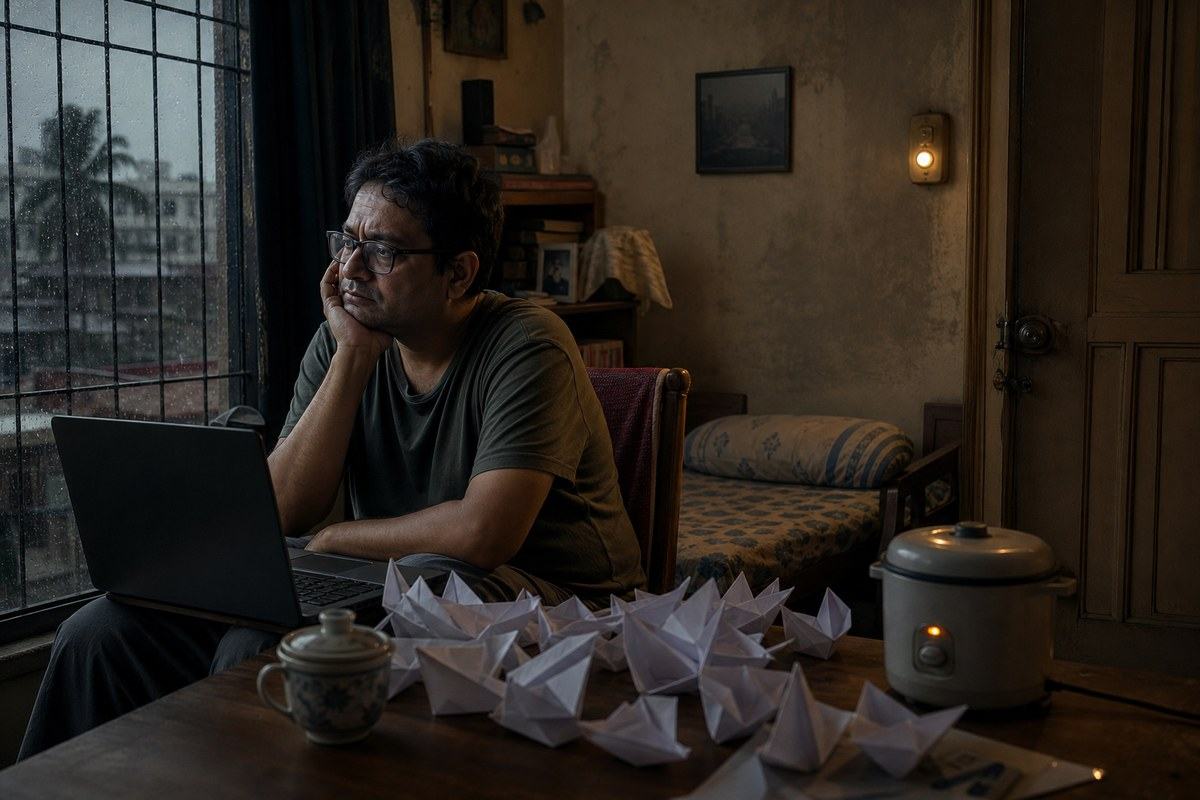
The rice cooker clicks off with a tiny plastic sound, like a clerk stamping a file in Writers’ Building after thirty-seven years of consideration.
Done.
The rice is done.
The life, however, remains under review.
I stand in the sweaty half-dark of my rented South Calcutta room, looking into the white steam as if some grand answer may rise from it. A message. A sign. A small edible telegram from the universe. But nothing comes. Only steam, starch, and that familiar bachelor smell of rice cooked slightly too long because the mind was elsewhere, possibly in 1998, possibly in San Antonio, possibly under the bed with the dust and the old charging cables.
My stomach makes a noise.
Not hunger exactly.
More like a municipal complaint.
Even the gut has paperwork.
Hope did not leave me dramatically. That is the first thing to understand.
No thunder. No violin. No heroine running along Sealdah platform in slow motion while rain falls and one sincere man ruins three generations by not speaking clearly. No tram bell. No black-and-white art-film silence. No one whispered, “This is the moment, old boy, after this you will be permanently altered.”
It dried.
That is all.
Like a towel forgotten on a line in May. Like a small pond behind an old house near Dum Dum, first green with algae, then lively with mosquitoes, then decorated by plastic packets, then one day not a pond at all, only a civic embarrassment with a coconut shell floating in it like a moon that failed its school final.
Inside me, the same development happened.
First sadness.
Then a bad year.
Then several bad years standing in a queue and pretending not to know one another.
Then a decade.
Then age arrived, not as wisdom, which is a brochure word used by people with strong knees and decent savings, but as sediment. Kettle scale. Rust on a balcony railing. A slow crust around the part of the mind that once said, “Get up. Something may yet happen.”
Something may yet happen.
Lovely phrase.
It should be printed on glucose biscuit packets and sold to unemployed middle-aged men with weak teeth and heroic acidity.
At fifty-one, the body becomes an archive of small defeats. The knee has minutes from previous meetings. The tooth keeps emergency files. The lower back has colonial records in triplicate. The scalp has resigned without notice. The bladder has become a night-shift security guard who keeps waking the whole building.
And the brain?
The brain still pretends it is headquarters.
This is touching. Also comic.
The brain sits inside the skull like an old manager in a collapsing office, pointing at charts, ordering tea, and announcing strategy while half the switches do not work and the other half spark at three in the morning. That is when the stray dogs begin their debate under the window. They have strong views. They are against everything.
Bipolar depression is not sadness.
Sadness is when a favorite cup breaks.
This is different.
This is as if the laws of physics have been quietly edited while you were asleep. Morning arrives, but it does not quite arrive for you. Light enters the room but refuses to register. Tea tastes like warm paperwork. Rice tastes like chalk that has retired from education. Music becomes furniture. Desire becomes a museum label under an empty glass case: male animal, once capable of foolish enthusiasm, believed to have vanished sometime after dial-up internet and before affordable dental implants.
People say, “Write something positive.”
Positive?
Positive is not chaat masala. You cannot sprinkle it over a dead mood and say, “There, now it has become inspiring.”
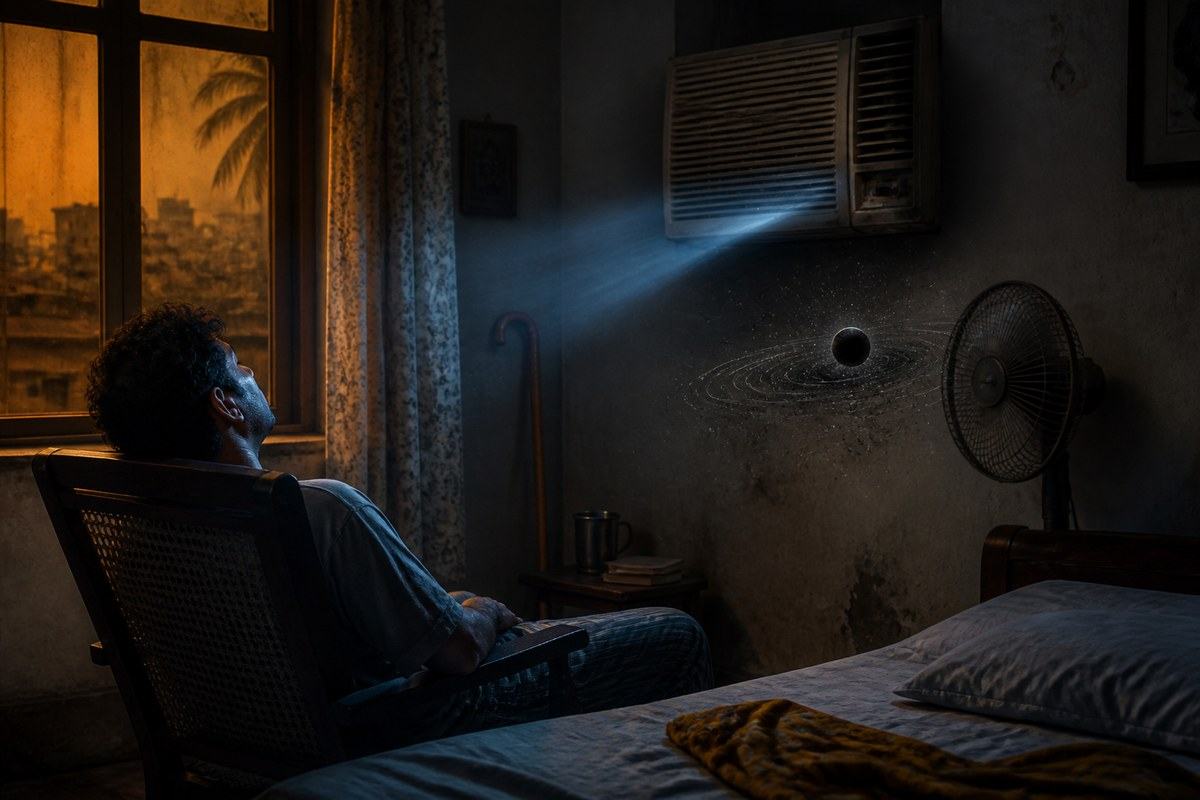
There is a black hole inside me.
I do not mean that in the decorative teenage way, with eyeliner and soft rock music. I mean something duller and more practical. A dark little office behind the ribs. A place where incoming things disappear without receipt.
Compliments go in.
Possibilities go in.
Good memories go in too, but not neatly. They stretch first. They become long noodles of regret. Then they vanish.
This, I suppose, is why depression is so hard to explain to cheerful people. Cheerful people believe the mind is a room. Open a window, let in air, tidy the shelves, put one motivational quote near the door, and matters improve.
But sometimes the mind is not a room.
Sometimes it is a well.
Sometimes it is a locked government office.
Sometimes it is Howrah Bridge in peak traffic with one bus sideways, one cow philosophical, and three hundred people honking as if sound has engineering value.
Einstein showed that mass bends space and time. Schwarzschild, doing mathematics during the First World War, found equations that pointed toward black holes, those strange cosmic drains where escape is no longer a question of effort. It is geometry.
That is depression at its worst.
Not laziness.
Geometry.
You may flap, plan, promise, journal, meditate, buy a nicer notebook, download a habit app, listen to a podcast expert with teeth like polished bathroom tiles telling you to optimize your morning. But if the day’s escape velocity exceeds the engine inside you, you remain on the mattress. The ceiling fan rotates above you like a rubber stamp.
Denied.
Denied.
Denied.
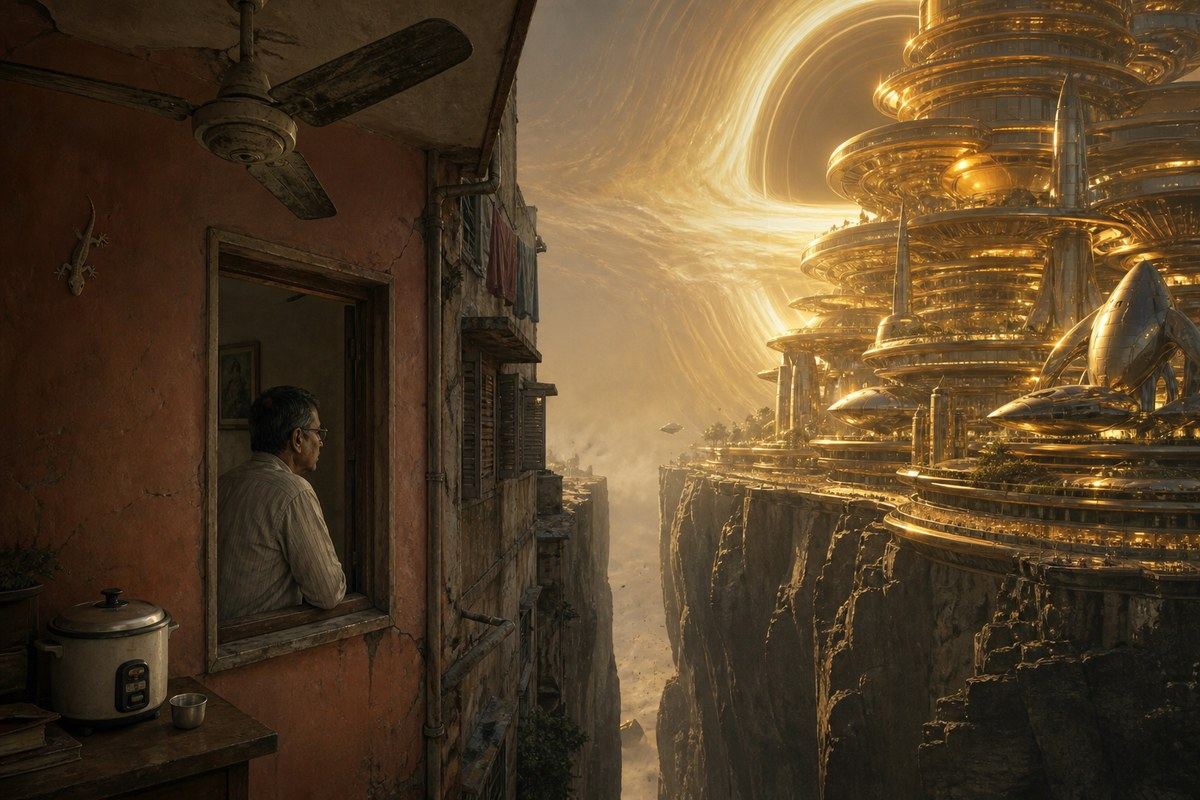
I came back to India, and India did not embrace me like a motherland from a school poem.
India looked at me, checked my pockets, measured my current usefulness, detected depreciation, and said, “Stand there, dada. Someone will come.”
No one came.
Perhaps the country had changed. Perhaps I had changed. Perhaps youth is simply a fog machine rented by the nervous system for twenty-five years. When it stops, you begin seeing the room properly. The slogans are louder. The cruelty is better organized. The middle class has become very brave in front of screens and very polite in front of power. Everyone shouts about civilization while stepping over a man sleeping beside a drain.
This is not an Indian specialty, let us be fair. Stupidity is one of the few truly global industries.
America, where I spent my better working years, put on its own circus tent. Trump rose again like a badly cooked steak with hair and grievance, and millions applauded because democracy, it turns out, can become what happens when loneliness finds a microphone and blames foreigners for the indigestion of capitalism.
I watched from Calcutta, not as a superior Indian. Please. Our own public life is not exactly sandalwood-scented. I watched as a man who has lived long enough to see two continents compete in the same sport: losing their minds while calling it renewal.
Meanwhile AI arrived, smiling.
Not as a metal monster with red eyes. That would at least have been honest. No, AI arrived as autocomplete with venture funding. As dashboards. As demos. As young men on podcasts saying productivity, disruption, frontier, agentic, alignment, and other clean dangerous words that sound like they were washed in consultancy soap.
It did not stab the future.
It absorbed it.
Like damp climbing a wall.
First artists worried. Then writers. Then coders. Then analysts. Then teachers. Then the people who explain things. Then people like me, who spent years in IT, healthcare data, standards, codes, systems, databases, mappings, all that magnificent boring plumbing by which modern civilization avoids pouring confusion directly into medical records.
I looked at AI and thought: even the last cupboard has a thief inside.
At twenty-five, opportunity is a city with too many doors.
At fifty-one, opportunity is a tea stall closing early because the owner’s nephew got a job in Bangalore.
This is the part young people do not believe yet. Why should they? Their brains are still throwing festival lights over every blank wall. At twenty-five, one can say “maybe” with real appetite. Maybe research. Maybe America. Maybe love. Maybe money. Maybe a decent flat. Maybe some large late adventure.
At fifty-one, maybe becomes smaller.
Maybe the inverter will survive the power cut.
Maybe the tooth will not explode tonight.
Maybe the rent will not rise.
Maybe I will not say something sharp to the only person still kind enough to call.
Age is not only wrinkles. It is not only the bladder becoming a melodramatic neighbor. It is the shrinking of plausible futures. The corridor gets shorter. The doors become painted doors. Some are locked. Some were never doors. Some were advertisements.
A man becomes small not when the world defeats him, but when he begins helping it.
I help it daily.
I pre-cancel myself. I remove my own name from imaginary lists. I do not apply. I do not call. I do not visit. I do not attend. I do not try, and then I accuse the universe of not replying, which is unfair but satisfying, like scratching a mosquito bite until it becomes a minor archaeological site.
Still, there are mornings.
Not good mornings.
Let us not become sentimental and start lying.
But mornings.
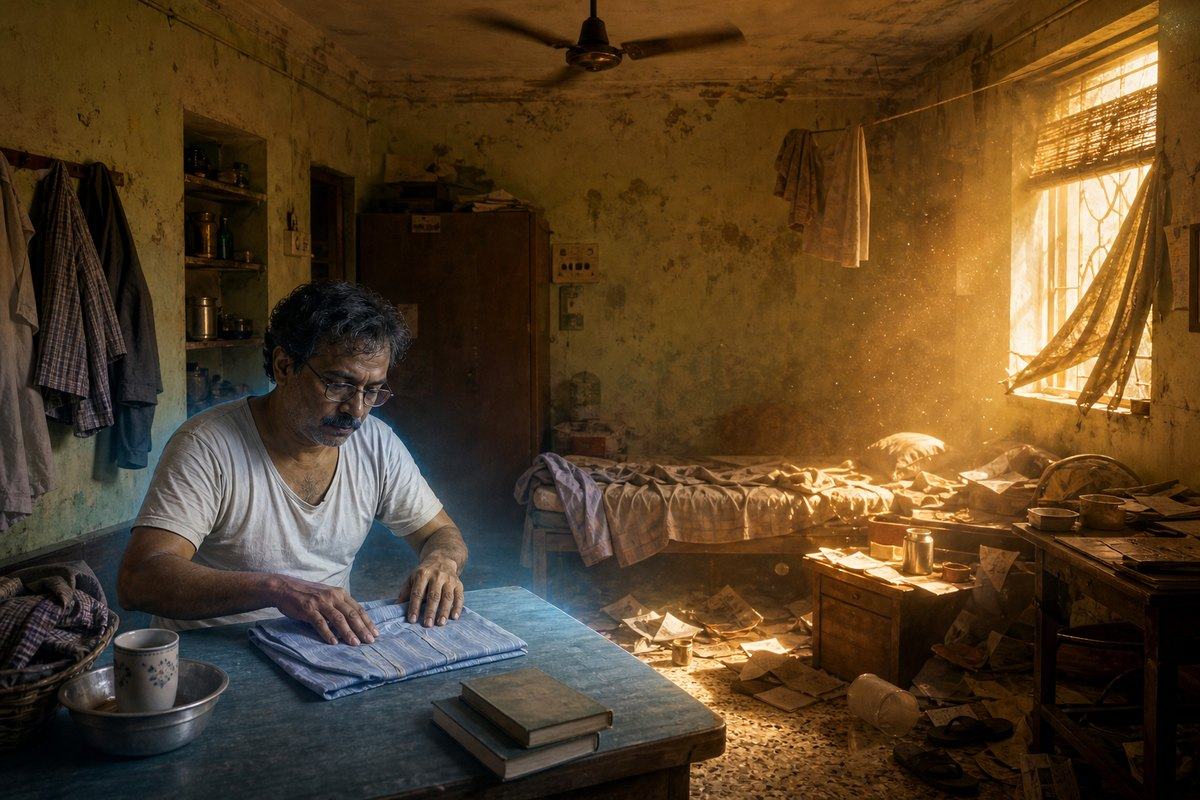
The tea pan is black at the bottom. The rice cooker sits there with the grave expression of a small appliance promoted beyond its ability. One clean plate waits. The spoon is bent. The towel from yesterday smells like yesterday’s towel, which is to say it has begun developing a personality.
Outside, someone is honking as if traffic can be persuaded by respiratory collapse. A delivery boy goes past. A neighbor drags a chair. Somewhere a pressure cooker whistles with the confidence of a small steam locomotive. Calcutta begins again, though nobody has formally requested it.
And I stand there.
Unshaved. Soft-bellied. Overeducated beyond market value. Underemployed. Badly slept. Still alive in that slightly comic way middle-aged men are alive, as if some clerk forgot to remove our names from the list.
The steam rises.
For one second, it looks almost alive.
Almost like breath.
Then a thought appears.
Not hope.
Hope is too large a word. Too clean. Too motivational-poster. Hope arrives wearing shoes. This thing is barefoot.
The thought is: continue.
Not triumph.
Not heal.
Not reinvent.
Continue.
What an ugly little word.
A municipal word. A cracked-slipper word. A drain-cleaning word. A word that does not smell of perfume. A word that has waited in ration-shop lines. A word that knows how to eat leftover rice with salt and pretend the pickle is a side dish.
Continue.
The universe itself continues, though it does not ask for applause. Stars burn. Dust becomes planets. Bacteria invent chemistry in hot vents. Apes discover fire and immediately use it for food, warmth, and murder. Newton pokes gravity. Darwin annoys every religious uncle. Curie poisons herself with wonder. Turing helps save civilization, and civilization thanks him with cruelty.
History is not inspiring.
It is merely stubborn.
And perhaps stubbornness is what remains when hope has lost weight.
The black hole inside me remains.
It does not become a sun because one paragraph develops manners.
It sits there.
Dense. Patient. Well-behaved.
But even black holes, if Hawking was right, are not perfectly black. They leak. Faintly. Almost rudely. A little radiation at the edge of nothing.
Maybe that is all I have.
Not hope.
Leakage.
A small emission from the rim of annihilation.
So I take the rice out with a spoon. I burn my finger. I say something unprintable to the room. The room, being used to me, makes no objection.
The rice is clumpy.
The room smells of starch, sweat, and old towel.
Outside, Calcutta honks, sweats, bargains, worships, cheats, cooks, scrolls, votes, complains, survives, and asks for exact change.
Inside, the black hole chews politely.
No salt.
Still, I eat.
Word Cloud
Related reading
Selected by shared topics and section, with closer publication dates breaking ties.