Mahalaya: The Four O'Clock Broadcast
Uses the speech voice supplied by your browser or device.

Somewhere in Calcutta tonight, somebody will look at the clock and say, “If we go to sleep now, we’ll never get up.”
Somebody else will say there is still time. An alarm will be set, then checked, then set five minutes earlier. In another house, the decision will already have been made. Stay awake. Put the kettle on. Four o’clock isn’t that far away.
Tonight is October 9. By tomorrow morning it will be Mahalaya, and across this city there will be people carrying themselves through the last few hours of darkness for the sake of a voice they have heard all their lives.
I may as well join them. Sleep and I have been conducting unsuccessful negotiations for years. Usually, being awake at that hour means I have been left alone with a committee of thoughts, every member an objectionable bastard and none willing to adjourn. Tonight, at least, there is something to wait for.
There will be tea somewhere. There will be a light under somebody’s door.
There will be Birendra Krishna Bhadra.
You can hear him any day now. This needs acknowledging before we start constructing an ancestral temple around a radio with a broken knob. The recording is on the internet. You can play it in June, at three in the afternoon, while looking for a plumber. Nothing will stop you.
And yet we wait.
We wait for this particular darkness, this particular morning, for the knowledge that another household has turned the sound on too. A familiar voice coming through your own speaker is one thing. Hearing a little of it drift across from somebody else’s window, before the city has properly woken, does something to the room.
You turn your volume down for a second.
Yes. There it is.
They are listening.
In the childhood version of this morning, you are usually not the person responsible for waking anybody. That is part of its enormous, unrecognized luxury. Someone else has remembered the date, found the station, made sure the radio works. You can remain half asleep while the adults arrange the arrival of autumn.
“Oth. Mahalaya shuru hoye gechhe.”
Get up. Mahalaya has started.
Perhaps you do get up. Perhaps you make an indistinct noise and turn toward the wall. The sound comes through the mosquito net anyway. It comes through the thin cotton sheet, through the last scraps of a dream, through the small resentment of a child who wanted to be woken and now objects to the procedure.
The room is dark enough for the furniture to be uncertain. A cupboard is a large, patient shape. The window has bars and almost no sky. Somewhere beyond the bed, a cup touches a saucer. Someone clears a throat. Someone says the volume is too loud.
“Let him sleep. He can hear it.”
And you lie there, permitted to do both.
That is the part I find difficult now. The permission. The enormous ease of being a person for whom somebody else is awake.
Bhadra’s voice enters that half-sleep with a seriousness no adult in the room needs to explain. The Sanskrit is larger than your understanding. The Bengali narration offers a handhold. Then a song arrives, and something that sounded immense and distant comes close enough to belong to the house.
Years later, you may forget the order of the songs and remember exactly where a breath falls.
Your ear gets there before you do.
There is no need to improve the weather in this recollection. Calcutta does not require visible breath and shivering families to produce an autumn morning. The fan may still be running. The sheet may have been pulled over one ankle and kicked off the other. There may be rainwater in a flowerpot, a damp patch under the window, a mosquito conducting a private air offensive beside your ear.
And then, on some mornings, a little change in the air.
Enough for someone to say, “Pujor gondho.”
The smell of Puja.
An absurdly imprecise statement, scientifically useless, understood at once.
Damp earth, perhaps. Shiuli, if there is a tree nearby. Bamboo and rope where the neighborhood pandal is going up. Fresh cloth coming out of a packet. The thick new pages of a puja barshiki that you want to begin before anybody else folds the cover back.
Outside the city, the kash flowers do their beautiful work. Inside it, we make do with what reaches us between buildings.
We have always been good at that.
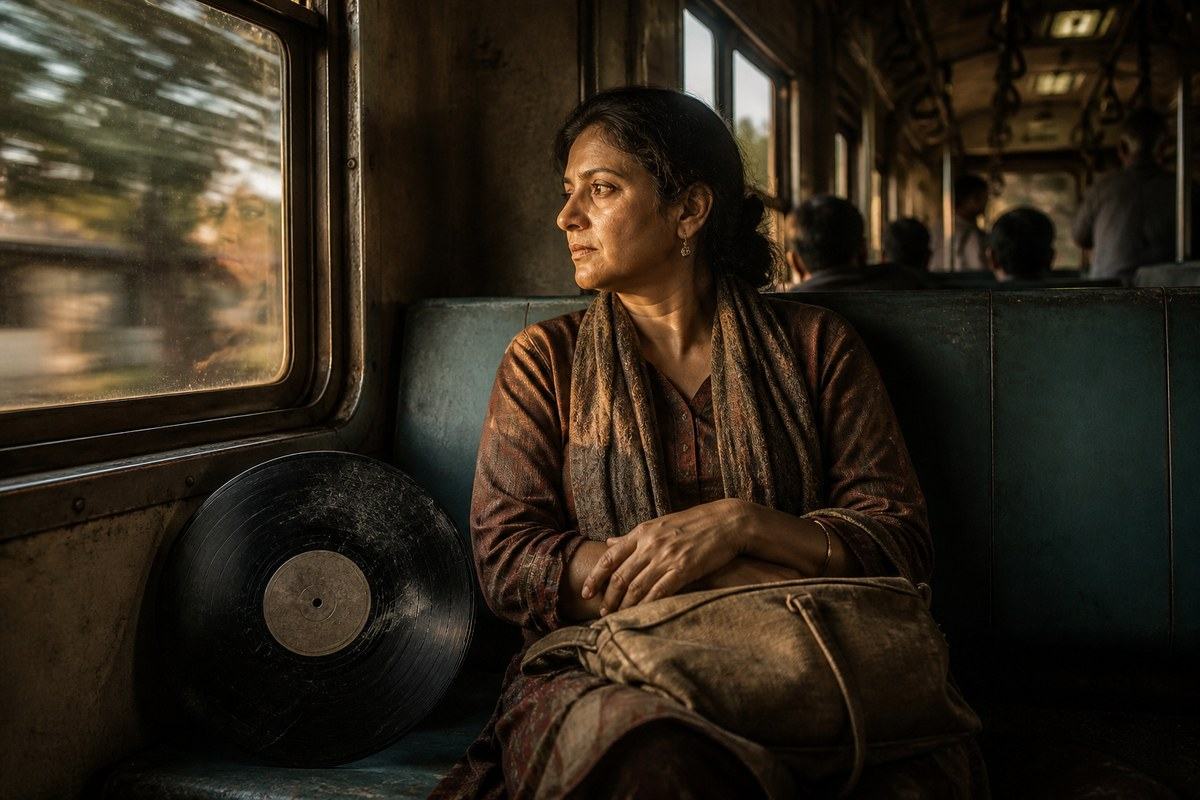
The remembered radio need not be a magnificent wooden heirloom. In many homes it was an ordinary transistor, its handle worn, its tuning scale a small geography of places nobody in the family had visited. It might live on top of a cupboard all year and be brought down for this morning with an attention usually reserved for an elderly relative.
Someone would turn the dial too far.
Someone would object.
Someone, having contributed nothing to the search, would announce that it had been perfectly clear a moment ago.
A Bengali family can make a committee out of a volume knob.
Then the station would settle, and the same people would go quiet.
I like remembering the fuss around the listening. The broadcast itself has been preserved; the little household noises have not. Nobody made a recording of the slippers crossing the floor, the kitchen latch, the whispered argument about whether there was enough milk. Nobody thought those sounds would become precious. They were in the way of what we had got up to hear.
Now I would give a great deal for another minute of them.
And Bhadra was still alive when I was a child. He died in 1991. It would be false to put a dead man’s voice into every childhood Mahalaya, as though he had always belonged to the other side of time.
He was a man doing extraordinarily good work.
So were the people around him. Mahishasuramardini grew out of Calcutta radio in the 1930s, with Bani Kumar’s writing, Pankaj Kumar Mullick’s music, Bhadra’s recitation and narration, and the singers and musicians whose work we sometimes absorb so completely that we forget to name them. The program moves through Sanskrit verses, Bengali narration, songs, music, battle, supplication.
The familiar recording carries all that labor into our rooms.
For roughly an hour and a half, people who could never have known us give us something we know almost by touch.
I am an atheist. Four in the morning does not alter that, although it does considerable damage to my ability to defend myself against a familiar tune.
For a believer, these are sacred words. I have no wish to explain away somebody else’s devotion merely because mine has taken another form. Mahalaya also belongs to the remembrance of ancestors, to tarpan at the river, to people speaking names over water. Its religious meaning is not an embarrassing wrapper to be removed before the rest of us can enjoy the contents.
I listen from where I am.
I can hear a goddess being invoked and think of the people who first turned the radio on. I can disbelieve in heaven and still want, with a force that makes my throat hurt, to hear an ordinary voice from an ordinary room again.
“Cha khabi?”
Will you have tea?
What a small question to survive so much.
At fifty-one, I understand how much of a festival is made by people doing things you scarcely notice while they are doing them. Someone remembers what you like to eat. Someone checks whether your new shirt fits. Someone tells you to take an umbrella, and you are irritated because you are old enough to know when to take an umbrella.
Then the arrangement changes.
Some people die. Some move away. Some are still here, growing older in another part of the city, while you keep meaning to visit under circumstances less humiliating than your present ones. There are distances measured in bus fare and distances that shame makes longer. A living person can be terribly missed.
The old morning contained all of you without anybody having to organize a reunion.
You did not know this was an achievement.
You thought a house full of familiar sounds was simply what morning was.
Of course those years were not innocent. The adults had debts, resentments, illnesses, fears. The city had its cruelties. I have no desire to disinfect the past until it smells like a heritage hotel charging extra for an authentic Bengali experience.
But a child could lie under a sheet and let other people carry the day’s weight for a while.
I miss that with an intensity no amount of sensible thinking seems to reduce.
Tonight, there will be younger people staying up together because going to bed would spoil the occasion. There will be someone determined to wake a child who will later insist they heard the whole thing, despite having slept through most of it. There will be an old radio coaxed into service. There will be a phone charging beside a pillow.
The phone belongs here too.
I am fond of the old crackle, but I will not tell somebody listening alone in a rented room that their memories require better equipment. Nor will I begrudge a young person the screen through which this reaches them. One day they may remember the charging cable, the little blue light, the speaker balanced on a windowsill, with the same ache we attach to a tuning dial.
Let them have their morning.
Somewhere far from Bengal, someone will work out the time difference. Someone will listen after work, in daylight, while trying to remember the darkness of a particular Calcutta room. Someone will send a link to a sibling and receive, several minutes later, “Listening.”
There can be a whole childhood behind that one word.
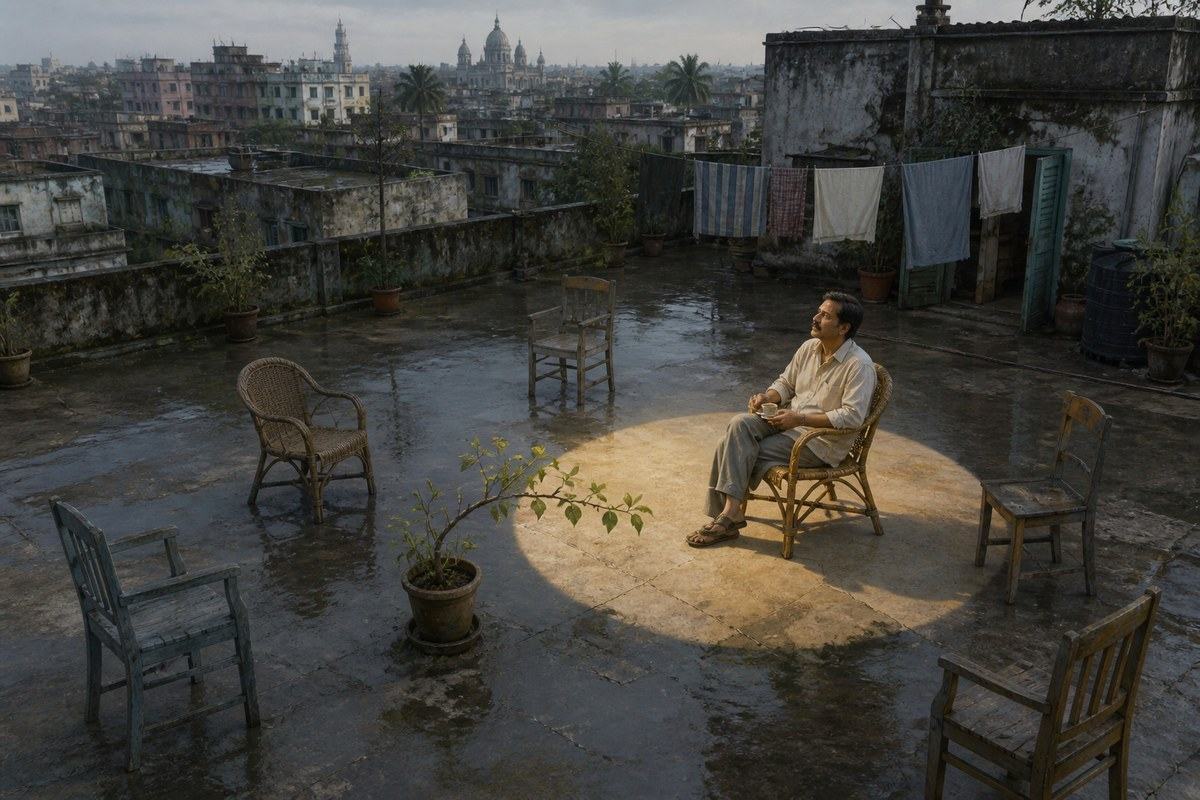
Here, in the city itself, dawn will gradually find the unfinished things. A pandal with its covering still loose. A length of bamboo projecting above a lane. A shop shutter. Clothes left out on a balcony. The men who worked late will need to sleep; the men beginning early will need tea. At the ghats, people will gather for tarpan. Elsewhere, someone will turn the sound down because a baby has finally settled.
The day will make its usual demands.
For now, I am thinking of those scattered lights that will stay on tonight.
Behind one of them, a person may be waiting happily. Behind another, someone may be wondering why a thing they love has begun to hurt so much. There will be houses full of people and rooms occupied by one. I do not imagine we will all feel the same thing when the music starts.
I would like to hear it through another window, though.
Just faintly. Enough to recognize where we are in the program. Enough to know that somebody nearby has reached this part with me.
I will put my tea within reach. If the air is still warm, the fan can go on turning. There is no need to dress the room for a childhood it cannot reproduce.
But when the broadcast begins, I may close my eyes.
It is easier, with my eyes closed, to leave the cupboard where it used to be. To hear someone moving in the next room. To be drowsy and mildly cross at being woken, with no idea how fortunate I am.
“Oth. Mahalaya shuru hoye gechhe.”
I heard you.
Give me another minute.
Word Cloud
Related reading
Selected by shared topics and section, with closer publication dates breaking ties.