The Morning Verdict Is Not Law
Uses the speech voice supplied by your browser or device.

The mouth tastes metallic in the morning, as if a cheap railway canteen spoon has melted overnight on the tongue, and before philosophy, before dignity, before any noble poster about resilience, the body performs its first public service: a small stale belch of acid and defeat.
This is not sadness with music.
No sitar. No rain on glass. No tragic woman in a white sari dissolving into mist beside a pond while some decent man slowly ruins himself in black-and-white.
This is older depression. Municipal depression. Calcutta Corporation depression. It comes with cracked plaster, unpaid bills, damp towel smell, medicine strips, weak tea, phone battery at seventeen percent, and a face in the bathroom mirror that looks less like a man and more like an old government file nibbled by silverfish.
Young depression has costume options. At twenty-three, a man can wear a black shirt, smoke one cigarette too many, stare into coffee, and look ruined in a way that might still attract a dangerous person with pretty eyes and a rescue fantasy. There is theatrical lighting. There is possibility. There is the faint absurd hope that suffering may be converted into cheekbones.
At fifty-one, no such luck.
At fifty-one, depression enters wearing loose underpants and a calcium deficiency. It scratches its stomach. It checks the bank balance. It looks at the face and says, with the flat honesty of a paan shop owner refusing credit, well, this is the remaining furniture.
The cruel thing is not that the day looks bad.
The cruel thing is that the mind has already rejected the whole day before the day has even lifted its shutters.
No good news will come.
No money will arrive.
No old friend will suddenly remember.
No email will open like a secret door.
No woman, man, employer, client, cousin, landlord, or small benevolent committee of fate will look at this face and think, ah, here is a man still carrying a little fire under the ash.
Even language dies at the gate. Depression robs speech before it robs happiness. It does not merely make you unhappy. It makes you boring to yourself. The inner announcer, usually a lively fellow with a microphone and poor boundaries, has gone home.
The mind cannot say, “I am passing through a difficult season.”
Too elegant.
Too seminar-like.
It says, “Same old wreckage.”
And even that sounds second-hand, borrowed from an exhausted uncle at a tea stall who has been explaining the collapse of civilization since 1987.
There is a bankruptcy beyond money, and it is worse because no court records it. Financial bankruptcy at least has papers. Stamps. Dates. Officials. A humiliating little architecture. Mental bankruptcy has no clerk. One simply wakes up and discovers that the account of self-love has insufficient funds. The cheque of self-soothing bounces. The ATM of hope spits out the card and says, contact branch.
In older times, people had more decorative explanations for such mornings. Saturn was annoyed. Ancestors were displeased. Some priest had not been paid. Some goat had escaped its cosmic responsibility. Now we have neuroscience, which is less colorful but often more useful.
The brain is not a temple.
It is more like a wet electrical market in Burrabazar during rain. Chemical shopkeepers shouting. Wires crossing. One bulb flickering. Someone trying to sell you something duplicate. Somewhere an overworked security guard called the prefrontal cortex is trying to maintain order while the amygdala runs through the lanes screaming that everything is on fire.
Depression is not only sadness.
It is prediction.
That is the dirty little science of it. The brain is not quietly receiving reality like a saint on a mat. It is always guessing the next thing. It is a bookie in a dark gambling den, calculating odds from old injuries. When enough mornings have arrived carrying bad news, the brain begins to pre-load defeat. Before the foot touches the floor, the verdict is typed, signed, stamped, and placed in triplicate.
The day will be useless.
The body will be ugly.
The work will not matter.
The phone will not ring.
Tea will taste like boiled resignation.
And because the prediction feels like truth, the man obeys it.
That is how a life shrinks. Not always with thunder. Often by obeying the weather forecast inside the skull.
A younger man may still manufacture fantasies. Career comeback. Romance. Gym body. New shirt. New city. New beginning. A dramatic haircut, because youth always believes the scalp is a policy instrument.
Older depression laughs at this like a bus conductor spitting paan into traffic.
Comeback? With what knees?
Romance? With which face?
Transformation? On this budget?
New beginning? In this heat?
The mind becomes a prosecutor who has read every file and is delighted to present evidence.
Exhibit A: body.
Exhibit B: face.
Exhibit C: bank balance.
Exhibit D: phone silence.
Exhibit E: morning.
The face becomes especially unforgivable. This is a terrible thing to admit because polite society prefers suffering to remain spiritual, but much of depression is brutally physical. A man does not wake up as an abstract soul. He wakes up as skin, teeth, belly, hair loss, stains, smell, age, breath, knees, gums, and the mysterious ache near the shoulder that began during one administration and has survived several others.
The mirror is not a mirror.
It is a hostile witness.
It gives testimony without compassion.
And the body, poor old defendant, is blamed for everything.
The body did not create the economy. It did not design the job market. It did not invent loneliness, corruption, unpaid consulting, dental bills, family pressure, bad luck, old illness, or the thousand tiny humiliations that collect around middle age like mosquitoes around a dim bulb. But there it stands in the bathroom, available for punishment.
So the mind kicks it.
Old.
Ugly.
Finished.
Unwanted.
A whole civilization of cruelty can fit inside one man brushing his teeth.
Outside, meanwhile, normal people perform morning as if issued a better operating system. Milk packets are collected. Children go to school. Pressure cookers whistle. Someone in the next building plays a devotional song at a volume suggesting that heaven is either deaf or trapped under furniture. The vegetable seller shouts. Motorbikes cough. A delivery boy looks at his phone as if the fate of empires depends on one packet of momo.
The news keeps arriving too. Wars, elections, markets, heat alerts, celebrity divorces, artificial intelligence promising to replace everyone except the people who make the promises. The world does not pause because one man in South Calcutta is sitting on the edge of his bed, already exhausted by the accusation of being alive.
This is where cheerful people offer advice.
Walk.
Meditate.
Be grateful.
Think positive.
Make a list.
Drink water.
Call a friend.
All excellent suggestions, like recommending ballroom dancing to a buffalo stuck in a drain.
Not wrong.
Just delivered from another planet.
The depressed mind does not reject these things because it is dramatic. It rejects them because action requires a small down payment of belief, and belief is precisely what has been looted. To make tea, one must believe tea is worth making. To bathe, one must believe there is some dignity worth rinsing. To open the laptop, one must believe the future has at least one email-shaped crack through which money, work, or usefulness may enter.
But depression says: why polish a locked door?
Still, there is one small complication, and depression hates complications because it prefers a clean dictatorship.
The morning verdict is not always evidence.
Sometimes it is weather.
Not imaginary weather. Real weather. Neural weather. Chemical weather. Circadian weather. Old grief mixed with poor sleep, cortisol, financial fear, stomach acid, body shame, and the peculiar punishment of waking alone. The body at 6:30 in the morning is a bad philosopher. It speaks with authority but not necessarily accuracy. It is a drunk judge in a lungi.
This does not make the pain false.
A fever is not false because the thermometer explains it.
But explanation puts one thin matchstick between the man and the sentence.
The mind says, “There will be nothing good today.”
A smaller, more careful voice says, “That is a prediction made under hostile biochemical conditions.”
Not uplifting.
Useful.
There is a difference.
The old Greeks had tragedy. Bengal has the morning after the inverter failed. Same basic genre, less marble. The tragic hero once wrestled fate on a hillside. Now he wrestles a rice cooker, a missed payment, a dead libido, and a face that appears to have been assembled during a power cut. Civilization has not reduced suffering. It has merely given suffering cheaper plastic buckets.
And yet the task is not to love oneself in some glossy motivational way. That may be too much. Self-love can sound obscene when a man is broke, alone, ashamed, aging, and older than many of his remaining chances.
Fine.
Do not love yourself this morning.
That is allowed.
But do not let the morning hang the whole man.
That is the smaller law.
A life is not one mood report. A face is not a verdict. A bank balance is not a biography. A body is not a failed advertisement. A bad morning is not a complete philosophy, though it will try very hard to become one, the cunning little tyrant.
Some mornings the only rebellion is procedural.
Make tea without believing in tea.
Wash the face without admiring the face.
Open the window without expecting revelation.
Take the medicine if medicine is part of the arrangement.
Eat something, not because life is beautiful, but because the brain is a glucose-burning organ and even despair needs maintenance if it is going to talk so much.
There is no grand redemption here.
The day may indeed be poor.
The phone may remain silent.
The mirror may continue its dirty work.
Evening may come like an exhausted sweeper dragging the same dust from one corner to another.
But the verdict passed at waking is still not law. It is only the mind in its ugliest uniform, shouting early because it knows one dangerous thing: if the man makes tea, if he stands under water, if he delays final judgment by one ordinary hour, the dictatorship weakens slightly.
Not enough for happiness.
Do not be vulgar.
Enough for postponement.
And sometimes postponement is the only civilized act left to a man whose inner parliament has been occupied by scoundrels.
So the morning sits there with its bad breath, cracked teeth, and stale prophecy. The man sits opposite it. Neither wins. The kettle makes a small ridiculous sound, like a dying mosquito trying to become a whistle.
That is all.
For now, that is all.
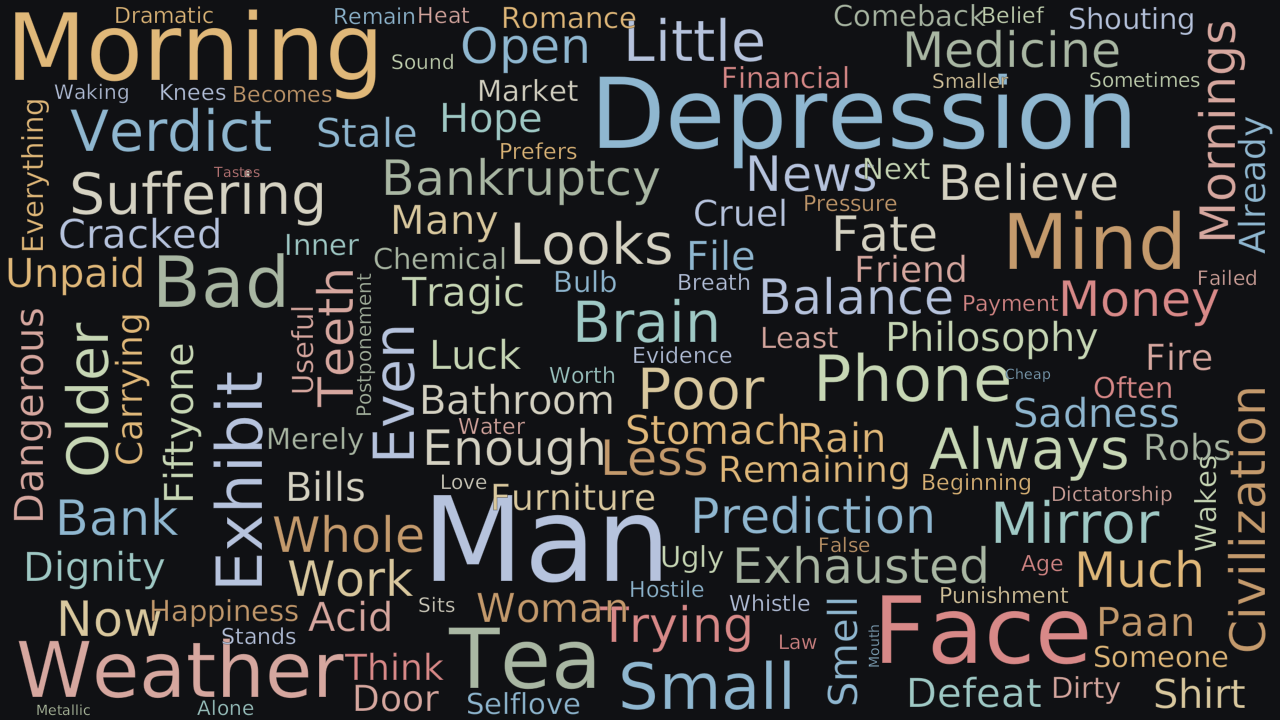
Word Cloud
Related reading
Selected by shared topics and section, with closer publication dates breaking ties.