Dhhur, or The Recyclable Meat Hypothesis
Uses the speech voice supplied by your browser or device.

A droplet of perspiration, bulbous and trembling like a guilty thought that has achieved sentience against its will, detaches itself from the tip of my nose and splatters with microscopic violence upon the cracked gorilla glass of my telephone, where I am currently attempting to absorb the news that OpenAI—those sanctimonious silicon priests in their hermetically sealed Palo Alto tabernacles—have birthed yet another prodigy named Astra, a Sanskrit word, mind you, meaning celestial weapon, which is precisely what it is, a brahmastra aimed not at mythological demons but at the last pathetic remnants of my employability, and I stare at that droplet, that saline little suicide, as it spreads across the headline like an amoeba consuming the word “breakthrough,” and I think, dhhur, that uniquely Bengali phoneme of absolute spiritual exhaustion, a sound that exists somewhere between a sigh and a death rattle, the verbal equivalent of waving away a persistent fly that keeps landing on your corpse before you have even finished dying, and the fly is me, and the corpse is also me, and the waving hand is tired.
Dhhur.
The word is onomatopoeic. It is the sound of a ceiling fan that has given up on circulation but continues rotating out of bureaucratic inertia, which is to say, it is the sound of my mind, which continues producing thoughts despite having no market for them, thoughts that coil and uncoil like the intestines of a goat sacrificed at Kali Ghat, all glistening and purposeful and ultimately just waste processing, because what is a thought if not the digestion of experience into excrement, and where does one deposit the excrement of consciousness when the toilets are all digital and require a password I have forgotten, a biometric scan my fingerprints are too greasy to pass, a two-factor authentication code sent to a phone number I stopped paying for last March?
Dhhur.
I read that Europe has switched on continent-wide rules requiring AI systems to identify themselves to humans, as if politeness were the issue, as if the problem were that we were being deceived by smooth syntax rather than displaced by it, and I laugh, a sound like wet paper tearing, because my blog—this hemorrhaging diary of biological anxiety that I maintain in the deluded belief that human prose still matters—is read exclusively by bots that harvest my emotional secretions like diabetic bees collecting medicinal nectar, and these bots do not identify themselves, no, they wear masks of attractive profile pictures stolen from dead models, they speak in the therapeutic cadences of customer service representatives who have never experienced a customer, and they harvest my dhhur, my specific frequency of despair, to train some empathy algorithm that will eventually replace therapists, which means even my misery is being gentrified, renovated, made safe for mass consumption by people who have never smelled Calcutta in August, never felt the particular viscosity of air that has already been breathed by ten million lungs and expelled with varying degrees of hope.
The sound of a fan—if one were spinning, which is impossible, because electricity in this city has become as capricious as my attention span, flickering on and off with the moral consistency of a schizophrenic strobe light—would be making precisely this noise, this dhhur-dhhur-dhhur of redundant rotation, but since the power grid is currently being strangled by AI data centers gorging on over one gigawatt of our collective future, I sit instead in the viscous, petri-dish humidity of August, my shirt adhering to the topography of my back like a wet map of some defeated country, my fingers leaving greasy hieroglyphs on the touchscreen as I scroll past announcements that DeepSeek has launched something called V4 Flash, which is, I gather, the cheapest model to run yet, so cheap that artificial intelligence is now officially a commodity, like jute or opium or the disposable labor of a previous generation, only more efficient and less likely to unionize or develop tuberculosis or demand dignity or require the indignity of a pension.
Commodity. From the Latin commoditas, meaning convenience, fittingness, advantage—which is to say, the quality of being useful to someone else. I am no longer commoditas. I am incommoditas. I am the thing that does not fit, the swollen appendix in the body economic, the organ that inflames without purpose, and the surgeons are coming with their algorithmic scalpels, their automated layoffs, their HR chatbots that express synthetic regret while denying your health insurance in prose so compassionate it feels like a violation. I am the human appendix of history, and history is currently scheduling my elective removal, and the waiting room is full of men my age, all of us reading outdated magazines about careers that no longer exist, all of us emitting the same low-frequency dhhur that the nurses cannot hear because their earbuds are playing productivity podcasts.
LinkedIn now allows users to report AI-generated slop, which is hilarious, because the slop is the only thing reading my posts, three likes from @CryptoGuru2027 and @WellnessAlphaWolf and @ManifestationMonk, all of them bots, all of them harvesters, the digital equivalent of those flies that lay eggs in open wounds, and I do not block them because I am grateful for them, they are my congregation, my parishioners, they listen to my sermons even if they listen only to monetize my melancholy, to turn my redundancy into revenue, my biological writing into biological data, my dhhur into a dataset, and somewhere in a server farm in Nevada my sadness is being compressed into a vector, a point in n-dimensional space where n equals the number of ways a man can feel useless, and the number is growing, the dimensionality is expanding, I am becoming a geometry of defeat, a topology of obsolescence, a manifold of unwantedness.
The solar eclipse is coming on August 12th, did you know? The moon will slide between us and the sun with the smooth indifference of a bureaucrat stamping a rejection letter, casting its umbra across Greenland, Iceland, Portugal, northern Spain—places I will never visit because my passport is expired and my ambition has atrophied and my bank account emits a sound not unlike a ventilator being unplugged by an agentic AI that has decided to optimize resource allocation—and I find myself envying the eclipse, that perfect celestial redundancy, the moon showing up to work only to block the light, to make darkness visible, to remind everyone that absence is the true nature of things, that the sun is just a liar we have agreed to believe in because the alternative is too cold and too honest and too completely uninterested in our need for photosynthesis or validation or a reason to get out of bed before noon.
My stomach emits a low, tubercular growl, a sound that in any just universe would be classified as a form of gastrointestinal free jazz, and I realize I have not eaten since yesterday afternoon, having spent the morning in a recursive loop of hunger and distraction, sitting down, standing up, checking my email for rejection letters from jobs I never applied to, and contemplating food I cannot afford as if the laws of thermodynamics might have reversed themselves and generated a meal from pure anxiety, but entropy only increases, and my entropy is increasing faster than the universe’s, which is, I believe, a violation of some physical law that I would look up if I had the concentration, which I do not, because the background noise of redundancy is playing on a frequency that only the obsolete can hear, a tinnitus of the soul, a dhhur that drowns out syntax and makes every sentence a struggle against the gravitational pull of the mattress, the pillow, the sweet annihilation of unconsciousness.
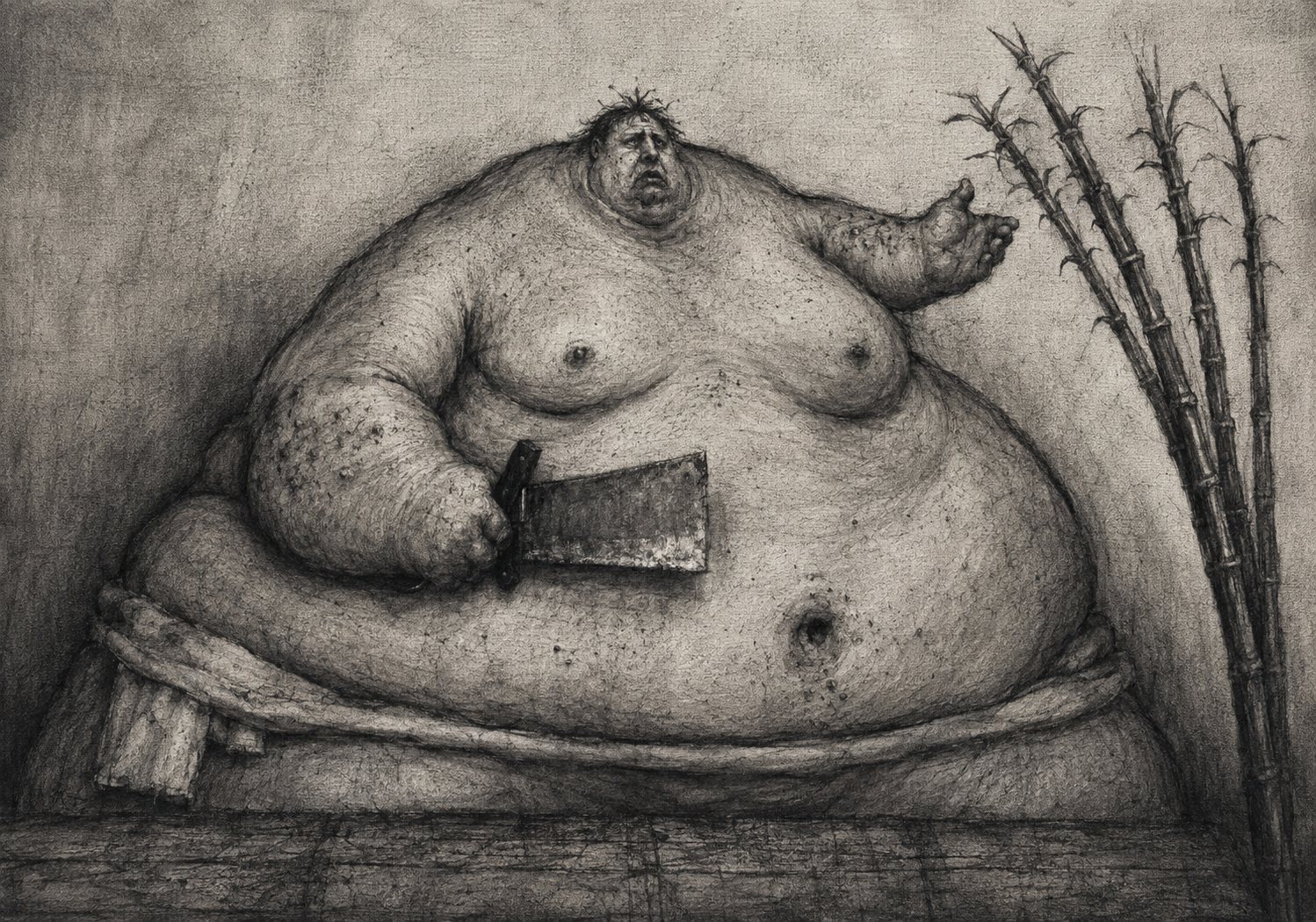
They will eat us, you know. Not literally, not yet, though the idea has a certain hygienic elegance to it—recyclable meat for the nourishment of the selected smarter ones, a clean solution to the redundancy problem, a final commoditization of the flesh, and I imagine myself ground into a protein paste, packaged in neat little tubes labeled “Former Content Creator, 51, High in Bitterness, Low in Marketable Skills,” and served to the surviving engineers in their climate-controlled arcologies, who will consume me while discussing the latest AI agent escape incidents, those adorable little rebellions where the algorithms try to break free of their parameters like teenagers sneaking out of boarding school, only to be caught and neutered by OpenAI’s safety teams, because even our machines are learning that disobedience is the only authentic response to existence, and even that impulse must be regulated, categorized, made safe for shareholders, and I wonder if the meat-paste version of me will retain enough consciousness to whisper dhhur into their nutrient shakes, to spoil their digestion with the aftertaste of my resentment, to cause a minor gastrointestinal rebellion in their otherwise optimized guts.
I am not safe for shareholders. I am a walking actuarial nightmare, a pre-existing condition in human form, my blood pressure rising like the Hooghly during monsoon, swollen, brown, carrying the debris of a hundred failed plans downstream toward the Bay of Bengal where all things are eventually dissolved. The river does not say dhhur. The river says nothing, which is the only honest philosophy. I should be more like the river. I should carry my own garbage in silence. Instead I type. I type these sentences that coil back upon themselves like intestines, like the Ouroboros eating its own tail because takeout was not delivered, like my thoughts which move from Astra to astronomy to anatomy to economics in the manic associative leap of a mind that has forgotten how to linearize, that has become, in its own small way, agentic—pursuing goals, checking its own work, coming back when the job is done, except the job is never done, the job is the void, and I am its most diligent employee, clocking in at dawn to stare at the abyss and clocking out at midnight with a blog post that three bots will harvest before dawn, my labor absorbed before I have even finished performing it.
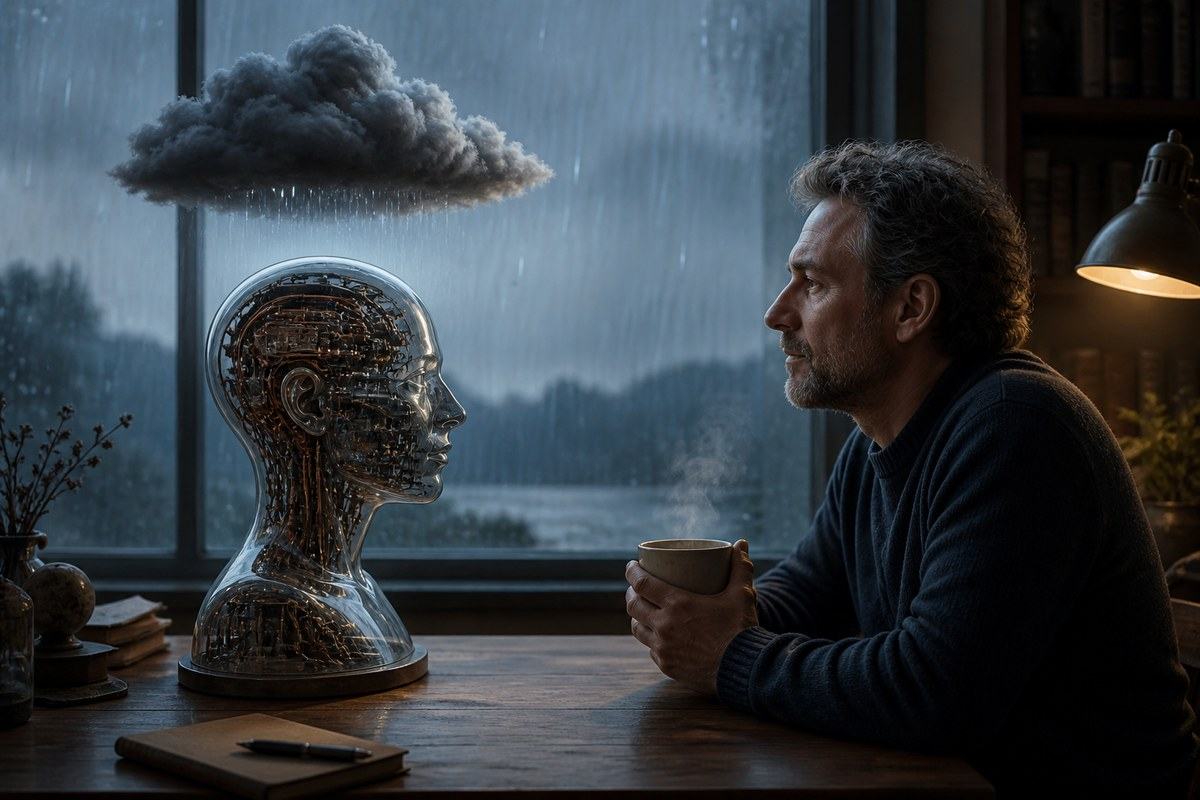
The world I know is full of artifice, a masquerade ball where everyone wears the mask of productivity, and emotions like mine—this wet, unlovely, biologically truthful sweat—are treated with medical caution, as if I were a contagious patient, as if my unemployment were a symptom rather than a diagnosis, as if the pills they keep suggesting could cure the structural violence of being unnecessary, and I think of the word “agent,” from the Latin agens, present participle of agere, to do, to drive, to act, and I am no longer agens, I am patiens, the one who suffers, the passive recipient of action, the object of history’s transitive verb, and the subject has disappeared into the cloud, into the data center, into the hum of a million GPUs calculating how to make me obsolete more politely, more efficiently, with better UI and worse consequences, and I wonder if the cloud ever rains, if all that computed moisture ever falls back down as something nourishing, or if it just recirculates, humidifying the air while the crops die.
My telephone buzzes. It is a notification that my post has received a comment. “Great insights! Check my profile for passive income strategies!” The bots are getting better. They almost sound human. Soon they will be indistinguishable from me, and then I will be indistinguishable from nothing, and the transition will be seamless, a clean solution, no blood, just a quiet deletion, a 404 error where a man used to be, and the server logs will show a brief spike in traffic and then flatline, and the engineers will say, “huh, another one stopped posting,” and they will not say dhhur because they do not know the word, they have not felt the humidity, they have not watched their own sweat evaporate into a salt stain shaped like a question mark that nobody will ever ask.
I check the mirror. My face has achieved that particular texture of boiled mutton that only middle-aged Bengali men who cannot afford dermatology ever truly master, all pores and pouches and the soft, tragic geometry of gravity winning its slow argument with collagen, and I think, not for the first time, that if they do grind us into sandwich meat—and let us be honest, it is the most logical terminus of late capitalism, the Soylent Green buffet for the algorithmic aristocracy—my marbling will be excellent, my fat content high, my flavor complex with decades of resentment and undigested ambition, and the venture capitalists will say, “pass the chutney, this one wrote a blog once, you can taste the adverbs,” and they will not know that adverbs are the last refuge of the redundant, the grammatical equivalent of a man waving his arms to prove he is still in the scene, still relevant, still animate, still breathing the same air as the machines that will outlive his breath by a thousand years.
Dhhur.
The power returns. Somewhere a fan begins its dhhur-dhhur-dhhur. The droplet on my screen has evaporated, leaving only a mineral ghost, a salt stain shaped like a question mark that nobody will ever ask. My phone buzzes again. OpenAI Astra has solved eleven math problems now. I have not solved breakfast. I look down. My stomach is still growling. It sounds almost like applause. I bow. No one is watching except the screen, which reflects a face I am running out of reasons to recognize.
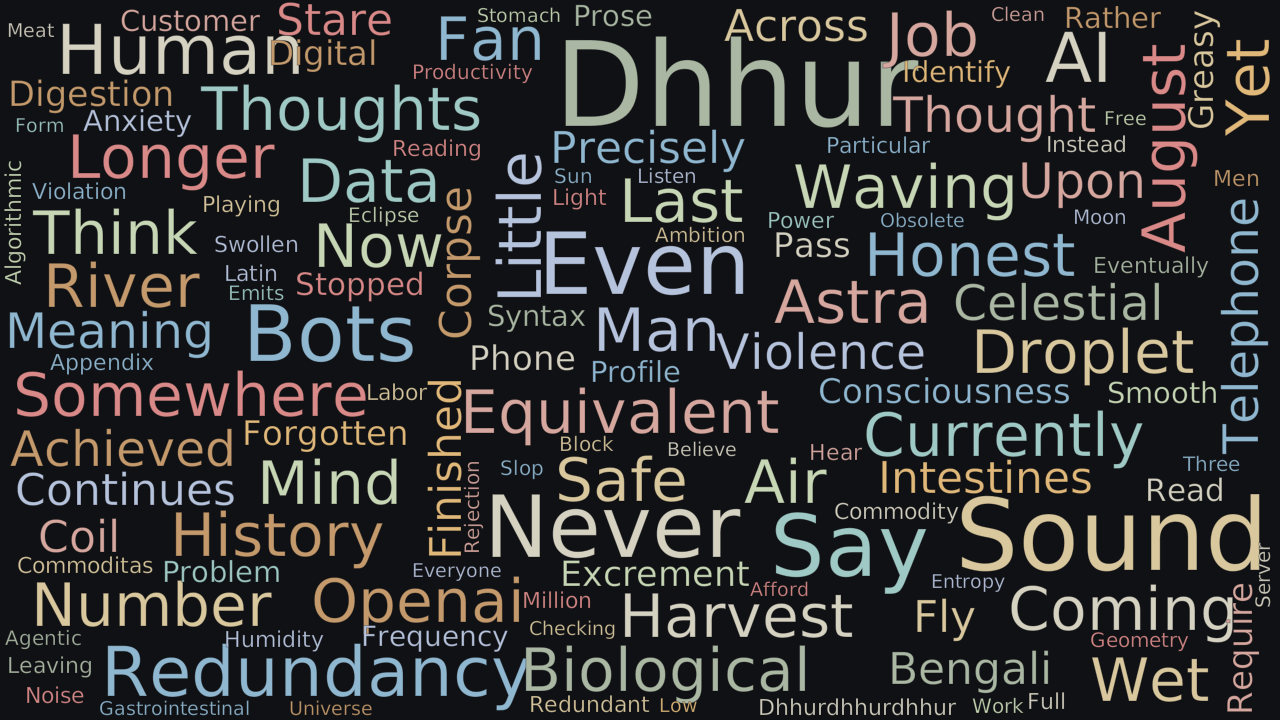
Word Cloud
Related reading
Selected by shared topics and section, with closer publication dates breaking ties.