Topic Headquarters
HL7, FHIR, and Healthcare Interoperability
A practical route from hospital messages and FHIR resources to identity, terminology, provenance, implementation guides, data warehouses, and real health-system constraints.
Healthcare interoperability begins with an ordinary irritation: the information already exists, yet the patient or clinician must supply it again. One hospital knows the allergy, another knows the laboratory result, a third holds the discharge summary, and none can reliably assemble the same person at the moment of care. The failure is not merely that computers use different file formats. Healthcare data carries identity, time, terminology, workflow, and institutional history. Moving a value without those conditions can move confusion faster.
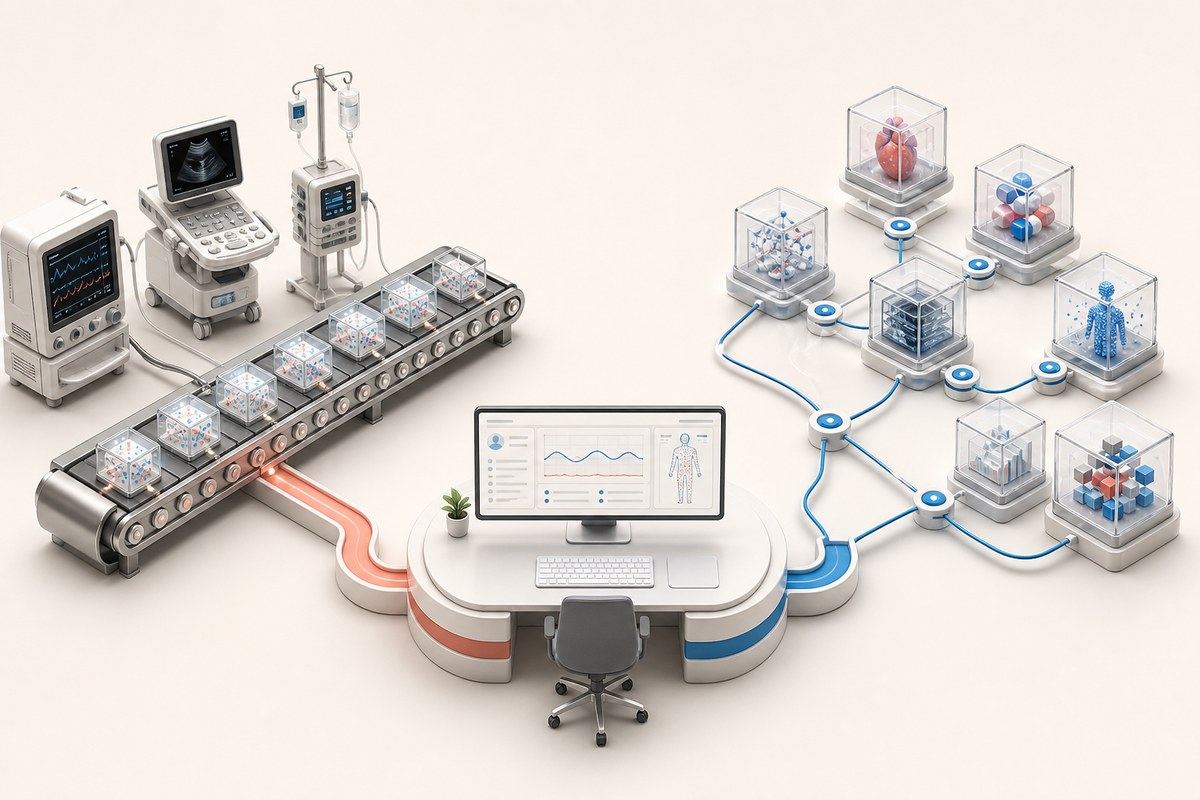
HL7 v2 and FHIR address different boundaries inside that problem. HL7 v2 remains the workhorse for event messages such as admissions, orders, and results. FHIR organizes information into modular resources and uses familiar web patterns for queries, apps, patient access, and ecosystem exchange. Profiles and implementation guides narrow the broad standard for actual use. Terminology bindings try to keep two systems from using the same field to mean nearby but incompatible things.
Neither standard is a health information exchange by itself. Real exchange also needs patient matching, registries, consent and access rules, provenance, monitoring, version governance, and people empowered to resolve ambiguity. The deeper readings follow data into VA operational systems and warehouses, compare different longitudinal architectures, and examine countries where the institutional prerequisites are uneven. The goal is not to memorize acronyms. It is to understand why a message can be delivered perfectly while the clinical meaning arrives late, incomplete, or wearing the wrong patient’s shoes.
Best place to start
One useful first door
Start here to learn why HL7 v2 messages and FHIR resources are complementary tools, not rival generations in a simple replacement story.
HL7 v2 and FHIR solve different interoperability problems. Learn when event messages, web APIs, profiles, and terminology governance each belong.
Three reading paths
These are ordered editorial journeys, not automatic difficulty labels. Follow one route or move between them as your questions change.
Begin here
Beginner path
Start with the repeated-clipboard problem, then widen from one API standard to the governance and shared services required for exchange.
- Article Healthcare ITFHIR and the Clerk With the Clipboard
How FHIR uses web APIs, resources, profiles, and terminology to exchange health data—and why a standard alone cannot fix fragmented care.
Updated - Article Healthcare ITHIE from First Principles
How Health Information Exchange and OpenHIE coordinate patient identity, terminology, provenance, registries, and shared records across health systems.
Updated
Build context
Intermediate path
Follow health data from operational systems into enterprise architecture, where translation, provenance, and institutional memory become unavoidable.
- Article Healthcare ITThe Shadow Architecture of Healthcare Data
A first-person account of a decade spent as a founder and independent architect learning the structural realities of healthcare data, markets, and AI.
Updated - Article Healthcare ITHow VA Healthcare Data Systems Work: From MUMPS to SQL
How VA clinical data moves from VistA, MUMPS, and FileMan into SQL warehouses—and why the journey is semantic translation, not simple conversion.
Updated - Article Healthcare ITBuilding VA Data Warehouses
A practical primer on VA data warehouses, where extraction is easy but semantic stability, provenance and grain are difficult.
Updated
Go further
Deep-reading path
Examine national constraints, longitudinal data architecture, and what happens when clinical reality is compressed into learned representations.
- Article Healthcare ITWhy EHR and HIE Struggle in India but AI Diagnostics might not
Why EHR and HIE architectures struggle in India, and how the same structural gaps may create openings for AI-driven diagnostics.
Updated - Article Healthcare ITThe Questions You Ask
Why longitudinal, population, and predictive analysis diverge between academic medical centres and VA healthcare data systems.
Updated - Article Healthcare ITLatent Space in Healthcare Data, From the Beginning
How clinical embeddings represent hidden patterns in healthcare data, where they fail, and why every patient vector needs provenance and an audit path.
Updated
Suvro’s contrarian view
Transport is the easy part
Interoperability is too often presented as a plumbing problem: choose the modern standard, connect the endpoints, and let information flow. Healthcare repeatedly proves that transport can succeed while meaning fails. A lab result may arrive without the local method, a diagnosis may reflect billing pressure, and a clean resource may hide an uncertain patient match. The hard work is agreeing what data represents, who may rely on it, how exceptions are governed, and which institution is accountable when the shared story is wrong. FHIR improves the language of exchange; it does not abolish the politics or archaeology of healthcare data.
Glossary
A small working vocabulary for this subject, defined for the way it appears across this site.
- HL7 v2
- A widely deployed family of event messages used by hospitals to send admissions, orders, results, and other operational updates between systems.
- FHIR
- Fast Healthcare Interoperability Resources, an HL7 standard that represents health information as modular resources and exposes it through web-friendly exchange patterns.
- FHIR resource
- A structured unit such as Patient, Observation, Condition, or MedicationRequest with a defined purpose and standard representation.
- Profile
- A constrained statement of how a FHIR resource is used for a particular country, program, workflow, or exchange requirement.
- Implementation guide
- A published package of profiles, terminology bindings, examples, rules, and guidance that makes a broad standard implementable in a specific context.
- Terminology
- Controlled codes and naming systems used to preserve clinical meaning, such as identifiers for tests, diagnoses, medications, and observations.
- HIE
- Health Information Exchange: the technical and governance arrangement that lets information move among otherwise separate healthcare organizations.
- Provenance
- Evidence of where data came from, who or what changed it, when the change occurred, and which transformation produced the current form.
- Semantic interoperability
- The ability of receiving systems and people to preserve and use the meaning of exchanged data, not merely parse its syntax.
- Patient identity
- The difficult process of deciding which records from different systems refer to the same person without merging different people or splitting one person's history.
Frequently asked questions
Is FHIR replacing HL7 v2?
Not as a universal one-for-one replacement. HL7 v2 remains deeply embedded in event-driven hospital workflows, while FHIR is often better suited to APIs, apps, patient access, and query-based exchange. Many sound architectures use both.
Is FHIR just JSON for healthcare?
No. JSON is one possible serialization, but FHIR also defines resources, relationships, search behavior, conformance artifacts, and terminology expectations. A JSON document can be syntactically valid while still being clinically ambiguous or locally unusable.
Why do two conformant systems still fail to understand each other?
Standards leave choices because healthcare settings differ. Systems still need shared profiles, code systems, identity rules, workflow agreements, version policies, and governance for exceptions.
What is the difference between an HIE and a data warehouse?
An HIE coordinates exchange for care and operational continuity, often close to the time data is needed. A warehouse reorganizes data for analytics, reporting, research, and longitudinal use; treating one as the other creates damaging assumptions.
Why does provenance matter if the value looks correct?
The same-looking value may have been measured, copied, inferred, transformed, corrected, or entered for an administrative reason. Without provenance, a consumer cannot judge which interpretation or use is safe.
Can a country adopt FHIR before every hospital has a mature EHR?
It can adopt the standard, but meaningful exchange still depends on source systems, identity, terminology, workflow, connectivity, governance, and incentives. A national specification is an important coordination tool, not a substitute for the institutions that must produce and use trustworthy data.
Recently updated material
Automatically ordered by each resource’s declared update date, with publication date used only when no update is recorded.
- Article HealthcareThe Hidden Architecture of Healing: How Ontologies and Data Models Quietly Run Modern MedicineUpdated
- Game GamesThe Healthcare IT Crossword: Systems RoundsUpdated 3–15+ min play read
- Visualization VisualizationsThe Prior Authorization Machine: a patient, an MRI, and the invisible decisions between themUpdated 22 min read
- Article Healthcare ITTrying to Write About Healthcare IT While the Ceiling Paint Falls Into the DalUpdated
- Article Artificial IntelligenceThe Mental Health System Will Meet the AI Wave at Its Weakest JointUpdated
- Article Healthcare AIThe Negative Infinity Before the SingularityUpdated
Browse all material
The complete published collection currently assigned to this headquarters: 21 resources.
- Article HealthcareThe Hidden Architecture of Healing: How Ontologies and Data Models Quietly Run Modern MedicineUpdated
- Game GamesThe Healthcare IT Crossword: Systems RoundsUpdated 3–15+ min play read
- Visualization VisualizationsThe Prior Authorization Machine: a patient, an MRI, and the invisible decisions between themUpdated 22 min read
- Article Healthcare ITFHIR and the Clerk With the ClipboardUpdated
- Article Healthcare ITTrying to Write About Healthcare IT While the Ceiling Paint Falls Into the DalUpdated
- Article Artificial IntelligenceThe Mental Health System Will Meet the AI Wave at Its Weakest JointUpdated
- Article Healthcare AIThe Negative Infinity Before the SingularityUpdated
- Article Healthcare AIHealthcare AI and the Wrong ObjectiveUpdated
- Article Healthcare ITMental Health Polypharmacy Needs Real Decision Support, Not Another CheckboxUpdated
- Article Useful Mental ModelsFirst Principles Thinking in Calcutta, Healthcare, and the Machinery of RealityUpdated
- Article Healthcare ITThe Shadow Architecture of Healthcare DataUpdated
- Article Healthcare ITHL7 vs FHIR, Explained SimplyUpdated
- Article Healthcare ITHow VA Healthcare Data Systems Work: From MUMPS to SQLUpdated
- Article Healthcare ITLatent Space in Healthcare Data, From the BeginningUpdated
- Article Healthcare ITDatabases and Data WarehousesUpdated
- Article Healthcare ITBuilding VA Data WarehousesUpdated
- Article Healthcare ITVector DatabasesUpdated
- Article Healthcare AIAI in Healthcare: BewareUpdated
- Article Healthcare ITHIE from First PrinciplesUpdated
- Article Healthcare ITWhy EHR and HIE Struggle in India but AI Diagnostics might notUpdated
- Article Healthcare ITThe Questions You AskUpdated
Related Topic Headquarters
Healthcare AI Beyond the Demonstration
A route through clinical data, objectives, evaluation, workflow, safety, trials, interoperability, monitoring, and the distance between an impressive model and dependable care.
Explore topicInteractive Mathematics and Visual Models
Learn by manipulating systems: sample probability, colour complex functions, build perceptrons, compare neuron models, and bend rays through simulated spacetime.
Explore topic