The Ghost in the Machine: A Layman's Guide to Virtualization, VMs, and Docker
On this page
Checking article narration…

The Ghost in the Machine: A Layman’s Guide to Virtualization, VMs, and Docker
I want you to imagine something with me. Not a computer, not yet, but a house. A very strange house, with very strange rules. This house has a single kitchen, but ten different families live inside it, and each family believes—truly, deeply believes—that they alone possess the kitchen. They cook their meals simultaneously, unaware of the others, each convinced that the stove they use is theirs alone, the refrigerator they open contains only their food, the clock on the wall tells their time. They are, in a word, deluded. But here is the peculiar thing: the delusion works. Perfectly. No family ever burns another’s dinner. No one ever opens the refrigerator to find someone else’s leftovers staring back at them. The house functions, impossibly, harmoniously, because of a silent, invisible landlord who manages everything, who arbitrates every dispute before it happens, who maintains the beautiful fiction that ten kitchens exist where only one does.
This house, I should tell you now, is not really a house. It is your computer. The families are virtual machines, each with its own operating system and programs. The landlord is what we call a hypervisor, and the entire delicate, preposterous, magnificent con that makes it possible is called virtualization. And if you have ever used the internet—and you have, you are using it now—you have been living inside this house your entire digital life without knowing it.
Let me back up. I promised you first principles, and first principles we shall have, but I must warn you: the rabbit hole goes deep, and the rabbits are stranger than you might expect.
The Tyranny of One: Why Computers Needed to Become Multiple
To understand why virtualization exists, you must first understand a peculiar historical accident. In the beginning—and by “the beginning” I mean the 1940s and 1950s, when computers were the size of rooms and required the tender ministrations of priests in lab coats—computers were singular. One machine, one job at a time. The ENIAC, that glorious, 27-ton behemoth of vacuum tubes and copper wire, did not multitask. It did not even single-task particularly efficiently. It computed artillery trajectories while the entire building hummed with its hunger for electricity, and when it was done, it stopped, and humans scurried in to feed it the next problem.
This was, if you think about it, an absurd arrangement. Here was a machine that could calculate in minutes what would take a human mathematician months, and yet it spent most of its time idle, waiting for humans to punch cards, load tapes, and generally behave like slow, fleshy bottlenecks in an otherwise sleek mechanical pipeline. The computer was a Ferrari stuck in first gear, driven by someone who insisted on stopping at every intersection to consult a map.
The waste was staggering. And waste, as any good engineer will tell you while staring mournfully at an underutilized resource, is an affront to the natural order of things. The early computer scientists—people like John McCarthy, who coined the term “artificial intelligence” and then spent decades being disappointed by it—looked at these hulking, expensive, mostly-idle machines and thought: What if one computer could pretend to be many?
This thought, which seems almost trivial in retrospect, was in fact revolutionary. It was the cognitive leap that gave us time-sharing, helped lay the groundwork for virtualization, and eventually helped make possible the modern cloud, the app economy, and the ability to spin up a server in Singapore while sitting in your pajamas in Brooklyn. But to appreciate the leap, we need to understand what, exactly, these scientists were trying to duplicate.
The Illusion of Ownership: What Virtualization Actually Does
Here is the first principle, the bedrock upon which everything else rests: a computer is not a thing, but an idea.
Bear with me. When you think of “a computer,” you probably picture a physical object—a laptop, a phone, a humming metal box under a desk. But to a program, a computer is not aluminum and silicon. It is a set of promises. The program asks: Give me memory to store my variables. Give me a processor to execute my instructions. Give me input and output so I can communicate with the world. The operating system and physical machine fulfill these promises, and the program, satisfied, goes about its business.
Virtualization exploits this philosophical loophole with the subtlety of a stage magician. It asks: what if we could intercept those requests? What if, instead of one operating system managing one physical machine, we inserted a middleman—a hypervisor, that landlord from our opening parable—that could handle a guest operating system’s requests and pretend to fulfill them, while actually sharing the physical resources among many virtual machines, each believing it had the machine to itself?
The hypervisor, you see, is a liar. A benevolent, meticulous, extraordinarily competent liar. When VM A asks for memory, the hypervisor says, “Certainly, here is your memory,” and hands it a slice of the physical RAM, carefully fenced off from the slices given to VMs B, C, and D. When VM B asks for CPU time, the hypervisor says, “Of course, you may run,” and lets it execute for a few milliseconds before snatching the processor away and giving it to VM C, which resumes from where it left off.
This is the essence of virtualization: the art of making one physical computer behave like many imaginary computers. Those imaginary computers—we call them virtual machines, or VMs—are complete, self-contained universes. Each has its own operating system, its own memory, its own virtual hard drive, its own network card. If you were a program living inside a VM, you could usually go about your business without caring whether the hardware was “real.” The illusion is that useful. The matrix, it turns out, was built in the 1960s, and it runs on mainframes.
A Brief History of Pretending: From IBM to Your Laptop
The story of virtualization does not begin with a bang but with a whimper of economic desperation. In the mid-1960s, IBM—the Google, Microsoft, and Apple of its day, all rolled into one slightly bureaucratic package—was selling computers like the System/360 to large corporations and universities. These machines cost millions of dollars, and as I mentioned, they sat idle most of the time. IBM’s customers were not pleased. Imagine buying a Rolls-Royce and being told you could only drive it on Tuesdays.
So IBM’s engineers, in a fit of pragmatic genius, developed the CP/CMS system, which stood for Control Program/Cambridge Monitor System. The Control Program was the hypervisor, the landlord, the keeper of the beautiful fiction. The Cambridge Monitor System was a lightweight operating system that ran inside the virtual machines, giving users the illusion of having a complete computer to themselves. Multiple users could now share one physical machine through separate virtual machines—one running a payroll calculation, another debugging a program, another writing what would probably be a very long memo about synergy.
By 1967, CP and CMS were in production use. Virtualization is older than the moon landing, older than the microprocessor, older than the personal computer. It is, in computing terms, a venerable, ancient art.
And then, oddly, it went dormant.
When the microprocessor revolution arrived in the 1970s and 1980s, computers became cheap. So cheap that the economic argument for virtualization—share one expensive machine among many users—collapsed. Why bother with the complexity of virtual machines when everyone could have their own physical computer? Virtualization retreated to the mainframe data centers, a forgotten relic, like a sophisticated court dance performed only in dusty ballrooms while the rest of the world discovered disco.
But virtualization was merely waiting for its moment, like a chess player biding time while the board rearranges itself. That moment arrived in the late 1990s, when a company called VMware—founded by a group of computer scientists who understood that the future was not one computer per person but thousands of computers per company—realized that the new, cheap x86 processors (the Intel and AMD chips that power PCs) could be tricked into running virtual machines too.
This was not supposed to be possible. The x86 architecture was notoriously unfriendly to virtualization—its instructions were designed with the assumption that programs would run directly on hardware, with no meddling middlemen. But VMware’s engineers found workarounds, clever hacks that let the hypervisor maintain the illusion even on hardware that resisted it. In 1999, they released VMware Workstation, and the virtualization revolution began in earnest.
The timing was exquisite. The internet was exploding. Companies needed servers—web servers, email servers, database servers—and they were buying physical machines by the pallet, filling data centers with hot, humming boxes that, just like their mainframe ancestors, sat mostly idle. Virtualization returned like a forgotten god, offering the same old bargain: let me help you stop wasting things.
The Hypervisor: God of a Tiny, Perfect World
Let us zoom in now, closer to the machinery, and examine the hypervisor itself—that benevolent dictator of the virtual realm.
There are two species of hypervisor, and the distinction matters, though not in any way that should keep you up at night. Type 1 hypervisors—also called “bare-metal” hypervisors—sit directly on the physical hardware. They are the operating system’s operating system, the landlord who owns the building outright. VMware ESXi, Microsoft Hyper-V, and the open-source Xen are of this kind. They are lean, mean, and found in data centers where efficiency is religion.
Type 2 hypervisors, by contrast, are applications. They run on top of a conventional operating system—Windows, macOS, Linux—like any other program. VMware Workstation, VirtualBox, and Parallels are Type 2. They are the tenant who sublets rooms in someone else’s building. Less efficient, more convenient, perfect for developers who want to run Linux inside Windows, or Windows inside macOS, like a computational turducken.
The hypervisor’s job, in either case, is arbitration. It must decide, moment by moment, who gets the CPU, who gets the memory, who gets to talk to the network. It must maintain the fiction of ownership while ruthlessly enforcing the reality of sharing. It is, in this sense, less like a landlord and more like a stage manager in a theater where every actor believes they are the star of a one-person show, unaware that they are sharing the stage, the lights, and the audience’s attention with a dozen other performers, all of whom are hitting their marks precisely because the stage manager is a genius of logistics.
But here is where the story takes an interesting turn. For all their elegance, virtual machines are, in a word, heavy.
The Container Revolution: Or, How I Learned to Stop Worrying and Love the Namespace
To understand why VMs are heavy, consider what they virtualize: everything. A VM includes a complete operating system—its kernel, its drivers, its utilities, its baggage, its childhood memories. If you run ten VMs on one physical server, you are running ten operating systems. Ten copies of the same code, ten sets of the same drivers, ten kernels all doing the same kernel-things, like ten identical twins all trying to use the same bathroom.
This is wasteful. Not as wasteful as ten physical servers, mind you, but wasteful nonetheless. And in the early 2010s, a group of engineers at a company called dotCloud—later renamed Docker, after their flagship product—asked a deceptively simple question: What if we could share the operating system, but keep the applications separate?
The answer, it turned out, had been hiding in the Linux kernel all along.
Linux, the open-source operating system that runs most of the world’s servers, has a feature called namespaces. Namespaces are, to use a technical term, weird. They allow different processes—running programs—to see different versions of the same system resources. One process can see a filesystem that another cannot. One process can have its own network stack, its own process IDs, its own hostname, its own user-ID mappings. It is as if each process gets its own private universe, but all these universes are built on the same physical foundation—the same Linux kernel, the same physical hardware.
Combine namespaces with another Linux feature called control groups (or cgroups, which limit how much CPU, memory, and I/O a process can consume), and you get containers: isolated environments that share the host operating system’s kernel but appear, to the applications inside them, to be complete, self-contained worlds.
Docker, released in 2013, did not invent containers. The technology had existed in various forms for years—Solaris had “zones,” FreeBSD had “jails” (a wonderfully evocative name), and Linux had LXC. What Docker did was make containers easy. It provided a simple command-line interface, a way to package applications and their dependencies into portable images, and a central repository (Docker Hub) where you could download pre-built images like ordering from a computational takeout menu. Docker did for containers what the iPhone did for smartphones: it took an existing technology and made it so accessible that your grandmother could use it, or at least your slightly technical nephew.
The difference between VMs and containers is often explained with diagrams showing how VMs stack operating systems on top of a hypervisor while containers stack applications directly on top of a shared kernel. But I prefer a different analogy. Virtual machines are like houses: each has its own foundation, its own plumbing, its own electrical system, its own roof. Containers are like apartments: they share the building’s foundation, plumbing, and electrical, but each has its own locked door, its own furniture, its own peculiar smell. Both give you privacy. One is more efficient. The other is more isolated.
The Dockerfile: A Recipe for Computational Reproducibility
Let us descend one more level into the machinery, because Docker has a secret weapon, and it is not what you think.
The secret weapon is the Dockerfile.
A Dockerfile is a text file—a script, really—that describes how to build a container image. It specifies the base image (often the files and tools from a minimal Linux distribution like Alpine, which is so small it makes other operating systems look bloated), the software to install, the files to copy, the commands to run. It is, in essence, a recipe. And like all good recipes, it helps produce the same dish in a data center in Virginia or a laptop in Vilnius—provided the ingredients are pinned to the same versions and the machinery is compatible.
This seems mundane. It is not. It is, in fact, a solution to one of the oldest, most maddening problems in software development: “It works on my machine.”
Every programmer knows this phrase. It is uttered with a mixture of bewilderment and defensive pride when code that functions perfectly on the developer’s laptop fails catastrophically on the test server, or the production cluster, or the CEO’s computer during a crucial demo. The reasons are endless: different library versions, different environment variables, different phases of the moon. Software is fragile, and its fragility stems from its dependence on context—the invisible ecosystem of dependencies that must align perfectly for the code to function.
Dockerfiles reduce this fragility by making the context explicit, versioned, and portable. When you build a Docker image, you are crystallizing not just your application but its packaged world—the application files, libraries, tools, and default configuration—into a single, immutable artifact. This artifact can be stored, shared, and deployed with much greater confidence that it will behave consistently on compatible systems, with the right runtime settings and external services. It is computational reproducibility, a concept borrowed from science, where the ability to replicate an experiment is the foundation of truth.
In this sense, Docker did not just change how we deploy software. It changed how we think about software. It transformed applications from fragile, context-dependent creatures into self-contained, portable units—computational tardigrades, if you will, capable of surviving any environment.
The Orchestration: When One Container Is Not Enough
But we are not done descending. The rabbit hole has further to go, and the rabbits are getting stranger.
If one container is good, a hundred containers must be better. Or at least, this is the logic of modern cloud computing, where applications are not monolithic programs running on single servers but distributed systems spanning hundreds or thousands of machines. A single web application might consist of dozens of microservices—small, independent programs that each handle one function: authentication, payment processing, image resizing, notification sending, and so on. Each microservice might run in its own container. And all these containers must be started, stopped, monitored, restarted when they crash, scaled up when traffic spikes, and networked together so they can communicate.
Doing this manually would drive a human to madness. So we built robots to do it for us.
Kubernetes—an open-source system originally developed by Google, named after the Greek word for “helmsman” or “pilot”—is the most famous of these robots. It is a container orchestrator, a system for managing fleets of containers across clusters of machines. Kubernetes decides which containers run on which servers, allocates resources according to your settings, can spin up new instances to handle increased load when autoscaling is configured, and restarts containers that fail their configured liveness checks. It is, in our ongoing analogy, the property management company that oversees thousands of apartment buildings, ensuring that the plumbing works, the tenants are happy, and the buildings do not collapse.
I will confess something here: Kubernetes is complicated. Notoriously, almost comically complicated. It has more moving parts than a Swiss watch, more jargon than a medical textbook, and a learning curve that resembles a cliff face. People who master it are simultaneously respected and pitied, like war veterans or people who have read Ulysses all the way through. But its complexity is not arbitrary. It is the accumulated weight of solving genuinely hard problems—problems of scale, reliability, and fault tolerance—at the scale of the internet’s largest companies.
And here we arrive at a peculiar inversion. Virtualization began as a way to make one computer pretend to be many. Container orchestration is, in a sense, the opposite: it makes many computers pretend to be one. A Kubernetes cluster presents a unified interface to a swarm of physical or virtual machines. You do not need to know where your containers are running. You simply declare: “I want three copies of this application, always running,” and Kubernetes ensures it is so, shuffling containers between machines like a dealer shuffling cards, maintaining the illusion of a single, coherent, reliable system even as individual components fail, crash, and are reborn.
The Cloud: Where Computers Live That You Will Never See
All of this—hypervisors, virtual machines, containers, orchestrators—converges on a single destination: the cloud. That vague, fluffy, marketing-friendly term that means, in practice, someone else’s data center.
When you spin up a virtual server on Amazon Web Services (AWS), Microsoft Azure, or Google Cloud Platform, you are not creating a computer out of thin air. You are asking a hypervisor, running on a physical server in a warehouse somewhere—probably in Oregon, or Virginia, or Ireland—to carve out a virtual machine for you. You are renting a slice of a computer that may be shared with other tenants, all of whom believe they have a machine to themselves.
This is the triumph of virtualization. It has made computing a utility, like electricity or water. You do not own a power plant; you plug into the grid. You do not own a server; you rent compute by the second, paying only for what you use. The economic implications are staggering. A startup in Nairobi can access the same computational power as a Fortune 500 company, scaling from one server to a thousand and back again as demand requires, without ever purchasing a physical machine.
But the cloud is not merely an economic innovation. It is a philosophical one. It completes the abstraction that virtualization began: the separation of the computer from the physical object. In the cloud, there is no “your computer” in any tangible sense. There is only capacity, available on demand, indistinguishable from magic.
The Trade-offs: Every Silver Lining Has a Cloud
I would be remiss if I did not mention the shadows. Virtualization is not without its costs, its limitations, its dark corners where the light of optimism does not reach.
Security is one concern. Containers, for all their isolation, share a kernel. If an attacker escapes a container—breaks through its isolation—they can gain access to the host and other workloads, depending on the vulnerability and the configuration. This is not theoretical; escapes can exploit software flaws or unsafe configuration. Virtual machines, with their fully separate operating systems, offer stronger isolation, which is why sensitive workloads often run in VMs rather than containers, or in containers running inside VMs, like a safe inside a locked room inside a guarded building.
Performance is another trade-off. Virtualization adds overhead. The hypervisor must manage shared resources and handle operations that need its intervention, which takes time. For many applications, this overhead is small, but it varies with the workload, hardware, and configuration. But for high-performance computing—scientific simulations, financial trading, real-time gaming—that overhead can matter. This is why some organizations still run critical workloads on bare metal, refusing the virtualization bargain entirely.
And then there is complexity. The modern cloud-native stack—containers, Kubernetes, service meshes, serverless functions—is powerful, but it is also complicated. The abstraction layers stack up like geological strata, and debugging a problem can feel like archaeology, digging through layers of virtualization to find the physical root cause. The very flexibility that makes virtualization powerful also makes it fragile in subtle, unexpected ways.
Finally, there is the environmental cost. Data centers consume enormous amounts of electricity—already a significant percentage of global power consumption, and growing. Virtualization improves efficiency by increasing utilization, but it also lowers the barrier to consuming compute, which increases demand. It is the efficiency paradox: making something cheaper and easier to use means more people use it, often negating the efficiency gains. The cloud may be virtual, but its carbon footprint is very real.
The Deeper Pattern: Abstraction as the Engine of Progress
Step back with me now, if you will, and look at the shape of what we have explored. Virtualization is not merely a technology. It is an instance of a deeper pattern, one that recurs throughout the history of computing and, indeed, throughout the history of human thought.
The pattern is abstraction: the art of building something complex on top of something simple, then pretending the simple thing does not exist.
Every layer of computing is an abstraction. Transistors abstract electricity. Logic gates abstract transistors. Processors abstract logic gates. Machine code abstracts processors. Programming languages abstract machine code. Operating systems abstract hardware. Virtual machines abstract physical machines. Containers isolate applications while sharing an operating-system kernel. The cloud abstracts everything.
Each abstraction hides complexity, making the layer above simpler, more powerful, more expressive. But each abstraction also introduces distance from the underlying reality, a gap between what we think is happening and what is actually happening. This gap is where bugs live, where security vulnerabilities hide, where the map diverges from the territory.
And yet, this is how progress works. We cannot build skyscrapers by thinking about atoms. We cannot write novels by thinking about phonemes. Abstraction is not a luxury; it is a cognitive necessity. It allows us to think at the level of ideas rather than mechanisms, to build towers of complexity that would otherwise collapse under their own weight.
Virtualization is abstraction pushed to its logical extreme: the abstraction of the computer itself. It is the moment when the tool becomes so thoroughly abstracted that it disappears, leaving only its function. You do not need a computer to compute. You need only the idea of a computer, instantiated on demand, dissolved when no longer needed.
Where the Ghosts Live
I began this essay with a house, a strange house with strange rules, where ten families share one kitchen and each believes they are alone. I want to end with a different image, one that has stayed with me since I first began to understand these technologies.
Imagine a vast, humming warehouse, filled with rows upon rows of servers, their LEDs blinking in the darkness like a field of artificial stars. Inside each server, hypervisors are working their quiet magic, carving physical reality into virtual slices. Inside those slices, containers are spinning up and dissolving, ephemeral as soap bubbles, each one a complete world that exists for milliseconds or years. And inside those containers, applications are running—applications that let you video-call your mother, transfer money to a friend, diagnose a disease, or read a blog post about virtualization written by someone you have never met.
None of this is visible. None of it is tangible. The entire edifice—the cloud, the internet, the digital civilization we have built—exists as a series of nested illusions, each layer pretending to be something it is not, each layer maintaining the fiction so perfectly that we forget the fiction exists.
The ghost in the machine is not some mystical consciousness or emergent soul. It is simpler and stranger than that. The ghost is the idea of the machine itself, liberated from physical form, multiplied beyond counting, living everywhere and nowhere, in the warehouse in Oregon and the data center in Dublin and the phone in your pocket.
We built computers to calculate artillery trajectories, and instead we built a universe of pure abstraction, a realm where the distinction between one and many has dissolved, where resources flow like water, where the only limit is imagination and the occasional out-of-memory error.
The families in the kitchen do not know about each other. They do not need to. The landlord takes care of everything, and the meals are cooked, and the illusion holds, and somewhere in the blinking lights of a data center you will never visit, the future is being computed, one virtual machine at a time.
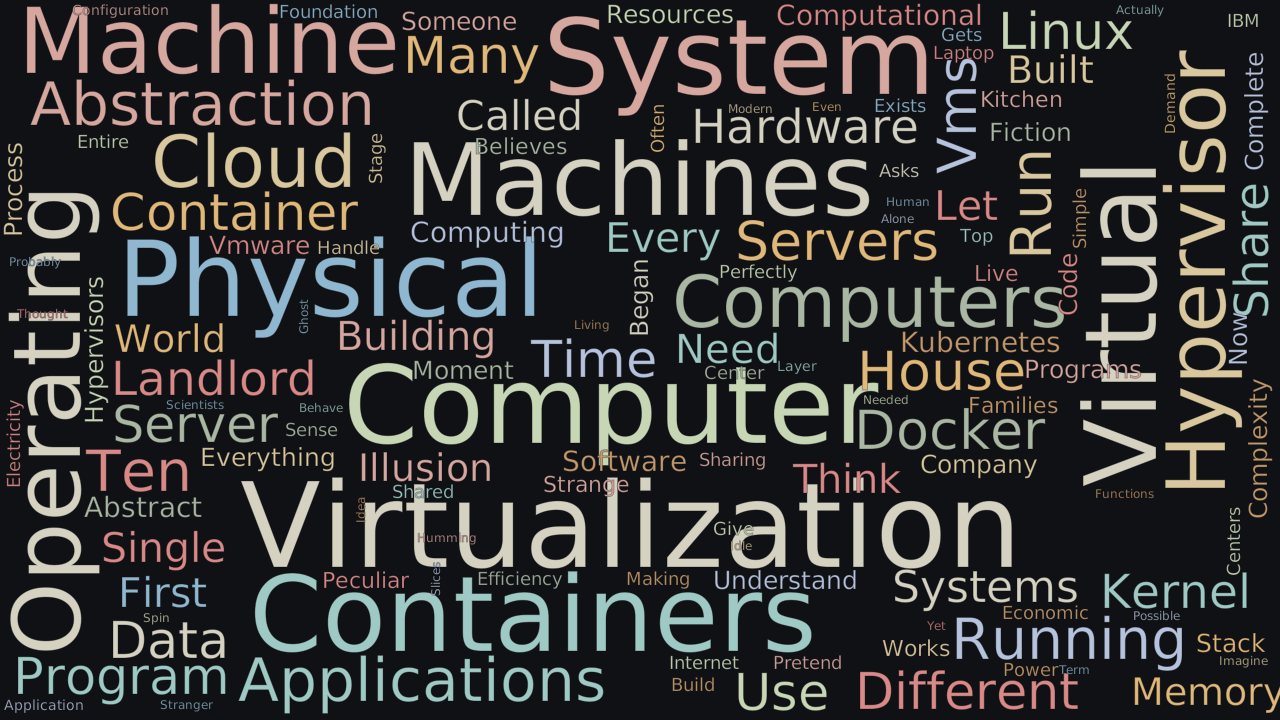
Word Cloud
Related reading
Selected by shared topics and section, with closer publication dates breaking ties.



Comments
Read the conversation or leave a thought for review. Comments load when this section is in view.