When the Gods Nap and the Donkeys Pull the Sun: A Calendar of Cosmic Excuses
Checking article narration…

I am writing this for my landlord’s son, that poor, unsuspecting specimen of arranged marital optimism, who was careless enough to mention that the month of Bhadra had thrown a wrench into the proceedings of his impending union, and I thought, well, here is a topic that has been waiting for me like a dog waits for a butcher’s slip, and I would be remiss, I would be derelict in my duties as a professional overthinker, if I did not jump upon it with both feet and a mouthful of bile. Of course, in my own life, my marriage of fifteen years dissolved in divorce, not due to any weather-related mythological or astrological whiplash, not because Vishnu was napping or the sun was being pulled by donkeys, but due to the usual, grinding, unglamorous forces of my bipolar illness, that strange bookish mind that turns every conversation into a dissertation, an entrepreneurial habit that leads with the unerring accuracy of a homing pigeon to financial precarity, an unsteady pariah lifestyle, and a dour future that I have come to wear like a second skin. I in fact congratulate my wife for saving herself, for she is, I presume, living happily ever after in a completely opposite and happy situation, one that does not involve waking up next to a man who is either writing a manifesto at three in the morning or sleeping for sixteen hours because the chemicals in his brain have decided to take a union-mandated break, and I hope she has found the peace that I could not give her, the stability that I could not provide, the kind of marriage that the Panchang actually approves of, scheduled in a month when all the gods are awake and all the planets are sober and the sun is being pulled by its proper, premium horses and not by a pair of overworked asses.
I have spent the better part of my adult life trying to reconcile the fact that I hold a degree in a discipline that demands empirical evidence with the reality that I was raised in a household where the precise angle of Jupiter’s left testicle could determine whether my cousin could legally consume fish on a Tuesday. The Hindu calendar, that magnificent, bloated, centuries-old almanac of cosmic paranoia we call the Panchang—or in Bengal, the Panjika, which sounds less like a sacred text and more like a digestive disorder—is less a timekeeping device and more a bureaucratic nightmare designed by gods who, frankly, seem to need an inordinate amount of naps.
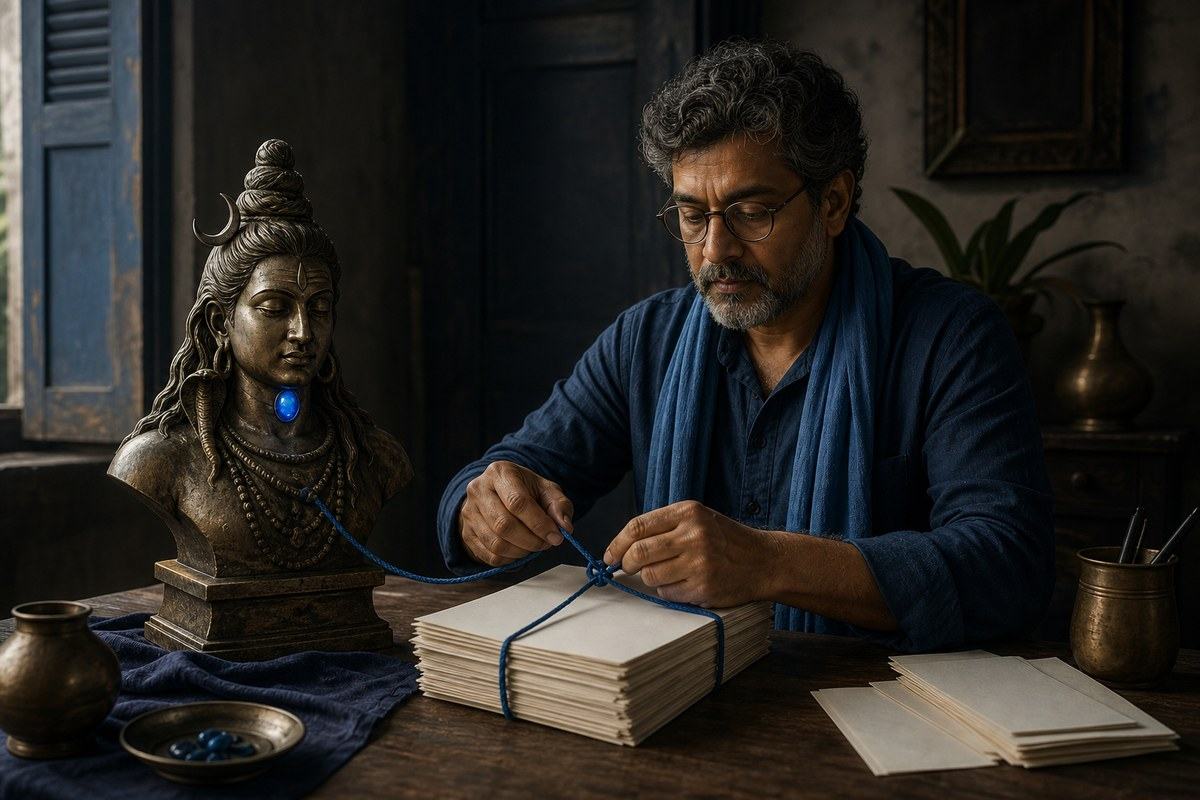
Let us begin with the granddaddy of all matrimonial prohibitions: Chaturmas, the four-month siesta of Lord Vishnu, that blue-skinned preserver of the universe who, according to the Puranas, decides that the absolute best time to take a cosmic snooze is precisely when the Indian subcontinent is being waterboarded by the monsoon. From mid-July to mid-November, Ashadha to Kartik, Vishnu reclines upon the thousand-hooded serpent Shesha in the cosmic ocean, entering Yoga Nidra—which, if you break it down etymologically, comes from the Sanskrit yoga (union) and nidra (sleep), thus beautifully describing the state of being so spiritually united with your bed that the universe can quite literally go to hell. Another version of the myth, because one absurdity is never enough, claims he abandons his post entirely to go guard the underworld kingdom of King Bali, a demon king who somehow merited a divine bodyguard while the rest of us are left to the tender mercies of the rain and the mosquitoes.
The logic, if one squints, is impeccable. Vishnu is the deity of preservation, of household harmony, of the Grihastha ashram—that stage of life where you are supposed to settle down, procreate, and argue about whose turn it is to do the dishes. If the Preserver is asleep, or off on an extended security detail in the netherworld, the universe is handed over to Shiva, the Destroyer. Now, I have nothing against Shiva; the man has impeccable taste in intoxicants and a third eye that can incinerate reality itself, which is, I admit, a party trick of some distinction. But marrying while the Destroyer is on duty is, according to the priests, akin to inviting chaos, destruction, and a distinct lack of divine protection into your newly formed marital home. It is as if the cosmos itself is saying, “You want to start a life together? Great. The god in charge of keeping things nice and stable is currently drooling on a snake. Best of luck with that.”
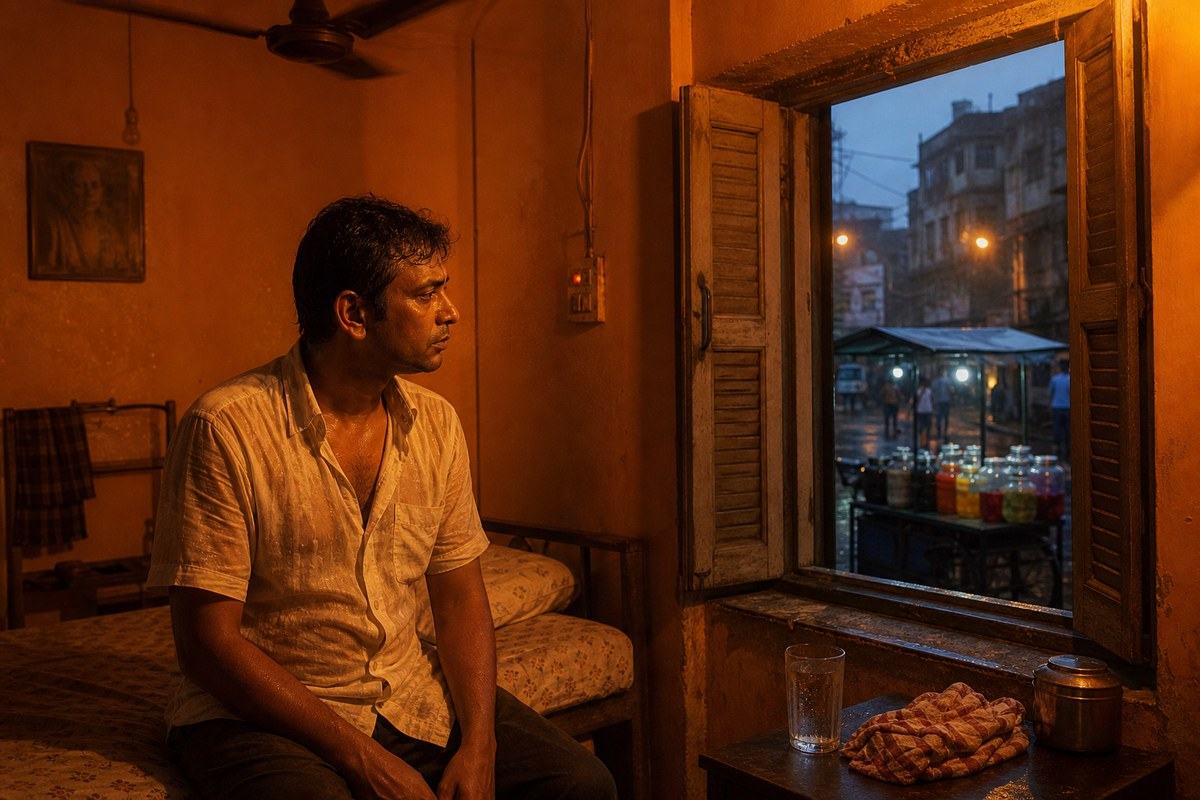
But here is where the satire curdles into something darker, something that smells less of incense and more of the truth we bury under our floorboards. The monsoon in India is not merely wet; it is an act of meteorological violence. Rivers swell into ravenous beasts, diseases bloom like toxic flowers in the stagnant water, travel becomes an exercise in suicidal optimism, and food reserves dwindle to the point where a wedding feast would be an obscene display of delusion. The myth of Vishnu’s sleep is a divine cover story for a very human, very practical reality: you cannot gather five hundred relatives, a brass band, and enough mutton biryani to feed a small army when the roads have become rivers and the rivers have become graves. The gods nap so that we do not have to admit we are simply too poor, too waterlogged, and too disease-ridden to celebrate. It is theology as public relations, myth as a politely worded RSVP of “Sorry, we are drowning.”
And then, just when you think the cosmic bureaucracy has finished its coffee break, we arrive at Kharmas, the month of the donkey, which sounds less like a sacred prohibition and more like a particularly harsh insult one hurls at a bad driver. Mid-December to mid-January, Poush, and again mid-March to mid-April, Chaitra, when the Sun enters Sagittarius and Pisces. The myth here is so deliciously absurd that one almost has to admire the sheer, unbridled creativity of whoever was smoking what in ancient Bihar. Lord Surya, the Sun God, he of the magnificent chariot pulled by seven swift horses, finds his steeds exhausted, thirsty, on the verge of a cosmic labor strike. To prevent the universe from plunging into darkness while his horses rest at a celestial watering hole, Surya looks around, spots two donkeys—khara in Sanskrit, a word that has the distinct phonetic quality of a cough—and hitches them to his chariot of fire.
Donkeys. To pull the sun. Let that sink in. The source of all light, life, and warmth in our solar system, the star around which our entire existence revolves, was allegedly kept aloft by two underpaid, overworked pack animals because the premium horsepower was on union-mandated break. And because donkeys are slow—this is apparently the critical astrological insight—the Sun’s movement slows down, its divine, purifying energy becomes dull, sluggish, and malefic. A marriage performed during the “donkey month” is believed to be cursed with stagnation, poverty, and a lack of vitality. The metaphor is so heavy-handed it could crush a small car. You marry when the sun is pulled by asses, your marriage will be pulled by asses. Your love life will move at the speed of a constipated mule. Your joint bank account will have all the vigor of a beast of burden that has just been told it has to work overtime on a Sunday.
The practical reality, of course, is that Poush is the bitter, bone-cracking cold of North Indian winter, when outdoor festivities are an invitation to hypothermia, and Chaitra marks the end of the agricultural and financial year, when farmers are exhausted, broke, and waiting for the spring harvest that has not yet arrived. Marriages require surplus—of grain, of gold, of goodwill. You cannot extract blood from a stone, and you cannot extract a dowry from a farmer who is currently praying his crops do not wither. So the donkeys pull the sun, and the priests pull the wool over our eyes, and everyone agrees that it is far better to blame a slow-moving celestial chariot than to admit that we are simply too cold and too poor to throw a party.
But if Chaturmas is a bureaucratic nap and Kharmas is a barnyard fiasco, then Bhadra is where the mythology takes a turn for the genuinely, gloriously, operatically dark. Mid-August to mid-September, Bhadrapada, strictly followed in Bengal with the kind of terrified reverence usually reserved for mothers-in-law and income tax officers. Bhadra is not merely a month; she is a goddess, a personification, a terrifying, malevolent entity who is, astrologically speaking, the cosmic equivalent of a “Do Not Disturb” sign written in blood. She is the daughter of Surya and Chhaya—Chhaya meaning shadow, which immediately tells you everything you need to know about her family dynamics. Her siblings are Shani, Saturn, the great malefic, slow-moving bringer of misfortune, and Yama, the God of Death, who rides a buffalo and carries a noose. Family dinners at the Surya household must have been absolutely delightful.
Bhadra was born with a destructive nature, because of course she was; when your mother is Shadow and your brother is Death, your career options are somewhat limited. She violently disrupted the sacrifices and auspicious work of sages, which is the mythological way of saying she was a woman who would not sit down, shut up, or stop ruining the carefully laid plans of powerful men. To pacify her—and this is the part that makes me want to both laugh and weep—Lord Brahma, the creator, gave her a specific place in the astrological calendar, the Vishti Karana, and told her she could consume or destroy any auspicious work done during her time. It is the divine equivalent of giving a toddler a time-out and then telling them they can break any toy they want during that specific hour. Here, Bhadra, you terrifying force of feminine rage, here is your designated slot in the schedule. Please do not destroy the universe outside of office hours.
Starting a marriage during Bhadra is believed to invite her wrath, leading to sudden death, severe illness, or violent separation. The shadow-goddess, the daughter of shadow, consumes the light of new beginnings. And again, the agrarian logic seeps through the mythological grout like monsoon water through a cracked wall. Bhadra is the peak of the monsoon, the absolute worst of the flooding, the diseases, the impassable roads. It is the month when the land is drowning and the people are praying. To marry then is not just to tempt fate; it is to tempt cholera, dysentery, and the collapse of your thatched roof under the weight of a month’s worth of rain. The myth of Bhadra is the myth of the monsoon made flesh, made female, made fearsome. She is the storm given a name and a grudge, and we placate her with calendars because we cannot placate her with science.
And then we come to Chaitra, mid-March to mid-April, which has the distinct misfortune of being both a Kharmas month and the site of one of Hindu mythology’s most spectacular acts of cosmic domestic violence. Kamadeva, the God of Love and Desire, he of the sugarcane bow and the flower-arrow, the original cupid with better abs and worse luck, made the fatal error of trying to strike Lord Shiva with an arrow of lust while Shiva was in deep meditation. Now, Shiva was meditating because his wife Sati had immolated herself, and he was grieving, and the last thing a grieving man needs is some winged pretty-boy shooting him in the ass with a lust-arrow to make him fall in love with Parvati. So Shiva, in a display of temper that would make even the most volatile bipolar patient feel seen, opened his third eye and burned Kamadeva to a pile of ash.
The God of Love. Incinerated. By the God of Destruction. For doing his job. And because this happened just before or during Chaitra, the month is associated with the death of romance, lust, and fertility. It is a time for penance and mourning for Kamadeva’s wife, Rati, who must have been absolutely thrilled to learn that her husband’s murder was now an excuse to postpone everyone’s wedding. Marrying in Chaitra is feared to result in a loveless or childless marriage, because the divine patron of getting it on has been reduced to particulate matter. The symbolism is so on-the-nose it could be used for target practice. Love was destroyed by anger; therefore, do not begin your love story in the month when love itself was murdered. It is astrology as trauma response, mythology as a warning label. Do not open. Love has been known to cause burning.
But Chaitra is also the end of the agricultural year, when farmers are exhausted, when the old harvest is gone and the new one has not yet arrived, when wealth is a memory and surplus is a prayer. Marriages require money, and Chaitra is the month when money is as scarce as Kamadeva’s ashes are plentiful. The myth of the burning god is a beautiful, terrible distraction from the mundane, grinding poverty that makes a wedding impossible. We mourn the death of love so that we do not have to mourn the death of our bank accounts.
And finally, the Guru Aditya Dosha, the combustion of wisdom, which sounds like a prog-rock album title but is in fact the astrological prohibition against marrying when Jupiter or Venus is too close to the Sun. Jupiter, Guru, the teacher, the planet of wisdom, the husband in a woman’s chart, the very symbol of marital happiness. Venus, Shukra, the planet of love, the wife in a man’s chart, the emblem of fertility and desire. When the Sun gets too close, its fire burns them, neutralizes them, renders their divine energies as impotent as a eunuch at an orgy. A wedding without Jupiter is a wedding without wisdom; a wedding without Venus is a wedding without love. It is a blind, doomed union, a marriage of the stupid and the frigid, a cosmic mismatch presided over by a priest who is too busy checking his ephemeris to notice that the couple is already having second thoughts.
The astronomical reality, of course, is that when a planet is behind the Sun from our perspective, it is invisible, lost in the solar glare, and ancient astrologers, with their keen eyes and their lack of telescopes, interpreted this disappearance as a burning, a death, a temporary cancellation of the planet’s influence. It is not combustion; it is geometry. But geometry does not sell almanacs, and “the planet is on the other side of the Sun” does not have the same mythological weight as “the Sun has incinerated the god of your marital happiness with its fiery breath.” We need the drama. We need the divine. We need to believe that our misfortunes are orchestrated by celestial beings rather than by the simple, brutal fact that we are standing on a rock that moves, and the light sometimes hides the things we need to see.
I look at this calendar, this Panchang, this Panjika, this bloated, beautiful, terrible document of human fear and human ingenuity, and I feel a wonderment that is only slightly poisoned by contempt. The wonderment is real. I am in awe of the minds that constructed this system, that looked at the sky and saw stories, that looked at the seasons and saw gods, that took the raw, unfeeling mathematics of planetary motion and wrapped it in narrative so compelling that thousands of years later, people are still scheduling their lives around the nap schedule of a blue deity and the pulling power of celestial donkeys. It is science and poetry and bullshit, all swirled together in a concoction so potent it could make you believe that the angle of Saturn’s rings determines whether your marriage will survive the first year.
But the contempt is real too. Because behind every unreachable, difficult-to-pronounce Sanskrit word—Chaturmas, Kharmas, Bhadra, Vishti Karana, Guru Aditya Dosha—is a history of fumbling, of observation, of trial and error, of ancient people trying to make sense of a world that was trying to kill them with rain and cold and disease and hunger. And instead of admitting that we fumbled, instead of saying “we noticed that people who marry in the monsoon tend to die of cholera,” we hid the truth in fat textbooks of mythology. We buried the agrarian logic under layers of divine narrative, we obscured the economic reality behind the smoke of burnt gods and sleeping saviors, and we made it holy so that no one would question it. The etymology of Panchang itself—pancha, five, and anga, limb or part—refers to the five elements of the Hindu almanac: the Tithi (lunar day), the Vara (weekday), the Nakshatra (lunar mansion), the Yoga (a specific calculation of the sun and moon), and the Karana (half of a Tithi). Five limbs, five ways to measure time, five ways to control behavior, five fingers of the priestly hand closing around the throat of human agency.
And yet. And yet. I cannot fully dismiss it. Because there is a truth in the fumbling that is deeper than the truth of the science. The truth that we are small, and the sky is large, and the rain does not care about our weddings. The truth that we need stories to survive the seasons, that we need gods to blame for the weather, that we need prohibitions to protect us from our own optimism. The Panchang is not just a calendar; it is a survival manual written in the language of the divine. It is a record of every time the monsoon killed a bride, every time the winter starved a feast, every time the end of the harvest left a groom without a dowry. It is history disguised as astrology, economics disguised as mythology, and fear disguised as faith.
So I will not marry in Chaturmas, not because Vishnu is asleep, but because I respect the wisdom of generations who learned that the rains bring death. I will not marry in Kharmas, not because the sun is pulled by donkeys, but because I understand that winter is cruel and spring is hopeful. I will not marry in Bhadra, not because the shadow-goddess will consume me, but because I know that some months are for survival, not for celebration. And I will not marry when Jupiter is combust, not because the Sun has burned the god of wisdom, but because I know that sometimes, the things we need to see are hidden by the very light that lets us see everything else.
The wonderment of science is that it tells us how the world works. The wonderment of the Panchang is that it tells us how we survive the world. And the wonderment of satire is that it lets us laugh at both, even as we obey them. Even as we know that the gods are napping, the donkeys are pulling, the shadows are consuming, and the love-god is ash, we still check the almanac. We still ask the priest. We still believe, because the alternative is to admit that we are alone on a rock, under a sun pulled by nothing, in a universe that does not care whether we marry or mourn.
And that, my friends, is a truth too raw even for this blog.
P.S. References: The Vishnu Purana for Vishnu’s cosmic nap; the Skanda Purana and various Brahma Vaivarta Purana iterations for the Bhadra myth; the Surya Siddhanta for the astronomical computations underlying Kharmas and Guru Aditya Dosha; and the Shiva Purana for the incineration of Kamadeva. For the etymology of Panchang, see Monier-Williams’ Sanskrit-English Dictionary. For the agrarian realities, I recommend any basic history of Indian agricultural cycles, though I suspect the farmers themselves could have told you all of this without the Sanskrit.
Word Cloud
Related reading
Selected by shared topics and section, with closer publication dates breaking ties.