The Alimentary Residue of Infinity
Uses the speech voice supplied by your browser or device.

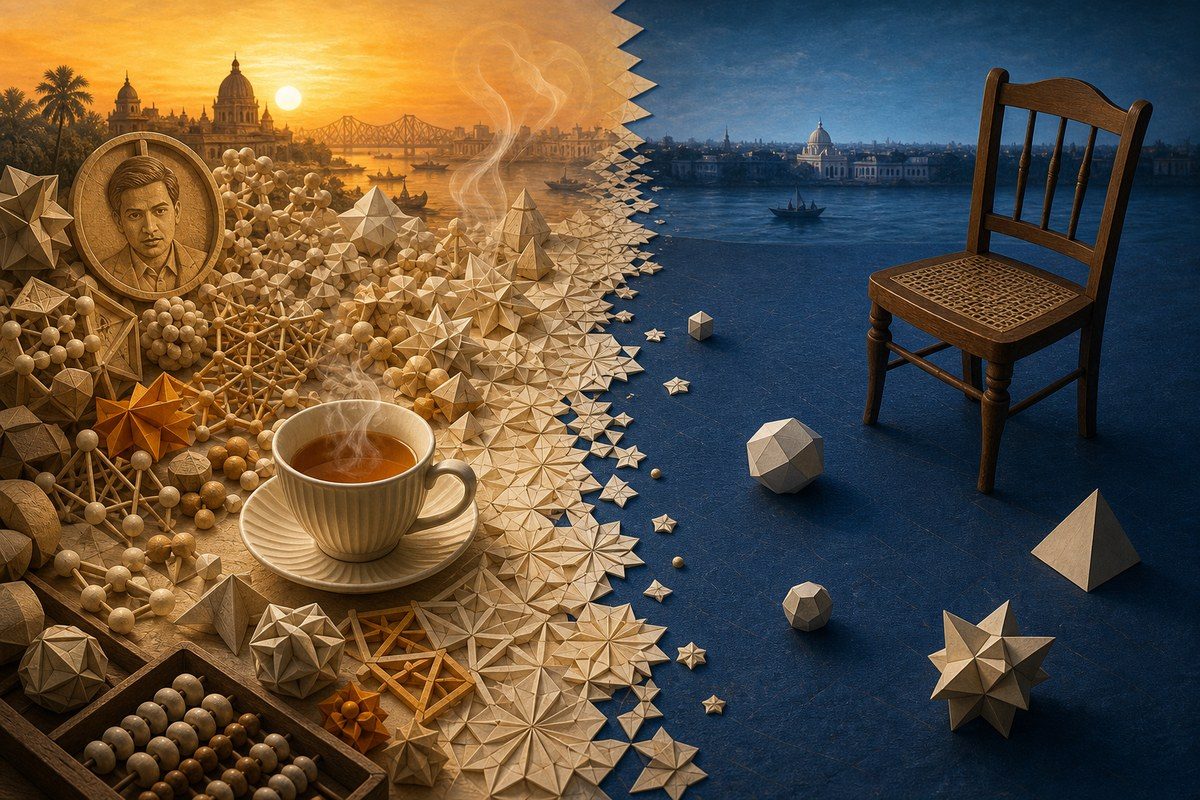
The tea has gone cold, that particular temperature of abandonment where the milk separates into a thin, greasy scum and the surface reflects the ceiling fan’s lazy rotation like a dyspeptic eye staring back at my own stupidity, and there it sits, The New York Times Book of Mathematics, edited by Gina Kolata, foreworded by Paul Hoffman, a sky-blue slab of paper and pretension that I have opened and closed perhaps seventeen times this month alone, not because I am learning anything—Christ, no, learning requires a continuity of consciousness that my brain, this traitorous, serotonin-deficient organ, treats with the same reliable consistency as a Calcutta tram during monsoon—but because an essay, you see, an essay is a manageable unit of failure, a self-contained catastrophe that I can abandon at the bottom of a page without the guilt of having deserted a novel, a career, or any other sustained narrative arc that demands emotional continuity I am medically incapable of providing. And this is precisely why I write these essays and these short, grotesquely truncated posts for my blog—because my attention, that despicable fraction of a fraction, that paan-stained, debased currency of consciousness, has been broken into such microscopic denominations that only the essay, only the blog post, only the literary equivalent of a two-rupee coin, can be exchanged in the marketplace of my own shattered mind without the entire transaction collapsing into the Hooghly silt.
And yet, and yet, here we are in July of 2026, a year so grotesquely futuristic it sounds like a bad science fiction premise written by a man with a high fever, and Elon Musk—may his progenitors engage in carnal congress with a malfunctioning quantum battery—has become the world’s first trillionaire because SpaceX had its IPO on June 12th and is now valued at one point seven seven trillion dollars, a number so large it ceases to be economic and becomes instead a kind of mathematical pornography, a genital chasm of zeros that makes the Riemann Hypothesis look like a child’s arithmetic homework, and I sit here with my cold tea and my brittle attention trying to understand why NASA is simultaneously trying to rescue the Swift satellite with Katalyst Space Technologies while Ford recalls seven hundred forty-one thousand vehicles because their transmissions have developed an excremental philosophy of their own, refusing to park, refusing to obey, much like my own neurotransmitters on a Tuesday afternoon when the depression is so thick you could spread it on a paratha and sell it at Gariahat Market.
The word mathematics, from the Greek μάθημα, meaning “that which is learnt,” which is a laughable etymological joke because what I have learnt is that I cannot learn, that my attention is a sieve made of wet newspaper, that the essay—French essayer, to try, to attempt, from the Latin exagium, a weighing—exists precisely because books are too heavy and my mind is too light, a balloon filled not with helium but with the flatulent emanation of broken promises.
But oh, the essays in this collection, the way James Gleick writes about chaos as if it were a tram conductor arguing with a passenger over the exact fare, the way George Johnson explains topology as though he were describing the precise geometry of a phuchka vendor’s hand as he dips the hollow sphere into tamarind water, the way these writers make numbers feel like College Street at dusk, all yellow light and dust and the smell of old paper and the particular melancholy of knowing that every volume you buy there will be eaten by silverfish eventually, because nothing lasts, not even mathematics, especially not mathematics, which pretends to be eternal but is really just a set of conventions agreed upon by dead men who never had to worry about whether their SSRI dosage was sufficient to get them through a chapter on set theory.
They are building quantum batteries now, did you know? Batteries that charge using the strange rules of quantum mechanics, which is to say they charge using the same logic that governs my mood swings—simultaneously charged and uncharged until observed, collapsing into a state of exhaustion the moment a therapist asks how I feel. And scientists have created artificial photosynthesis that regulates itself, eliminating the need for batteries, which is the kind of technological optimism that makes me want to perform a urinary soliloquy into the Hooghly, because we can mimic the sun but we cannot fix a Ford transmission, we can teleport information using light but we cannot teleport my attention span back to the year 1998 when I could still read a whole book without checking the empty room seventeen times to see if someone, anyone, had left a message confirming that I exist.
I do not exist. Not really. I am a collection of essays, loosely bound, edited by Gina Kolata, foreworded by Paul Hoffman, published by a newspaper that has spent more than a hundred years writing by the numbers, as if numbers were something you could write by, as if you could use the Fibonacci sequence to construct a sentence, as if the golden ratio could explain why I am fifty-one years old and still measuring my life in the length of paragraphs I can finish before the darkness comes back.
And the darkness comes back like a Calcutta monsoon, sudden, filthy, carrying the smell of diesel and drowned rats and the particular acoustic quality of a city that has given up on drainage, and in that darkness I reach for the sky-blue book and I read about prime numbers, about how they are solitary, indivisible, stubborn as a Bengali bureaucrat refusing to process your paperwork unless you perform the appropriate genuflection, and I think: yes, this is me, I am prime, I am indivisible, I cannot be divided by any integer except one and myself, and even that is debatable because there are days when I feel divisible by zero, undefined, a mathematical error walking around in human skin, a floating point exception in the operating system of existence.
Meanwhile, a tiny blue octopus has been officially identified as a new species near the Galápagos Islands, small enough to fit in a person’s hand, which is the kind of fact that would have delighted the old naturalists but now merely adds to the overwhelming inventory of things I will never know, never see, never understand, because my brain is a Ford F-150 with a damaged park system, seven hundred forty-one thousand units recalled, and I am one of them, parked on a slope with the transmission grinding, waiting for the inevitable roll into the silt.
Infinity, they say, is not a number but a concept, which is exactly what the city said about my ambitions when I was twenty, and the city was right, and the book is right, and the tea is cold, and the ceiling fan turns, and I think of infinity as the Howrah Bridge at rush hour, a structure that appears to have an end but is actually an endless loop of taxis and buses and hand-pulled rickshaws and the particular despair of a man who has been trying to cross the road for forty minutes, each step forward requiring two steps back, an asymptotic approach to the other side that he will never quite reach, because the limit does not exist, because the limit is a lie told by calculus professors to make death seem orderly.
Attention, from the Latin attendere, to stretch toward, to direct the mind, and my mind is a rubber band that has been stretched toward so many broken things—the trillionaire’s rocket, the rescued satellite, the quantum battery, the blue octopus, the cold tea—that it has lost all elasticity, it lies limp on the table next to the book, a flaccid circle of failed intention, and I stretch it again, I always stretch it again, because what else is there, what else is the bipolar bibliophile—Greek βιβλίον, book, φίλος, loving, Latin bi-, two, polaris, of the poles, a man who loves books from two opposite ends of the earth simultaneously—to do except reach for another essay, another weighing, another attempt that is doomed to be exactly that: an attempt, an essay, a trying that never becomes a doing, a máthēma that never becomes knowledge.
Paul Hoffman, in his foreword, says something elegant about the beauty of numbers, and I am sure he is correct, I am sure that in some universe where my dopamine receptors function correctly, I too would find beauty in the proof of Fermat’s Last Theorem, but in this universe, in this room, with this cold tea and this rotating fan and this brain that is either a supernova or a black hole with no in-between, I find beauty only in the fact that the book has 480 pages, a number so obscenely divisible it could be halved, quartered, split into fifths and sixths and eighths and tenths and twelfths and sixteenths and twentieths without ever once leaving a remainder, without ever once being prime, without ever once being like me, and I think: what a grotesque lie, what a digestive aftermath of an idea, that anything could be so accommodating, that anything could be so thoroughly divisible, that the sum of broken parts could ever add up to a whole, when I have spent fifty-one years proving, with the exacting precision of a man who counts his pills twice, that the sum of my parts adds up to nothing but a lower back pain and a library of half-read books.
But I am not a perfect number. I am 51, which is 3 times 17, both prime, both stubborn, both divisible only by themselves and one, and the book is closed now, the tea is finished, the fan turns, and outside somewhere in the city a tram has derailed on College Street, not because of mathematics but because of physics, because of inertia, because of the weight of too many passengers trying to get somewhere they will never arrive at, and I am one of them, I am all of them, I am the alimentary residue of infinity, the fecal sculpture of failed concentration, and tomorrow I will open the book again, I will read another essay, I will attempt again, because that is what essayer means, that is what máthēma promises, that is what the cold tea and the rotating fan and the trillionaire’s rocket all demand: not understanding, not redemption, not the moral of the story, but simply the grotesque, stubborn, beautifully futile act of stretching the mind toward a number it will never touch.
I close the book at page 240, exactly half of 480, a fraction that understands me better than any essay ever could: halfway to nowhere, midway between the manic and the void, and I place the cold tea on top of the cover, a wet, circular stain that will warp the cardboard by morning, a small, brown, alimentary monument to the fact that I tried, I weighed, I attempted, and the mathematics, the absolute posterior oracle, remained exactly as indifferent to my effort as the monsoon is to a Calcutta pothole’s ambition to remain dry.
Word Cloud
Related reading
Selected by shared topics and section, with closer publication dates breaking ties.