The Gracefully Grotesque Collapse
Uses the speech voice supplied by your browser or device.

Acronyms and terms:
DNA — Deoxyribonucleic acid, the molecule that carries genetic instructions and, in this essay, stands for the grand biological recipe book that somehow produced both Mozart and knee pain.
Gibbus — An old Latin medical term for a hump or sharp spinal curvature.
Nietzsche — Friedrich Nietzsche, the German philosopher who wrote about overcoming the ordinary human condition and gave future undergraduates a dangerous supply of dramatic sentences.
Quasimodo — The hunchbacked bell-ringer from Victor Hugo’s The Hunchback of Notre-Dame, often used as a symbol of bodily deformity and social cruelty.
Richard III — The English king whose curved spine became tangled with politics, theater, and moral judgment, especially through Shakespeare.
Bending over backwards sounds noble until you remember that the back involved is usually yours.
This is one of civilization’s little tricks. It takes an ordinary bodily disaster, adds moral perfume, and serves it with a napkin. “He bends over backwards for others,” people say, as if the poor fellow is a saint. More likely he is a tired man with unpaid electricity bills, a weak mattress, and a spine making noises like a ceiling fan in June.
In Calcutta, bending over backwards is not even a metaphor. It is Tuesday.
You bend to enter the auto. You bend to avoid the hanging wire. You bend to pick up the slipper that has gone under the bed with the cunning of a political defector. You bend to adjust the gas cylinder, to check the leaking tap, to search for the missing phone charger, to peer at the mosquito coil that has died heroically after poisoning exactly no mosquitoes. By the time philosophy arrives, you are already folded.
And then comes the grander bending. For family. For money. For work. For respectability. For landlords. For clients who pay late but speak early. For relatives who think your life is one long software update. For society, that great auntie with a handbag, always watching from the balcony.
The original phrase in my mind was grotesque, yes: bending over backwards on the hunched humps of humping hunchbacks. A mad sentence. A sentence wearing too many ornaments and sweating in them. But underneath the noise was a useful little animal. It was saying: look at us. Look at what we call living. We are all stacked on each other’s burdens, leaning on somebody’s deformity, making music out of discomfort, then calling the result civilization.
The body is not a temple. I have never liked that phrase. A temple suggests clean stone, bells, incense, symmetry, some caretaker with a broom. The body is more like an old rental flat near the edge of the city. One window jams. One tap coughs. The wiring is mysterious. The ceiling has a stain shaped like Indonesia. Something smells slightly damp in the monsoon. Still, you live there, because where else will you go?
Evolution, that celebrated genius, built us like a contractor who had three days, no budget, and a cousin in procurement.
We began on all fours, then stood upright and congratulated ourselves. Big mistake, possibly magnificent, but still a mistake. The spine, which had been doing respectable bridge work, was suddenly promoted to tower duty. It was asked to balance a skull, carry memory, endure chairs, survive office work, tolerate school benches, lift gas cylinders, and absorb the moral weight of being human. Naturally it objected. First politely. Then with lower back pain.
This is why I distrust heroic statues. All those leaders in bronze, chests out, chins up, one arm extended toward the future. Very impressive. But put them in a Sonarpur-to-Garia bus for forty minutes in July and let us see how long the posture lasts.
The ancient Romans called a hump gibbus. Latin has this power. It can make suffering sound like a department at a university. Gibbus. So tidy. So official. But a hump is not tidy to the person carrying it. It is not a word. It is weight. It is stares. It is memory lodged in bone. It is the world noticing your outline before it notices your face.
History made this worse, as history often does after entering the room with muddy shoes.
A curved back was not allowed to be only a curved back. It became a sign. A curse. A joke. A villain’s silhouette. A destiny. Quasimodo could not simply be a man with a damaged body and a large heart. He had to become a symbol, because literature loves a body it can overload. Richard III could not simply be a ruthless king in a ruthless age. His spine was dragged into the witness box and asked to explain his soul.
This is one of humanity’s oldest bad habits: we see shape and invent character.
A bent body becomes suspicious. A beautiful face becomes trustworthy. A limp becomes sinister. A scar becomes biography. A potbelly becomes laziness, unless it belongs to a rich man, in which case it becomes prosperity. We are ridiculous detectives, always finding evidence for stories we wrote before the trial began.
Yet the body itself is innocent. It is not moral. It is not immoral. It is just trying to keep the roof up.
Bones are not elegant ivory pillars. They are scaffolding. Useful, fragile, overpraised scaffolding. Flesh hangs from them. Nerves run through them. Joints negotiate daily peace treaties. The brain sits above the whole arrangement like an anxious chairman, issuing instructions it cannot enforce. Somewhere in this damp republic lives the thing we call “I.”
Nietzsche said man is something to be overcome. Very fine. Very thunderous. Very German. But most mornings man is something to be unfolded from bed without tearing anything important. That is where philosophy meets the bathroom slipper.
You think ambition is upward. That is the trick.
Most ambition is actually a curve. We bend to rise. We compromise to survive. We flatter to be accepted. We tolerate foolishness because rent is real. We smile when we want to bite. We become soft in public and hard in private. We tell ourselves this is maturity. Sometimes it is. Sometimes it is cowardice wearing a clean shirt.
Here is the uncomfortable part: the hump is not always on the back.
Sometimes the hump is debt. Sometimes it is shame. Sometimes it is depression, that black municipal fog that comes without notice and parks itself inside the skull. Sometimes it is loneliness in a room where the fan turns and the day refuses to begin. Sometimes it is the small humiliation of being educated enough to understand your situation and powerless enough not to escape it quickly.
That is a particularly Bengali torture. We have grammar for despair. We have poetry for failure. We can discuss civilization while the rice boils over.
The body bends. The mind bends. The city bends.
Look at Calcutta. A grand old city standing on one leg, arguing about culture while water collects in the lane. There are flyovers, malls, hospitals, apps, digital payments, and young people speaking in the fast bright language of the future. Meanwhile, one good rain and the street remembers it was once a pond. Progress arrives, removes its shoes, steps into sewage, and pretends nothing happened.
Civilization is a posture problem.
It says forward, but looks backward. It says development, but forgets drains. It says dignity, but makes people beg for basic services. It says modernity, but runs on unpaid labor, old favors, hidden bending, and the silent endurance of people who cannot afford dramatic collapse.
The same is true of a life.
From outside, a person may appear normal. Upright enough. Shirt worn. Hair combed. Bills somehow paid. But inside, whole vertebrae of compromise are stacked badly. One old disappointment presses on another. One fear sits on the shoulders of one memory. One unpaid invoice leans against one medical bill. One failed plan humps itself over the next. The structure holds, but not because it is healthy. It holds because falling is expensive.
And this, strangely, is where comedy enters.
Not cheerful comedy. Not television comedy, with people laughing like pressure cookers. I mean the darker, smaller comedy of being a human creature in a disobedient body. A man may know philosophy, statistics, software, literature, and the history of the Roman Empire, and still be defeated by bending down to pick up a towel. That is not tragedy. That is the universe clearing its throat.
The knee clicks.
The back protests.
The towel remains where it is, smug and damp.
You bargain.
This is why I no longer believe in perfect uprightness. Uprightness is for flagpoles, school assembly speeches, and people who have not yet met sciatica. Real life is crooked. Not always nobly crooked. Often foolishly crooked. Bent by desire, fear, laziness, duty, illness, love, habit, and the price of cooking oil.
But crooked is not the same as defeated.
A tree bends in a storm. A bamboo pole bends under wet clothes. A mother bends over a child. A clerk bends over a ledger. A man in a small room bends over a cheap table and tries to write one honest sentence before the day collapses into heat and noise. There is no marble heroism in this. No trumpet. No statue. Only continuation.
That is the hidden dignity.
Not standing straight forever. Nobody does that. Not overcoming man in some grand philosophical explosion. Most of us cannot even overcome the afternoon. The dignity is smaller and more stubborn. To bend without becoming servile. To laugh without becoming cruel. To suffer without making suffering your entire profession. To remain human while life keeps pressing its thumb between your shoulder blades.
So yes, the image is grotesque. Humps on humps. Bodies bent beyond sense. A carnival of contortion. But grotesque does not mean meaningless. The grotesque is often truth with its shirt untucked.
We are not clean vertical creatures marching toward glory. We are patched, aching, improvising animals carrying invisible loads through visible streets. We lean. We adjust. We complain. We drink tea. We try again. Sometimes we collapse. Sometimes we rise badly, which is still rising.
The spine bends.
The city bends.
The day bends toward evening.
And somewhere in that crooked arrangement, if we are lucky, a little grace survives.
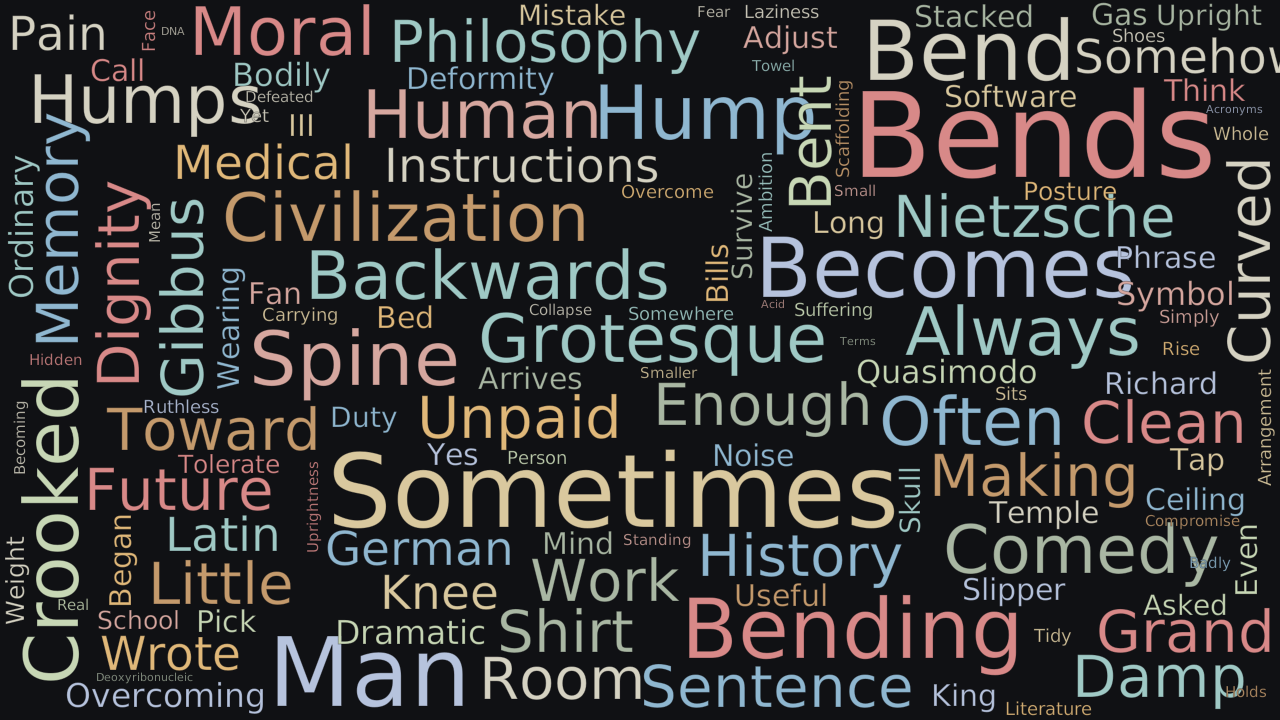
Word Cloud
Related reading
Selected by shared topics and section, with closer publication dates breaking ties.