The Berry Eater
Uses the speech voice supplied by your browser or device.

THIS IS A WORK OF FICTION
Pratim unlocked the Bose Gallery at five-thirty, while the lane off Shyambazar was still grey with dawn and the tram wires overhead dripped with last night’s rain. His key stuck in the old brass lock, as it always did, and he had to jiggle it with his left hand while his right steadied the tin of milk tea he had bought from the stall on Raja Dinendra Street. The milk was already turning sour in the heat. That was July in Calcutta. The city did not wake; it simply persisted, sweating through another night into another morning.
Inside, the gallery smelled of damp plaster, old marble, and the particular camphor sweetness of stored canvas. The Bose Gallery occupied the ground floor of a townhouse built in 1923, and the family still lived above, though Rhea Bose had converted the sitting rooms into white cubes with track lighting that Pratim did not trust. The wiring was older than he was. He swept the floor slowly, his cataracts turning the dust motes into silver fish that darted away from his broom. He needed this job. Keya’s school fees were due by the end of the month, and the nursing home had not yet returned the deposit from his wife’s final week. He was fifty-four, a widower with soft hands and a permanent stoop, and he had learned to be invisible in rooms where art was bought and sold.
At nine, Bishnu Pal arrived with his youngest son, both of them grunting under the weight of a wooden crate that smelled of mildew and something darker, like iron left in a drain. The exhibition opened at eleven. Rhea had been talking about it for weeks—a rediscovered masterpiece by her great-uncle, Hemanta Bose, a painter who had died in an asylum in 1974. “The Berry Eater,” she called it, her voice carrying that particular Calcutta accent of the educated young, clipped and impatient. “It will put us on the map, Pratim-da. The grotesque is very in right now.”
Pratim helped them unwrap it. The canvas was larger than he expected, nearly six feet tall, and the frame was heavy teak, carved with what looked like leaves but might have been tongues. When Bishnu pulled back the cloth, Pratim felt a drop of sweat run down his spine, though the ceiling fan was turning overhead.
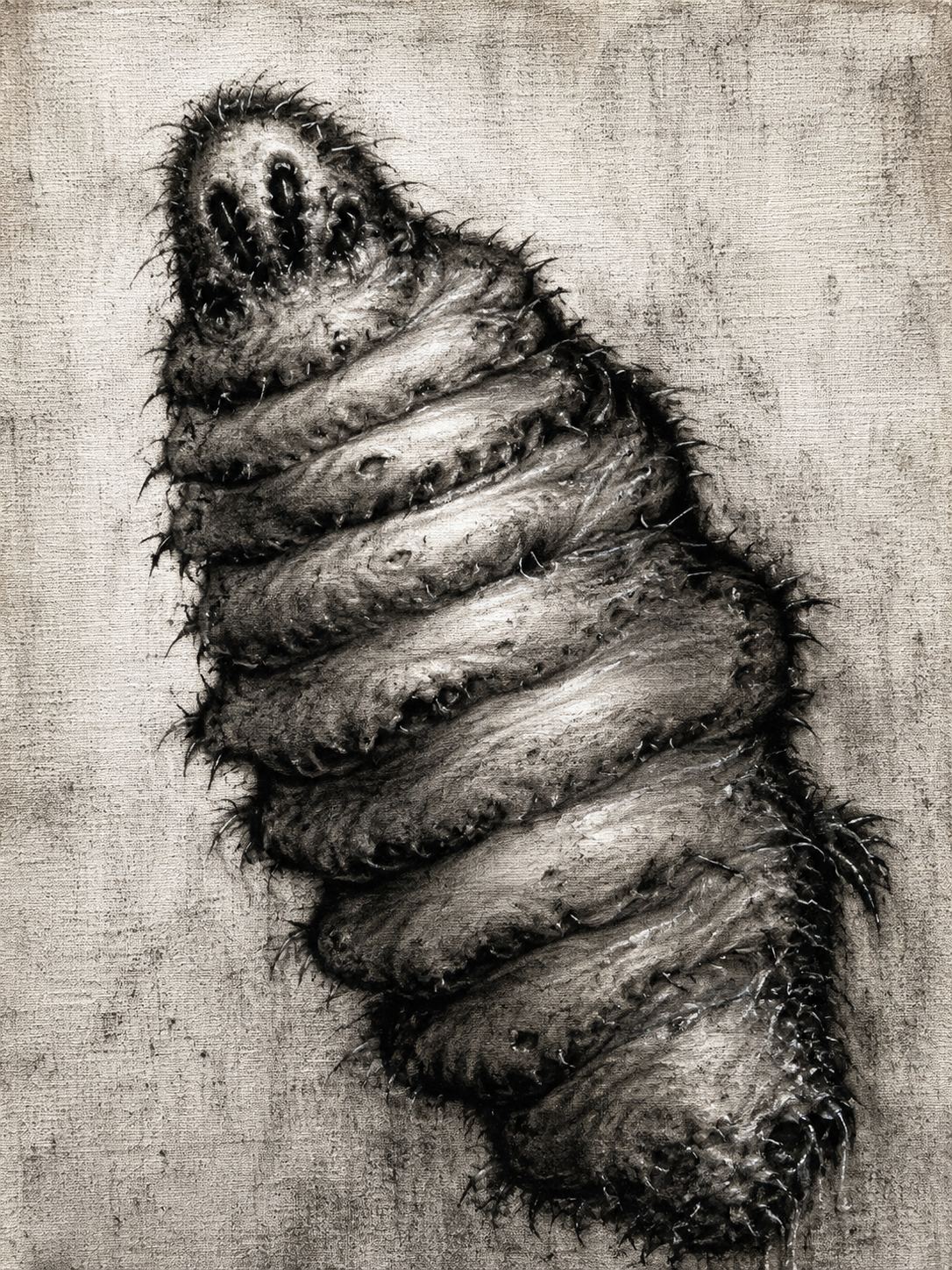
The painting showed a naked man crouched on a stone slab, his back humped like a question mark, his skin the colour of old dough. A goiter swelled at his throat, massive and obscene, pushing his chin up so that he seemed to be staring down at something in his lap. In his hands was a brass bowl, and in the bowl were dark, wet things that looked like jamuns, the purple berries that fell each summer from the trees in the courtyards of North Calcutta. But the man’s face was what held the eye. It was not quite human. The eyes bulged sideways, the mouth was too wide, and the lips were stained black. He looked like a creature that had once been a child and had been slowly, patiently, turned into something else by the weight of being looked at.
“The background,” Pratim said, his voice hoarse. “That courtyard. The jamun tree.”
Rhea looked at him, surprised he had spoken. “What about it?”
“It looks like the one behind this house. Before they paved it.”
Rhea laughed, a short, sharp sound. “Don’t be sentimental, Pratim-da. It’s a painting. It’s not a photograph.”
But Bishnu was not laughing. The old framer wiped his hands on his kurta and pulled Pratim into the corridor, near the toilet that had not worked since the last monsoon. “Your father framed this,” Bishnu said, his voice low. “In 1974. He brought it to me to seal the back. He told me—he made me swear—that it should never see direct sunlight. Never hang where the noon light could touch it.”
Pratim blinked. His father had been a framing assistant at the Academy, a quiet man who died when Pratim was nineteen. He had never spoken of Hemanta Bose. “Why?”
Bishnu shook his head. “Because it isn’t a painting of a man eating berries. It is a confession. And confessions rot in the dark.”
By eleven, the gallery was crowded with the particular mix of people who came to openings in Calcutta: critics in kurtas with ink-stained fingers, collectors with gold watches and the restless eyes of men who had made money in construction and wanted to buy culture, students in cheap jeans carrying sketchbooks, and the elderly aunties who came for the tea and stayed for the gossip. Pratim moved among them with his tray of plastic cups, his bad eyes making the room a soft blur of colour and noise. He heard Sen before he saw him—the art critic’s voice carried like a knife through butter.
“Frog-man,” Sen was saying, standing too close to the canvas, his breath fogging the glass Rhea had insisted on. “Village superstition dressed as modernist commentary. Hemanta Bose was always a minor talent with a major stomach for melodrama. Look at the hands. Too delicate. He painted his own fantasy of the deformed. The rich have always liked to look at what they have broken.”
Mehra, the collector, chuckled. “I might buy it. Put it in the guest toilet. Frighten the wife’s relatives.”
Pratim wanted to look away. But his eyes, traitorous and weak, kept returning to the figure in the painting. Through his haze, the berries seemed to glisten, as if freshly washed. The figure’s shoulder rose and fell. He told himself it was the heat, the bad wiring, the shimmer of dust in the track lights. But the skylight above the painting was directly aligned with the sun, and he knew, with the certainty of a man who had spent his life in old houses, that at exactly twelve o’clock, the sun would strike that canvas with a beam of white, merciless light.
The clock in the tower down the lane began to strike. The sound was cracked, uneven, like an old man coughing. Pratim counted the strokes. Twelve. The sun moved into the skylight.
The room went silent. Not quiet—silent. The ceiling fan stopped. The hum of the refrigerator in the back room died. The lights flickered once, then held. For a moment, the painting was nothing but a white rectangle, bleached by the sun. Pratim raised his hand to shield his eyes.
When his vision cleared, the painting was empty.
The stone slab was gone. The brass bowl sat on the floor, real and solid, its rim dented. And in the middle of the white cube, where the canvas had been, stood the figure. It was shorter than the painting suggested, but wider, denser, as if the oils had compressed into meat. It smelled of iron and overripe jamun, of ponds that had been still too long. Its skin was not dough-coloured now but grey-green, slick with something that might have been resin or sweat.
Sen was still smiling. The creature turned its head. Where its eyes should have been, there were only hollows, wet and dark, lined with a pale membrane that fluttered as it breathed. It moved slowly, each step making a sound like a foot pulling free from mud. It walked to Sen. Sen did not run. Perhaps he thought it was performance art. Perhaps he could not believe that his own words—his own gaze—could summon anything.
The creature placed its thumbs on Sen’s temples. Sen’s mouth opened. The scream that came out was not human. It was the sound of a man realising that the distance between observer and observed had collapsed. Then there was a wet, soft sound, like a fruit being pulled from its stem. The creature held two round things in its hands. It tried to press them into its own hollow sockets. They did not fit. It dropped them on the marble floor, where they rolled, sticky and useless, and turned to Mehra.
Mehra ran. He tripped on the Kashmiri rug that Rhea had borrowed from her mother. The creature was on him before he could rise. The gold watch shattered. The collector’s scream was high and thin, like a child’s. Then it stopped.
The room erupted. People rushed to the door. The old lock, swollen from decades of monsoon damp, would not turn. Ananya, the art student with the sketchbook, stood frozen in the corner, her pencil still in her hand. Pratim moved without thinking. He grabbed her arm and pulled her behind the teak reception desk, crouching low. His knees ached. His heart hammered against his ribs. Through the crack between the desk and the wall, he watched.
The creature stood. It made a sound. “Jamun?” It was a question, plaintive, almost childlike. It shuffled toward the courtyard door. The door was locked. The courtyard beyond had been paved over with concrete the year before, the old jamun tree cut down to make room for Rhea’s scooter. The creature scratched at the wood with nails that were long and yellow. It made a sound of frustration, a croak that vibrated in its swollen throat.
Pratim looked at Ananya. She was trembling, her eyes wide and dry. “Close your eyes,” he whispered. “It finds the ones who look.”
She shut them. Pratim shut his. In the darkness behind his eyelids, he heard the creature shuffle past them. He could smell its breath—sweet, fermenting, like fruit left too long in a closed room. It stopped near them. He felt the air shift. Then it moved on.
When Pratim opened his eyes, the creature was standing before Rhea. She had not hidden. She had not screamed. She stood with her back to the wall, her face white, her lips pressed together. She was staring at it. Not with fear. With recognition.
“You came back,” she said. Her voice was steady. “I knew you would. I hung you where the light would find you. I did what they wouldn’t do. I let you out.”
The creature tilted its head. It reached for her.
“No,” Pratim said.
He stood up. His legs were unsteady. He took off his glasses, and the world dissolved into a white, forgiving blur. He stepped forward, holding out his hands. “Take mine,” he said. “I don’t need them. I am already blind. Take them and let her go.”
The creature turned its hollow face toward him. It shuffled closer. It touched Pratim’s cheek with fingers that were cold and slightly sticky. It felt his eyelids, the loose skin, the cloudy film of his cataracts. It made a sound—not a word, but a sigh. “Not sweet,” it said. “Not ripe.”
It turned away from him. It turned back to Rhea. And then it took her eyes. She did not scream. She fell against the wall and slid down, her mouth open in a silent O, her hands fluttering at her face like moths.
The creature held the eyes. It tried to press them into its own sockets. They would not stay. It dropped them. They rolled across the floor, coming to rest near the brass bowl. The creature shuffled to the empty canvas. It gripped the frame. It stepped inside. The canvas rippled, once, like water, and was still.
The painting was whole again. The hunched figure crouched on the stone slab, the brass bowl between its feet. But the bowl was no longer full of berries. It was full of eyes. Human eyes, wet and dark, staring up at the ceiling. And the figure’s face was turned toward the viewer now, its hollow sockets somehow meeting Pratim’s gaze, its mouth stained black, smiling.
The police arrived an hour later. They broke the lock. They took statements. They covered Rhea with a sheet. They asked Pratim what he had seen. He told them the truth, or part of it: a man had entered the gallery. There had been a robbery. The man had escaped. They did not believe him, but they wrote it down. In Calcutta, the official record and the real record are seldom the same book.
Bishnu found Pratim sitting on the steps in the afternoon heat, drinking tea that had gone cold. The old framer sat beside him. “I told your father,” Bishnu said. “I told him in ’74. Do not paint the boy. Do not sell the painting. Let the dead stay dead.”
Pratim looked at him. “What boy?”
“The master’s son. Hemanta’s nephew. He was born with the goiter, with the swelling. The family kept him in the cellar. Fed him jamuns from the courtyard tree to keep him quiet. Your father was the only one who went down there. He painted the boy. Sold the painting to a European collector for passage money. The boy died the next year. They said it was fever. But your father knew. He told me once, drunk on country liquor, that the boy didn’t eat berries. They gave him berries to make him docile. But what he really hungered for was the sight of the sky. He had never seen it. They kept him blind in the cellar, and your father painted him in the dark.”
Pratim looked at his hands. Fine, delicate hands. Artist’s hands. Like the hands in the painting. He had never known his father well enough to ask what he had seen in the dark.
He walked home through the afternoon crush. The trams were packed. The fruit sellers had set up on the pavement. He stopped at a cart and bought a kilo of jamuns. They were dark and warm from the sun, their skins dusted with bloom. He ate one. The juice ran down his chin, sweet and slightly bitter, the taste of his childhood, of the courtyard before it was paved, of a tree that no longer existed.
He passed a car window and saw his reflection. A hunched man, grey-faced, mouth stained purple, eyes white with cataract, staring at something he could not quite see. Behind him, in the glass, the crowd moved like a river, everyone looking, everyone hungry, everyone with their eyes wide open.
He walked on, carrying the jamuns in a paper bag, waiting for the noon light to find him again.
Word Cloud
Related reading
Selected by shared topics and section, with closer publication dates breaking ties.