Rain Before Rain
Uses the speech voice supplied by your browser or device.

THIS IS A WORK OF FICTION
By the time the white trucks reached Bantala, the rain had already frightened the city into bad manners.
Buses leaned at crossings like old men with liver complaints. Autos coughed blue smoke. At Chingrighata, a goat stood under a political poster and chewed the face of a smiling candidate who had promised drainage, jobs, dignity, and other things available only in flex printing. Fish-water ran along the pavement in silver gutters. Tea boys slapped glasses on tin counters. The smell was petrol, wet jute, coriander, drains, frying telebhaja, and that green swamp-breath Calcutta releases when the sky lowers itself like a wet bedsheet.
Malati Das stood beside a muri stall with a plastic folder pressed under her blouse, because the folder contained her contract and the rain had no respect for income. The trucks crawled past her one by one, sealed, refrigerated, marked with a gold crest: BASU HERITAGE LIFE FOUNDATION.
“Heritage,” said Shibu the tea seller, pouring tea from an impossible height. “Earlier our heritage was tram, library, tuberculosis, and unpaid electricity bill. Now it is rich people bringing dead animals back.”
“Animals are not dead if they are coming back,” Malati said.
“Same with landlords,” Shibu replied. “Very philosophical matter.”
From inside the third truck came a knock.
Not a bang. A knock. Three careful taps, as if someone wanted to enter a room politely.
The traffic constable looked up from under his plastic hood. A cyclist stopped. Even the goat paused with half the candidate’s cheek in its mouth.
Tap. Tap. Tap.
Then something inside dragged a heavy nail down the metal wall, slowly enough to make the sound intimate.
The driver spat red paan juice into the rain and told nobody in particular, “Crates are moving. Normal.”
Malati knew animal sounds. She had grown up beside a bheri, where fish rose in moonlight like thoughts one did not want. She knew goats, dogs, cats, cows, snakes, birds, and men pretending not to be drunk. That sound was none of them.
She climbed into the staff bus because she needed the job.
Her son’s school had given its last polite warning about fees. Her mother’s medicines had reached the stage where the chemist sighed before taking them down. And the wetlands, which had once fed families through fish and vegetable patches and the black cleverness of sewage turned into life, were being fenced, leased, measured, beautified, reimagined, renamed. In Calcutta, the poor did not lose land all at once. First came surveyors. Then brochures. Then one day the tea stall became “concept retail” and everyone praised development while standing outside it hungry.
The Heritage Life Park rose from the old fishponds beyond the leather units, where the city’s waste had once become carp, greens, and livelihoods. Now tall walls cut the flat land into mysteries. Electric wire crowned them. Beyond, cranes moved like patient birds. A gatehouse of polished laterite and smoked glass announced, in English and Bengali, BENGAL BEFORE MAN.
“Bengal had man,” muttered Sadhan Kaku beside Malati. He was the old night guard, narrow as a bamboo pole, with a white moustache stained by tea. “Who wrote this nonsense?”
“Before important man,” said a young guard.
Sadhan Kaku looked at him with pity. “Then it is still now.”
The bus entered.
Inside the park, the billionaire had planted wilderness with municipal efficiency. Imported cycads stood in geometric clumps. Artificial mounds had been made from old brick, clay, and something darker that smelled of wet bone. Pools steamed faintly though the morning was not cold. Beyond the service road, Malati glimpsed the first paddock.
At first she thought the animal was a buffalo badly assembled by committee.
It stood hip-deep in black water, enormous, low-headed, plated along the back with ridged armor. Its mouth was too wide. Its nostrils opened and closed like coin purses. Two horns curled not upward but forward, as if designed to hook the world and pull. Rain slicked its hide. Around its neck hung a tasteful brass tag: A-03.
A guide in a new uniform whispered, reverently, “Pleistocene marsh grazer.”
The animal turned its head.
It looked at the bus window. It looked through the reflection, past uniforms and wet hair and borrowed umbrellas, and found Malati’s face.
For a second she was not inside a bus. She was very small under a hot sky. The air was full of insects. Something vast moved in reeds taller than houses. Humans—if the little upright things could be called human—were clustered on a rise, clutching sticks, smelling of fear and smoke. Above them, thunder. Below them, mud.
The animal blinked.
Malati gasped and sat back.
“You saw?” Sadhan Kaku asked quietly.
“Saw what?”
“Good,” he said. “Don’t start seeing on the first day. Seeing has no increment.”
Mr. Rishav Basu met the new staff at noon in the Orientation Pavilion, where the air-conditioning worked so hard that everyone forgave capitalism for fifteen minutes.
He was not what Malati expected. She had imagined a fat man in gold. Instead Basu was lean, handsome, almost boyish, wearing linen the color of steamed rice. He spoke gently. That was how the very rich often frightened her. Loud men had edges. Gentle rich men spread like oil.
“My friends,” he said, though nobody there was his friend, “we are not building a zoo. We are returning memory to the land.”
Behind him, projected on a wall, extinct creatures crossed a digital-looking forest in perfect silence. Malati looked away. She preferred real animals. Even a rat had more grammar than these elegant moving pictures.
“There was a time,” Basu continued, “when Bengal was larger than our anxieties. Rivers changed course. Forests breathed. Mammals migrated. Reptiles ruled channels. Humans were late arrivals. Tiny. Temporary.” He smiled. “We have forgotten humility.”
A few staff members clapped because salaries make philosophers of people.
Dr. Ila Sen stood near the emergency exit, arms folded. She was the chief paleobiologist, though the guides called her Dinosaur Madam behind her back. Her hair was cut short. Her face had the tired beauty of someone who had won arguments and lost sleep. When Basu spoke of humility, she looked at the floor.
Malati’s job title was Behavioral Enrichment Assistant. In practice, she carried feed, recorded refusals, cleaned secondary gates, and spoke softly near animals who reacted badly to male voices. This last part had brought her the work. She had once calmed a mad bull during immersion season by feeding it banana peels and abusing it in a soothing tone for forty minutes. Someone had filmed that, and Basu’s recruiters had found her.
“Animals like mothers,” the young supervisor explained. “Village voice, you know?”
“I am not a village,” Malati said.
“No, no, of course. Local authenticity.”
She nearly left then. But her son’s school fee had authenticity also.
The creatures arrived in batches.
Not dinosaurs. Basu disliked vulgarity. These were resurrected fragments of Bengal’s deeper mud: armored marsh grazers, long-snouted river hunters, night lemurs with lamp-eyes and human little hands, a flightless bird taller than a door with a beak like a broken oar. There were enormous soft-shelled turtles whose shells seemed like old wet mattresses. There was one cat, if cat was the word, striped like darkness through grass, with sabre teeth hidden until it yawned.
The park called it R-01.
Sadhan called it Borobilli.
“Big cat,” Malati said. “Very creative.”
“Names should not attract attention,” he said. “You call a dangerous thing by fancy name, it becomes vain.”
At first the work was merely strange. The animals disliked recorded sounds. They ignored imported meat but ate fish from the old ponds. They grew restless before rain, always twenty minutes before the first drop, even under clear sky. They gathered facing southwest. The night lemurs dipped their fingers in mud and drew repeating shapes on concrete: loops, lines, clustered dots.
“Territory markings,” said Dr. Sen, too quickly.
“They draw the same thing,” Malati said. “See? Here and here.”
“Patterning is common under stress.”
“What stress?”
Dr. Sen did not answer.
The first accident happened three weeks before the private opening.
A junior groom named Paltu entered the grazer enclosure to retrieve a dropped hose. It was not his fault. The animals had been shifted. The lock showed green. The rain had not started. By all written procedures, nothing should have moved.
Malati was at the feed shed when she heard him shout.
She ran with Sadhan Kaku and two guards. In the paddock, A-03 stood under the artificial mound, perfectly still. Paltu crouched behind a concrete salt block, shaking. Between him and the exit, the mud had changed.
It was trembling.
No, not trembling. Breathing.
All five grazers had submerged themselves so only their nostrils showed, and those nostrils were arranged in a crescent around the boy. Their plated backs lay just under the water like hidden boats.
“Don’t run!” Malati called.
Paltu sobbed. “Didi, they are speaking.”
“They are not speaking. Walk to me.”
“They said rain.”
The sky above was white-hot. No cloud. The air smelled metallic.
Malati stepped through the secondary gate before anyone could stop her.
“Madam!” shouted a guard, discovering hierarchy at an inconvenient moment.
She walked slowly into the mud, arms out, speaking as she had spoken to the bull years ago. “Yes, yes, very impressive. Everyone has horns. Everyone is ancient. Now move aside, fathers and mothers. Boy has work.”
The nostrils did not move.
A-03 lifted its head. Mud poured from its jaw. Its eyes settled on her.
Again the world tilted.
Reeds. Heat. Flies. A child crying under a skin shelter. Women scraping meat from bone with stone flakes. Men watching the sky, frightened not of rain but of what hunted before it. The knowledge sat inside the animal’s gaze like a stone inscription: soft ones gather before rain. Eat before flood. Eat before river takes.
Malati stumbled.
A drop struck her cheek.
Then another.
The sky cracked open.
The grazers surged.
Not toward Paltu. Toward Malati.
Sadhan Kaku threw a flare. Red fire hissed across the mud. The animals recoiled, not from flame but from its smell. Malati grabbed Paltu by the collar and dragged him through water suddenly alive with hidden backs. At the gate, one horn struck the metal so hard the lock bent outward.
Afterward, Basu called her brave in front of everyone. He gave her an envelope with ten thousand rupees. She took it. Pride was cheaper than medicine.
Paltu resigned that evening.
“What did they say?” Sadhan asked her at the tea shed.
“Nothing.”
“Good. Stick to that.”
He was lying about something. His lies were old, like a folded dhoti kept for funerals.
That night, Malati found him near Enclosure R, feeding raw fish through the outer mesh.
“You’ll lose your job,” she said.
Borobilli moved in darkness beyond the fence. Its eyes flashed, not green or gold, but rain-colored.
“Job will lose me first,” Sadhan said.
“Why feed it?”
“It is hungry.”
“All are hungry.”
“No. This one knows hunger.”
The cat came close. It moved without hurry, each paw placed as if remembering the first mud. Its skull was too heavy for its body. Its whiskers trembled.
Sadhan whispered, “This one was made from my pond.”
“Your pond?”
“Our bheri. Before Basu. Before fencing. They dug for old bones. Dr. Madam said samples. Soil, tooth, shell, pollen, all scientific. Then the machines failed, so they took more. Mud from under the shrine, mud from cremation ghat run-off, mud where cattle drowned in eighty-seven, mud where my brother disappeared in the flood.”
Malati looked at him. “Your brother?”
Sadhan’s mouth tightened.
“I was twelve. He was six. Rain came early. We were catching small fish from overflow. Something pulled him. People said current. My mother said I let go.”
“Did you?”
He stared at Borobilli. “Hand slipped. Same thing in poor families. If hand slips, morality comes free of cost.”
The cat pressed its face to the mesh. For a moment its stripes lined up with the shadows of the fence, and Malati felt a child’s wet fingers in her own hand, slipping.
She stepped back.
“That animal is not your brother.”
“No,” Sadhan said. “But it remembers the thing that ate him.”
The public story, announced in newspapers and business magazines, was elegant. Basu Heritage Life had used recovered genetic material from fossil fragments, comparative biology, and carefully reconstructed habitats to bring back lost species. Schoolchildren would learn wonder. Foreigners would come. Bengal would lead the world, at least until the next bridge collapsed or minister said something decorative.
The staff story was less elegant. Animals broke doors before storms. The lemurs cried like old women during power cuts. The turtles gathered under the staff quarters and scratched the foundations. Meat vanished from cold storage though locks held. Twice, Malati found footprints outside the perimeter wall facing inward, as if something had left and come back politely.
Dr. Sen stopped sleeping. Basu became more charming.
At the investor preview, he wore a blue kurta and spoke to men who smelled of money, perfume, and impatience. Their wives photographed the artificial marsh. A foreign consultant said, “Extraordinary authenticity,” while standing on land where people had once grown spinach from sewage with more science than any boardroom had produced.
Malati kept to the service path.
Dr. Sen found her there. “Did Sadhan talk to you?”
“People talk to me. I have that kind of face.”
“Don’t listen to him.”
“That is also what people say before truth comes limping.”
Dr. Sen almost smiled, then didn’t. “The animals display inherited responses. Not memory. Not thought. Responses.”
“To what?”
“Pressure. Rain cycles. Predator-prey relationships. Human scent.”
“Human scent means food?”
Dr. Sen looked toward the VIP deck, where Basu was laughing softly at something. “In their world, perhaps.”
“Then why make them?”
The question sat between them, damp and impolite.
“My father taught at Presidency,” Dr. Sen said at last. “Retired with a pension that cannot pay for his dignity. I was abroad. Came back. There are not many places here for people who have spent their lives learning something useless and beautiful. Basu offered a lab, land, money, no committees of bored uncles asking if the project had immediate commercial application.” She wiped rain mist from her glasses. “I thought wonder would be enough.”
“It never is,” Malati said.
“No.”
From the VIP deck came applause.
The flightless bird had emerged from bamboo cover, huge and absurd, shaking rain from its feathers like a magistrate displeased by dust. The guests delighted in it. It opened its beak.
The sound that came out was not a call.
It was a human cough.
Once. Twice. Then many coughs layered together—children, old men, women clearing smoke from their throats, someone trying to speak under water.
The crowd fell silent.
Basu clapped first. “Mimicry!” he said. “Remarkable!”
The bird lowered its head and looked at the guests’ shoes.
Its beak tapped the wooden deck.
Tap. Tap. Tap.
Malati felt the hair rise on her arms.
That night the rain did not stop.
By ten, the service road was knee-deep. Pumps failed. The old wetlands, which had tolerated insult for months with the patience of grandmothers, began taking back gradients, paths, trenches, expensive landscaping. Water crossed under fences and through drains. It carried leaves, plastic cups, pale worms, and small dead things.
The animals grew quiet.
That was worse.
At eleven, Basu ordered all staff to remain on site. “Tomorrow’s launch cannot be compromised,” he said over the public address system. “We are monitoring conditions.”
At eleven-thirty, the power cut out.
Emergency lights glowed red in the corridors. In that color, the Orientation Pavilion looked like a stomach.
Malati was in the feed room with Sadhan when Dr. Sen burst in, soaked.
“R-01 is out,” she said.
Sadhan closed his eyes.
“How?” Malati asked.
“It didn’t break the fence. It waited near the culvert. Water lifted the lower mesh.”
“Where is Basu?”
“With guests in the main lodge.”
Of course. The richest people were in the highest building. Civilization, Malati had noticed, was often another word for elevation.
A scream came from outside. Not long. Cut cleanly.
Sadhan took the flare gun from the emergency cabinet.
Dr. Sen said, “Fire may not stop it.”
“Then we request politely,” he said.
They moved through rain with torches. The beams struck water, reeds, fences, signs. Bengal Before Man had become Bengal During Litigation. Somewhere the flightless bird coughed in the dark. The lemurs shrieked from their enclosure, drawing mud circles on the glass so hard their nails cracked.
At the main lodge, guests huddled under chandeliers. Basu stood near the staircase, speaking into a dead landline as if wealth might restore dial tone.
Borobilli crouched on the dining table.
It had not attacked anyone there. It sat among silver plates and imported fruit, tail moving slowly. At its feet lay a piece of cloth torn from a guard’s uniform. Blood darkened the tablecloth, but the guard himself was not visible.
The cat watched the room.
Nobody breathed properly.
Basu whispered, “Do something.”
Malati almost laughed. Men like him built impossible things and then became surprised when the impossible required maintenance.
She stepped forward.
Dr. Sen gripped her arm. “Don’t.”
“It reacts to running. To fear.”
“It reacts to us being us.”
Malati moved closer, speaking softly. “Borobilli. Come. Table manners are finished.”
The cat looked at her.
There was no vision this time. Only recognition.
Not of Malati. Of human.
Small. Warm. Temporary.
Best eaten before rain.
Behind her, one investor sobbed, “I’ll pay anything.”
Sadhan made a sound in his throat. Malati turned.
The old man was staring not at the cat but at the far wall, where rainwater had seeped through and darkened the plaster. A shape was forming there in damp patches. Loops. Lines. Dots. The same marks the lemurs drew.
Dr. Sen saw it too.
“What is that?” Malati whispered.
Dr. Sen’s face had gone slack. “Map.”
“Of what?”
“The old river channels.”
Sadhan said, “No. Hunting paths.”
The wall darkened further. The pattern spread across plaster, down to floor tiles, under carpets, around the guests’ polished shoes. Lines connected exits, stairs, service doors. Dots clustered where people stood.
The whole building had become a memory.
And the animals were reading it.
Outside, something massive struck the lodge doors. The grazers. Another impact followed. Wood splintered.
Basu said, “The helipad roof. Everyone upstairs.”
Dr. Sen said, “No. They’ll follow the cluster.”
He stared at her. “I own this place.”
“That is not the same as being important in it.”
The doors burst.
Water rushed in first. Then the grazers came low through the broken frame, not clumsy now but smooth, ancient engines of mud. The guests screamed and ran upward. The animals followed the movement.
Malati saw what would happen. Panic would pull every living thing to the roof. The cat would spring. The grazers would crush. The bird would corner the rest. Morning would find headlines polished by lawyers.
There was another way.
She ran to the kitchen.
Not away. Across.
Her movement split the room’s attention. Borobilli’s head snapped toward her. The nearest grazer turned. Predators, prey, rain, human scatter: the old pattern shook.
“Malati!” Dr. Sen shouted.
In the kitchen, Malati grabbed the sacks of dried fish meal, kerosene for the outdoor stoves, and the emergency flare from the wall. Her hands moved without nobility. She was terrified. She thought of her son’s unpaid fees, of her mother sleeping under a fan that clicked, of her husband swallowed years ago by fever and debt rather than water, of all the times she had chosen survival and then been asked to call it gratitude.
She dragged the sacks to the rear service door and tore them open into the flood.
The smell hit like a slap: fish, salt, rot, pond-bottom, home.
The animals paused.
Borobilli leapt from the table and landed without sound.
Malati backed into the rain, spilling meal. The cat followed. The grazers turned from the stairs, nostrils wide. Even the coughing bird appeared in the corridor, head jerking.
“Come,” Malati whispered. “Before rain, yes? Come eat.”
She led them away from the lodge, through the service yard, toward the old central bheri that Basu had deepened into a display lake. Water poured over its banks. The artificial island in the middle had cracked, exposing layers beneath imported stone: black mud, brick dust, old shells, a child’s blue plastic sandal, bones of goats, fish, perhaps other things. The park had built its wonder on the city’s buried appetite.
At the lake edge, Malati splashed kerosene across the remaining fish meal.
Sadhan caught up, gasping, flare gun raised.
“No,” she said. “Wait.”
Borobilli came first, rain streaming from its whiskers. Behind it, the grazers formed a crescent. The bird stood on the path, coughing softly. The lemurs watched from roofs and wires, free now, their little hands black with mud.
Dr. Sen appeared beside Sadhan, holding a metal case.
“What is that?” Malati asked.
“Sedatives.”
“For all?”
Dr. Sen gave a small, hopeless laugh. “For one medium-sized miracle.”
Basu staggered after them, shoes ruined, face naked with fear and fury. “You are destroying years of work.”
The animals looked at him when he spoke.
Not at his body. At his certainty.
Something passed through them, a shiver older than language.
Malati understood then. The creatures did not remember merely eating humans. They remembered the first mistake humans made: standing in rain with fire and deciding the world had become theirs.
Basu stepped back.
The mud at the lake edge softened under him.
He reached for Malati. Not commanding now. Begging.
She caught his wrist.
For one second she could pull him up. For one second the whole park balanced on her hand: salary, school fees, medicines, decency, anger, the old wetland, the new zoo, the rich man who had resurrected hunger because boredom had troubled him.
His fingers slipped.
Not because she let go.
Because the mud below him opened.
A horned head rose from water where no grazer had been. Then another. Not resurrected animals. Not tagged animals. Shapes made of rain, bone-memory, sewage, pollen, tooth, ash, drowned cattle, lost children, and every buried thing the project had taught to wake. The lake itself lifted a mouth.
Basu made one small offended sound, as if service had been poor.
Then he was gone.
Sadhan fired the flare into the fish meal.
Blue-white light burst across the rain. Flame ran over the floating slick. The animals recoiled, crying out—not in pain, Malati thought, but recognition. Fire. Human trick. Old theft. Old warning.
Dr. Sen grabbed Malati and pulled her back as the lake boiled. The mud shapes sank. Borobilli retreated into reeds beyond the broken fence. The grazers followed, not toward cages but toward the dark open wetland, where the city’s lights trembled in floodwater like cheap jewelry.
By dawn the rain had thinned.
Police came. Reporters came. Officials came wearing boots too clean for the place. The story arranged itself quickly, as stories do when money dies: freak flood, tragic accident, escaped animals, investigation pending. The surviving guests remembered little and agreed on less. Dr. Sen resigned before anyone could dismiss her. Sadhan disappeared before sunrise, leaving his whistle and one packet of bidis on a windowsill.
Malati found him at the old culvert beyond the eastern wall.
He was watching the water.
“Going?” she asked.
He nodded.
“Where?”
“Where they went.”
“Why?”
He looked old enough to have been born from the mud. “My brother was not current.”
She stood beside him. In the distance, something large moved through reeds. Not toward them. Away.
“Will they come back?” she asked.
Sadhan smiled sadly. “This is Calcutta. Everything comes back if rain is sufficient.”
He stepped into the water and waded across the broken boundary, following the flattened reeds until the mist took him.
Three weeks later, Malati received her final salary by courier, minus deductions for uniform damage. Her son’s school accepted partial payment with the expression institutions use when kindness must not become habit. Her mother asked why she no longer bought fish from the market.
“Smell has changed,” Malati said.
The newspapers moved on to a flyover crack, a film star’s divorce, and whether the monsoon had officially arrived, as if rain cared for paperwork.
But in the evenings, when clouds gathered above the wetlands, the city altered by a fraction.
Dogs stopped barking first. Crows lifted from wires and flew inland. Men at tea stalls paused mid-sentence. In new apartment towers built on filled ponds, children woke from naps crying about tall grass they had never seen. On certain damp walls, before the first drop, loops and lines appeared beneath the paint, mapping old channels under bedrooms, malls, clinics, cafés, schools.
Malati would stand at her window and smell mud before rain reached her lane.
Once, only once, she heard three careful taps from the dark stairwell outside her flat.
Tap. Tap. Tap.
She did not open the door.
She placed a bowl of fish scraps beside it, lit a match, and waited for the city to remember she was small.
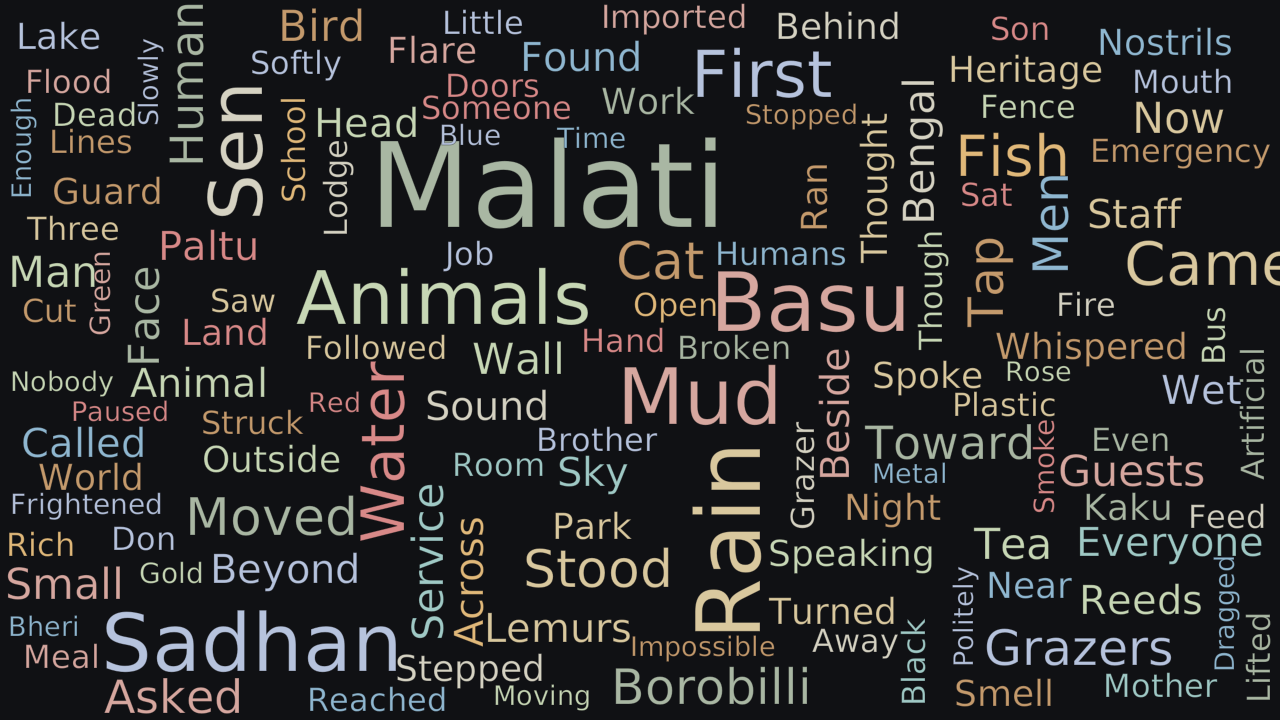
Word Cloud
Related reading
Selected by shared topics and section, with closer publication dates breaking ties.