raw frontier giggle and the great algorithmic enema
Checking article narration…

There is a particular species of chucklefuck currently infesting the digital airwaves, a pestilence of podcast prophets clutching their dildo-sized microphones like scepters of divine revelation, and I have watched them multiply with the grim fascination of a man observing mold colonize his last slice of bread. They speak of “frontier models” with the reverent tremolo usually reserved for messiahs or particularly impressive bowel movements, and I, sitting in my overheated Calcutta flat with the fan spinning its lazy sonnets, am supposed to tremble. I am supposed to marvel. I am supposed to open my wallet and my mouth and let the future pour in like cheap whiskey. Instead I feel the distinct sensation of being intellectually waterboarded by a firehose of recursive hype, each iteration of artificial intelligence promising to be the final prophet while delivering the same old parlor tricks dressed in computational vestments.
The horror, you see, is not that these machines are thinking. The horror is that we have stopped. Somewhere between the gradient descent and the stochastic gradient of our collective attention spans, we have surrendered the beautiful, clumsy, gloriously inefficient process of actual science for the fast food of simulated insight. I watch these silicon snake oil salesmen peddle their wares, their eyes gleaming with the particular mania of converts who have never debugged a memory leak at three in the morning or felt the exquisite agony of a null pointer exception mocking their existence, and I want to scream into the void of their content farms. But the void, being a well-trained algorithm, only screams back with more of the same, optimized for engagement, marinated in the sauce of my own declining standards.
What they sell is not intelligence but a mirror polished to such a sheen that we mistake our reflection for transcendence. The transformer architecture, that magnificent bastard child of attention mechanisms and matrix multiplication, has indeed produced marvels. I concede this with the grace of a man admitting his hangover is self-inflicted. The mathematics is real, bless its heart. When we write the attention mechanism as , we are engaging in a peculiar form of digital alchemy, turning the lead of statistical correlation into the gold of apparent understanding. The query, the key, the value; the holy trinity of modern computation, worshipped by acolytes who couldn’t explain backpropagation if their cryptocurrency portfolios depended on it. And yet, and yet, the beauty of the thing is undeniable. It is calculus performing a striptease, revealing just enough to keep us hooked while hiding the fundamental hollowness beneath.
I remember when I first encountered the concept of gradient descent, that elegant descent into the local minima of our intellectual laziness. The idea is simple enough to fit on a napkin and profound enough to destroy civilizations: . We nudge the parameters, we follow the slope, we minimize the loss. It is hill climbing in reverse, a systematic exploration of the valley of incompetence until we find a comfortable ditch to wallow in. But the prophets on my screen would have me believe that within this arithmetic of approximation lurks the ghost of Einstein, the spirit of Newton, the collective wisdom of humanity distilled into a loss function. They confuse correlation with causation, interpolation with intuition, and the ability to predict the next token with the capacity to understand why the token matters.
The history of science, that glorious chronicle of human fumbling, tells a different story. It tells of Lavoisier weighing his chemicals with obsessive precision while the guillotine sharpened its appetite for his neck. It tells of Semmelweis begging his colleagues to wash their hands, to simply wash their goddamn hands, while colleagues resisted him and continued their charnel house obstetrics; he later died in an asylum. It tells of Boltzmann, that magnificent depressed genius, formulating statistical mechanics while his ideas met fierce opposition, only for him to hang himself in 1906, six years after Planck had used his work on entropy to help launch quantum theory. This is the true texture of discovery: not the smooth exponential curves of venture capital pitch decks but the jagged, bloodied path of men and women who questioned the fundamental assumptions of their age and were rewarded with ridicule, poverty, or death.
But who needs Boltzmann when you have a chatbot that can regurgitate his equations without the slightest comprehension of the human struggle behind them? The entropy formula becomes just another string to be predicted, another pattern in the great statistical soup, devoid of the anguish of its creation. We have built machines that can simulate understanding without the inconvenience of consciousness, and we celebrate this as progress. It is like celebrating a prosthetic leg that can run marathons while forgetting that the original leg was amputated due to gangrene we refused to treat.
The recommendation algorithms, those invisible puppeteers of our digital desires, have noticed my discomfort. They see me watching one video, just one, about the limitations of large language models, and they decide that what I really need is forty-seven hours of content about the singularity, the rapture for the technically inclined, the moment when the machines supposedly wake up and either save us or turn us into paperclips. The algorithm does not understand nuance. It understands engagement metrics. It is a mirror that shows us not what we are but what we have clicked, and in doing so, it creates a feedback loop so tight it threatens to strangle the very curiosity it purports to serve. I am trapped in a hall of mirrors where every reflection is slightly more distorted than the last, and the exit signs have been replaced with thumbnails of grinning tech bros promising to explain quantum computing in five minutes using only rubber ducks and condescension.
There is a particular cruelty in being poor in the age of expensive enlightenment. These frontier models, these digital deities, demand tribute in dollars I do not possess. So I am left with the scraps, the demos, the freemium teasers that show me just enough to know what I am missing. It is the intellectual equivalent of window shopping at a brothel, except the prostitutes are chatbots and the pimps are trillion-dollar companies. And yet, even in my exclusion, I am not spared the evangelism. The podcasts find me. The hot takes infect my feed. The discourse, that rancid river of performative certainty, flows whether I will it or not.
I am told that these models scale, that emergent properties arise from simple rules applied to vast datasets, that intelligence is just a matter of sufficient parameters and compute. The scaling laws, they whisper, are inevitable. In one scaling-law study, loss fell as a power law with model size: , where is the parameter count and ; the separate data-limited exponent was . These are fitted trends, not guarantees. It is beautiful mathematics, coldly precise, and it suggests that if we just make the models bigger, feed them more of the internet’s accumulated vomit, they will eventually wake up and write poetry that makes Keats look like a drunken limerick composer. But I look at these curves and I see not the ascent of intelligence but the consolidation of power. I see the enclosure of the cognitive commons. I see a future where thought itself is rent-seeked by entities that have never had a single original idea, only statistically probable recombinations of the ideas of the dead.
The tragedy is that the science itself is magnificent. The backpropagation algorithm, that clever application of the chain rule , is a genuine intellectual achievement, a way to distribute blame for error through layers of abstraction with mathematical precision. It is Leibniz’s dream made silicon, the characteristica universalis approached through the back door of optimization theory. But the implementation, the deployment, the capitalist capture of this cognitive infrastructure, that is where the beauty curdles into something rancid. We have taken the loom of thought and turned it into a slot machine that pays out in engagement metrics.
And so I find myself retreating, not from science, never from science, but from the theater of science, the performance of progress. I delete the apps. I silence the notifications. I return to the fat textbooks, the ones that hide the fumbling, the failed experiments, the petty rivalries between Newton and Leibniz over calculus priority while both stood on the shoulders of giants they refused to credit. I return to the primary sources, to the original papers where the uncertainty is palpable, where the authors admit their confusion, where the science is still wet and bloody and alive. Because that is where the wonder lives, not in the polished outputs of models trained on the aggregated knowledge of humanity but in the specific, idiosyncratic, often wrong-headed struggles of individual minds grappling with the unknown.
The wonder of science is not that it provides answers. It is that it dares to ask questions. It is the humility to say “I do not know” followed by the hubris to try to find out anyway. It is the method of conjecture and refutation, the Popperian crucible where ideas are tortured until they confess their limitations. It is the recognition that every equation is a poem written in the language of nature, but a poem that can be revised, falsified, improved upon. When Maxwell unified electricity and magnetism in his four equations, and and their companions, he was not just doing mathematics. He was composing a symphony of the invisible, predicting radio waves before Marconi was born, revealing that light itself is an electromagnetic embrace.
But the current crop of AI enthusiasts would have us believe that such insights can emerge from scaling up next-token prediction, that understanding is merely compression, that the map is the territory if we make the map detailed enough. They point to GPT passing bar exams and medical licensing tests as if regurgitating the canon were equivalent to extending it. They confuse the library for the librarian, the database for the scientist, the simulation for the reality. And in their fervor, they forget that science advances not by prediction but by anomaly, not by interpolation but by revolution, not by saying what is likely but by discovering what is impossible until it isn’t.
Kuhn understood this. The structure of scientific revolutions is not a smooth gradient descent but a series of punctuated equilibria, paradigm shifts that require the old guard to die off before the new paradigm can breathe. Planck himself, the father of quantum theory, resisted the implications of his own discovery. Einstein never accepted quantum mechanics fully. The giants were as confused as the rest of us, perhaps more so, because they could see the edges of the map where the dragons still roam. But the algorithm does not want me to sit with this discomfort. It wants me to watch another video, another podcast, another breathless explanation of how the machines are about to solve everything from climate change to my own existential dread.
I refuse. Not the technology, which is neutral as a hammer, but the mythology, the eschatology, the desperate need to believe that we have finally built something that will save us from the burden of thinking. I refuse to believe that intelligence is merely computation, that consciousness is merely complexity, that the mystery of the mind will dissolve in a sufficiently large bath of matrix multiplications. I hold out for the irreducible, the subjective, the qualia of being that no amount of training data can capture. I hold out for the science that acknowledges its limits, that trembles before the unknown, that understands that every answer opens a thousand new questions.
So let the chucklefucks have their podcasts. Let them worship at the altar of the scaling laws. Let them believe that the singularity is near, that the machines are waking, that the future belongs to those who can afford the most compute. I will be here, in my corner of Calcutta, reading the original papers, tracing the history of human error and insight, marveling at the fact that we figured out anything at all. I will marvel at the double helix, not as a data point but as a revelation of the molecular basis of inheritance, worked out by Watson and Crick using crucial X-ray data from Rosalind Franklin that had been shared without her knowledge. I will marvel at general relativity, not as a benchmark to be passed but as a reconceptualization of gravity as geometry, as the bending of spacetime by mass-energy according to , an equation so beautiful it deserves to be carved on tombstones.
The wonder is not in the artificial. The wonder is in the artifice of human understanding, the fragile, error-prone, glorious attempt to make sense of a universe that does not owe us comprehension. And if the algorithms want to feed me more content, let them try. I have learned to hunger for the slow, the difficult, the unoptimized. I have learned to prefer the fumbling of real scientists to the confident hallucinations of artificial ones. I have learned that the truth, like a particularly stubborn bowel movement, requires patience, pressure, and the willingness to endure discomfort before relief arrives.
The frontier is not in the cloud. It is in the mind, that leaky, biased, beautiful organ that dreamed up mathematics while dreaming of gods, that built telescopes while burning witches, that can hold both the sublime and the ridiculous in the same synaptic breath. That is where the real intelligence lives, for now, in the wetware between our ears, in the community of skeptics and dreamers who refuse to let the machines do their wondering for them. And if that makes me a dinosaur, a Luddite, a bitter old man yelling at the digital clouds, then so be it. At least I am yelling in my own voice, not one generated by a statistical parrot with delusions of grandeur.
P.S. References to Maxwell’s equations, Boltzmann’s entropy, and the attention mechanism are accurate as of my last reading of the physics literature, which is more than I can say for certain podcast hosts who shall remain nameless but not blameless.
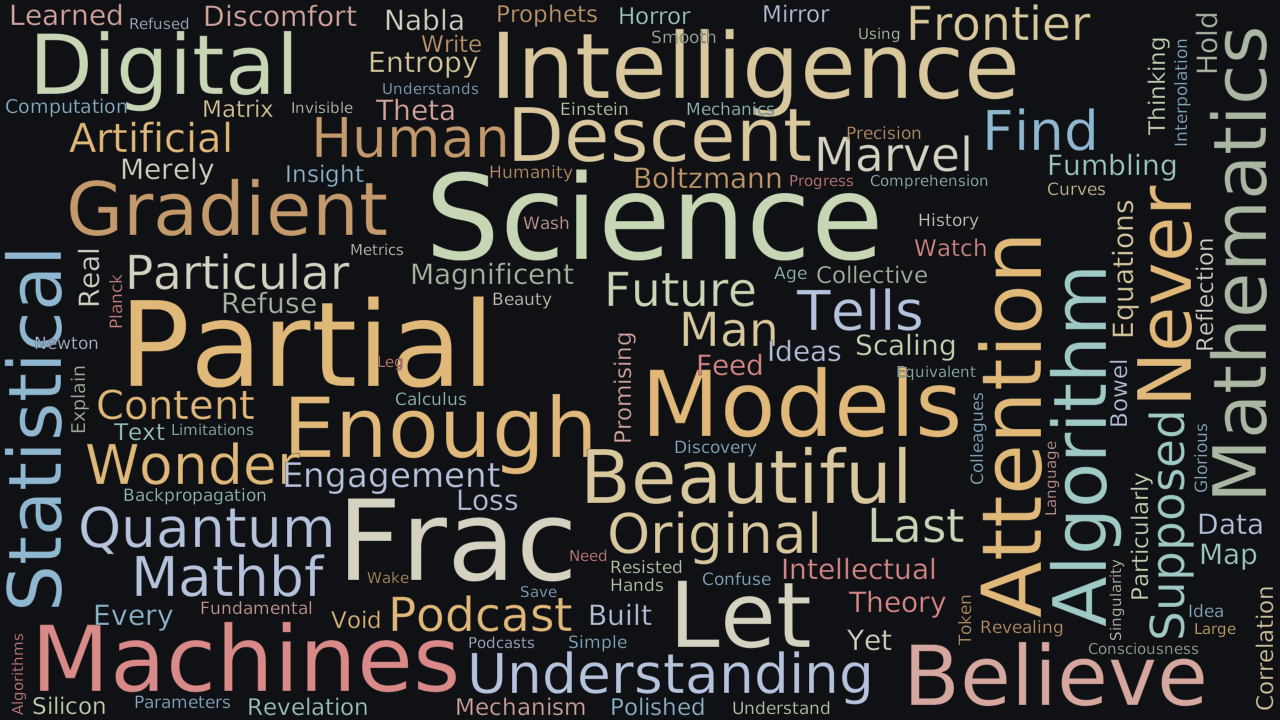
Word Cloud
Related reading
Selected by shared topics and section, with closer publication dates breaking ties.
Comments
Read the conversation or leave a thought for review. Comments load when this section is in view.