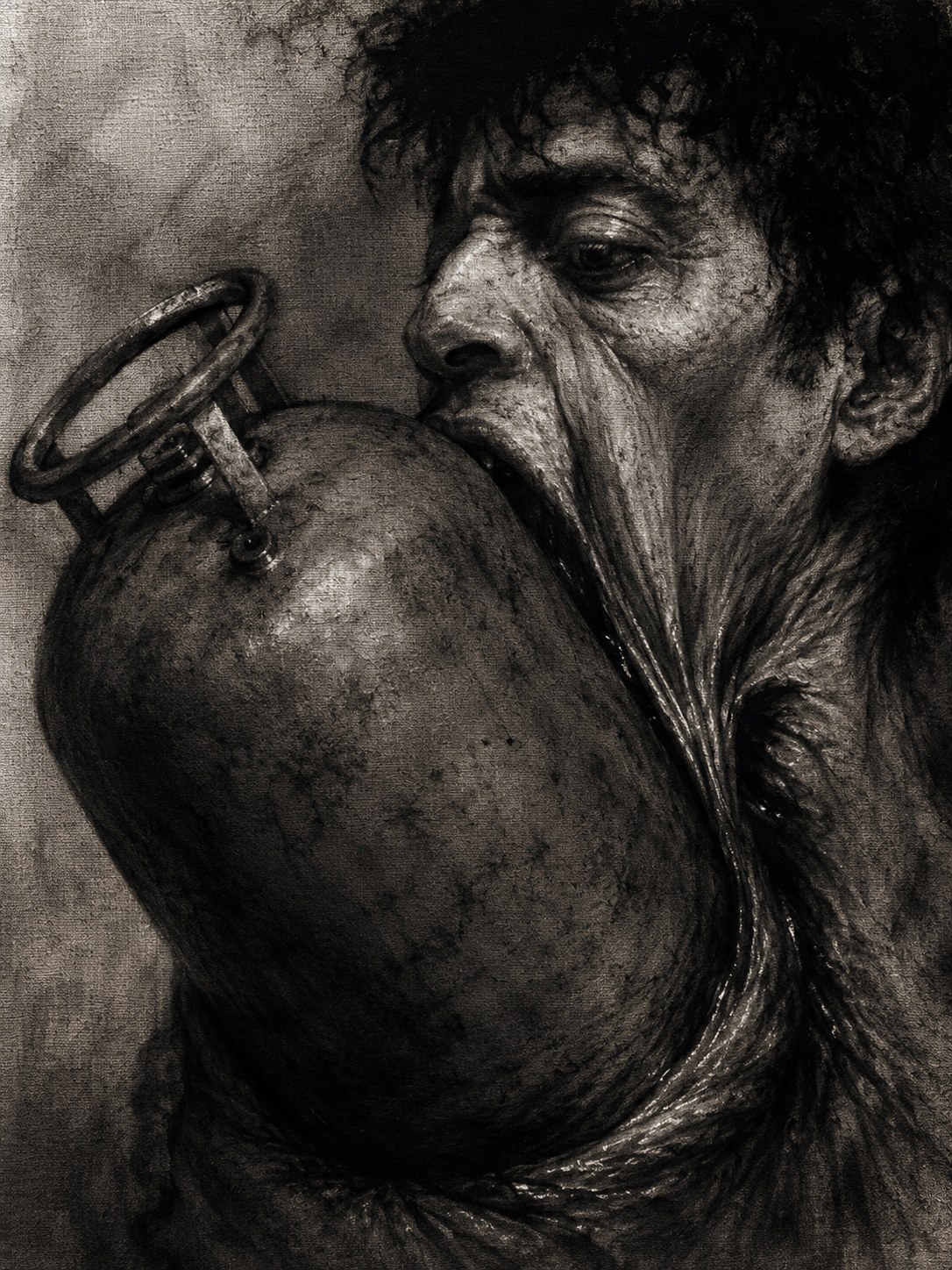
When Suffering Refuses to Leave the Room
Uses the speech voice supplied by your browser or device.

That is the part many cheerful people do not understand. They think trauma is a memory. It is not always a memory. Sometimes it becomes weather. It becomes the air pressure inside the skull. It becomes the little tightening before a phone call, the dread before opening WhatsApp, the sudden collapse of energy before doing ordinary work, the private court case that keeps running in the mind long after all parties have left the building.
There is acute suffering, which arrives like a bus hitting the ribs. Betrayal. Humiliation. Romantic collapse. Social cruelty. Financial threat. Legal fear. Public insult. One morning life is merely difficult; by afternoon it has acquired teeth.
Then there is chronic suffering, which is worse in a more bureaucratic way. It does not explode. It leaks. It seeps through the walls. Month after month of uncertainty, distrust, unpaid invoices, rotten dealings, hostile business environments, social manipulation, and that peculiarly Indian cocktail of corruption, oligarchy, swagger, and moral lectures from men whose ethics could not survive a mild audit.
The body, being an old animal and not a philosopher, does not always distinguish cleanly between a tiger, a treacherous friend, a bad lover, a corrupt business partner, an unpaid rent demand, and a future with no visible staircase. It simply learns: danger may come from anywhere.
Once that lesson settles in, the nervous system stops being a guard dog and becomes a village loudspeaker. It barks at everything. It announces danger at dawn, danger at lunch, danger while bathing, danger while reading, danger while trying to sleep. The mind begins to live not in the present but in a badly lit waiting room where some new injury may be called at any moment.
For someone already living with bipolar disorder, this is not merely sadness with extra seasoning. Bipolar disorder is already a condition in which mood, energy, sleep, irritability, motivation, and judgment can become unstable. Add trauma to that landscape and the whole inner geography changes. The slopes become steeper. Small provocations roll downhill faster. Shame becomes heavier. Anger ignites more easily. Exhaustion becomes not laziness but system failure.
This is the point where outsiders, with the confidence of people who have never had their inner wiring chewed by rats, say things like, “Move on.”
Move on where, exactly?
The mind is not a rented flat in Behala where one can simply pack two trunks, quarrel with the landlord, and leave. The mind carries its damaged furniture with it. One may change cities, jobs, lovers, business plans, diets, philosophies, and mobile phones, and still find the same old dread sitting in the corner like an elderly uncle who has no intention of dying before tea.
Bad relationships do a special kind of injury because they contaminate trust. A failed romance is not just the loss of a person. It can become the loss of one’s faith in one’s own perception. Was I foolish? Was I used? Did I ignore signs? Was affection real or merely theater? In youth such questions are painful. In middle age they acquire a more frightening weight, because one also feels the inventory of years. Time stands nearby with a clipboard.
Bad social relationships can do something equally poisonous. A society that smiles while calculating your weakness teaches the body to flinch before the blow. You stop entering rooms as a person and begin entering them as a defendant. You explain too much. You anticipate betrayal. You rehearse arguments with people who are not present. You become tired before anything has happened.
Entrepreneurship in a hostile environment can finish the job.
People romanticize entrepreneurship as if it is a TED Talk wearing shoes. In many places, especially in the Indian small-business landscape, it can resemble being asked to build a bridge while monkeys steal the cement, officials demand blessings in cash, large players block the road, and everyone later asks why you did not scale. The market is not always a market. Sometimes it is a pond owned by crocodiles.
A person can survive one betrayal. Many people do.
A person can survive one business failure.
A person can survive one bad romance, one social humiliation, one unpaid invoice, one corrupt system, one season of fear.
But suffering becomes disabling when the blows stop appearing as separate incidents and merge into a single conclusion: the world is unsafe, people are unreliable, effort is punished, trust is foolish, and my own mind cannot be trusted either.
That last sentence is where the real horror begins.
Because when the outer world becomes unsafe and the inner world also becomes unstable, there is no easy refuge. Work becomes difficult because concentration has to pass through fog. Love becomes difficult because tenderness has to pass through suspicion. Ambition becomes difficult because hope itself feels like a trap. Even ordinary self-care can become absurdly hard. Bathing, cooking, replying to a message, opening the laptop, making tea — these are not heroic tasks, but under chronic distress they can feel like climbing Howrah Bridge with a fever.
This is why many trauma injuries are wrongly judged as character defects. People see nonfunctioning and call it laziness. They see withdrawal and call it arrogance. They see irritability and call it bad manners. They see indecision and call it weakness. They see a man unable to move and assume he has chosen stillness.
But sometimes stillness is not a choice. Sometimes the system has tripped its own breaker.
There is also a moral injury in betrayal. It is not only that someone harmed you. It is that reality itself was falsified. Promises were made and broken. Loyalty was staged. Affection was performed. Business was presented as partnership while the trapdoor was being oiled underneath. The injured person is then expected to behave reasonably in a world that has behaved unreasonably.
Reason is a fine instrument, but it gets tired when asked to mop up after treachery.
What remains after repeated injury is often not dramatic madness but a quieter paralysis. You sit. You know things must be done. You may even know exactly what must be done. But between knowledge and action there is a swamp. The old self, the one who could study, build systems, solve problems, argue architecture, write, code, plan, laugh, love, and restart, now feels like a previous tenant.
This is not self-pity. It is an attempt at accurate description.
A person can be intelligent and broken. Educated and frightened. Funny and depressed. Technically competent and practically frozen. Capable of deep thought and still unable to answer a simple email. The world likes clean categories because clean categories are cheap. Human beings are expensive.
Recovery, if that word is not too shiny, cannot mean pretending the injuries were minor. It cannot mean chanting optimism into a cracked skull. It has to begin with a more honest sentence: something happened to me, and it changed the operating conditions of my life.
That sentence matters.
It does not excuse cruelty. It does not remove responsibility. It does not magically repair bipolar disorder, money, loneliness, reputation, work, or sleep. But it stops the extra punishment of calling injury a moral failure.
The first practical task is not to become triumphant. That is movie nonsense. The first task is to reduce the daily load on the nervous system enough that ordinary life becomes possible again. Smaller expectations. Fewer unsafe people. Less exposure to performative relationships. More predictable routines. Work divided into pieces small enough that the mind does not treat them as invading armies. Medical care where available. Therapy if possible. Medication discipline if prescribed. Sleep protected like the last candle in a storm.
And perhaps, also, a stricter border policy for the soul.
Not everyone gets entry. Not every call must be answered. Not every accusation deserves a courtroom. Not every charming person is safe. Not every business opportunity is opportunity. Some are just potholes wearing perfume.
The hardest part is accepting that trauma may have made me slower without making me worthless. It may have made me suspicious without making me cruel. It may have made me tired without making me lazy. It may have worsened my bipolar disorder without erasing the person underneath it.
That person is still there.
Damaged, yes. Angry, often. Afraid, more than he likes to admit. Sometimes almost nonfunctional. Sometimes ashamed of being almost nonfunctional. Sometimes looking at his own life like a house after a cyclone, wondering which wall to lift first.
But still there.
And perhaps that is where one begins again. Not with grand reinvention. Not with speeches. Not with the fake sunrise of motivational fraud. With one wall. One cup of tea. One cleaned corner. One honest paragraph. One refusal to let the people who injured you become the final authors of your nervous system.
The wound may have written many chapters.
It does not get the copyright.
Word Cloud
Related reading
Selected by shared topics and section, with closer publication dates breaking ties.