The Unrecorded Error
Quick Answer
A clinical error that is never recorded cannot be counted, investigated, learned from, or prevented. Understaffing, blame, missing systems, fragmented records, weak reporting culture, and fear can erase harm from institutional memory even when patients and workers carry its consequences.
Key Terms
- Patient Safety
- Incident Reporting
- Clinical Error
- Underreporting
- Root Cause Analysis
- Safety Culture
- Clinical Documentation
- Institutional Learning
Frequently asked questions
Why do clinical errors go unrecorded?
Workers may lack time, reporting tools, psychological safety, clear definitions, feedback, or trust that disclosure will improve care rather than produce individual punishment.
What is lost when an error is absent from the record?
The organization loses evidence needed to identify patterns, investigate causes, support affected people, redesign workflows, allocate resources, and measure whether prevention works.
How can a hospital improve error reporting?
It can simplify reporting, protect good-faith disclosure, separate system learning from reckless conduct, give feedback, analyze near misses, and act visibly on recurring hazards.
Uses the speech voice supplied by your browser or device.

Acronyms used in this post: Healthcare IT means Healthcare Information Technology, the technical and organizational systems used to capture, preserve, move, and govern health information. EHR means Electronic Health Record, the supposed digital clinical record of a patient’s care, though in much of India this exists more as brochure language than operating reality. EMR means Electronic Medical Record, a narrower digital record inside one hospital or clinic, again often incomplete or absent in real practice. HAI means Healthcare-Associated Infection, an infection acquired during medical care. ICU means Intensive Care Unit, the hospital unit for critically ill patients. OR means Operating Room, where surgery happens. ABDM means Ayushman Bharat Digital Mission, India’s national digital health infrastructure initiative. NEET means National Eligibility cum Entrance Test, India’s medical entrance examination. NMC means National Medical Commission, India’s regulator for medical education and professional standards. WHO means World Health Organization. BMJ means British Medical Journal. CDC means Centers for Disease Control and Prevention.
A hospital can harm a patient in India and leave behind less evidence than a street-side tea stall leaves after rain.
This is not because India lacks clever people. India has doctors who can diagnose from three clues and a cough. It has nurses who can run a ward with the stamina of railway porters and the patience of saints, though I do not believe in saints, so let us say the patience of someone who has survived Indian bureaucracy without biting a table. It has technicians who can make dead machines breathe again. It has surgeons of alarming skill. It has families who will sell jewelry, land, scooters, and peace of mind to keep one person alive for one more day.
And still the system is rotten in places where rot matters.
Not uniformly rotten. That would be too easy. India is never that considerate. It is excellent here, medieval there, shiny in the lobby, crumbling behind the oxygen manifold, brilliant in the consultant’s brain, prehistoric in the record room, world-class in one floor, village fair in another. Indian healthcare is not one thing. It is a circus, a battlefield, a temple economy, a marketplace, a miracle shop, a debt machine, and occasionally, despite all odds, a place of genuine rescue.
But if we are talking about patient safety, we must begin before the patient reaches the bed.
We must begin at the gate.
Who is allowed to become a doctor? Who gets into medical college? Who passed by merit, who passed by money, who passed by leaked paper, who passed by influence, who passed because some uncle knew someone with a chair and a rubber stamp? Who was trained properly? Who learned by watching? Who was absent during postings but present during certificate collection? Who got hired because of competence, and who arrived by surname, political contact, caste network, cash, or that great Indian qualification: “our person”?
People think corruption is a moral problem. It is. But in healthcare it is also a clinical risk factor.
A leaked exam paper is not only an education scandal. It is a possible future medication error wearing school shoes. A fake degree is not merely fraud. It is a hand reaching toward your mother’s vein. Nepotistic hiring is not just unfair to the better candidate. It may be the reason an ICU monitor alarms while the wrong person decides whether the alarm matters.
This is where the polite drawing-room conversation usually coughs and changes subject.
Let us not.
Indian healthcare is full of missing proof. Fake doctors are discovered, then we act shocked, as if the fake doctor grew overnight like fungus behind the bathroom bucket. But fake practice needs an ecosystem. Someone rented the chamber. Someone printed the board. Someone sold the drugs. Someone referred patients. Someone looked away. Someone benefited. Someone believed the white coat because in India costume is half the credential. We are a civilization that respects laminated paper. Put a seal on anything and we lower our voice.
The patient sees “Doctor” on the signboard. That may be enough.
This is not safety. This is theatre with a stethoscope.
Then there is the staff problem, which is not glamorous, so it does not attract the right sort of outrage. Understaffing kills without making a speech. It does not arrive like a villain. It arrives as one nurse for too many patients, one resident awake too long, one technician covering too many machines, one cleaner missing from infection control, one ward boy doing work he was never trained to do, one junior doctor making decisions with a brain cooked by fatigue.
In India, overwork is often praised as dedication. This is dangerous nonsense. A tired doctor is not a more noble doctor. A tired nurse is not a more economical nurse. Fatigue is not patriotism. It is a neurological tax. It narrows attention, damages memory, worsens judgment, weakens courage, and makes shortcuts feel reasonable. At 3 a.m., after too many hours, the human brain becomes a badly paid clerk stamping whatever form is placed before it.
That is when harm enters quietly.
The underpaid worker has another problem. Underpayment does not automatically make someone corrupt, careless, or cruel. Many people remain decent under conditions that should have made them bitter. But chronic underpayment plus impossible workload plus weak supervision plus no career dignity is a factory for decay. People cut corners. People moonlight. People stop caring about details. People learn survival instead of craft.
A health system cannot run forever on sacrifice. Sacrifice is not a staffing model.
Then comes what I call artisanal nursing, and I do not mean that as a compliment. Artisanal is a lovely word for bread, pickles, bamboo lamps, or some hand-painted thing sold at a winter fair by a person with better taste than income. It is less lovely when applied to injections, catheter care, wound dressing, ventilator suctioning, chemotherapy handling, ICU monitoring, sterilization, and postoperative observation.
A great deal of Indian healthcare still runs on informal skill. “She has experience.” “He knows the work.” “They manage.” These phrases sound practical. Sometimes they are. Experience matters. But experience without formal training, assessment, supervision, scope of practice, and accountability is not a workforce model. It is folklore in uniform.
And folklore should not be hanging blood.
The machinery has its own biography, usually hidden. The monitor beeps. The oxygen flows. The infusion pump blinks. The sterilizer heats. The ventilator breathes. Everyone relaxes because machines look honest. But machines are only as honest as their parts, calibration, maintenance, consumables, power supply, software, alarms, and operators.
India has counterfeit parts. India has refurbished equipment sold as nearly divine. India has machines repaired by jugaad because the official service contract costs more than the administrator’s conscience can tolerate. India has cannibalized equipment, where one machine donates a part to another like a tragic family drama. India has devices with stickers, seals, service dates, and histories nobody can fully reconstruct. India has spare parts of uncertain parentage moving through supply chains that would make a detective retire.
If a machine lies, who knows?
If a part fails, who records it?
If an alarm was disabled, who admits it?
If a ventilator was serviced by someone not qualified, where is that written?
If a dialysis unit uses a questionable consumable, how does the patient discover it before the body does?
This is not a small problem. Equipment is now part of care. A machine is no longer furniture. It participates. It measures, pumps, filters, breathes, shocks, warms, cools, images, cuts, seals, and alarms. If we do not know the machine’s history, we do not know the care history.
A hospital bed in India may have more secrets than a coalition government.
Now notice something. I have barely talked about EHRs. That is deliberate.
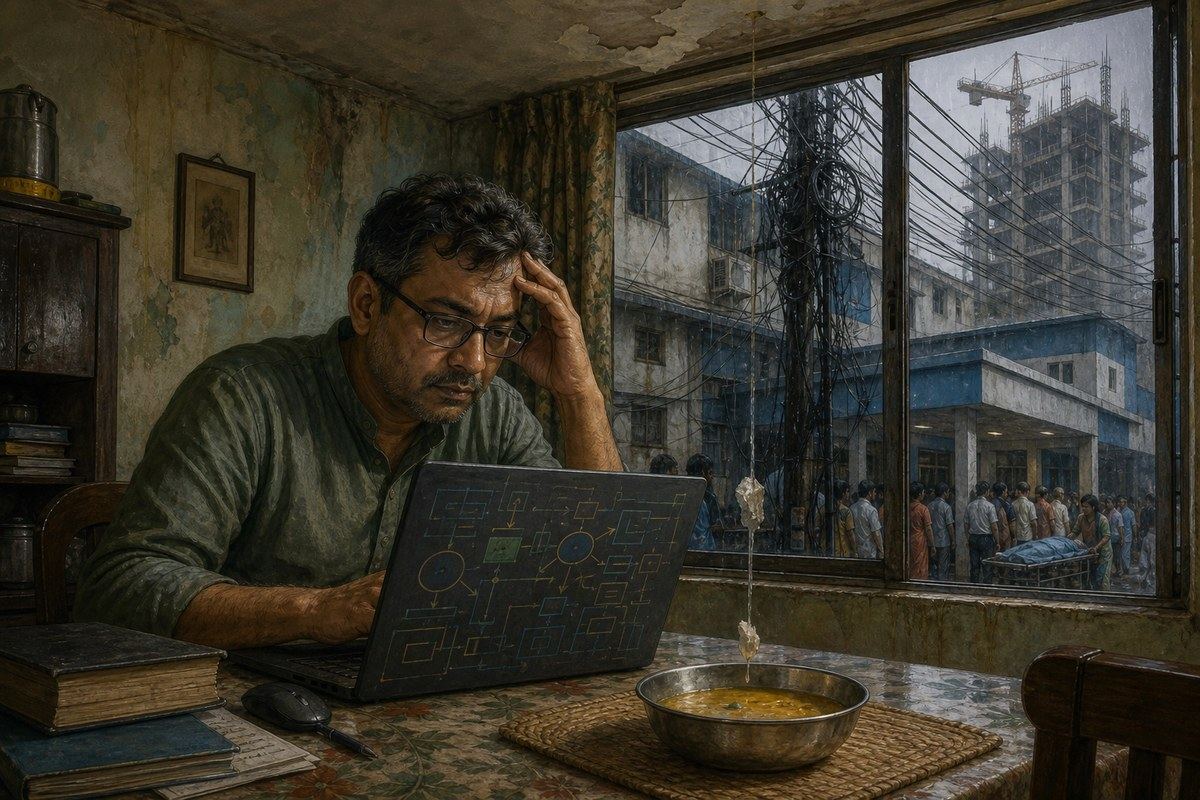
In the United States, one can complain about EHRs because they exist, often too much, like an overfed aunt sitting on the clinician’s chest. In India, outside some large hospitals and polished corporate islands, the EHR is often a brochure animal. It appears in tenders, strategy decks, conference speeches, vendor demos, and consultant invoices. It looks impressive in screenshots. It purrs in PowerPoint. Then you visit the ward and find paper, phone calls, WhatsApp messages, handwritten orders, scanned discharge summaries, and a clerk who knows where the real file is because the system certainly does not.
This is why Indian Healthcare IT often feels like gold paint on damp plaster.
I say this as someone who has spent years in healthcare data systems in America and then returned to Kolkata to discover that in India, healthcare IT is frequently treated as a decorative layer, not a structural beam. The real work happens in corridors, registers, memory, influence, and improvisation. Digital systems, when present, often serve billing, insurance, inventory, or administrative display before they serve clinical truth.
And if clinical truth is not captured, nothing downstream can rescue it.
This is the central point. Patient safety begins with reality. Not the record. Reality. Who touched the patient? Who ordered the medicine? Who administered it? Was the staff qualified? Was the drug genuine? Was the machine maintained? Was the ward overloaded? Was the infection acquired inside? Was the patient deteriorating before someone noticed? Was the family warned? Was the note written before or after the disaster? Was the record changed?
If the system cannot answer these questions, then it is not a safety system. It is a memory palace with no doors.
India has a habit of confusing paperwork with proof. We have forms, signatures, stamps, registers, certificates, seals, photocopies, acknowledgments, declarations, undertakings, and consent forms written in a language that would frighten a lawyer’s grandmother. But paperwork is not proof if nobody can trust how it was created. A backdated note is paper. A forged certificate is paper. A consent form signed under panic is paper. A maintenance log filled in before inspection is paper. A staffing roster that does not reflect the ward is paper.
Paper can lie very fluently.
Digital systems can lie too, but at least a serious digital architecture can make lying harder. It can preserve timestamps. It can show amendments. It can restrict who can enter orders. It can connect credentials to privileges. It can attach equipment identity to procedures. It can record medication chain of custody. It can make incident reporting structured. It can force critical alerts to be acknowledged. It can show whether the same device failed before. It can help count infections honestly.
But that requires healthcare IT to matter.
And in India, too often, it does not.
It is not prominent because safety is not prominent. Billing is prominent. Packages are prominent. Branding is prominent. The lobby is prominent. The consultant’s name is prominent. The hospital’s exterior lighting is prominent. The patient’s family’s fear is prominent. But the quiet machinery of safety, documentation, auditability, and accountability remains treated as back-office housekeeping. Something for accreditation week. Something to show inspectors. Something the software vendor can “customize.”
Customize is a dangerous word in Indian enterprise software. It often means “remove the irritating truth.”
The tragedy is that many Indian hospitals do not lack intelligence. They lack incentive alignment. A hospital may not want to know too much about its own errors. A nursing home may not want detailed records because detailed records can become evidence. A doctor may not want incident reporting because reporting becomes blame. A manager may not want staffing data because staffing data proves underinvestment. A procurement officer may not want device provenance because provenance asks rude questions about money. A regulator may not have manpower. A patient may not have power.
So the error disappears.
Not always by conspiracy. Often by evaporation.
A medication delay becomes “managed.” A hospital infection becomes “fever.” A device problem becomes “technical issue.” A fake practitioner becomes “local doctor.” A poor outcome becomes “patient was serious.” A missing nurse becomes “staff was available.” A botched process becomes “complication.” In Indian medicine, “complication” is sometimes a true clinical word and sometimes a bedsheet pulled over a mess.
The difference matters.
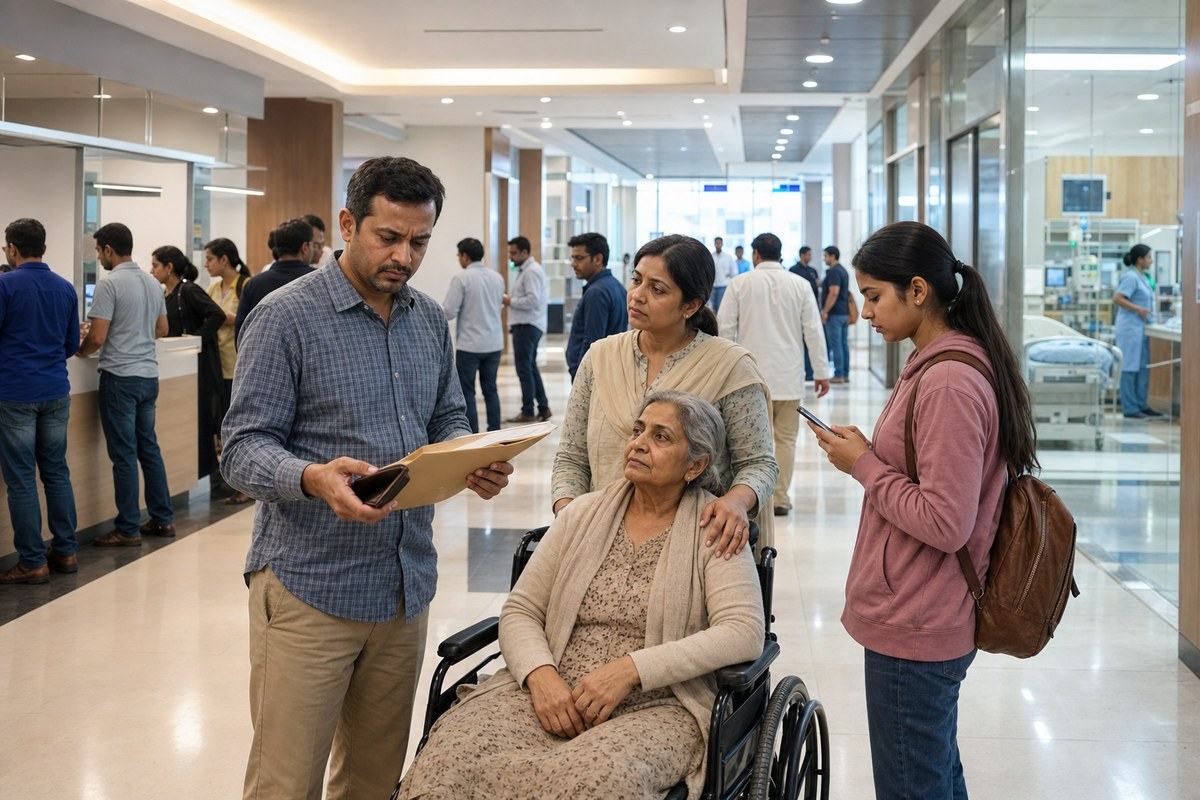
Here is an ordinary scene. A middle-class family in Kolkata sits outside a hospital room. The father has a plastic folder of reports. The daughter has a phone at 18 percent battery. The mother has not eaten. A doctor passed by quickly and said something about infection. A nurse came and gave an injection. Nobody knows its name. The bill is growing like a mythological demon. The family wants to ask questions but is afraid of becoming “difficult.” In India, a difficult family may be ignored, scolded, or asked to shift the patient. So they whisper.
This whisper is part of the architecture.
When patients cannot ask, records become more important. When records are weak, authority becomes more powerful. When authority is corrupt or careless, harm becomes almost impossible to prove. The poor suffer first. The elderly suffer quietly. Disabled patients suffer invisibly. Women without income, migrants, psychiatric patients, and rural families in city hospitals often lack the language, money, and social force to make the system remember.
This is why patient safety is political without needing party politics.
It is about power.
A rich family can demand records. A poor family receives instructions. A connected family can call someone. An unconnected family waits near the lift. A loud family may get attention. A polite family may get crushed. A family with medical knowledge can challenge a dose. Another family may not know whether the bottle hanging above the bed is saline, antibiotic, or financial doom.
The record should protect the weak from needing influence.
In India it often does not.
So what would a serious Indian patient safety architecture look like, before we start throwing expensive acronyms into the air like wedding confetti?
First, verify people. Every doctor, nurse, technician, pharmacist, therapist, and clinical assistant should have a verified identity, qualification, role, and scope of practice. Not in a file that sleeps in administration. In the working system of the hospital. If someone is not authorized to perform a task, the system should know. If someone orders, administers, repairs, calibrates, or documents, the record should know who, when, and under what authority.
Second, verify things. Drugs, implants, devices, spare parts, consumables, blood products, oxygen supplies, sterilization cycles, and biomedical repairs must have traceable histories. This sounds boring. Good. Safety is often boring until it is absent. The screw in the machine matters. The label on the ampoule matters. The maintenance date matters. The person who repaired the pump matters.
Third, verify staffing. Do not record only the patient’s condition. Record the care environment. How many nurses were actually on duty? How many patients? How many ICU beds occupied? How long had the resident been working? Was the ward using temporary staff? Was the unit overloaded? A bad outcome in an overloaded ward is not the same as a bad outcome in a properly staffed ward. Context is not an excuse. It is evidence.
Fourth, verify the dangerous verbs. Ordered. Dispensed. Administered. Held. Delayed. Substituted. Escalated. Reviewed. Acknowledged. Transferred. Repaired. Calibrated. Overridden. Cancelled. Amended. Reported. Ignored.
Healthcare fails in verbs.
Indian records are full of nouns. Patient. Bed. Doctor. Bill. Diagnosis. Package. Procedure. Discharge. But harm lives in verbs. Missed. Waited. Assumed. Reused. Borrowed. Faked. Rushed. Silenced. Backdated. If we do not capture the verbs, we capture the corpse of the event, not the event.
Fifth, protect reporting. A junior doctor or nurse should be able to report a near miss without being turned into sacrificial goat curry. Near misses are not embarrassments. They are free warnings. The bridge has cracked but the bus has not fallen. A mature system says thank you and repairs the bridge. An immature system beats the person who noticed the crack.
Guess which one saves lives.
Sixth, give patients usable information. Not a discharge summary written in fog. Not a PDF scan of illegible handwriting. Not a bill with more detail than the clinical explanation. Give medication names. Procedure details. Complications. Infection information. Implant details. Device identifiers where relevant. Follow-up risks. Warning signs. Names and roles. Dates and times. Plain language. A patient should not need a cousin in medicine to understand what happened to his own body.
This is not anti-doctor. It is pro-reality.
Doctors also benefit from honest systems. A good doctor should want fake doctors removed, untrained staff identified, counterfeit supplies blocked, equipment maintenance documented, staffing risk visible, and unsafe shortcuts exposed. The competent suffer when the system protects the incompetent. The honest suffer when the corrupt hide among them. The exhausted suffer when administrators pretend understaffing is a motivational challenge.
A clean system protects good clinicians from bad systems and patients from bad actors.
Will India do this easily? Of course not. We are a country where a pothole can survive longer than a cabinet minister and acquire more local familiarity. We will produce committees, circulars, portals, pilot projects, dashboards, and procurement disputes. There will be speeches. There will be acronyms. Someone will say “AI-enabled” before the nurse has enough gloves. Someone will put blockchain in a proposal, because no public-sector fantasy is complete without one decorative technology too many.
Meanwhile the ward will continue.
The ward is where reality lives.
A man will be admitted with fever. A woman will wait for surgery. A child will receive an injection. A resident will choose between two urgent calls. A nurse will run from bed to bed. A machine will beep. A family will ask what is happening. A clerk will ask for deposit. A technician will say the part is coming. A consultant will arrive late because traffic near Science City has eaten half the morning. Someone will write “stable.”
And under that one word, a universe may be hiding.
The point of Healthcare IT in India should not be to look modern. It should be to make hiding harder. If it cannot do that, it is just a glossy patina over a primordial wall. Nice from a distance. Damp underneath.
We do not need digital perfume. We need structural repair.
The first truth is that harm happens.
The second truth is that some harm is preventable.
The third truth is that preventable harm cannot be prevented if it is not honestly seen, counted, recorded, investigated, and learned from.
The fourth truth, unpleasant but necessary, is that India has allowed too many things to remain unofficial: unofficial training, unofficial staffing, unofficial repairs, unofficial substitutions, unofficial payments, unofficial influence, unofficial silence. But patients die officially. Bills arrive officially. Death certificates are issued officially. Families grieve officially, though grief itself has no stamp.
So let the record become less cowardly.
Let it say who treated the patient.
Let it say whether they were qualified.
Let it say what drug was given.
Let it say where it came from.
Let it say what machine was used.
Let it say whether it was maintained.
Let it say how many staff were on duty.
Let it say when deterioration was noticed.
Let it say what was done.
Let it say what failed.
Let it say what changed afterward.
Until Indian healthcare can preserve these truths, many errors will continue to perform their oldest trick.
They will happen in the body.
Then vanish from the file.
Healthcare IT consulting
Working through a difficult clinical data or interoperability problem?
I advise on HIE and EHR architecture, HL7/FHIR interoperability, clinical data migration, terminology, analytics, and AI data readiness.
Word Cloud
Related reading
Selected by shared topics and section, with closer publication dates breaking ties.