The Thermodynamics of Fishy Things
The sweat pooling in the hollow of my collarbone tastes of iron and something vaguely metallic, a private chemistry experiment conducted in the stupefying envelope of a Calcutta afternoon that the India Meteorological Department politely lists as thirty-eight degrees Celsius but which the heat index—a composite measure fusing air temperature with relative humidity that my telephone application displays in a small, judgmental font—translates into fifty-one degrees of what the body actually experiences, a number that means my thermoregulatory system is laboring at maximum capacity yet dissipating almost no heat because at seventy-three percent humidity sweat cannot evaporate efficiently, and so the moisture simply accumulates, a stagnant, salty lake forming in the creases of my elbows, behind my knees, along the ridge of my upper lip, while I sit motionless on a cane chair trying not to generate additional metabolic warmth and read, on a screen that itself radiates a small, treacherous fever, about a Japanese artificial intelligence company named after fish.
Sakana.
It means fish. Not majestic fish. Not whale. Just fish. The ordinary, swimming, schooling kind.
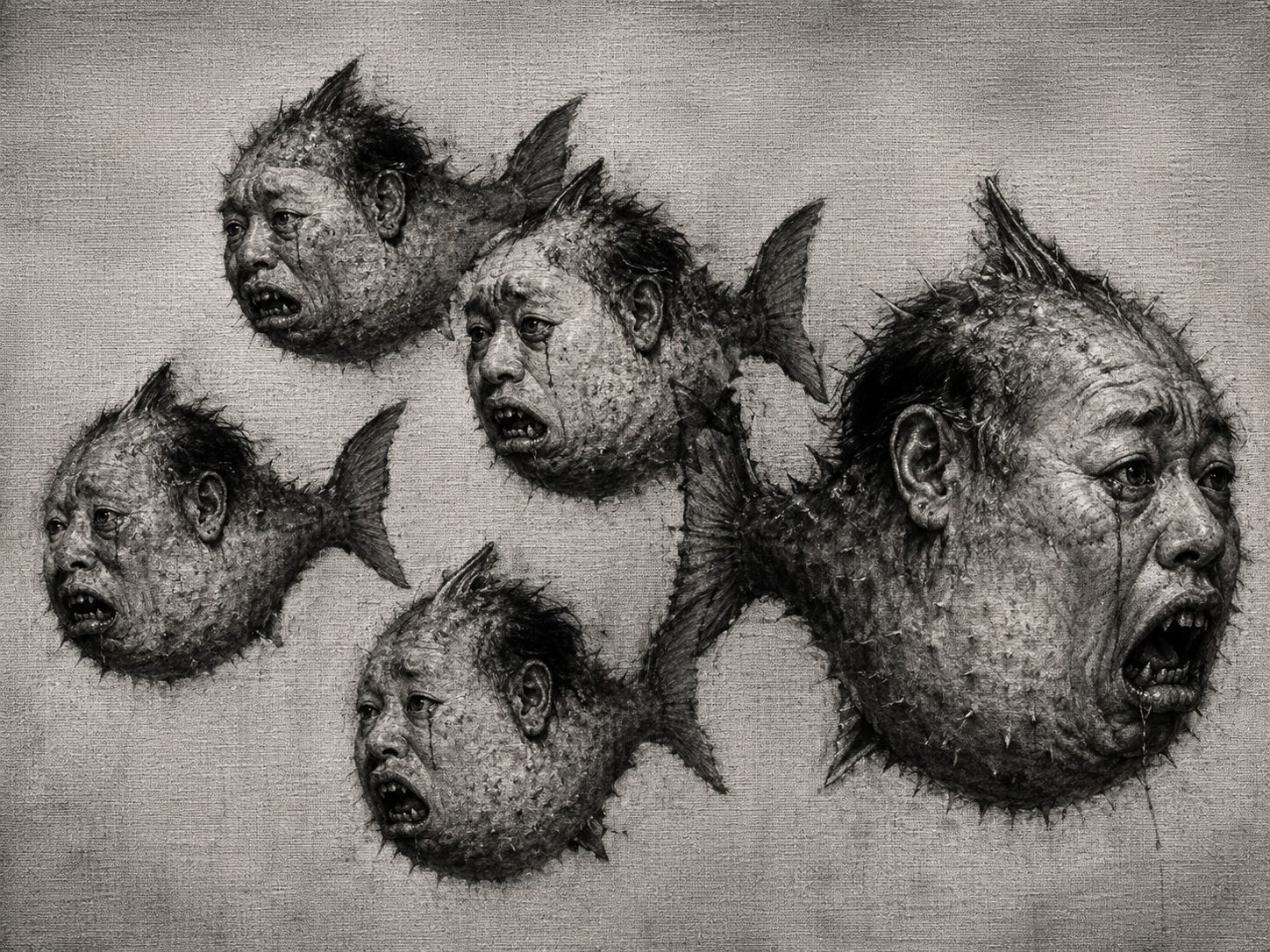
And they have named their latest multi-agent orchestration API Fugu. The pufferfish. The one that contains tetrodotoxin and kills you if a chef without a license prepares it incorrectly.
I smell something fishy. Something very, very fishy. And perhaps, in a perverse way, that is a good thing.
The American artificial intelligence narrative, which arrives in my humid inbox with the relentless frequency of the afternoon dust storms that now precede our delayed monsoon, smells of something else entirely. It smells of antiseptic money. Of the Great American Artificial Intelligence Act, a two-hundred-and-sixty-nine-page discussion draft dropped earlier this month by representatives from California and Massachusetts that proposes to preempt Colorado’s comprehensive state AI law before that law can even take effect five days from now, on June thirtieth, as if federal legislators have suddenly realized that algorithmic discrimination might be inconvenienced by actual regulations. It smells of Anthropic confidentially filing for an initial public offering at a valuation approaching one trillion dollars, a number so large it ceases to mean anything in the context of my electricity bill. It smells of OpenAI’s Dreaming V3 memory architecture, which now automatically catalogs user preferences in the background without asking, a benevolent surveillance that forgets to forget. It smells of SpaceX trading on the Nasdaq under the ticker SPCX, having raised seventy-five billion dollars in the largest public offering in recorded history, merging rockets with artificial intelligence as if the two forms of escape velocity are fundamentally the same.
All of this smells expensive. Clean. Sanitized. Deodorized.
But Sakana—Sakana smells like the market near Sealdah on a Tuesday.
I do not mean this as a criticism. I mean it as a recognition.
The company, founded in Tokyo by a Canadian former derivatives trader, a Welsh co-author of the Transformer paper, and a Japanese diplomat-turned-entrepreneur, has chosen a different mythology. Not the singular God-brain. Not the frontier model that consumes more electricity than a small nation and emits answers with the blank confidence of a fortune teller. Instead, they talk about collective intelligence. About schools of fish. About many small models swimming together, merging, evolving, negotiating their way toward a solution through what they call evolutionary optimization. Their Fugu system is not itself a massive fish but an orchestrator, a thing that decides which model, which agent, which verification path to deploy, as if the intelligence is not in the whale but in the school.
This is fishy in the old sense. The sense my grandmother would have used, standing in the bazaar, lifting a rui by the gills to inspect the eyes for cloudiness. The sense that indicates something organic, recently alive, possibly decomposing, requiring expertise to handle safely.
The fugu metaphor is almost too perfect. The pufferfish does not threaten you with scale. It threatens you with precision. One wrong cut and the diner dies. In Japan, only chefs who have undergone rigorous training and licensing may prepare it. There is no equivalent licensing for the people currently deploying autonomous agents across power grids, water systems, healthcare networks, and defense infrastructure. Sakana itself has contracts with Japan’s Ministry of Defense and its largest financial institutions. The Darwin Gödel Machine rewrites its own code. The AI Scientist generates peer-reviewed papers without human intervention. We are serving fugu to the public without checking whether the kitchen has a license.
And yet.
And yet, on this afternoon when my body cannot cool itself because the Bay of Bengal has pumped so much moisture inland that the air has become a warm, wet blanket, there is something almost reassuring about an AI company that admits it is fishy. That names itself after creatures who navigate not by dominating the ocean but by moving in concert with thousands of others. The American approach—brute-force scaling, trillion-dollar valuations, memory systems that build behavioral profiles unilaterally—assumes that intelligence is a pyramid. Sakana suggests it might be a swarm.
I do not know if they are right. I am not a computer scientist. I am a man in Calcutta who understands that sweat is supposed to evaporate, that trees are supposed to provide a canopy, and that when the tree canopy cover in a city declines by eighteen percent over two decades the concrete re-radiates heat long after sunset, trapping the poor in ovens of their own geography. I understand that my body is a collective intelligence of cells and bacteria and neural firings that is currently failing to regulate its own temperature because the larger collective intelligence of the city has paved over its evaporative cooling buffer. We do not need a singular superintelligence to tell us this. We need many small intelligences—urban planners, botanists, engineers, politicians, citizens—swimming together toward a cooler configuration.
The telephone buzzes. Another notification about the Colorado AI Act’s impending enforcement, or perhaps another leak about GPT-5.6, or perhaps simply an advertisement for an air conditioner I cannot afford. The screen is slick with the humidity that has condensed on its glass surface. I wipe it with the edge of my kurta, which is damp and clinging and entirely unglamorous.
Sakana Fugu will not save me from this heat. It is not designed for me. It is designed for developers in Tokyo and San Francisco who need to route queries between models at slightly lower cost. But the image stays with me: thousands of small fish, each individually stupid, turning in unison to avoid a predator, creating a shape in the water that looks, for a moment, like a single, enormous, intelligent organism.
Maybe that is the best we can hope for. Not one brilliant mind that knows everything. Not a trillion-dollar deity that dreams our memories without asking. Just a school of small, limited, careful intelligences moving together, smelling faintly of the sea, dangerous if handled wrong, alive if handled right.
The fan in the corner turns its head from side to side with a mechanical weariness that mirrors my own. Outside, a vendor calls out the price of hilsa in a voice hoarse from the heat. The monsoon is still days away. The sweat on my neck has not dried. It simply waits, holding its own small, saline intelligence against the skin, patient as any fish in a school that has not yet decided which way to turn.