The Juggernaut of My Own Mouth
Uses the speech voice supplied by your browser or device.

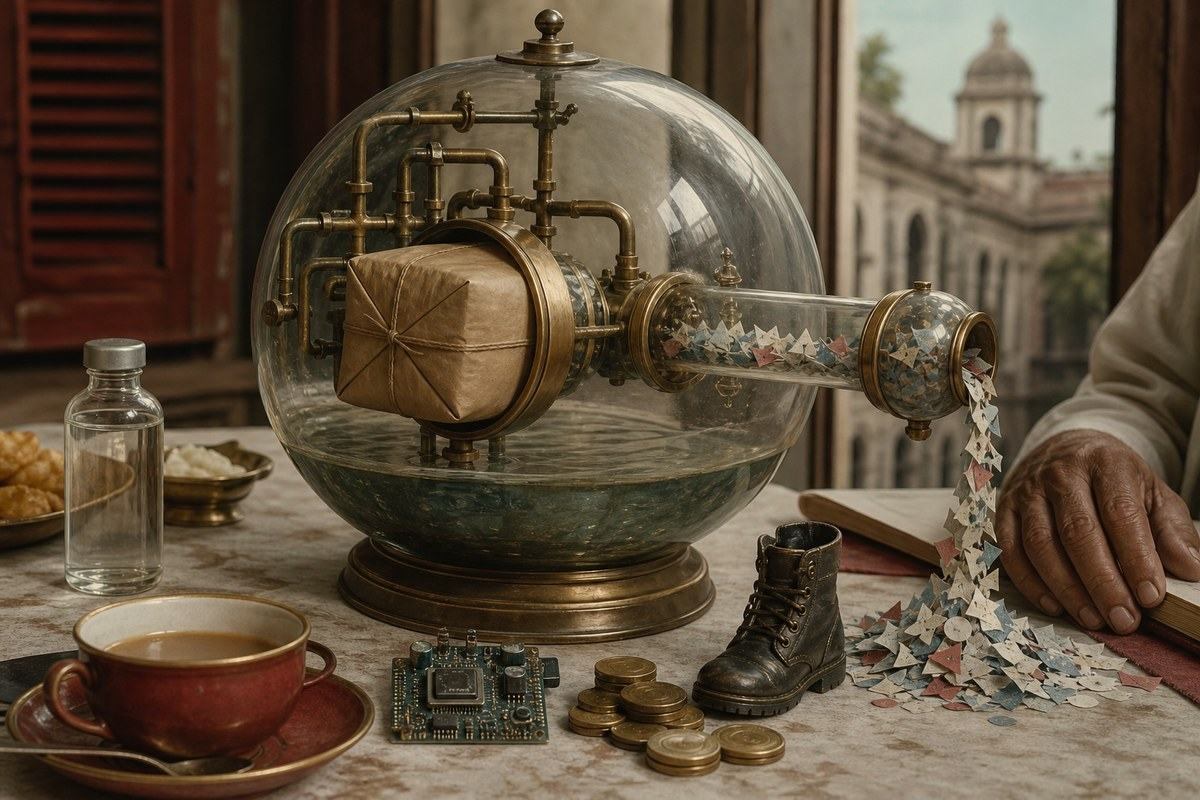
Krishna, that blue-skinned mischief-monger, that butter-thief, that cosmic cad, when he opened his mouth to his mother Yashoda—famously, mythically, with the theatrical pomp of a boy caught red-handed in the larder—she did not see teeth, she did not see a uvula waggling like a pink flag of surrender, she did not see the half-masticated remnants of a stolen laddu; no, she saw a globe, a whole spinning, watery, mountainous, cartographically precise globe, the earth with its continents and its oceans and its little pinpricks of human ambition, and I can tell you, with the certainty of a man who has spent fifty-one years in the humidity of Calcutta watching the world shrink and expand like a diseased lung, that if this were today, if that little blue bastard opened his mouth right now, right here, on the 17th of July 2026, with the Rath Yatra having just begun yesterday—the 16th, a Thursday, the Dwitiya Tithi ending at 8:52 AM, the chariots already lumbering through Puri’s bada danda like wooden leviathans pulled by a million sweating, chanting, delirious devotees—that globe would be made in China, stamped with a barcode, probably manufactured in Shenzhen by a teenager working sixteen-hour shifts, and Yashoda, poor dear, would squint into her son’s throat and see not the infinite but the Alibaba, not the cosmic brahmanda but a plastic spheroid with a Made in China sticker peeling at the equator, and she would sigh, because even divine mischief is outsourced now, even theophany is subject to global supply chains, and what is a mother’s love if not the final, futile inspection of a defective product before it ships to the warehouse of history.
But if I—if I, this insignificant, defective, middle-aged Indian, this bipedal complaint wrapped in a lungi and a layer of perspiration that could irrigate a small paddy field—if I open my mouth, if I part these lips that have kissed nothing but the rim of a tea glass and the bitter air of Park Street at 2 AM, what tumbles out is not a globe, not a universe, not even a decent burp of digestive satisfaction; no, what comes rolling out, what comes cascading out like a sewage pipe finally giving up its ghost, is a recursion of plaintives, one within the other, a matryoshka of whines, a fractal of grievances, each complaint containing within it a smaller, more concentrated complaint, and within that, a smaller one still, until you reach the quantum level where the fundamental particle of my being is just a subatomic moan, a fermion of dissatisfaction, a boson of why-me, and if this recursion, if this infinite regress of self-pity came rolling out fully formed, if it somehow acquired mass and momentum and the terrible inertia of a thing that cannot stop once started, it would be a juggernaut, a word that sits in my mouth like a hot coal, a word that burns because it is topical, because we are in Rath Yatra times, because the chariots are moving, because the British, those pale, tea-drinking, map-drawing vandals, took the word Jagannath—Lord of the Universe, the deity whose heart supposedly beats inside that wooden idol in Puri, whose name is a Sanskrit compound of jagat (world) and natha (lord)—and they mangled it, they chewed it up in their Anglo-Saxon jaws and spat out juggernaut, a word that means not divinity but destruction, not grace but a crushing, unstoppable, obliterating force, and they used it to describe the accidents, the gas-speaking accidents (as they imagined them, with the casual racism of empire) where devotees, in their ecstatic fervor, in their holy delirium, would supposedly throw themselves beneath the wheels of the chariot to be crushed, to be flattened into a red paste of salvation, and the British, in their infinite capacity for moral horror at the customs of others while simultaneously starving millions in Bengal, recorded this as proof of Hindu barbarism, as evidence of the heathen’s fatalistic abandon, never mind that the truth was more prosaic, more Calcutta, more suffocatingly human: that stampede, that crush, that trampling, happens not because anyone willingly comes to the wheels, not because some ecstatic bhakta decides that moksha is best achieved through tire treads, but because when too many of us are super holy and totally there at the same time, when the density of devotion reaches a critical mass, when the air itself becomes thick with the exhalations of a hundred thousand pilgrims who have not bathed in days and whose diet consists of prasad and faith, then a stampede can happen for the most banal, the most biological of reasons, because one holy person’s poot—yes, I said poot, because I am a refined Bengali man and we do not say fart like some coarse American, we say poot or pad or we refer obliquely to vayu or we simply wave our hands in front of our faces with an expression of exquisite suffering—because one holy person’s poot, one single, sulphurous, protein-rich emission, the kind that comes from a diet of lentils and desperation, can be so poisonous, so corrosively pungent, that the natural reflex to escape, the involuntary, Darwinian lurch away from the olfactory assault, can start a stampede, can trigger a chain reaction of stumbling, of shoving, of bodies falling and being fallen upon, and suddenly the juggernaut is not the chariot but the crowd itself, the crowd as crushing machine, the crowd as the true deity, the crowd as the only god that matters in a country of 1.4 billion, and you are under the wheels, not because you wanted salvation but because someone else’s digestive tract betrayed them at the exact wrong moment, and that, that is the real theology of India, the real darshan: not the beatific vision of the Lord but the panicked scramble to escape another man’s flatulence.
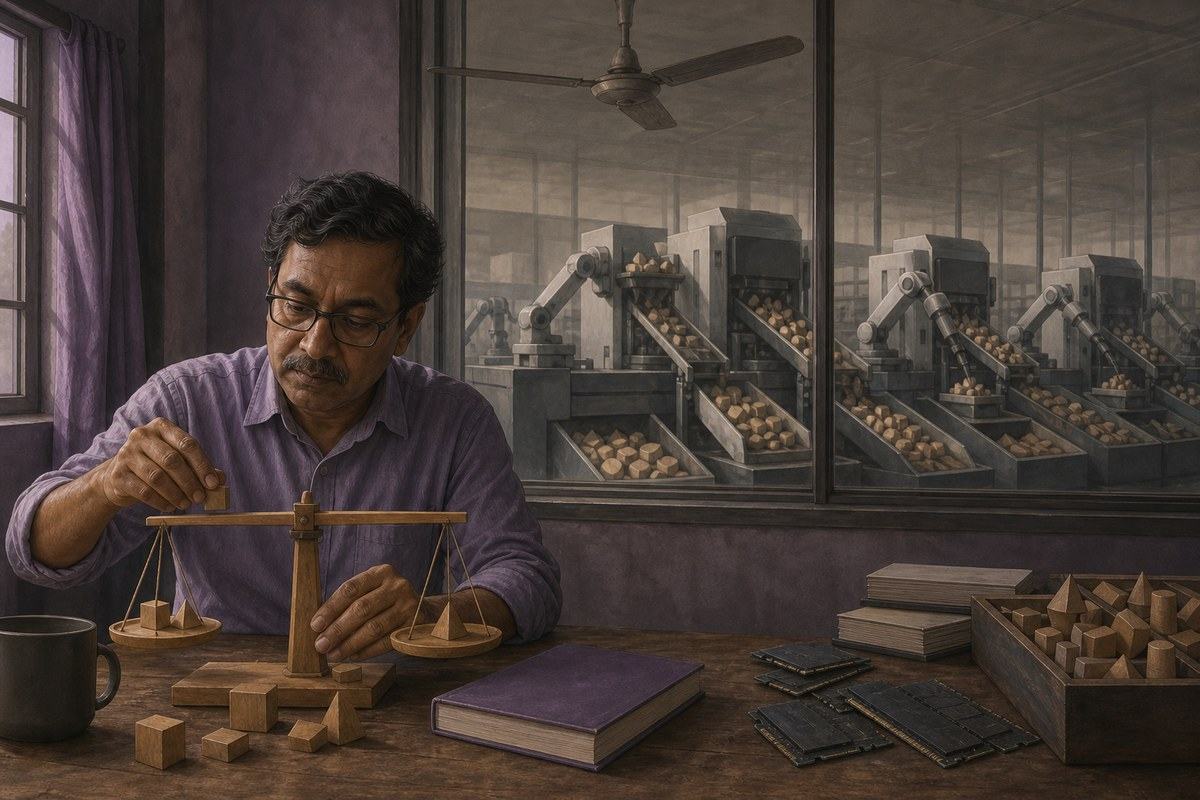
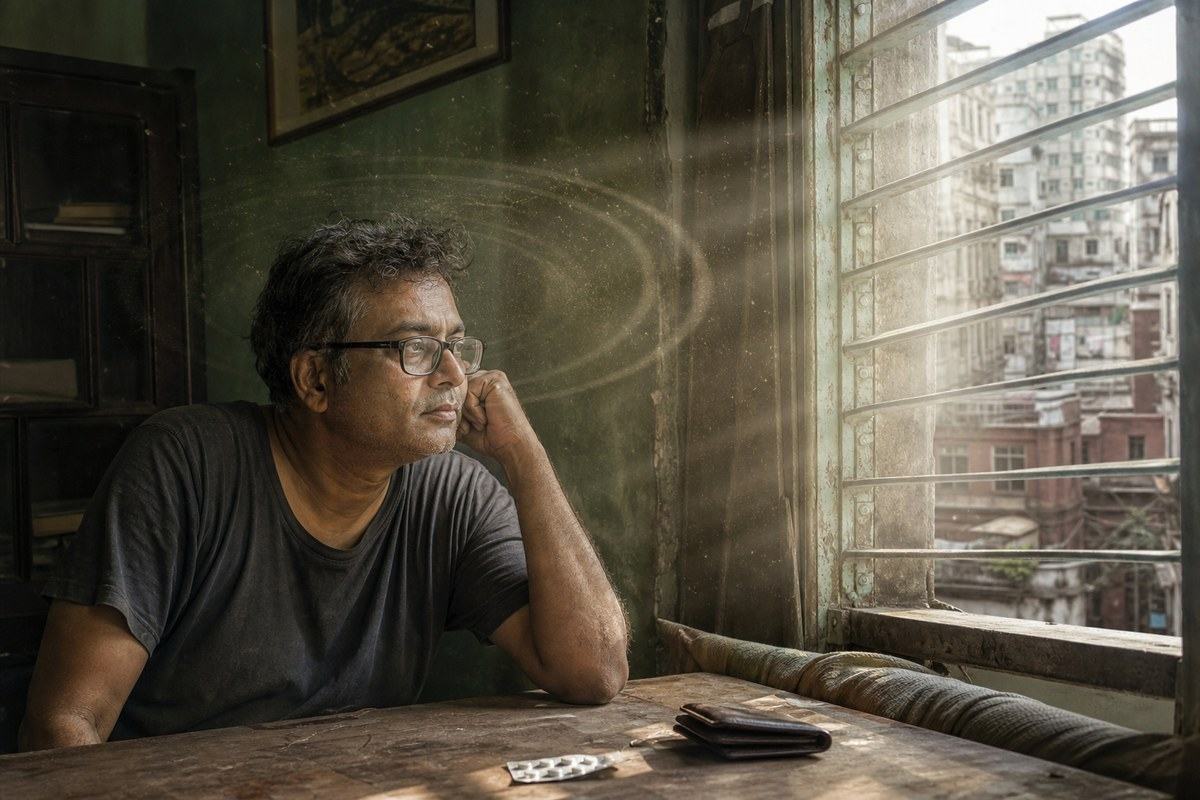
And here I am, fifty-one, bipolar as a seesaw in an earthquake, manic one moment and depressive the next, my moods swinging like the pendulum in a grandfather clock that has been possessed by a demon with a sense of humor, and I am trying to write this, trying to make sense of the recursion, of the juggernaut of my own consciousness, and the words keep folding in on themselves, each sentence a parenthetical labyrinth, each clause a digression from a digression, because that is what it is to be inside this skull, to be trapped in the humid, overcrowded, poot-scented cathedral of my own mind, where every thought contains its own contradiction, where every assertion is immediately undermined by a counter-assertion, where I am simultaneously the chariot and the crowd and the crushed body and the sulphurous gas, where I am the devotee and the deity and the British observer taking notes for his ethnographic monograph, and the recursion never stops, it just keeps opening its mouth and showing another globe, another made-in-China globe, and I look into it and I see not the world but a reflection of my own face, distorted, grotesque, comically swollen with the bloat of self-importance and the deflation of self-loathing, and I think, I think—though thinking is perhaps too dignified a word for what I am doing, which is more like a mental seizure, a cognitive Rath Yatra where the chariots are my neurotransmitters and the crowd is my anxiety and the wheels are the relentless, crushing passage of time—yes, I think that the real miracle of Krishna’s mouth was not that it contained the universe but that it contained the universe and the awareness of containing it, the recursive knowledge that the universe inside his mouth was itself a mouth containing another universe, and so on, ad infinitum, and that Yashoda, in her maternal myopia, in her beautiful, blinding, Bengali mother-love, saw only the first layer, the outermost doll, the surface globe, and missed the infinite regression of mouths and worlds and made-in-China stickers that lay beneath, because a mother cannot bear to look too deep, a mother must stop at the first layer or go mad, and I am not a mother, I am a fifty-one-year-old man with a receding hairline and a receding sense of purpose, and I have looked too deep, I have peeled back the layers, I have seen the recursion, and it has made me this, this swollen, cynical, grotesquely articulate complainer, this juggernaut of verbiage rolling down the bada danda of your attention, and I cannot stop, I cannot be stopped, because the wheels are moving, the chariot is lumbering, and somewhere in the crowd, someone is about to let out a poot that will start the stampede that will crush us all, and the British are still watching, still taking notes, still mangling our words into their dictionaries, and the only consolation, the only prasad at the end of this procession, is the knowledge that even a juggernaut eventually reaches its destination, even the most crushing force eventually stops, and when it does, when the chariot halts and the crowd disperses and the sulphur dissipates into the Calcutta air, there will be a moment, a brief, manic moment, before the depression sets in, before the recursion starts again, when I will stand there, alone, covered in the dust of my own words, and I will laugh, because the whole thing, the whole magnificent, grotesque, made-in-China, poot-scented, recursively infinite catastrophe of being alive, is so funny, so unbearably, crushingly, juggernautically funny, that laughter is the only response that doesn’t require a footnote.
P.S. The word juggernaut entered English in the 17th century via the travels of European merchants and missionaries to Puri, where they witnessed the Rath Yatra and, in their characteristic fashion, misunderstood it completely, conflating religious devotion with suicidal fanaticism, and thereby gifted the English language a word that now means any unstoppable, destructive force, which is, if you think about it, a perfect description of both colonialism and my digestive system after a plate of kosha mangsho at 11 PM.
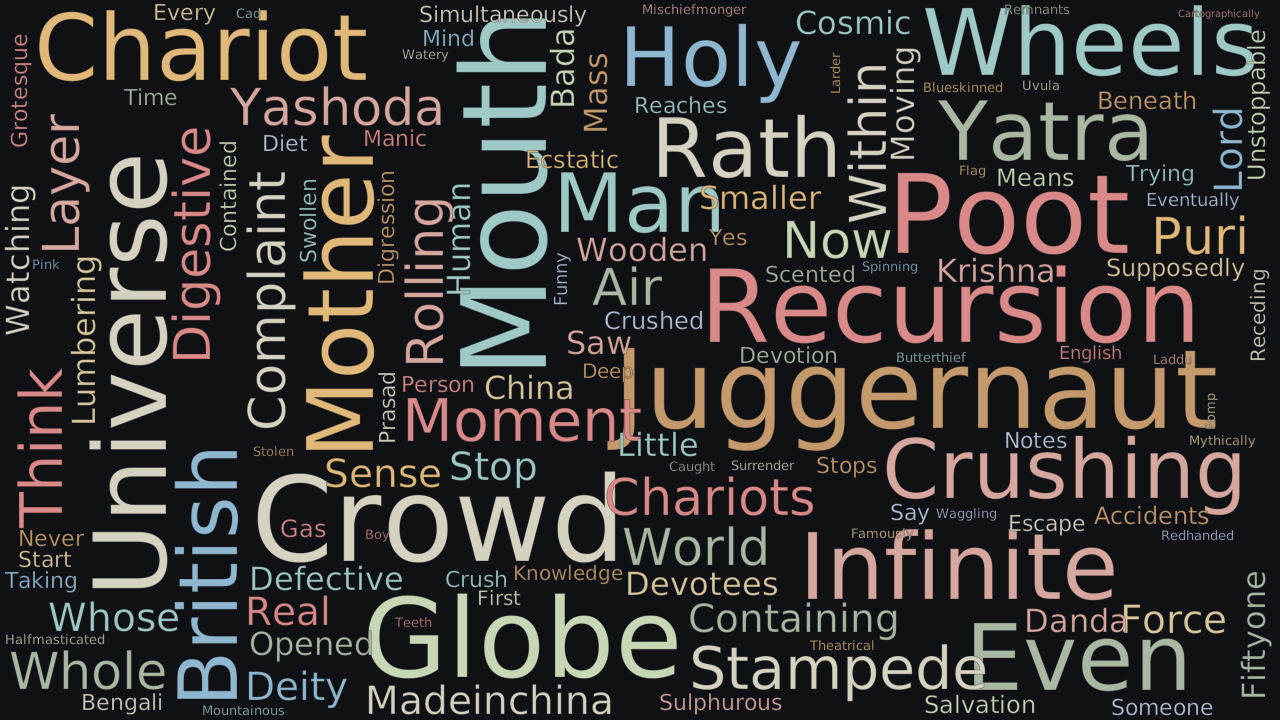
Word Cloud
Related reading
Selected by shared topics and section, with closer publication dates breaking ties.